It’s More Than Playoffs, It’s Playoffs Plus

Sitting six games behind the Brewers for the NL Central crown but holding a five and a half game lead for the first Wild Card slot, the Cubs sent out post-season invoices to their season ticket holders yesterday for the first time since 2023.  Thanks to a randomly selected combination assignment, I would end up with tickets to two games in each potential round.  I would maintain my normal seats through the NLCS but would end up relocated to the right field side should the team advance to the World Series.

Mixing things up a bit, the Cubs are also offering a three-year renewal which will guarantee some access to All-Star week activities in 2027.  For my package, that would include the Futures Game on Saturday and either the Home Run Derby or the All-Star Game itself.  Going the annual renewal route will give you the opportunity to purchase tickets to those events should any remain.

Barring a complete collapse over the next five weeks, the Cubs seem to be a lock to make the postseason.  Getting out of that Wild Card round, where they would face the Padres if the season ended today, might be more difficult.

A Fallen Icon

For the second time in the month, a Chicago baseball legend has lost his life prematurely due to cancer.  Former Cubs second baseman Ryne Sandberg, who had been suffering from metastatic prostate cancer for over a year, died Monday at 65.

Ryne Sandberg was acquired by the Cubs, along with Larry Bowa, from the Phillies for Ivan DeJesus in January of 1982.  He was the primary third baseman for the Cubs during the 1982 season, hitting .271 with 7 home runs and 54 RBIs, good enough to place sixth in Rookie of the Year voting.  After the Cubs acquired Ron Cey following the season, they moved Sandberg to second base, where he would become a mainstay for the next decade plus.

1983 saw Sandberg garner his first Gold Glove while hitting .261 with 8 home runs and 48 RBIs.  He blossomed in 1984, as the Cubs made a surprising run at the NL East title.  Sandberg won the MVP, Silver Slugger, and Gold Glove awards while leading the league with 114 runs and 19 triples.  He hit .368 during the NLCS against the Padres, which the Cubs dropped in 5 games.  1985 saw him win another Silver Slugger and Gold Glove, while still earning MVP support despite the Cubs falling to the bottom of the division.  He earned another Gold Glove in 1986, hitting .284 with 14 home runs.  Injuries limited him to 132 games in 1987. but he still took home his fifth consecutive Gold Glove.

Sandberg posted a .741 OPS in 1988, good enough for his third Silver Slugger award and his sixth straight Gold Glove.  The Cubs returned to the post-season in 1989, as Sandberg hit .290 with 30 home runs, which garnered him yet another Silver Slugger and Gold Glove while coming in fourth for MVP voting.  He hit .400 and drove in four in the Cubs’ NLCS loss to the Giants in five games.  In 1990, Sandberg set a career high with 40 home runs, which led the National League, and duplicated his Silver Slugger, Gold Glove, and fourth place for MVP voting results from the previous year.  1991 saw Sandberg win his ninth consecutive, and final, Gold Glove award, breaking a tie with Bill Mazeroski.  In 1992, he won his fifth straight, and seventh overall, Silver Slugger award.  1993 saw Sandberg make his tenth consecutive, and final, All-Star team.

Sandberg struggled out of the gate in 1994, and with rumored marital issues at home, he abruptly retired on June 13th, saying “I lost the desire that got me ready to play on an everyday basis for so many years. Without it, I didn’t think I could perform at the same level I had in the past, and I didn’t want to play at a level less than what was expected of me by my teammates, coaches, ownership, and most of all, myself.”  Following a divorce and a new marriage, Sandberg returned to the Cubs in 1996, hitting .244 with 25 home runs and 92 RBIs.  With his OPS dropping to .711 in 1997, his lowest total since 1983, Sandberg retired for good following the 1997 season.  He was inducted to the Hall of Fame in 2005 and, that August, the Cubs retired his #23.  Last June, a statue of Sandberg was unveiled on Gallagher Way outside Wrigley Field

Crossing Sides Of Town

So far in 2025, Brad Keller, Mike Tauchman, Nicky Lopez, and Reese McGuire pushed the total of players I’ve seen take the field in person for both the Cubs and the White Sox to 47.  With the final round of crosstown kicking off tonight at Rate Field, here’s a look at those players, in alphabetical order.

David Aardsma

After posting a decent season with the Cubs in 2006, Aardsma was traded to the White Sox for Neal Cotts.  Aardsma lasted one season with the Sox, where he was unable to duplicate his success from the year before.

Jason Bere

Drafted by the White Sox in the 36th round in 1990, Bere debuted with the big-league club in 1993, finishing 2nd in Rookie of the Year voting.  After an All Star selection in 1994, injuries marred the remainder of his tenure on the South Side, which ended in 1998.  He resurfaced with the Cubs in 2001 and had a decent season, but he went 1-10 in 2002 before being let go.

Emilio Bonifacio

Bonifacio spent back-to-back partial seasons in Chicago, first for the Cubs in 2014 after signing as a free agent, where he played decently enough to be flipped at the trade deadline, along with James Russell, to the Braves for a young catching prospect by the name of Victor Caratini.  He returned to Chicago in 2015, signing with the White Sox, where he he did not do well at all, hitting .167 in 47 games before being released in August.

Welington Castillo

Debuting with the Cubs in 2010, Castillo spent time behind the plate for the Cubs until May of 2015, when, having been replaced in the starting lineup by Miguel Montero, he was flipped to the Mariners.  He returned to Chicago in 2018 after signing with the White Sox as a free agent.  On May 24th of that season, he was suspended 80 games for a violation of the PED policy.  The White Sox then cut bait following the 2019 season, shipping him off to the Rangers.

Neal Cotts

Acquired by the White Sox in the Billy Koch trade, he debuted with the team in 2003.  He was a key contributor in the bullpen during the 2005 championship season and was the only relief pitcher to appear in all 3 rounds of the playoffs that season.  Following the 2006 season, he was traded to the Cubs for David Aardsma, and he spent the next 3 injury filled seasons on the North Side.

Scott Eyre

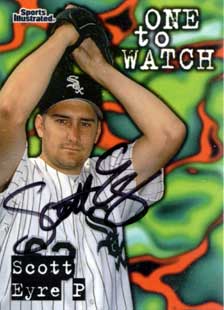
Joining the White Sox organization in a 1994 trade with the Rangers, he debuted with the big-league team in 1997.  He split the next 4 seasons between the rotation and the bullpen, not to mention between Chicago and Charlotte, before being moved to the Blue Jays following the 2000 ALDS loss to the Mariners.  He joined the Cubs as a free agent for the 2006 season and enjoyed 2 seasons of relative success, before falling apart in 2008, when he was traded to the Phillies.

Clint Frazier

After missing the second half of 2021 with an injury, Frazier was DFA’d by the Yankees.  He signed a deal with the Cubs that offseason, though he notched just 45 plate appearances before being DFA’s once again.  He chose to finish the year in the Cubs system before becoming a free agent following the season.  After failing to catch on with the Rangers, he signed a minor league deal with the White Sox, eventually hitting .197 in 33 games with the big-league club.

Kosuke Fukudome Continue reading →

And Then There Were None

The Cubs career of Kyle Hendricks officially came to an end Wednesday when the free agent pitcher signed a one-year deal with the Angels.  After an eleven-year Cubs career, he was the last remaining member of the 2016 World Series champions to remain on the roster for the North Siders.

Hendricks was first acquired by the Cubs at the trade deadline in 2012 as part of the return from the Rangers for Ryan Dempster.  He made his major league debut nearly two years later, throwing six innings against the Reds at Great American Ballpark and earning a no-decision.  2016 was his best season, winning 16 games and posting a 2.13 ERA in the regular season and making five post-season starts, giving up just two earned runs in 21 2/3 innings between the NLCS and the World Series.  He has struggled with injuries and worsening performance over the past three seasons, making his departure feel inevitable.

While Hendricks was the last continuous link to the 2016 squad, he may not be the last member of that team to suit up for the Cubs.  Rob Zastryzny, who made his major league debut for the 2016 team and made eight appearances down the stretch, was recently re-acquired off waivers from the Brewers and will be given a chance to claim a bullpen spot during spring training.

Hendricks’s numbers in a Cubs uniform, both for games I attended and overall, were:

Continue reading →

What If… Moises Alou Makes That Catch

Welcome to the first installment of what should become a recurring feature, taking a look back at some occurrence in the world, mostly sports, and trying to ascertain what the outcome would have been if just one thing, a decision or an outcome, went a different way.  We start in October 2003, with game six of the NLCS where one particular play, debated for years, may have turned the tide.


On October 14, 2003, the Cubs were five outs away from winning their first National League pennant since 1945. Mark Prior was on the mound for the Cubs and had retired eight straight batters into the eighth inning when Juan Pierre doubled, bringing Luis Castillo to the plate. On the eighth pitch of the at bat, Castillo hit a high foul ball down the left field line, heading towards the stands. Moises Alou tracked the ball and reached, when the ball was touched by a fan. A visibly upset Alou, along with Prior and Cub manager Dusty Baker, pleaded for a call of fan interference, but the umpires ruled that the ball had left the field of play. Castillo returned to the plate and, on the next pitch, walked on a wild pitch, allowing Pierre to advance to third.

Ivan Rodriguez then hit an 0-2 pitch for a single, knocking in Pierre and making the score 3-1. When the next batter, Miguel Cabrera, hit a shard ground ball to shortstop Alex Gonzalez, it looked like the rally was over, but, instead of turning the ready-made double play, Gonzalez booted the ball, loading the bases. Derrek Lee then drilled the next pitch for a double, knocking in Castillo and Rodriguez and tying the score 3-3. At this point, Baker emerged from the Cub dugout to remove Prior, but the damage had been done. The Marlins scored five more times, winning the game 8-3 and forcing a Game 7.

The following night, the Marlins completed the unlikely comeback, beating the Cubs 9-6 and going on the face the Yankees in the World Series. They would wind up winning that as well, defeating the Yankees in six games to take home their second title.

But what if Alou had made that catch? How would the rest of history play out? Let’s take a trip through the multiverse to see what the outcome would have been.

OK, so Alou makes the catch for the second out of the inning.  Let us assume Rodriguez still singles, scoring the speedy Pierre from second to make it a 3-1 game.  Let us also assume Cabrera hits the same grounder to Alex Gonzalez, but, without the pressure of trying to make up for the missed out, he fields it cleanly, retiring Cabrera and ending the inning. Continue reading →

Playoffs?

The Cubs, effectively tied for the third and final wild card spot after last night’s victory against the White Sox, have sent out post-season invoices to their season ticket holders for the first time since 2019.  Thanks to a randomly selected combination assignment, I would end up with tickets to two games in each potential round, a slight downgrade from years past.  I would maintain my normal seats through the NLCS but would end up relocated to the right field side should the team advance to the World Series.

The Cubs still have some work to do on the field to make sure all this preparation isn’t for naught.  They have been one of the hottest teams in the second half, but injuries to Marcus Stroman and inexperience may haunt them down the stretch.

Switching Sides Revisited

Five years ago today, the White Sox continued their selloff and pulled off the trade that many said couldn’t be done, sending Jose Quintana to the Cubs in exchange for Eloy Jimenez, Dylan Cease, Matt Rose, and Bryant Flete.  At the time, the Cubs were looking for a boost to their starting rotation as one of the strengths of their championship season the year before had turned into a question mark during the first half of 2017.  For the rebuilding White Sox, Jimenez, who was the 8th ranked prospect in baseball, and Cease, who was the 63rd, gave them nine out of the top 100 prospects.

So how did it work out, five years later?  You can say the White Sox were the runaway winners of the trade, but not for the reasons you would have thought five years ago.  After a slow start in his rookie campaign in 2019, Jimenez seemed to figure things out down the stretch and followed that up with an pandemic-abbreviated 2020 campaign that earned him the Silver Slugger.  Unfortunately, he’s played less than 75 games since, with major injuries keeping him on the shelf for large portions of the 2021 and 2022 seasons.  When he has played, he hasn’t yet been able to put together the type of production he showed in previous years.

Dylan Cease, on the other hand, has turned into the ace of the White Sox staff.  After a slow start in 2019 after making his debut in early July, Cease has improved each season.  He currently leads the American League in strikeouts and is widely considered one of, if not the biggest, snub for this year’s All Star team.

Quintana, meanwhile, spent parts of four seasons with the Cubs, going 33-23 with a 4.24 ERA.  He was decent, but not great, and the Cubs never were able to replicate their 2016 success.  In the postseason, he appeared in four games in 2017, two each in the NLDS and NLCS,

By The Numbers – 8

In 1929, uniform numbers appeared on the back of baseball jerseys for the first time, thanks to the Indians and the Yankees.  By 1937, numbers finally appeared across all uniforms, both home and away, across both major leagues.  Since that time, 81 distinct numbers have been worn by members of the White Sox, while the Cubs boast 76.

Today, we continue our look at those players, picking our favorite, if not the best, player to wear each uniform number for both Chicago teams with #8.  82 different players have donned #8 while playing in Chicago, 40 for the White Sox and 42 for the Cubs.

Vincent Edward “Bo” Jackson joined the White Sox as a free agent on April 3, 1991 after being released by the Royals following a catastrophic hip injury suffered in January during the NFL playoffs as a member of the Raiders.  “In making the business decision,” owner Jerry Reinsdorf said at the time, “I assume he will not play this year. If he does, it will be a big bonus.”  Jackson did spend most of 1991 on the disabled list, rehabbing the injury, but did eventually manage to make his way back to the field.  He appeared in 23 games, hitting only .225 with 3 home runs.

Diagnosed with avascular necrosis of the hip joint and having lost all of the cartilage supporting his hip, Jackson decided to undergo a hip replacement surgery, keeping him on the shelf for the entire 1992 season.  While rehabbing, Jackson promised his mother he would return to the major leagues and hit a home run for her.  Unfortunately, Jackson’s mother died before he could return, but, in his first at bat of the 1993 season, and his first with an artificial hip, he hit a home run to right field against the Yankees at Comiskey Park.  On September 27, Jackson belted a three-run home run off of the Mariners to help the White Sox clinch their first AL West Division title in a decade.  Jackson ended up appearing in 85 games for the White Sox, hitting .232 and hitting 16 home runs while driving in 45.  He appeared in 3 of the 6 ALCS games against the Blue Jays, going hitless in 10 at bats.  Following the season, he became a free agent, ending his White Sox playing career.  In 2014, he returned to the organization as an ambassador, a role he continues to play today.

A free agent following the 1986 season, Andre Dawson was looking for a new home with natural grass that would be easier on his injured knees.  With MLB owners colluding against the players by agreeing not to sign free agents, Dawson found himself without takers.  When the Cubs opened their spring training camp that spring, Dawson and his agent, Dick Moss, arrived with a signed blank contract in an attempt to get a job.  GM Dallas Green derided the stunt as a “dog and pony show,” but, after reviewing the contract, Green and Moss reached an agreement on a lowball salary of $500,000, the second-lowest salary amongst the team’s starters.  The Cubs easily got their money’s worth, as Dawson became the Cubs’ starting right fielder, and hit a major league leading 49 home runs and was named NL MVP, despite the Cubs finishing in last place.

Dawson played five more seasons with the Cubs and was one of the franchise’s most popular players during that time.  His worst individual season came in 1989, when the Cubs won the NL East title.  During the NLCS, Dawson slumped terribly, hitting .105 as the Giants beat the Cubs 4 games to 1.  Dawson’s .507 career slugging percentage with the Cubs is fourth highest in team history.

Throwback Thursday – Team Records Of The 2000s

It’s time for another trip in the wayback machine, as this week we move our focus to the start of the 21st century and see what my view of the baseball world looked like in the 2000s.  This was my first decade as a season ticket holder, starting in 2002 for the Cubs and 2005 for the White Sox.

I attended 518 contests during the 2000s, starting with my first trip to Cincinnati in April of 2000 and finishing with Daniel Hudson’s first major league victory in September of 2009.  I attended games at 13 stadiums from coast to coast and saw my first post-season action, with an ALDS in 2000, an NLCS in 2003, and a World Series game in 2005.

2021 Team Records
Team Name Won Loss Winning Pctg
Arizona Diamondbacks 11 1 0.917
Philadelphia Phillies 10 4 0.714
Toronto Blue Jays 6 3 0.667
Florida Marlins 12 7 0.632
Tampa Bay Rays 3 2 0.600
Texas Rangers 8 6 0.571
Los Angeles Dodgers 8 6 0.571
Chicago White Sox 130 107 0.549
Chicago Cubs 172 147 0.539
Baltimore Orioles 9 8 0.529
Cleveland Indians 10 9 0.526
Los Angeles Angels 10 9 0.526
Boston Red Sox 9 9 0.500
Colorado Rockies 6 6 0.500
Seattle Mariners 5 5 0.500
Anaheim Angels 1 1 0.500
Houston Astros Continue reading →

By The Numbers – 12

In 1929, uniform numbers appeared on the back of baseball jerseys for the first time, thanks to the Indians and the Yankees.  By 1937, numbers finally appeared across all uniforms, both home and away, across both major leagues.  Since that time, 81 distinct numbers have been worn by members of the White Sox, while the Cubs boast 76.

Today, we continue our look at those players, picking our favorite, if not the best, player to wear each uniform number for both Chicago teams with #12.  91 different players have donned #12 while playing in Chicago, 44 for the White Sox and 47 for the Cubs.

A.J. Pierzynski signed with the White Sox on January 6, 2005 and rewarded the organization with eight seasons of stability behind the plate that included one All-Star selection, two playoff appearances, and, of course, the 2005 World Series championship.  Over those 8 seasons, Pierzynski was involved in many key moments while wearing #12 that endeared him to the White Sox faithful, including:

  • The walk-off home run, and resulting bat flip (pictured above), against the Dodgers in 2005 while wearing 1959 throwbacks
  • The two home runs in a thrashing of the Red Sox in game one of the 2005 ALDS, the first White Sox home postseason victory since 1959
  • The controversial dropped third strike that led to a White Sox victory in game two of the 2005 ALCS against the Angels
  • The 2006 brawl against the Cubs where Michael Barrett sucker-punched him after Pierzynski enthusiastically scored a run against the crosstown rivals
  • Hanging on to the throw from Ken Griffey Jr. to preserve the shutout in the 2008 tie-breaker game that pushed the White Sox into the playoffs over the Twins
  • Being behind the plate for Mark Buehrle’s no-hitter in 2007 and Philip Humber’s perfect game in 2012

On the north side of town, a dynamic shortstop, the first player chosen in the 1982 draft, wore #12 when he made his major league debut in 1985.  Shawon Dunston quickly became a fan favorite.  In 1989, he entered the national consciousness thanks to the Shawon-O-Meter, a fan made sign that tracked Dunston’s batting average during each game.  The sign was seen in the Wrigley Field bleachers for a number of years and even made its way to San Francisco’s Candlestick Park for the 1989 NLCS.  Following the 1995 season, he left as a free agent before resigning with the team for the 1997 campaign.  He was traded to the Pirates at the end of August, ending his Cubs career for good.