A Fallen Icon

For the second time in the month, a Chicago baseball legend has lost his life prematurely due to cancer.  Former Cubs second baseman Ryne Sandberg, who had been suffering from metastatic prostate cancer for over a year, died Monday at 65.

Ryne Sandberg was acquired by the Cubs, along with Larry Bowa, from the Phillies for Ivan DeJesus in January of 1982.  He was the primary third baseman for the Cubs during the 1982 season, hitting .271 with 7 home runs and 54 RBIs, good enough to place sixth in Rookie of the Year voting.  After the Cubs acquired Ron Cey following the season, they moved Sandberg to second base, where he would become a mainstay for the next decade plus.

1983 saw Sandberg garner his first Gold Glove while hitting .261 with 8 home runs and 48 RBIs.  He blossomed in 1984, as the Cubs made a surprising run at the NL East title.  Sandberg won the MVP, Silver Slugger, and Gold Glove awards while leading the league with 114 runs and 19 triples.  He hit .368 during the NLCS against the Padres, which the Cubs dropped in 5 games.  1985 saw him win another Silver Slugger and Gold Glove, while still earning MVP support despite the Cubs falling to the bottom of the division.  He earned another Gold Glove in 1986, hitting .284 with 14 home runs.  Injuries limited him to 132 games in 1987. but he still took home his fifth consecutive Gold Glove.

Sandberg posted a .741 OPS in 1988, good enough for his third Silver Slugger award and his sixth straight Gold Glove.  The Cubs returned to the post-season in 1989, as Sandberg hit .290 with 30 home runs, which garnered him yet another Silver Slugger and Gold Glove while coming in fourth for MVP voting.  He hit .400 and drove in four in the Cubs’ NLCS loss to the Giants in five games.  In 1990, Sandberg set a career high with 40 home runs, which led the National League, and duplicated his Silver Slugger, Gold Glove, and fourth place for MVP voting results from the previous year.  1991 saw Sandberg win his ninth consecutive, and final, Gold Glove award, breaking a tie with Bill Mazeroski.  In 1992, he won his fifth straight, and seventh overall, Silver Slugger award.  1993 saw Sandberg make his tenth consecutive, and final, All-Star team.

Sandberg struggled out of the gate in 1994, and with rumored marital issues at home, he abruptly retired on June 13th, saying “I lost the desire that got me ready to play on an everyday basis for so many years. Without it, I didn’t think I could perform at the same level I had in the past, and I didn’t want to play at a level less than what was expected of me by my teammates, coaches, ownership, and most of all, myself.”  Following a divorce and a new marriage, Sandberg returned to the Cubs in 1996, hitting .244 with 25 home runs and 92 RBIs.  With his OPS dropping to .711 in 1997, his lowest total since 1983, Sandberg retired for good following the 1997 season.  He was inducted to the Hall of Fame in 2005 and, that August, the Cubs retired his #23.  Last June, a statue of Sandberg was unveiled on Gallagher Way outside Wrigley Field
By The Numbers – 22

In 1929, uniform numbers appeared on the back of baseball jerseys for the first time, thanks to the Indians and the Yankees.  By 1937, numbers finally appeared across all uniforms, both home and away, across both major leagues.  Since that time, 81 distinct numbers have been worn by members of the White Sox, while the Cubs boast 76.

Today, we continue our look at those players, picking our favorite, if not the best, player to wear each uniform number for both Chicago teams with #22.  76 different players have donned #22 while playing in Chicago, 26 for the White Sox and 50 for the Cubs.

Acquired from the Dodgers, along with Ivan DeJesus, in exchange for Rick Monday and Mike Garman, Bill Buckner joined the Cubs, wearing #22, in 1977.  A staph infection in his ankle the previous year caused the Cubs to move the former outfielder to first base, a position he would man for the rest of his career.  Appearing in 122 games, he hit .284 with 11 home runs and 27 doubles.  He improved in 1978, raising his average to .323 and placed 17th in MVP voting.  1979 was another steady year for Buckner.  On May 17th, in the infamous slugfest where the Cubs lost 23-22 to the Phillies, he went 4–for–7 with a grand slam and a career-high seven RBIs.  He finished the year hitting .284 with 14 home runs and 34 doubles, but was also described as “nuts” when manager Herman Franks resigned late in the season.
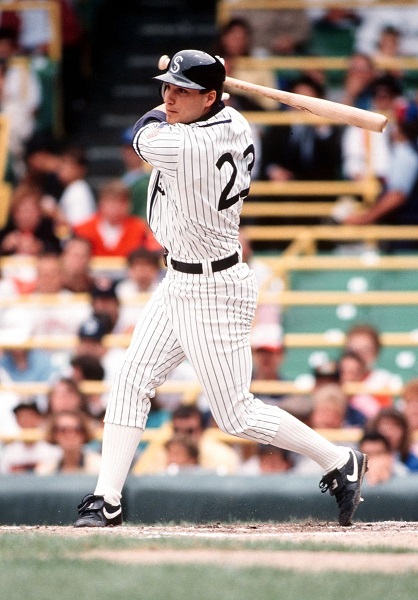
In 1980, Buckner won a batting title, hitting .324 while striking out only 18 times, earning him a 14th place finish in MVP voting.  In the strike-shortened 1981 season, he was the lone Cub representative for the All Star game and batted .311 while tying Cecil Cooper for the major league lead with 35 doubles.  1982 saw Buckner hit over .300 for the fourth time as a Cub while racking up career highs in hits, with 201, RBIs, with 105, and assists at first base, setting a major league record with 159.

In 1983, Buckner again led the NL with 38 doubles, but saw his batting average drop to .280, his lowest finish as a Cub.  With the acquisition of Gary Matthews in 1984 pushing Leon Durham to first base, Buckner found himself the odd man out.  Appearing mostly as a pinch hitter, Buckner hit a paltry .209 through the end of May, when he was traded to the Red Sox, ending his Cub tenure.

Scott Podsednik was acquired by the White Sox from the Brewers for Carlos Lee on December 13, 2004.  Wearing #22, he moved in to the leadoff spot and, after putting up a .294 average with 44 steals in the first half, he earned his first All Star game nod.  While injuries slowed him in the second half, he was back to full strength when the regular season came to an end and the White Sox embarked on their first post-season appearance in 5 years.  After going the entire regular season without a home run, Podsednik went deep against the Red Sox in Game 1 of the ALDS, helping the White Sox to a 14-2 victory on their way to a 3 game sweep of the defending champions.  Podsednik continued his steady play during the ALCS, hitting .294 with a triple and 3 stolen bases in the 5 game series.  The shining moment of his career came in Game 2 of the World Series, thanks to a walkoff home run against Brad Lidge in the 9th inning, giving the White Sox a 2-0 lead on their way to a sweep and their first world championship in 88 years.  For his efforts, Podsednik finished in 12th place for MVP voting.

As the White Sox looked to repeat in 2006, Podsednik found it difficult to duplicate his efforts from the year before.  His average was down 29 points, to .261, and his stolen base total was off by 19.  Injuries limited Podsednik to 62 games in 2007.  His offensive production continued to be lacking and, after the White Sox fell completely out of contention for the first time in years, the team decided to change their approach and gave Podsednik his release.  He returned to the White Sox organization in 2009, signing a minor league deal.  Injuries to Brian Anderson, Dewayne Wise, and Carlos Quentin gave him plenty of opportunity with the big league club, and he responded by hitting .304, his highest total since 2003.  Following the season, he became a free agent.

By The Numbers – 23

In 1929, uniform numbers appeared on the back of baseball jerseys for the first time, thanks to the Indians and the Yankees.  By 1937, numbers finally appeared across all uniforms, both home and away, across both major leagues.  Since that time, 81 distinct numbers have been worn by members of the White Sox, while the Cubs boast 76.

Today, we continue our look at those players, picking our favorite, if not the best, player to wear each uniform number for both Chicago teams with #23, one of the most famous and successful numbers in city history across all sports.  67 different players have donned #23 while playing in Chicago, 35 for the White Sox and 31 for the Cubs, including a familiar face for both sides of town.

Robin Ventura made his major league debut donning #23 in September of 1989, appearing in 16 games down the stretch, hitting only .178 while driving in 7 runs in 45 at bats.  A good spring in 1990 led to Ventura breaking camp with the White Sox, but he struggled both on the field and at the plate, suffering through a horrendous 0-for-41 slump while committing 25 errors over the course of the season.  He finished the year with a .249 average, 5 home runs, and 54 RBIs and placed 7th in Rookie of the Year voting and was named to the Topps All Star Rookie team.

Ventura and the White Sox moved in to the new Comiskey Park in 1991, hoping to improve on the previous year’s growth.  He improved his fielding enough to earn his first Gold Glove award and, at the plate, he set a White Sox team record for RBIs by a third baseman, finishing with an even 100.  He upped his average to .284 and hit 23 home runs.  His work was enough to garner enough MVP votes to finish in 20th place.  1992 was another good year for Ventura.  He earned his first All Star nod, going 2-2 in the AL’s victory at Jack Murphy Stadium.  He finished the year with a .282 average, 16 home runs, and 93 RBIs.  He also snagged his second consecutive Gold Glove award.  Ventura continued his successful ways in 1993, collecting his 500th hit in May and, on August 4, entering the public consciousness with an event that would come to define his entire career.  While batting against the Rangers, Ventura was hit by a pitch thrown by Nolan Ryan and charged the mound.  Ryan, 20 years Ventura’s senior, placed him in a headlock and punched him several times, starting a bench-clearing brawl that was voted the best baseball brawl of all time by SportsCenter.  After the season, he was awarded his third consecutive Gold Glove award.

The strike in 1994 saw Ventura’s streak of 90 RBI seasons and Gold Gloves come to an end.  When baseball stopped in August, Ventura was hitting .282 with 18 home runs and 78 RBIs, while posting a new career high with an .832 OPS.  When play resumed in late April 1995, Ventura struggled out of the gate, committing ten errors in the first ten games.  As the White Sox started to tear down the team that had finished the previous two seasons on top of their division, trade rumors started to follow Ventura, though nothing came to fruition.  On September 4, he became the eighth player in history to hit two grand slams in one game, and the first since Frank Robinson in 1970.  He finished the year setting career highs with a .295 average, an .882 OPS, and 26 home runs while driving in 93 runs.  Ventura had the best year of his career to date in 1996, setting White Sox team records in career home runs by a third baseman, with 142, and grand slams, with 9.  He set new career highs with 34 home runs, 105 RBIs, 2 triples, an OPS of .888, and a .974 fielding percentage at the hot corner.  He hit .287, while earning his fourth Gold Glove award.

1997 turned into a dismal year for both Ventura and the White Sox.  During a spring training game, Ventura caught his foot in the mud while sliding into home plate and suffered a broken and dislocated right ankle.  Expected to miss the entire season, he returned on July 24, collecting the game-winning hit that night, and homered in his first at-bat the next night.  With the White Sox only 3.5 games behind the Indians in the standings, a healthy Ventura might have put them over the top.  A week later, the team threw in the towel in what eventually became to be known as the White Flag Trade, sending 3 pitchers to the Giants for prospects.  “We didn’t realize Aug. 1 was the end of the season,” said an upset Ventura.  He finished the year appearing in 54 games, hitting .262 with 6 home runs and 26 RBIs.  Entering the last year of his contract in 1998, the White Sox made little attempt to sign Ventura to an extension, with owner Jerry Reinsdorf claiming his skills were “deteriorating” after his injury the year before.  With more trade rumors following him throughout the season, he finished the year with a .263 average, 21 home runs, and 91 RBIs while earning his fifth Gold Glove award.  Following the season, he became a free agent, ending his White Sox playing career.

Continue reading →