150 Years Of Cubs Baseball – Outfielders Part 2

Originally founded in 1869, the Chicago Cubs became a charter member of the National League in 1876.  Over the next 150 seasons, the Cubs have played more than 22,000 games, scored over 103,000 runs and recorded more than 200,000 hits, more than any other team in baseball history.  Nearly 2,300 players have worn a Cubs uniform, earning eight division titles, 17 NL pennants, and three World Series championships.

Fans have witnessed generations of unforgettable players, from historical heroes like Joe Tinker, Gabby Hartnett, Ernie Banks, and Billy Williams to more recent stars like Ryne Sandberg, Derrek Lee, Kerry Wood, and Anthony Rizzo.  The team has called Wrigley Field home for 110 of those 150 seasons.

To celebrate this milestone, the Cubs are holding a fan vote to select the franchise’s anniversary team.  Each week, we will go through the provided options for each position and declare who should, and, if different, who will, win the fan vote.  We continue today with the second eight selections for outfielder.
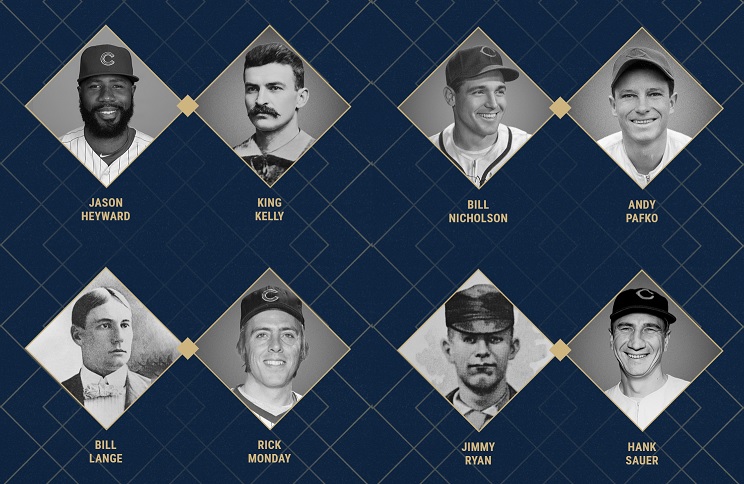
Jason Heyward signed an 8-year, $184 million contract with the Cubs in December of 2015.  His place in Cubs lore was set when he was credited with leading an inspiring, players-only meeting during the 17-minute rain delay towards the end of Game 7 of the 2016 World Series, after which the Cubs stormed out and took the lead in the 10th inning, leading to their first championship in 108 years.  While he never quite produced enough to justify his lofty contract and the team failed to duplicate their 2016 success, he became as much of a scapegoat as anyone else on the roster, eventually seeing his playing time reduced.  In addition to his World Series ring, Heyward won Gold Glove awards in both 2016 and 2017.

King Kelly emerged as one of 19th‑century baseball’s first true superstars as a member of the White Stockings.  He led the NL in runs scored for three consecutive seasons, from 1884 through 1889 and also won the NL batting title in both 1884 and 1886.  During his seven years with the franchise, they won five NL pennants.  In 1945, he was elected to the Hall of Fame.

Bill Lange spent his entire seven-year MLB career with the Colts/Orphans, becoming a full-time center fielder in 1894.  He retired at age 28 to marry a woman whose father had forbid her from marrying a ballplayer, finishing his career with a .330 batting average.  In 1897, he led the NL in stolen bases.  He is a member of the Cubs Hall of Fame.

Rick Monday spent five productive, if unspectacular, seasons with the Cubs, from 1972 through 1976.  His claim to fame came on April 25, 1976, at Dodger Stadium when two protestors ran onto the field during the bottom of the 4th inning and tried to light an American flag on fire.  Monday, playing center field, dashed over to grab the flag, and ran it in to the Dodgers’ dugout.  After the game, Monday received a congratulatory call from President Gerald Ford and was later invited to the White House.

Bill Nicholson was one of the most feared hitters in the NL during his ten seasons with the Cubs.  He led the league in home runs and RBIs in both 1943 and 1944.  While a member of the pennant-winning 1945 club, failing eyesight likely caused by his at-the-time undiagnosed diabetes limited his effectiveness, both in the regular season and in the World Series.  He was a five time All-Star and twice finished in the top three for MVP voting.

Andy Pafko spent parts of nine seasons with the Cubs from 1943 to 1951.  Widely regarded as one of the best defensive outfielders of his era, he helped lead the Cubs to the NL pennant in 1945, finishing fourth in MVP voting.  He was a five-time All-Star and is a member of the Cubs Hall of Fame.

Jimmy Ryan was one of the franchise’s earliest stars, playing for White Stockings from 1885 – 1889 and again with the Colts/Orphans from 1891 – 1900.  A power hitter in his era, Ryan led the National League with 16 home runs in 1888 while also leading the league hits, doubles, total bases, and slugging.  In 1893, Ryan was severely injured when the team’s train derailed in Ohio.  One day shy of the one-year anniversary of the derailment, Ryan found himself in another life-or-death situation, using his bats to tear down barbed-wire fencing to save fans from a fire in the stands at West Side Park.  He is a member of the Cubs Hall of Fame.

Hank Sauer was a star for the Cubs during a low time in the franchise’s history, never finishing with a winning record or above fifth place.  Nicknamed “The Mayor of Wrigley Field, he was a two-time All-Star, and, in 1952, he had his finest season, leading the major leagues in home runs and RBIs and earning the NL MVP award.  He is a member of the Cubs Hall of Fame.
150 Years Of Cubs Baseball – Outfielders Part 1

Originally founded in 1869, the Chicago Cubs became a charter member of the National League in 1876.  Over the next 150 seasons, the Cubs have played more than 22,000 games, scored over 103,000 runs and recorded more than 200,000 hits, more than any other team in baseball history.  Nearly 2,300 players have worn a Cubs uniform, earning eight division titles, 17 NL pennants, and three World Series championships.

Fans have witnessed generations of unforgettable players, from historical heroes like Joe Tinker, Gabby Hartnett, Ernie Banks, and Billy Williams to more recent stars like Ryne Sandberg, Derrek Lee, Kerry Wood, and Anthony Rizzo.  The team has called Wrigley Field home for 110 of those 150 seasons.

To celebrate this milestone, the Cubs are holding a fan vote to select the franchise’s anniversary team.  Each week, we will go through the provided options for each position and declare who should, and, if different, who will, win the fan vote.  We continue today with the first eight selections for outfielder.

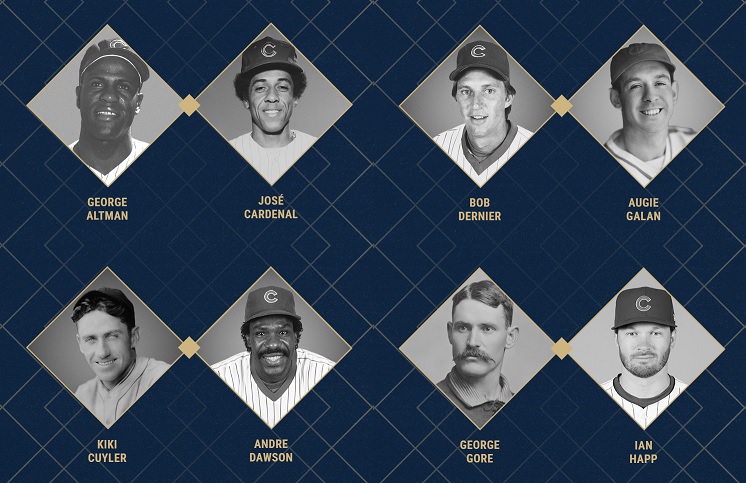
George Altman spent seven seasons with the Cubs across two stints.  Debuting with the club in 1959, he quickly emerged as one of the team’s most productive hitters, earning All-Star selections in both 1961 and 1962.  He accumulated 7.9 WAR across those two seasons while establishing himself as a dangerous power hitter.  He returned to the Cubs in 1965 but was unable to reclaim his former status and struggled to produce.  He finished his major league career in 1967, hitting just .111 in 15 games.

José Cardenal joined the Cubs for the 1972 season and stayed through 1977.  He was one of the most popular and productive players during his tenure, bridging the gap between the superstars of the 60s and the success coming in the 1980s.  He was named Cubs player of the year by local media in 1973.  His best season came in 1975, earning 3.1 WAR while hitting .317.  He was inducted into the Cubs Hall of Fame in 2022.

Kiki Cuyler joined the Cubs following the 1927 season and spent parts of eight years with the team.  During his tenure, Cuyler was one of the most dynamic offensive players in the league, helping the Cubs win two NL pennants.  He was named to his lone All-Star team in 1934 in its second year of existence.  He led the NL in three times, from 1928 through 1930.  In 1968, he was enshrined in Cooperstown as a member of the Hall of Fame.

Continue reading →

150 Years Of Cubs Baseball – Shortstops

Originally founded in 1869, the Chicago Cubs became a charter member of the National League in 1876.  Over the next 150 seasons, the Cubs have played more than 22,000 games, scored over 103,000 runs and recorded more than 200,000 hits, more than any other team in baseball history.  Nearly 2,300 players have worn a Cubs uniform, earning eight division titles, 17 NL pennants, and three World Series championships.

Fans have witnessed generations of unforgettable players, from historical heroes like Joe Tinker, Gabby Hartnett, Ernie Banks, and Billy Williams to more recent stars like Ryne Sandberg, Derrek Lee, Kerry Wood, and Anthony Rizzo.  The team has called Wrigley Field home for 110 of those 150 seasons.

To celebrate this milestone, the Cubs are holding a fan vote to select the franchise’s anniversary team.  Each week, we will go through the provided options for each position and declare who should, and, if different, who will, win the fan vote.  We continue today with the eight selections for shortstop.

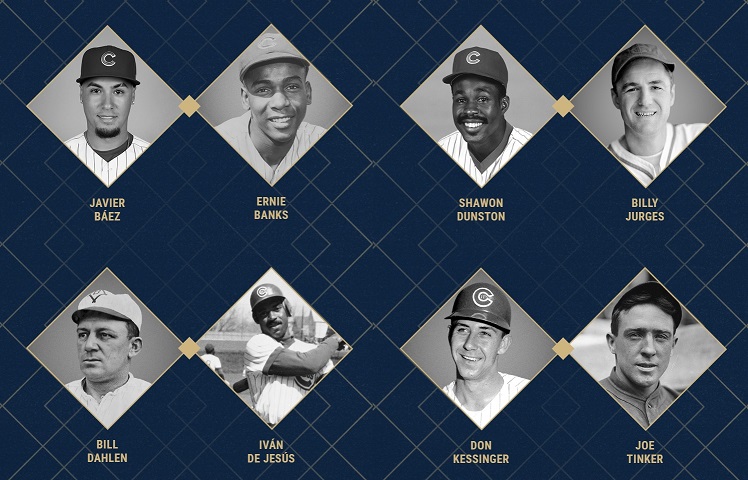
Javier Baez was drafted by the Cubs in the first round in 2011 and debuted with the big-league club in 2014.  He became a starter in 2016, helping the Cubs end their 108-year championship drought by winning the World Series.  His best season came in 2018, when he led the league in RBI and finished second in MVP voting.  His tenure with the Cubs ended in 2021, traded to the Mets for a young prospect named Pete Crow-Armstrong.  During his time on the north side, he was a two-time All-Star, the 2016 NLCS MVP, and won both a Gold Glove and a Silver Slugger.

Ernie Banks played his entire 19-year career with the Cubs, earning back-to-back MVP honors in 1958 and 1959.  At the time of his retirement following the 1971 season, he ranked ninth all-time in career home runs with 512.  He was elected to the Hall of Fame in 1977 and became a team ambassador, never seen without a smile on his face.  Known as Mr. Cub, his #14 was retired by the team in 1982, making him the first Cub to receive that honor.

Bill Dahlen spent eight seasons with the Colts and Orphans through most of the 1890s.  Playing in a dead ball era, he had a good amount of power, finishing among the NL’s top ten players in home runs four times and in slugging percentage three times.  He set a new record with a 42-game hitting streak in 1894.  He was traded away following the 1898 season.  He is considered to have the most career WAR of any eligible player, except those tainted by scandal, to not be in the Hall of Fame.

Continue reading →

150 Years Of Cubs Baseball – Third Basemen

Originally founded in 1869, the Chicago Cubs became a charter member of the National League in 1876.  Over the next 150 seasons, the Cubs have played more than 22,000 games, scored over 103,000 runs and recorded more than 200,000 hits, more than any other team in baseball history.  Nearly 2,300 players have worn a Cubs uniform, earning eight division titles, 17 NL pennants, and three World Series championships.

Fans have witnessed generations of unforgettable players, from historical heroes like Joe Tinker, Gabby Hartnett, Ernie Banks, and Billy Williams to more recent stars like Ryne Sandberg, Derrek Lee, Kerry Wood, and Anthony Rizzo.  The team has called Wrigley Field home for 110 of those 150 seasons.

To celebrate this milestone, the Cubs are holding a fan vote to select the franchise’s anniversary team.  Each week, we will go through the provided options for each position and declare who should, and, if different, who will, win the fan vote.  We continue today with the eight selections for third baseman.

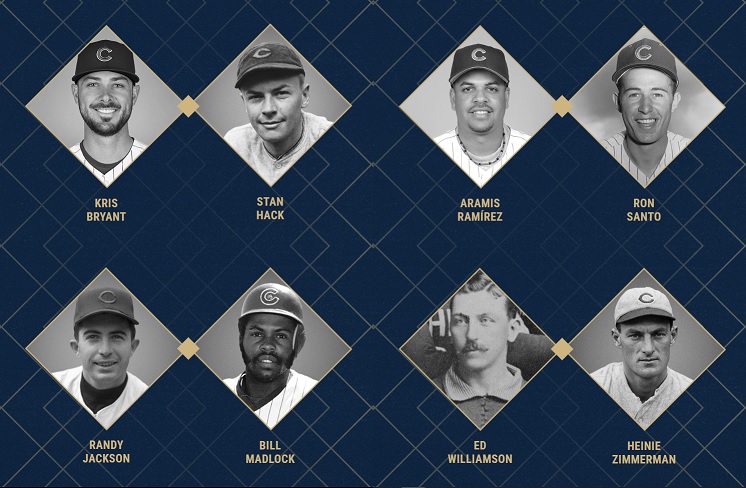
Kris Bryant was selected by the Cubs as the second-overall pick in the 2013 draft.  An injury to Mike Olt early in the 2015 season got Bryant called up to the big leagues and he did not waste time making his presence felt.  Hitting .275 with 26 HRs and 99 RBIs, Bryant won the Rookie of the Year award while leading the surprising Cubs to the NL Wild Card and an appearance in the NLCS.  Things were even better the following year, as Bryant won the NL MVP and the Cubs ended their 108-year title drought by defeating Cleveland in the World Series.  Unfortunately, neither Bryant nor the Cubs could replicate the highs of that year.  He was traded to the Giants at the trade deadline in 2021, finishing his time on the north side as a four-time All-Star and winner of the 2016 NL Hank Aaron Award.

Stan Hack spent his entire 16-year career with the Cubs, becoming the full-time third baseman in 1934.  He appeared in four World Series for the Cubs, losing efforts in 1932, 1935, 1938, and 1945.  When he retired following the 1947 season, he ranked second in team history behind Cap Anson in games played, at bats, and hits.  He twice led the National League in stolen bases and was a five-time All-Star selection.  He is a member of the Cubs Hall of Fame.
Randy Jackson spent parts of seven seasons across his two stints with the Cubs.  He debuted in 1950 and earned All-Star nods in 1954 and 1955.  Traded to the Dodgers following that 1955 season, he returned in 1959 for a final season after a knee injury derailed the trajectory of his career.

Continue reading →

150 Years Of Cubs Baseball – Second Basemen

Originally founded in 1869, the Chicago Cubs became a charter member of the National League in 1876.  Over the next 150 seasons, the Cubs have played more than 22,000 games, scored over 103,000 runs and recorded more than 200,000 hits, more than any other team in baseball history.  Nearly 2,300 players have worn a Cubs uniform, earning eight division titles, 17 NL pennants, and three World Series championships.

Fans have witnessed generations of unforgettable players, from historical heroes like Joe Tinker, Gabby Hartnett, Ernie Banks, and Billy Williams to more recent stars like Ryne Sandberg, Derrek Lee, Kerry Wood, and Anthony Rizzo.  The team has called Wrigley Field home for 110 of those 150 seasons.

To celebrate this milestone, the Cubs are holding a fan vote to select the franchise’s anniversary team.  Each week, we will go through the provided options for each position and declare who should, and, if different, who will, win the fan vote.  We start today with the eight selections for second baseman.

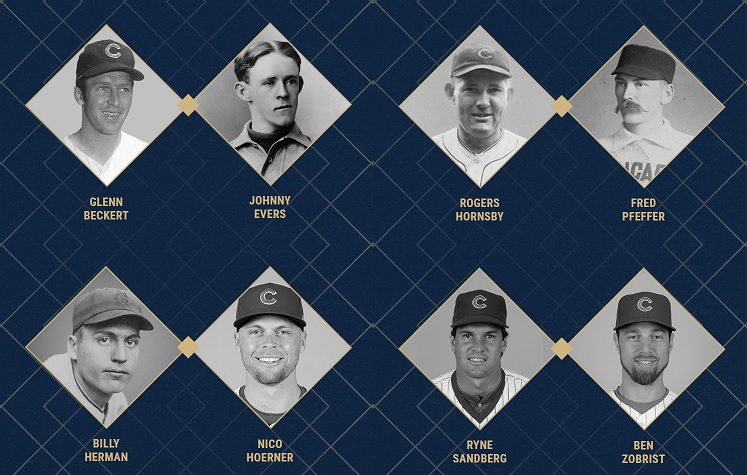
Glenn Beckert was called up by the Cubs in 1965, spending the next nine seasons as the team’s second baseman.  He won the Gold Glove in 1968 and was a four-time All-Star.  His best offensive season came in 1971, when he finished third in the NL with a career-best .342 batting average.

Johnny Evers played for the Orphans/Cubs from 1902 through 1913.  Known as “The Human Crab” for his combative play and fights with umpires, he earned a place in baseball history as part of the famous “Tinker-to-Evers-to-Chance” double-play combination thanks to the poem Baseball’s Sad Lexicon.  Evers was responsible for alerting umpires to the baserunning mistake that would come to be known as “Merkle’s Boner”.  He was part of three NL pennant winners with the Cubs, winning the championship in 1907 and 1908, and was elected to the Hall of Fame in 1946.

Billy Herman spent the first eleven years of his career with the Cubs, hitting over .300 in seven of his first nine seasons.  He led the league in games played (twice), hits, doubles, and triples across his nine full seasons.  During that time, he was named an All-Star seven straight times, beginning in 1934.  He was elected to the Hall of Fame in 1975.

Continue reading →

150 Years Of Cubs Baseball – First Basemen

Originally founded in 1869, the Chicago Cubs became a charter member of the National League in 1876.  Over the next 150 seasons, the Cubs have played more than 22,000 games, scored over 103,000 runs and recorded more than 200,000 hits, more than any other team in baseball history.  Nearly 2,300 players have worn a Cubs uniform, earning eight division titles, 17 NL pennants, and three World Series championships.

Fans have witnessed generations of unforgettable players, from historical heroes like Joe Tinker, Gabby Hartnett, Ernie Banks, and Billy Williams to more recent stars like Ryne Sandberg, Derrek Lee, Kerry Wood, and Anthony Rizzo.  The team has called Wrigley Field home for 110 of those 150 seasons.

To celebrate this milestone, the Cubs are holding a fan vote to select the franchise’s anniversary team.  Each week, we will go through the provided options for each position and declare who should, and, if different, who will, win the fan vote.  We continue today with the eight selections for first baseman.

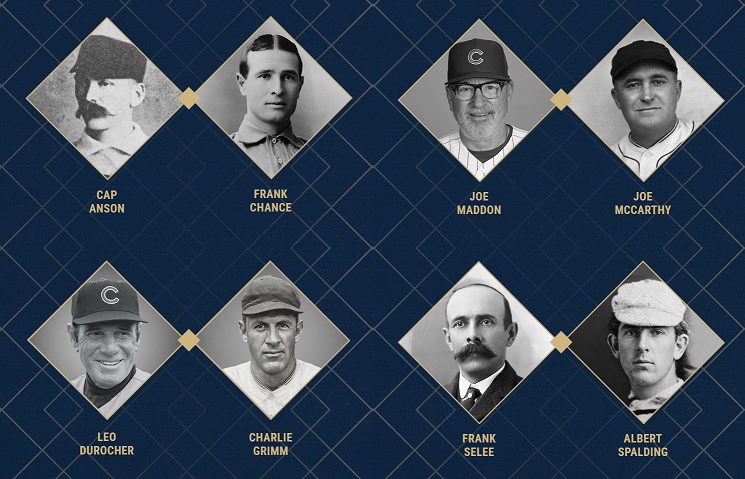
Cap Anson was one of the first superstars of professional baseball.  He joined the Cubs franchise, then known as the White Stockings, in 1876, the first year of the new National League.  In addition to managing the team from 1879-1897, he was the NL batting champion in both 1881 and 1888 and led the league in RBI eight times between 1880 and 1891.  He helped the team to five pennants between 1880 and 1886.  He was posthumously elected to the Hall of Fame in 1939.

Bill Buckner joined the Cubs in 1977, moving to first base due to a staph infection in his ankle the previous year.  He would win the NL batting title in 1980 and be named to his lone All-Star team in 1981.  In 1982, he set the major league record for assists at first base with 159.  Following some late acquisitions in 1984, Buckner found himself the off man out and was traded at the end of May.  He is a member of the Cubs Hall of Fame.
Phil Cavarretta spent 20 seasons with the Cubs, making his debut in September of 1934, just two months past his 18thn birthday.  He was a four-time All Star and, in 1945, he won the NL batting title and the MVP award while leading the Cubs to the pennant, their last one for over 70 years.  In his final season with the Cubs, he set the modern franchise record by playing in his 1938th game.  All told, he would hit .317 in three World Series appearances for the Cubs.

Continue reading →

150 Years Of Cubs Baseball – Catchers

Originally founded in 1869, the Chicago Cubs became a charter member of the National League in 1876.  Over the next 150 seasons, the Cubs have played more than 22,000 games, scored over 103,000 runs and recorded more than 200,000 hits, more than any other team in baseball history.  Nearly 2,300 players have worn a Cubs uniform, earning eight division titles, 17 NL pennants, and three World Series championships.

Fans have witnessed generations of unforgettable players, from historical heroes like Joe Tinker, Gabby Hartnett, Ernie Banks, and Billy Williams to more recent stars like Ryne Sandberg, Derrek Lee, Kerry Wood, and Anthony Rizzo.  The team has called Wrigley Field home for 110 of those 150 seasons.

To celebrate this milestone, the Cubs are holding a fan vote to select the franchise’s anniversary team.  Each week, we will go through the provided options for each position and declare who should, and, if different, who will, win the fan vote.  We continue today with the eight selections for catcher.

Willson Contreras first joined the Cubs in 2016 and became the 30th player in modern MLB history to hit a home run on the first pitch of his first major league at bat.  Contreras made it on to the post-season roster and helped the Cubs end their 108-year title drought in winning the 2016 World Series.  He became the everyday starting catcher in 2017 and was elected to the All-Star team three times.  He spent parts of seven seasons behind the plate for the Cubs, appearing in 30 postseason games across four seasons.

Jody Davis joined the Cubs in April of 1981, quickly becoming the team’s starter.  During his Cub tenure, he was named to two All-Star teams and won the Gold Glove in 1986, a season where he set the all-time MLB record for number of baserunners caught stealing with 89.  Davis remained with the Cubs through most of the 1988 season.  He will be inducted into the team’s Hall of Fame later this year.

Silver Flint played for the White Stockings from 1879-1889.  He, alongside pitcher Larry Corcoran, is believed to have developed the first system of signs between a pitcher and catcher to indicate pitch selection.  He was the first catcher in MLB history to catch three no-hitters.  Off the field, Flint had financial difficulties that nearly got him banned from the league.

Gabby Hartnett spent the first 19 years, from 1922-1940, of his career with the Cubs, appearing in six All-Star games and earning the MVP award in 1935.  Perhaps best remembered for the “Homer in the Gloamin’” in 1938, Hartnett was considered the best National League catcher until the emergence of Johnny Bench.  He was elected to the Hall of Fame in 1955.

Continue reading →

150 Years Of Cubs Baseball – Managers

Originally founded in 1869, the Chicago Cubs became a charter member of the National League in 1876.  Over the next 150 seasons, the Cubs have played more than 22,000 games, scored over 103,000 runs and recorded more than 200,000 hits, more than any other team in baseball history.  Nearly 2,300 players have worn a Cubs uniform, earning eight division titles, 17 NL pennants, and three World Series championships.

Fans have witnessed generations of unforgettable players, from historical heroes like Joe Tinker, Gabby Hartnett, Ernie Banks, and Billy Williams to more recent stars like Ryne Sandberg, Derrek Lee, Kerry Wood, and Anthony Rizzo.  The team has called Wrigley Field home for 110 of those 150 seasons.

To celebrate this milestone, the Cubs are holding a fan vote to select the franchise’s anniversary team.  Each week, we will go through the provided options for each position and declare who should, and, if different, who will, win the fan vote.  We start today with the eight selections for manager.

Cap Anson was one of the first superstars of professional baseball.  He joined the Cubs franchise, then known as the White Stockings, in 1876, the first year of the new National League.  In 1879, he became the player-manager, leading the team to five pennants between 1880 and 1886.  He introduced new tactics that are commonplace today, including having a third base coach, having fielders back up one another, using signs to the batter, and having a set pitching rotation.  He was fired as manager following the 1897 season, his last as a player.  Off the field, Anson was an outspoken proponent of segregation in baseball and was known to gamble on games.

Frank Chance debuted with the Cubs in 1898, becoming their full-time first baseman in 1903, where he became immortalized as part of the “Tinker-to-Evers-to-Chance” trio thanks to the poem Baseball’s Sad Lexicon.  He became the player-manager in 1905, becoming the first of only eight managers to lead their team to four 100-win seasons.  The Cubs would win four NL pennants and two World Series championships under Chance.  He was let go by the team as both a player and a manager following the 1912 season.  He remains the winningest manager in Cubs history, by winning percentage.

Leo Durocher returned to major league baseball after an eleven-year break to become the manager of the Cubs in 1966.  He inherited a team that had finished in eighth place the year before and, within two years, he led them to only their second winning season since 1946.  1969 appeared to be their year, as the Cubs led the new NL East for 105 days, but a late season fade left them eight games behind the so-called Miracle Mets.  During his tenure, Durocher faced trouble in the locker room, nearly coming to blows with Ron Santo and dealing with the decline phase of franchise legend Ernie Banks.  With a 46-44 record midway through the 1972 season, Durocher was fired.  He would later state that his biggest regret in baseball was not winning a pennant for Cubs owner Phillip Wrigley.

Continue reading →

Cubs All Time Leaders – Through 2025

To paraphrase from a famous movie, the one constant through all the years has been baseball.  With the start of the 2026 season coming next week, we start to wind down our look at the all-time leaders in both offensive and defensive categories for all 30 teams. Today, we take a deeper dive into the Chicago Cubs.

The Cubs, dating back to 1870, were charter members of the National League in 1876.  I’ve seen 544 players wearing a Cub uniform in the 463 of their games that I’ve attended live at nine different stadiums across seven cities, with the earliest identified game at Wrigley Field on August 4, 1984 against the Mets, through their NLDS appearance against the Brewers last fall.

Home Runs

Name Total
Sammy Sosa 42
Aramis Ramirez 41
Derrek Lee 38

Hits

Name Total
Derrek Lee 245
Aramis Ramirez 216
Sammy Sosa 136

Runs

Name Total
Derrek Lee 136
Aramis Ramirez 114
Sammy Sosa 102

RBI

Name Total
Aramis Ramirez 151
Derrek Lee 128
Sammy Sosa 97

Doubles

Name Total
Derrek Lee 51
Aramis Ramirez 48
Michael Barrett 29

Triples Continue reading →

A Fallen Icon

For the second time in the month, a Chicago baseball legend has lost his life prematurely due to cancer.  Former Cubs second baseman Ryne Sandberg, who had been suffering from metastatic prostate cancer for over a year, died Monday at 65.

Ryne Sandberg was acquired by the Cubs, along with Larry Bowa, from the Phillies for Ivan DeJesus in January of 1982.  He was the primary third baseman for the Cubs during the 1982 season, hitting .271 with 7 home runs and 54 RBIs, good enough to place sixth in Rookie of the Year voting.  After the Cubs acquired Ron Cey following the season, they moved Sandberg to second base, where he would become a mainstay for the next decade plus.

1983 saw Sandberg garner his first Gold Glove while hitting .261 with 8 home runs and 48 RBIs.  He blossomed in 1984, as the Cubs made a surprising run at the NL East title.  Sandberg won the MVP, Silver Slugger, and Gold Glove awards while leading the league with 114 runs and 19 triples.  He hit .368 during the NLCS against the Padres, which the Cubs dropped in 5 games.  1985 saw him win another Silver Slugger and Gold Glove, while still earning MVP support despite the Cubs falling to the bottom of the division.  He earned another Gold Glove in 1986, hitting .284 with 14 home runs.  Injuries limited him to 132 games in 1987. but he still took home his fifth consecutive Gold Glove.

Sandberg posted a .741 OPS in 1988, good enough for his third Silver Slugger award and his sixth straight Gold Glove.  The Cubs returned to the post-season in 1989, as Sandberg hit .290 with 30 home runs, which garnered him yet another Silver Slugger and Gold Glove while coming in fourth for MVP voting.  He hit .400 and drove in four in the Cubs’ NLCS loss to the Giants in five games.  In 1990, Sandberg set a career high with 40 home runs, which led the National League, and duplicated his Silver Slugger, Gold Glove, and fourth place for MVP voting results from the previous year.  1991 saw Sandberg win his ninth consecutive, and final, Gold Glove award, breaking a tie with Bill Mazeroski.  In 1992, he won his fifth straight, and seventh overall, Silver Slugger award.  1993 saw Sandberg make his tenth consecutive, and final, All-Star team.

Sandberg struggled out of the gate in 1994, and with rumored marital issues at home, he abruptly retired on June 13th, saying “I lost the desire that got me ready to play on an everyday basis for so many years. Without it, I didn’t think I could perform at the same level I had in the past, and I didn’t want to play at a level less than what was expected of me by my teammates, coaches, ownership, and most of all, myself.”  Following a divorce and a new marriage, Sandberg returned to the Cubs in 1996, hitting .244 with 25 home runs and 92 RBIs.  With his OPS dropping to .711 in 1997, his lowest total since 1983, Sandberg retired for good following the 1997 season.  He was inducted to the Hall of Fame in 2005 and, that August, the Cubs retired his #23.  Last June, a statue of Sandberg was unveiled on Gallagher Way outside Wrigley Field