150 Years Of Cubs Baseball – Outfielders Part 2

Originally founded in 1869, the Chicago Cubs became a charter member of the National League in 1876.  Over the next 150 seasons, the Cubs have played more than 22,000 games, scored over 103,000 runs and recorded more than 200,000 hits, more than any other team in baseball history.  Nearly 2,300 players have worn a Cubs uniform, earning eight division titles, 17 NL pennants, and three World Series championships.

Fans have witnessed generations of unforgettable players, from historical heroes like Joe Tinker, Gabby Hartnett, Ernie Banks, and Billy Williams to more recent stars like Ryne Sandberg, Derrek Lee, Kerry Wood, and Anthony Rizzo.  The team has called Wrigley Field home for 110 of those 150 seasons.

To celebrate this milestone, the Cubs are holding a fan vote to select the franchise’s anniversary team.  Each week, we will go through the provided options for each position and declare who should, and, if different, who will, win the fan vote.  We continue today with the second eight selections for outfielder.
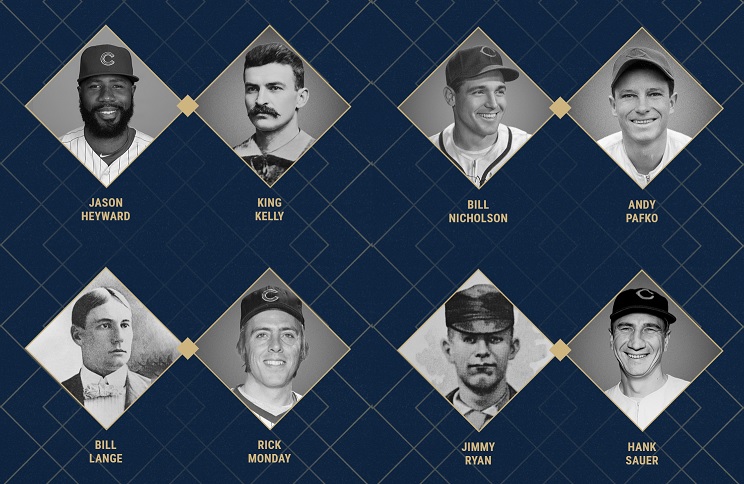
Jason Heyward signed an 8-year, $184 million contract with the Cubs in December of 2015.  His place in Cubs lore was set when he was credited with leading an inspiring, players-only meeting during the 17-minute rain delay towards the end of Game 7 of the 2016 World Series, after which the Cubs stormed out and took the lead in the 10th inning, leading to their first championship in 108 years.  While he never quite produced enough to justify his lofty contract and the team failed to duplicate their 2016 success, he became as much of a scapegoat as anyone else on the roster, eventually seeing his playing time reduced.  In addition to his World Series ring, Heyward won Gold Glove awards in both 2016 and 2017.

King Kelly emerged as one of 19th‑century baseball’s first true superstars as a member of the White Stockings.  He led the NL in runs scored for three consecutive seasons, from 1884 through 1889 and also won the NL batting title in both 1884 and 1886.  During his seven years with the franchise, they won five NL pennants.  In 1945, he was elected to the Hall of Fame.

Bill Lange spent his entire seven-year MLB career with the Colts/Orphans, becoming a full-time center fielder in 1894.  He retired at age 28 to marry a woman whose father had forbid her from marrying a ballplayer, finishing his career with a .330 batting average.  In 1897, he led the NL in stolen bases.  He is a member of the Cubs Hall of Fame.

Rick Monday spent five productive, if unspectacular, seasons with the Cubs, from 1972 through 1976.  His claim to fame came on April 25, 1976, at Dodger Stadium when two protestors ran onto the field during the bottom of the 4th inning and tried to light an American flag on fire.  Monday, playing center field, dashed over to grab the flag, and ran it in to the Dodgers’ dugout.  After the game, Monday received a congratulatory call from President Gerald Ford and was later invited to the White House.

Bill Nicholson was one of the most feared hitters in the NL during his ten seasons with the Cubs.  He led the league in home runs and RBIs in both 1943 and 1944.  While a member of the pennant-winning 1945 club, failing eyesight likely caused by his at-the-time undiagnosed diabetes limited his effectiveness, both in the regular season and in the World Series.  He was a five time All-Star and twice finished in the top three for MVP voting.

Andy Pafko spent parts of nine seasons with the Cubs from 1943 to 1951.  Widely regarded as one of the best defensive outfielders of his era, he helped lead the Cubs to the NL pennant in 1945, finishing fourth in MVP voting.  He was a five-time All-Star and is a member of the Cubs Hall of Fame.

Jimmy Ryan was one of the franchise’s earliest stars, playing for White Stockings from 1885 – 1889 and again with the Colts/Orphans from 1891 – 1900.  A power hitter in his era, Ryan led the National League with 16 home runs in 1888 while also leading the league hits, doubles, total bases, and slugging.  In 1893, Ryan was severely injured when the team’s train derailed in Ohio.  One day shy of the one-year anniversary of the derailment, Ryan found himself in another life-or-death situation, using his bats to tear down barbed-wire fencing to save fans from a fire in the stands at West Side Park.  He is a member of the Cubs Hall of Fame.

Hank Sauer was a star for the Cubs during a low time in the franchise’s history, never finishing with a winning record or above fifth place.  Nicknamed “The Mayor of Wrigley Field, he was a two-time All-Star, and, in 1952, he had his finest season, leading the major leagues in home runs and RBIs and earning the NL MVP award.  He is a member of the Cubs Hall of Fame.

Fitbit 12 – Week 1

Year twelve on the Fitbit platform gets off to a good start, thanks to a well-timed trip to southern California.  The week got off to a decent start on Sunday, where breakfast out and finding a charger for the rental car left me 35 steps shy of 6600, with some additional effort of an afternoon swim not included.  A trip to the beach followed by a tour of Sony Pictures Studios on Monday put me above goal with 8000 steps.  Tuesday was even better, jumping up to 8500 steps thanks to a tour of Dodger Stadium followed by a trip to Pauley Pavilion to see UCLA steal a victory against Purdue.  The trip to LAX for the flight back home on Wednesday left me with 5200 steps.  Returning to work, and getting a bit of rest, on Thursday led to a big drop, coming in with 3900 steps.  Bitter cold temperatures on Friday kept me inside all day, leading to 4300 steps.  The low point of the week came on Saturday, where the ongoing polar vortex left me 31 steps shy of 3700

Total steps: 40,230

Daily average: 5747.1

Ballpark Tour: Rockies

With the offseason underway, we continue our tour of all of the different baseball stadiums I’ve been to over the years. This week, we head west to Denver for a look at the Colorado Rockies. So, without further ado, let’s take a deeper look at my history with Coors Field.

Stadium Name: Coors Field

Years in Service: 1995 – Present

Visits: 2

After spending their first two seasons at Mile High Stadium, the Rockies moved to their own ballpark, the first baseball-only park opened in the National League since Dodger Stadium in 1962.  During construction of the park, numerous dinosaur fossils were found, eventually leading to the creation of the team’s mascot Dinger, a purple triceratops.  Coors Field has hosted two All-Star Games, in 1998 and again in 2021.

A quick trip to Denver in 2022 saw me taking in two games versus the White Sox.  I arrived in town on a Tuesday afternoon, heading to the ballpark for a night game in the Rockies’ club level.  The White Sox managed to pull out a squeaker, winning 2-1.  I returned to the ballpark the following afternoon, sitting on the first level down the third base line.  Things did not go as well for the White Sox this day, as the Rockies managed to score late to take the game 6-5.

Ballpark Tour: Dodgers

With the offseason well underway, we continue our tour of all of the different baseball stadiums I’ve been to over the years. This week, we head to Chavez Ravine to take a look at the Los Angeles Dodgers, owners of the third oldest ballpark in the major leagues. So, without further ado, let’s take a deeper look at my one game history with Dodger Stadium.

Stadium Name: Dodger Stadium

Years in Service: 1962 – Present

Visits: 1

Following the 1957 season, the Dodgers fled Brooklyn and headed west to California, landing in Los Angeles. The team played in the LA Coliseum while they built a new stadium at Chavez Ravine. In 1962, three years after breaking ground, Dodger Stadium opened as the Reds topped the Dodgers in the season opener.

The following year, the Dodgers won their first World Series in their new home. Between 1962 and 1965, Sandy Koufax threw three no hitters at the stadium, including a perfect game against the Cubs. Four home runs have been hit out of Dodger Stadium, two of which were hit by Pirate great Willie Stargell.

Dodger Stadium is currently the third oldest park still in use, behind Fenway Park and Wrigley Field.  I made my first visit to the stadium to see the second home game of the 2014 slate, with the Dodgers taking on their longtime rival Giants.  Thanks to traffic, I didn’t get to my seat until the 4th inning, by which point the Giants had secured a substantial lead. I sprung for decent seats, which put me down on the lower level. One odd thing about those lower sections were the aisles, which are so narrow that people could only go in one direction at a time. I did also manage to score a fabled Dodger Dog, or at least the all-beef version of it.  I hope to make it back some day for a repeat performance.

Games Per Stadium By Year

With the 2023 season officially in the rearview mirror, let’s take a look at the number of games I’ve attended each year at one of the now-29 different stadiums I’ve visited over the years.

Games Per Stadium Per Year

GameYear StadiumName TotalGames
2008 US Cellular Field 46
2003 Wrigley Field 46
Surprise playoff runs for the White Sox in 2008 and the Cubs in 2003 led to what remains my highest single season totals ever, boosted by post-season play.
2021 Guaranteed Rate Field 44
My highest-post-pandemic total, helped in part by a division champion and the desire to get back to the ballpark following the lockdown of 2020.
2007 Wrigley Field 43
2004 Wrigley Field 41
My highest non-playoff total saw me attending over half of the home games for the Cubs in 2004.
2011 US Cellular Field 40
2009 US Cellular Field 40
2010 US Cellular Field 36
2005 Wrigley Field 34
2008 Wrigley Field 34
2017 Guaranteed Rate Field 33
2016 US Cellular Field 32
2006 US Cellular Field 32
2023 Guaranteed Rate Field 32
2015 US Cellular Field 31
2012 US Cellular Field 31
2007 US Cellular Field 29
2014 US Cellular Field 28 Continue reading →

Travelling The 50 States – California

Over my 47 years, I’ve done my fair share of travelling across these United States.  I thought it would be an interesting experiment go look back at those trips to each of the 31 states I have visited (62% isn’t bad, is it?) and see if, and when, I may be returning.  Working in alphabetical order, we start today with the 31st state to be added to the Union: California.

State: California
Joined the Union: 1850
Visits: 11

With eleven visits between 1998 and 2019, the Golden State is the state I have visited the most, outside of those I have lived in and/or attended college.

My first visit was in 1998 to attend Comic Con International in San Diego.  I went early, spending the entire week and enjoying some pre-Con time checking out the sights, including the San Diego Zoo.

I returned the following year for Labor Day weekend, but this time up to the San Francisco Bay area, to visit my old friend Scott, who had moved out there after graduating to work at AMD.  What I remember from that trip is my first Giants/Phillies tilt at the former Candlestick Park, my first trip to the toilet that at the time was called Network Associates Coliseum, and a car trip over the Golden Gate Bridge.

I returned to San Diego for Comic Con in 2000 and 2003.  I don’t remember much of the 2000 trip, but the 2003 trip included my one visit to the former Jack Murphy Stadium to see the Padres face the Diamondbacks.  At the Con, I managed to see many of the stars (or, at least, bit players) from Buffy The Vampire Slayer, Smallville, and Tru Calling.

With the Cubs coming off their first division title since 1989 and a new stadium opening in San Diego, my friend Pete and I planned a trip for the Cubs mid-May road trip.  We attended all three games at PETCO Park, which the Cubs swept, while also taking in the local sights and the ambience of the Elephant and Castle bar in our hotel. Continue reading →

2022 All Star Break Standings

For the first time since 1980, the Midsummer Classic returns to Los Angeles and Dodger Stadium.  As the stars of the baseball world gather in Tinsletown, it’s time to take a look at the team records for the 21 games, featuring exactly half of the teams in the league, that I attended in the first half of the baseball season, a disappointing one, for different reasons, on both sides of town.

2022 Team Records

Team Name Won Loss Winning Pctg
Los Angeles Dodgers 2 0 1.000
Texas Rangers 1 0 1.000
New York Mets 1 0 1.000
Cleveland Guardians 1 0 1.000
Baltimore Orioles 1 0 1.000
New York Yankees 2 1 0.667
Chicago White Sox 10 8 0.556
Minnesota Twins 1 1 0.500
Chicago Cubs 2 5 0.286
Continue reading →

Games Per Stadium – All Time

It’s been 4 years (to the day!) since we’ve taken a look at the now 27 different stadiums I’ve been to and how often I’ve been to them.  With the World Series over and the off season upon us, it’s time to update that list.  I’ve added 5 additional stadiums in this time, three in 2019 and two this year.  As usual, different names for the same physical stadium are counted separately.

Games Per Stadium
Stadium Name Total Games
US Cellular Field 414
Wrigley Field 370
Guaranteed Rate Field 122
Comiskey Park II 38
Comiskey Park 13
Great American Ballpark 7
Miller Park 7
Ameriquest Field 4
PETCO Park 3
Ballpark in Arlington, The 3
Progressive Field 2
Target Field 2
Tropicana Field 2
Comerica Park 2
Cinergy Field Continue reading →

Book 8 (of 52) – Stealing Home

Stealing Home: Los Angeles, the Dodgers, and the Lives Caught in Between – Eric Nusbaum

The story, as I had heard it, was that Walter O’Malley, owner of the Brooklyn Dodgers, was looking to replace Ebbets Field and, after running into resistance from city officials on acquiring the land he needed, he turned his sights west, landing in Chavez Ravine and displacing Mexican immigrants who had called that area home.  In Stealing Home, Eric Nusbaum tells the story which is somewhat more nuanced than that.

Nusbaum weaves three tales, one of the Aréchigas family, one of Frank Wilkinson, and one of the Dodgers, which coalesce in the hills of what is now referred to as Chavez Ravine, but at the time was the neighborhoods of Palo Verde, La Loma and Bishop.  The Aréchigas put down roots in Palo Verde after emigrating from Mexico by way of Arizona, raising multiple generations in their humble abode.  Frank Wilkinson, meanwhile, had a vision for public housing that needed a place to build, and the neighborhoods of  Palo Verde, La Loma and Bishop were the unlucky winners.  As eminent domain notices went out to the affected families, including the Aréchigas, plans for the housing project hit a snag when Wilkinson was outed as a communist.  You would think this would have put a stop to the evictions, but no.

Following protracted negotiations, the city council convinced Walter O’Malley to uproot the Dodgers and move to Los Angeles and they purchased the Chavez Ravine property back from the Federal Housing Authority, with the stipulation that the land be used for a public purpose.  In June of 1958, 2 months after the Dodgers began their first season in LA, voters approved a “Taxpayers Committee for Yes on Baseball” referendum, which enabled O’Malley to acquire 352 acres of Chavez Ravine from the city in exchange for Wrigley Field (the Los Angeles version). After additional legal challenges, including the eventual removal of the Aréchigas, ground was broken on Dodger Stadium in September of 1959, and it opened for business on April 10, 1962.   The abandoned Palo Verde elementary school, which taught multiple generations of Aréchigas children, was simply buried and sits beneath the parking lot northwest of third base.

At the end of the day, multiple sources converged to remove the Mexican families from their homes in order to ultimately build a baseball stadium.  While the Dodgers have taken the majority of the blame over the years, had the original housing project either gone through to completion or never started in the first place, the land would not have been available for them to swoop in and overtake.  Had Walter O’Malley thrown a little extra money at the problem, it may have soothed a lot of hurt feelings.  This was an important story that I’m glad was finally told, filling in many of the holes of the popular myth.

The Decade In Baseball – Team Records

The 2010s have drawn to a close and its time to take a look back at the previous decade.  Today, we are starting with baseball, specifically the performance of all 30 MLB teams in games I attended between 2010 and 2019.  Locally, things were good on the north side of town, as the Cubs finished their rebuild with 3 straight NLCS appearances in the middle of the decade, including a World Series championship in 2016.  It was much bleaker on the south side, as the White Sox failed to compete after a late collapse in 2012, finishing the decade on a string of 7 consecutive losing seasons.

I managed to take in 385 games over the past 10 years at 12 different stadiums from coast (Dodger Stadium) to coast (Fenway Park).  2010 was my high water mark, with 52 games, while 2013 and 2018 tied for the lowest total of the decade with only 29 games.

Games Per Year
Year Total Games
2010 52
2011 43
2012 33
2013 29
2014 35
2015 39
2016 39
2017 49
2018 29
2019 37

Two franchises went through the decade undefeated in games I attended, while another 2 teams went winless.  Both local teams finished just a shade under .500.  The White Sox are far and away the team I saw most often, while the Diamondbacks bring up the rear with only 2 appearances over the past 10 years.

2019 Team Records
Team Name Won Loss Winning Pctg
Colorado Rockies 4 0 1.000
New York Mets 3 0 1.000
Boston Red Sox 9 3 0.750
New York Yankees 9 4 0.692
Washington Nationals 6 3 0.667
Houston Astros 6 3 0.667
Florida Marlins 2 1 0.667
Los Angeles Angels 9 5 0.643
Detroit Tigers 22 13 0.629
Pittsburgh Pirates 5 3 0.625
Kansas City Royals 21 17 0.553
Cleveland Indians 17 14 0.548
Toronto Blue Jays 8 7 0.533
Minnesota Twins 19 17 0.528
Oakland Athletics 7 7 0.500
St. Louis Cardinals 2 2 0.500
San Diego Padres 2 2 0.500
Arizona Diamondbacks 1 1 0.500
Chicago White Sox 159 164 0.492
Chicago Cubs 40 43 0.482
Continue reading →