150 Years Of Cubs Baseball – Starting Pitchers Part 3

Originally founded in 1869, the Chicago Cubs became a charter member of the National League in 1876.  Over the next 150 seasons, the Cubs have played more than 22,000 games, scored over 103,000 runs and recorded more than 200,000 hits, more than any other team in baseball history.  Nearly 2,300 players have worn a Cubs uniform, earning eight division titles, 17 NL pennants, and three World Series championships.

Fans have witnessed generations of unforgettable players, from historical heroes like Joe Tinker, Gabby Hartnett, Ernie Banks, and Billy Williams to more recent stars like Ryne Sandberg, Derrek Lee, Kerry Wood, and Anthony Rizzo.  The team has called Wrigley Field home for 110 of those 150 seasons.

To celebrate this milestone, the Cubs are holding a fan vote to select the franchise’s anniversary team.  Each week, we will go through the provided options for each position and declare who should, and, if different, who will, win the fan vote.  We start today with the final eight selections for starting pitcher.
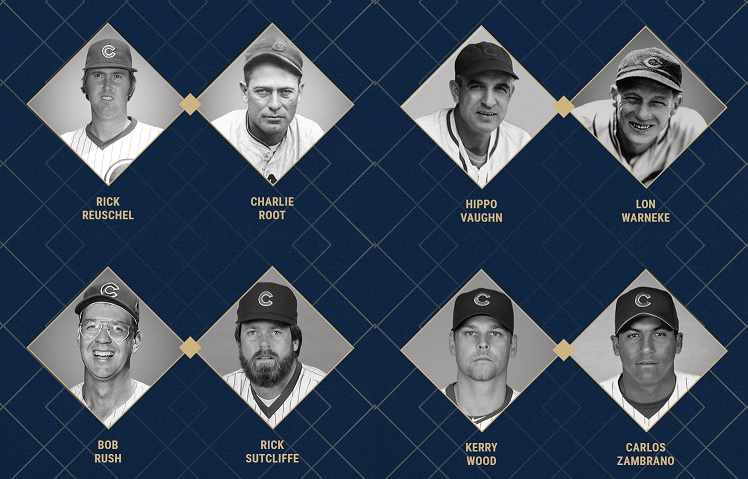
Rick Reuschel, a native of central Illinois, spent parts of twelve seasons across two stints with the Cubs, from 1972-1981 and again from 1983-1984.  From 1975-1978, he was teammates with his brother Paul, also a pitcher.  His best season came in 1977, when he won 20 games, made his lone All-Star team as a Cub, and finished third in Cy Young award voting.  After being traded in 1981, he returned to the Cubs in 1983 following a rotator cuff injury.  He is a member of the Cubs Hall of Fame.

Charlie Root spent the majority of his major league career with the Cubs, from 1926-1941.  In 1927, he led the National League with 26 wins, 48 games, 309 innings pitched, and, unfortunately, 117 walks.  In the 1932 World Series, Root was on the mound for Babe Ruth’s infamous called shot home run, though he would dispute the account.  Overall, he appeared in four World Series as a Cub and received some MVP support in five of his sixteen seasons.  He is a member of the team’s Hall of Fame.

Bob Rush debuted with the Cubs in 1948, spending ten seasons on the north side.  A two-time All-Star, he led the NL with 20 losses in 1950.  He was a steady, if unspectacular, mainstay of the Cub rotation during the fallow period following their final World Series appearance of the 20th century in 1945.
Continue reading →

150 Years Of Cubs Baseball – Starting Pitchers Part 1

Originally founded in 1869, the Chicago Cubs became a charter member of the National League in 1876.  Over the next 150 seasons, the Cubs have played more than 22,000 games, scored over 103,000 runs and recorded more than 200,000 hits, more than any other team in baseball history.  Nearly 2,300 players have worn a Cubs uniform, earning eight division titles, 17 NL pennants, and three World Series championships.

Fans have witnessed generations of unforgettable players, from historical heroes like Joe Tinker, Gabby Hartnett, Ernie Banks, and Billy Williams to more recent stars like Ryne Sandberg, Derrek Lee, Kerry Wood, and Anthony Rizzo.  The team has called Wrigley Field home for 110 of those 150 seasons.

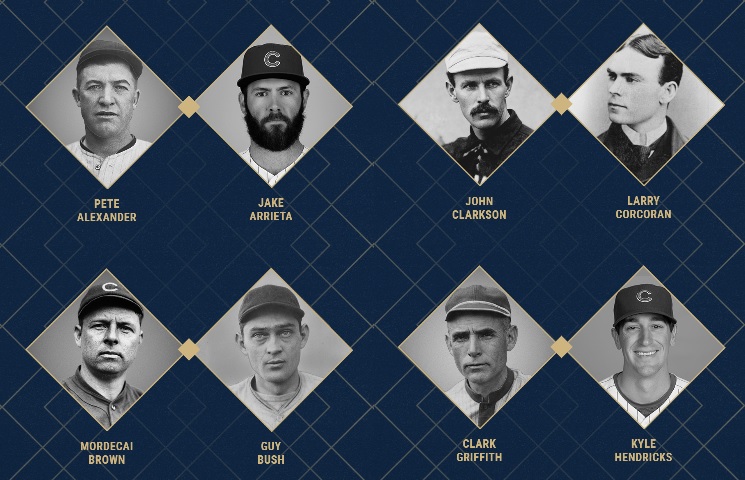
To celebrate this milestone, the Cubs are holding a fan vote to select the franchise’s anniversary team.  Each week, we will go through the provided options for each position and declare who should, and, if different, who will, win the fan vote.  We continue today with the first eight selections for starting pitcher.

Pete Alexander spent parts of nine seasons with the Cubs, from 1918-1926.  He missed the majority of 1918 after being drafted into the Army and being deployed to France.  In 1920, he won the pitching triple crown, leading the NL in wins, ERA, and strikeouts.  That turned out to be his last dominant season, thanks to injuries sustained in World War I, though he continued to be an effective pitcher for the remainder of his Cubs career.  In 1938, he was inducted into the Hall of Fame with 80.9% of the vote.

Jake Arrieta was acquired by the Cubs in July of 2013, making seven starts for Iowa before being recalled to the rebuilding big league club.  He turned into an ace for the team in 2015, winning the NL Cy Young Award, and was a key contributor to their World Series championship in 2016.  He threw two no-hitters, one in 2015 against the Dodgers and the second in 2016 against the Reds.  After leaving as a free agent following the 2017 season, he re-signed with the Cubs in 2021, with disastrous results.  He set the team record for highest ERA for a pitcher in a season with at least 20 starts.  He followed up his final appearance before his mid-August release, where he gave up 8 hits and 7 runs in the first inning, with a post-game tirade where he berated a reporter for wearing a mask, which he was required to do by city regulation, during a Zoom press conference.

Mordecai Brown spent two tours with the Cubs in the early 20th century, from 1904-1912 and again in 1916.  Nicknamed “Three Finger” due to a farming accident in his youth which mangled his right hand, the disfigurement gave him an unusual grip on the baseball, which gave his pitches extra topspin.  During his Cubs career, he topped the 20-win plateau six times and helped the franchise to their first two World Series titles in 1907 and 1908.  His 2.06 career ERA is the third best amongst Hall of Famers and the best amongst pitchers with at least 200 wins.  He was elected to the Hall of Fame posthumously in 1949.

Continue reading →

150 Years Of Cubs Baseball – Managers

Originally founded in 1869, the Chicago Cubs became a charter member of the National League in 1876.  Over the next 150 seasons, the Cubs have played more than 22,000 games, scored over 103,000 runs and recorded more than 200,000 hits, more than any other team in baseball history.  Nearly 2,300 players have worn a Cubs uniform, earning eight division titles, 17 NL pennants, and three World Series championships.

Fans have witnessed generations of unforgettable players, from historical heroes like Joe Tinker, Gabby Hartnett, Ernie Banks, and Billy Williams to more recent stars like Ryne Sandberg, Derrek Lee, Kerry Wood, and Anthony Rizzo.  The team has called Wrigley Field home for 110 of those 150 seasons.

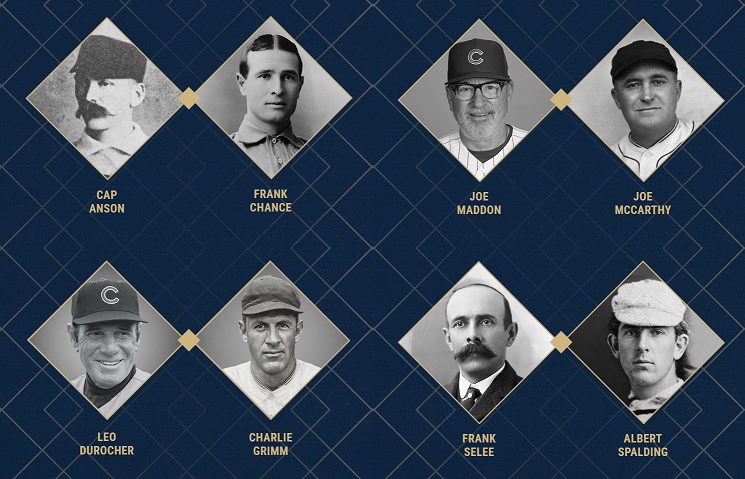
To celebrate this milestone, the Cubs are holding a fan vote to select the franchise’s anniversary team.  Each week, we will go through the provided options for each position and declare who should, and, if different, who will, win the fan vote.  We start today with the eight selections for manager.

Cap Anson was one of the first superstars of professional baseball.  He joined the Cubs franchise, then known as the White Stockings, in 1876, the first year of the new National League.  In 1879, he became the player-manager, leading the team to five pennants between 1880 and 1886.  He introduced new tactics that are commonplace today, including having a third base coach, having fielders back up one another, using signs to the batter, and having a set pitching rotation.  He was fired as manager following the 1897 season, his last as a player.  Off the field, Anson was an outspoken proponent of segregation in baseball and was known to gamble on games.

Frank Chance debuted with the Cubs in 1898, becoming their full-time first baseman in 1903, where he became immortalized as part of the “Tinker-to-Evers-to-Chance” trio thanks to the poem Baseball’s Sad Lexicon.  He became the player-manager in 1905, becoming the first of only eight managers to lead their team to four 100-win seasons.  The Cubs would win four NL pennants and two World Series championships under Chance.  He was let go by the team as both a player and a manager following the 1912 season.  He remains the winningest manager in Cubs history, by winning percentage.

Leo Durocher returned to major league baseball after an eleven-year break to become the manager of the Cubs in 1966.  He inherited a team that had finished in eighth place the year before and, within two years, he led them to only their second winning season since 1946.  1969 appeared to be their year, as the Cubs led the new NL East for 105 days, but a late season fade left them eight games behind the so-called Miracle Mets.  During his tenure, Durocher faced trouble in the locker room, nearly coming to blows with Ron Santo and dealing with the decline phase of franchise legend Ernie Banks.  With a 46-44 record midway through the 1972 season, Durocher was fired.  He would later state that his biggest regret in baseball was not winning a pennant for Cubs owner Phillip Wrigley.

Continue reading →

By The Numbers – 37

In 1929, uniform numbers appeared on the back of baseball jerseys for the first time, thanks to the Indians and the Yankees.  By 1937, numbers finally appeared across all uniforms, both home and away, across both major leagues.  Since that time, 81 distinct numbers have been worn by members of the White Sox, while the Cubs boast 76.

Today, we continue our look at those players, picking our favorite, if not the best, player to wear each uniform number for both Chicago teams with #37.  74 different players have donned #37 while playing in Chicago, 27 for the White Sox and 47 for the Cubs.

Selected in the fourth round of the 1985 draft, Bobby Thigpen made his major league debut for the White Sox just over a year later, wearing #58.  He switched to his more familiar #37 the following year, as he moved in to the closer role full time, replacing Bob James, and racked up 16 saves while also putting up a 7-5 record with a 2.73 ERA.  In 1988, he broke the team record for saves, with 34, while leading the league with 59 games finished.  He duplicated the effort in 1989 with another 34 saves, though with a 2-6 record and a 3.76 ERA.

Thigpen’s 1990 season was one for the record books.  He earned his first All Star nod while on his way to setting the major league record with 57 saves, while also leading the league with 77 games and 73 games finished.  On September 30, he earned his 57th save while throwing the final pitch at Comiskey Park.  After the 1990 season, Thigpen joined other major league all stars on a tour of Japan where, unfortunately, he would suffer a back injury that would plague him for the remainder of his career.

In 1991, he still managed to earn 30 saves, but his ERA jumped up to 3.49.  In 1992, he set a career high with a 4.75 ERA while earning only 22 saves, losing his grip on the closer role to both Scott Radinsky and Roberto Hernandez.  His 1993 was even worse, as his ERA jumped to 5.71 and he managed only 1 save in 25 appearances before an August 10 trade to the Phillies for former teammate Jose DeLeon.  He left as the franchise’s all time leader with 201 saves, a position he still holds today.

On the north side of town, pitcher Travis Wood was acquired by the Cubs, along with Dave Sappelt and Ronald Torreyes, in exchange for Sean Marshall.  Wearing #37, Wood was called up to the major league club in early May of 2012, replacing Chris Volstad, who started the season 0–6.  Wood went 6-13 with a 4.27 ERA in his first year as a Cub.  In 2013, Wood became the first Cub since Mordecai Brown to start a season with 9 straight quality starts and, on May 30, he hit his first career grand slam, leading to his first All-Star selection.

Wood struggled in 2014, with a 5.03 ERA in 31 starts, though he did hit his 9th career home run.  After struggling in the rotation to start the 2015 season, Wood was moved to the bullpen, where he fared much better, posting a 2.95 ERA and 4 saves in relief.  Continuing to work out of the bullpen in 2016, Wood posted a 4-0 record with a 2.95 ERA in 77 appearances.  In Game 2 of the NLDS, Wood hit a home run off of Giants’ reliever George Kontos, becoming just the second relief pitcher to homer in a postseason game., after Rosy Ryan in Game 3 of the 1924 World Series.  Wood appeared in 3 games of the 2016 World Series, giving up 2 hits and a run in 1 2/3 innings.  Following the season, he became a free agent.

Franchise Four – Chicago Cubs

Major League Baseball is asking its fans to vote for the four most impactful players who best represent the history of each franchise.  The winners will be announced in July at the All Star Game in Cincinnati.  Today, I will give my Franchise Four picks for the Chicago Cubs.

F4Cubs

EBErnie Banks, who was elected to the Hall of Fame in 1977, played his entire 19 year career with the Cubs, earning back-to-back MVP honors in 1958 and 1959.  When he retired following the 1971 season, he ranked 9th all-time in home runs, with 512.

RSRyne Sandberg joined the Cubs in 1982 and quickly became a fixture in the middle of the Cub infield, where he remained until 1997.  The 10-time all star, who earned MVP honors in 1984, was elected to the Hall of Fame in 2005.

TFBMordecai “Three Finger” Brown, who earned his nickname due to farming incident in his youth, spent 10 of his 14 seasons with the Cubs, leading them to World Series titles in 1907 and 1908.  He was elected to the Hall of Fame in 1949.

RoSRon Santo spent 14 of his 15 big league seasons with the Cubs, earning 9 All Star game appearances and 5 Gold Gloves.  He followed his playing career with a long broadcasting stint with the team.  He was posthumously elected to the Hall of Fame in 2012.

GHGabby Hartnett spent the first 19 years of his career with the Cubs, appearing in 6 All Star games and earning the MVP award in 1935.  Perhaps best remembered for the “Homer in the Gloamin'” in 1938, Hartnett was considered the best National League catcher until the emergence of Johnny Bench.  He was elected to the Hall of Fame in 1955. Continue reading →