Historic Games

With Vinny Capra and the White Sox falling victim to Clayton Kershaw on Wednesday night, giving him his 3000th career strikeout, I decided to take a look back at the historic games I’ve attended over the years.  Here is part one, featuring six games where an individual hit a career plateau or a team clinched a division title.

June 30, 1998 – Diamondbacks 4, Cubs 3

Sammy Sosa had broken the June record for home runs nine days earlier, surpassing the fifteen previously reached by Babe Ruth, Bob Johnson, Roger Maris, and Pedro Guerrero.  In the 8th inning of the final game of the month, Sosa connected against Alan Embree for his 20th home run of the month, setting the record not just for June, but for any month of the season.

September 27, 2003 – Cubs 7, Pirates 2

After winning the first game of a double header against the Pirates, the Cubs were in position to clinch at least a portion of their first Central Division title heading into the nightcap.  After the second-place Astros lost their game, a victory would give the Cubs the championship.  They jumped on Pirates starter Ryan Vogelsong early, scoring six runs in his 1 1/3 innings of work.  Dave Veres induced former Cub José Hernández to ground into a double play to wrap up the victory.

July 26, 2005 – Giants 3, Cubs 2

Following a nearly three-hour rain delay, Greg Maddux took the mound against the Giants sitting on 2998 strikeouts for his career.  In the third inning, Giants shortstop Omar Vizquel stepped up to the plate. With a 2-2 count, Maddux unleashed a sinker that Vizquel flinched away from, taking a third strike as the ball drifted back over the plate.  Maddux, who finished the game with three strikeouts, became just the 13th pitcher to reach 3000 strikeouts and the ninth to also have surpassed 300 victories.

August 5, 2007 – Mets 8, Cubs 3

On a warm Sunday night in Chicago, Tom Glavine took the mound for the Mets, sitting at 299 career victories.  The 41-year-old lefty tossed 6 1/3 innings, giving up just two runs to secure the win and his place in history.  Glavine became only the 23rd pitcher, and just the fifth southpaw, to reach the 300-win plateau.

September 16, 2007 – White Sox 9, Angels 3

Sitting at 499 home runs, Jim Thome entered the Sunday series finale, which just so happened to be Jim Thome bobblehead day, looking to reach 500 in Chicago.  With the score tied at seven in the bottom of the ninth, Thome came to the plate with a runner on first.  Having gone 0-4 to that point, Thome took Dustin Moseley to a 3-2 count before launching the walk-off milestone home run.  He became the 23rd major leaguer to reach the 500 home run mark and the third to do so in 2007.  He was the first slugger to reach the milestone with a walk-off.

September 30, 2008 – White Sox 1, Twins 0

After winning a makeup game against the Tigers to force a tie in the AL Central after 162 games, the White Sox took the field against the Twins in a tiebreaker to determine who would move on to the playoffs.  The Twins looked to strike first following a double by Michael Cuddyer to lead off the fifth inning, but a throw home by Ken Griffey Jr. nailed Cuddyer trying to score on a fly out to center field, ending the threat.  The game remained scoreless until the seventh, when Jim Thome blasted a home run to straight away centerfield.  Bobby Jenks came in to close down the game and the White Sox won their second division title in four years.
 

By The Numbers – 21

In 1929, uniform numbers appeared on the back of baseball jerseys for the first time, thanks to the Indians and the Yankees.  By 1937, numbers finally appeared across all uniforms, both home and away, across both major leagues.  Since that time, 81 distinct numbers have been worn by members of the White Sox, while the Cubs boast 76.

Today, we continue our look at those players, picking our favorite, if not the best, player to wear each uniform number for both Chicago teams with #21.  69 different players have donned #21 while playing in Chicago, 26 for the White Sox and 43 for the Cubs.

Near the end of the spring training in 1992, Sammy Sosa, along with Ken Patterson, was acquired from the White Sox for a fading George Bell.  Wearing #21, Sosa blossomed with the Cubs, going from 8 home runs and 25 RBIs in his first season to 33 home runs and 93 RBIs in his second, becoming the first 30-30 player in Cubs history.  Sosa continued to hit for power and speed in 1994, but he also upped his batting average to .300 for the first time.  Sosa was named to his first All-Star team in 1995, on his way to 36 home runs and 119 RBIs.  In 1996, Sosa continued his success, hitting .273 with 40 home runs and 100 RBIs.  1997, however, saw a decline in Sosa, who batted just .251 and posted a paltry .300 on-base percentage while leading the league with 174 strikeouts, despite hitting 36 home runs and driving in 119 runs.

A bulked-up Sammy Sosa arrived in camp in 1998, looking to turn things around, and turn them around he did.  While the surprising Cubs were in contention for the first time in nearly a decade, Sosa put on a home run barrage of historic proportions.  In the month of June, Sosa launched 20 home runs, drove in 47, and slugged .842 while pulling himself into the home run chase with Mark McGwire.  Sosa hit his 62nd home run on September 13, passing Roger Maris, and finished the season with 66, 4 behind McGwire’s then-record 70.  Sosa replicated that performance in 1999, hitting 63 home runs, again trailing McGwire, who hit 65.  Sosa finally led the league in home runs in 2000, though with “only” 50.  He managed another season for the ages in 2001, as he hit 64 home runs, becoming the first player to hit 60 or more home runs three times, and setting career highs in runs scored, RBIs, walks, OBP, slugging percentage, and batting average.  He notched his second career home run crown in 2002, adding 49 to his ledger.

Things started to turn for Sosa in 2003, despite the Cubs driving towards their first division title since 1989.  He went on the disabled list for the first time since 1996 in May and, when he returned, he was ejected, and ultimately suspended, for using a corked bat in the June 3 game against the Devil Rays.  He finished the season with 40 home runs, his lowest total since 1997, as the Cubs famously blew a 3-1 lead in the NLCS despite being 5 outs away from the pennant in Game 6.  The following May, he landed on the disabled list again following a violent sneeze at PETCO Park.  After returning from the DL, Sosa struck out 98 times the rest of the way, while hitting .238 and posting an OPS of .749.  For the entire year, Sosa hit .253, his worst average since 1997, with only 35 home runs and 80 RBIs, his lowest total since 1994.  When the Cubs fell out of contention for the NL Central title after losing 7 of their final 9 games, Sosa was given the day off for the final game of the season.  Unfortunately, he was spotted leaving Wrigley Field before the game even started while his teammates took out their frustrations with their “leader” my smashing his boombox with their bats.  That January, with the declined performance and the growing suspicion of PED use on their minds along with the end of the 2004 season, the Cubs decided to move on, trading Sosa to the Orioles for Jerry Hairston Jr. and Mike Fontenot.

On the South Side, Todd Frazier wore #21 after being acquired from the Reds in a three-team deal prior to the 2016 season.  On July 11, Frazier placed second in the Home Run Derby, losing to Giancarlo Stanton in the final round.  Frazier finished the year with career highs in home runs, runs batted in and walks despite hitting a career low .225 batting average in 158 games.  With the White Sox throwing in the towel and entering a full-fledged rebuild in 2017, Frazier was traded to the Yankees at the deadline.

Franchise Four – Chicago Cubs

Major League Baseball is asking its fans to vote for the four most impactful players who best represent the history of each franchise.  The winners will be announced in July at the All Star Game in Cincinnati.  Today, I will give my Franchise Four picks for the Chicago Cubs.

F4Cubs

EBErnie Banks, who was elected to the Hall of Fame in 1977, played his entire 19 year career with the Cubs, earning back-to-back MVP honors in 1958 and 1959.  When he retired following the 1971 season, he ranked 9th all-time in home runs, with 512.

RSRyne Sandberg joined the Cubs in 1982 and quickly became a fixture in the middle of the Cub infield, where he remained until 1997.  The 10-time all star, who earned MVP honors in 1984, was elected to the Hall of Fame in 2005.

TFBMordecai “Three Finger” Brown, who earned his nickname due to farming incident in his youth, spent 10 of his 14 seasons with the Cubs, leading them to World Series titles in 1907 and 1908.  He was elected to the Hall of Fame in 1949.

RoSRon Santo spent 14 of his 15 big league seasons with the Cubs, earning 9 All Star game appearances and 5 Gold Gloves.  He followed his playing career with a long broadcasting stint with the team.  He was posthumously elected to the Hall of Fame in 2012.

GHGabby Hartnett spent the first 19 years of his career with the Cubs, appearing in 6 All Star games and earning the MVP award in 1935.  Perhaps best remembered for the “Homer in the Gloamin'” in 1938, Hartnett was considered the best National League catcher until the emergence of Johnny Bench.  He was elected to the Hall of Fame in 1955. Continue reading →

#386 – Sammy Sosa

Name: Sammy Sosa

Rank: 386

Position: RF

Years With White Sox: 1989-1991

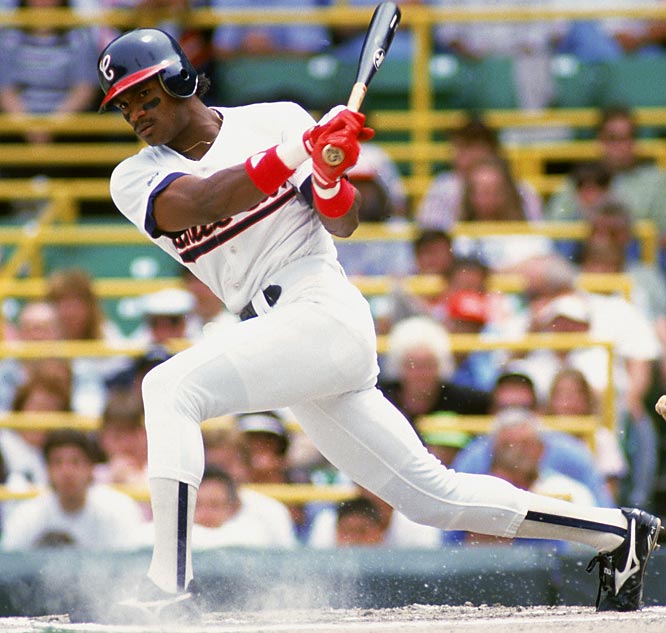
Before he and Mark McGwire helped heal the remaining wounds from the ’94 strike by smashing Roger Maris’ home run record, before becoming, again with McGwire, the poster boy for performance enhancing drugs and watching his Hall of Fame chances go up in smoke, Sammy Sosa spent 2 1/2 seasons frustrating the Chicago White Sox.

Acquired with Wilson Alvarez and Scott Fletcher at the trade deadline in 1989 in the deal that sent Harold Baines to Texas, Sosa started off strong, hitting .273 with 3 HR to close out the ’89 season.  In 1990, his first full season in the major leagues, his average slipped to .233 and he finished 4th in the AL with 150 strikeouts.

Following the 1990 season, GM Larry Himes, who engineered the trade with Texas, was fired, leaving Sosa without a guardian in the organization.  Unfortunately for Sosa, his 1991 season was even worse, with his average dropping again to .203 and being sent back to Triple A Vancouver for additional seasoning.  In his “autobiography”, aptly titled Sosa: An Autobiography, Sosa blames hitting coach Walt Hriniak for most of his problems with the White Sox and takes no responsibility for his lack of production.

Following the ’91 season, Himes was hired as the Cubs new GM, and near the end of the following spring training in 1992, Sosa was sent to the Northside along with Ken Patterson for a fading George Bell, where his career skyrocketed and then plummeted back down to Earth. But that is a story for a different time.

Sosa’s numbers in a White Sox uniform, both for games I attended and overall, were: Continue reading →