Everything’s Coming Up Jerry

For the first time since 1977, the White Sox will have the top overall pick in next July’s MLB draft.  Despite having the second worst record in baseball in 2025, the White Sox entered last night’s draft lottery with the best chance at the #1 pick, as the Rockies were ineligible for a top-nine pick due to consecutive years picking in the lottery.  Ironically, that same rule is what stuck the White Sox with the 10th pick in this year’s draft, despite finishing last year with the most losses in the history of the league.

This will be the third time the White Sox have had the overall #1 pick in the draft.  In 1971, they selected Danny Goodwin, a catcher out of Peoria High School.  In typical White Sox fashion, they lowballed him and he chose to go to college instead, becoming the first top pick to not sign.  Things went a little better in 1977, when they selected Harold Baines with the top pick.  He would, of course, eventually have his number retired by the team and be elected to the Hall of Fame.  Not to put any pressure on whoever the team ends up selecting come July.

Hall Of Fame Batting Leaders


The Hall of Fame Class of 2025, featuring hitters Ichiro Suzuki, Dick Allen, and Dave Parker, gets enshrined in Cooperstown today.  Though I’ve only seen one of the three new Hall of Famers play live, let’s check back in with the leaders on the offensive side of the ball amongst Hall of Famers for all of the games I’ve attended between 1984 and 2024.

Home Runs

Name Total
Jim Thome 35
Frank Thomas 15
Scott Rolen 7
David Ortiz 6
Vladimir Guerrero 6

Hits

Name Total
Jim Thome 110
Frank Thomas 54
Joe Mauer 43
Ken Griffey Jr 32
Fred McGriff 28

Runs

Name Total
Jim Thome 82
Frank Thomas 42
Joe Mauer 19
David Ortiz 16
Scott Rolen 14

RBI

Name Total
Jim Thome 84
Frank Thomas 38
Fred McGriff 23
David Ortiz 19
Continue reading →

Crossing Sides Of Town

So far in 2025, Brad Keller, Mike Tauchman, Nicky Lopez, and Reese McGuire pushed the total of players I’ve seen take the field in person for both the Cubs and the White Sox to 47.  With the final round of crosstown kicking off tonight at Rate Field, here’s a look at those players, in alphabetical order.

David Aardsma

After posting a decent season with the Cubs in 2006, Aardsma was traded to the White Sox for Neal Cotts.  Aardsma lasted one season with the Sox, where he was unable to duplicate his success from the year before.

Jason Bere

Drafted by the White Sox in the 36th round in 1990, Bere debuted with the big-league club in 1993, finishing 2nd in Rookie of the Year voting.  After an All Star selection in 1994, injuries marred the remainder of his tenure on the South Side, which ended in 1998.  He resurfaced with the Cubs in 2001 and had a decent season, but he went 1-10 in 2002 before being let go.

Emilio Bonifacio

Bonifacio spent back-to-back partial seasons in Chicago, first for the Cubs in 2014 after signing as a free agent, where he played decently enough to be flipped at the trade deadline, along with James Russell, to the Braves for a young catching prospect by the name of Victor Caratini.  He returned to Chicago in 2015, signing with the White Sox, where he he did not do well at all, hitting .167 in 47 games before being released in August.

Welington Castillo

Debuting with the Cubs in 2010, Castillo spent time behind the plate for the Cubs until May of 2015, when, having been replaced in the starting lineup by Miguel Montero, he was flipped to the Mariners.  He returned to Chicago in 2018 after signing with the White Sox as a free agent.  On May 24th of that season, he was suspended 80 games for a violation of the PED policy.  The White Sox then cut bait following the 2019 season, shipping him off to the Rangers.

Neal Cotts

Acquired by the White Sox in the Billy Koch trade, he debuted with the team in 2003.  He was a key contributor in the bullpen during the 2005 championship season and was the only relief pitcher to appear in all 3 rounds of the playoffs that season.  Following the 2006 season, he was traded to the Cubs for David Aardsma, and he spent the next 3 injury filled seasons on the North Side.

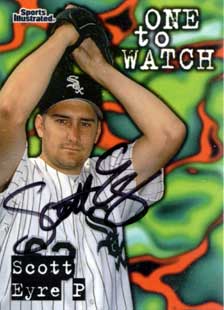
Scott Eyre

Joining the White Sox organization in a 1994 trade with the Rangers, he debuted with the big-league team in 1997.  He split the next 4 seasons between the rotation and the bullpen, not to mention between Chicago and Charlotte, before being moved to the Blue Jays following the 2000 ALDS loss to the Mariners.  He joined the Cubs as a free agent for the 2006 season and enjoyed 2 seasons of relative success, before falling apart in 2008, when he was traded to the Phillies.

Clint Frazier

After missing the second half of 2021 with an injury, Frazier was DFA’d by the Yankees.  He signed a deal with the Cubs that offseason, though he notched just 45 plate appearances before being DFA’s once again.  He chose to finish the year in the Cubs system before becoming a free agent following the season.  After failing to catch on with the Rangers, he signed a minor league deal with the White Sox, eventually hitting .197 in 33 games with the big-league club.

Kosuke Fukudome Continue reading →

Hall Of Fame Batting Leaders


The Hall of Fame Class of 2024, Adrian Beltre, Todd Helton, Joe Mauer, and veterans committee choice Jim Leyland, get enshrined in Cooperstown today.  With three new hitters joining the list of Hall of Famers I’ve seen play live, let’s check back in with the leaders on the offensive side of the ball amongst Hall of Famers for all of the games I’ve attended between 1984 and 2023.

Home Runs

Name Total
Jim Thome 35
Frank Thomas 15
Scott Rolen 7
David Ortiz 6
Vladimir Guerrero 6

Hits

Name Total
Jim Thome 110
Frank Thomas 54
Joe Mauer 43
Ken Griffey Jr. 32
Fred McGriff 28

Runs

Name Total
Jim Thome 82
Frank Thomas 42
Joe Mauer 19
David Ortiz 16
Scott Rolen 14

RBI

Name Total
Jim Thome 84
Frank Thomas 38
Fred McGriff 23
David Ortiz 19
Continue reading →

Hall Of Fame Batting Leaders


The Hall of Fame Class of 2023, former Phillie and Cardinal third baseman Scott Rolen and veterans committee choice Fred McGriff, get enshrined in Cooperstown today.  With two new hitters joining the list of Hall of Famers I’ve seen play live, let’s check back in with the leaders on the offensive side of the ball amongst Hall of Famers for all of the games I’ve attended between 1984 and 2022.

Home Runs

Name Total
Jim Thome 35
Frank Thomas 15
Scott Rolen 7
David Ortiz 6
Vladimir Guerrero 6

Hits

Name Total
Jim Thome 110
Frank Thomas 54
Ken Griffey Jr 32
Fred McGriff 28
Scott Rolen 25

Runs

Name Total
Jim Thome 82
Frank Thomas 42
David Ortiz 16
Scott Rolen 14
Ken Griffey Jr. 12

RBI

Name Total
Jim Thome 84
Frank Thomas 38
Fred McGriff 23
David Ortiz 19
Continue reading →

Fitbit IX – Week 24

Things continue to look up, as I extended my streak of 30,000-step weeks to eight.  Things got off to a slow start on Sunday as I finished with just 3400 steps.  Monday saw a nice improvement, going up to 5200 steps.  The Independence Day holiday on Tuesday left me just 16 steps shy of 4000.  Wednesday saw another decline, dropping down to 3700 steps.  A double header on Thursday between the White Sox and the Blue Jays left me 15 steps away from 6800.  Another long day at the ballpark, thanks to a batting practice session, helped Friday finish with 6500 steps and another autograph and picture with Harold Baines.  I decided to take a day off on Saturday after nearly fifteen hours at the ballpark over the previous two days, but dinner out for Angela’s birthday helped me get to 4900 steps.

Total steps: 34,643

Daily average: 4949

Hall Of Fame Batting Leaders


The Hall of Fame Class of 2022, former Red Sox DH David Ortiz joins veterans committee choices Minnie Minoso, Tony Oliva, Jim Kaat, Gil Hodges, Buck O’Neil, and Bud Fowler in enshrinement in Cooperstown.  With a new hitter joining the list of Hall of Famers I’ve seen play, let’s check back in with the leaders on the offensive side of the ball amongst Hall of Famers for all of the games I’ve attended between 1984 and 2021.

Home Runs

Name Total
Jim Thome 35
Frank Thomas 15
Vladimir Guerrero 6
David Ortiz 6
Ivan Rodriguez 4

Hits

Name Total
Jim Thome 110
Frank Thomas 54
Ken Griffey Jr 32
David Ortiz 23
Vladimir Guerrero 21

Runs

Name Total
Jim Thome 82
Frank Thomas 42
David Ortiz 16
Ken Griffey Jr 12
Vladimir Guerrero 11
Craig Biggio 11

RBI

Name Total
Jim Thome 84
Frank Thomas 38
David Ortiz 19
Ken Griffey Jr 17
Continue reading →

By The Numbers – 3

In 1929, uniform numbers appeared on the back of baseball jerseys for the first time, thanks to the Indians and the Yankees.  By 1937, numbers finally appeared across all uniforms, both home and away, across both major leagues.  Since that time, 81 distinct numbers have been worn by members of the White Sox, while the Cubs boast 76.

Today, we continue our look at those players, picking our favorite, if not the best, player to wear each uniform number for both Chicago teams with #3.  52 different players have donned #3 while playing in Chicago, 33 for the White Sox and 19 for the Cubs, including one who had it retired for him while he was still an active player.

Harold Baines was the first overall selection in the 1977 draft after White Sox owner Bill Veeck had seen him play little league years before.  He made his major league debut less than 3 years later, on Opening Day 1980 against the Orioles at old Comiskey Park.  Baines started to break out in 1981, but the long player’s strike limited him to only 82 games.  With a full slate of games played in 1982, Baines appeared in all but one of them, with numbers good enough to garner votes for AL MVP.

1983 was a banner year on the south side, as the White Sox captured their first ever division title.  Baines was a key contributor, hitting .280 with 20 home runs and 99 RBIs.  During the ALCS against the Orioles, Baines struggled, like most of his teammates, getting only 2 hits in the 4-game series.  At season’s end, he picked up 49 votes to finish 10th in MVP voting.

Baines continued to excel in 1984, though the rest of the team did not.  On May 8, he ended the longest game in major league history (8 hours and 6 minutes over 25 innings on successive evenings) with a walk-off home run against Chuck Porter of the Brewers.  He finished the year with a .304 average, a career high 29 home runs, and 94 RBIs, while leading the league in slugging at .541.  He once again garnered MVP consideration, finishing the vote tied for 13th place.  1985 was another strong season for Baines.  He earned his first All Star selection, singling off former teammate LaMarr Hoyt in his only at bat at the Metrodome.  He finished the year hitting .309 with 22 home runs and a career high 113 RBIs.  He earned 49 votes in placing 9th in MVP voting.

Baines saw his body start to betray him for the first time in 1986.  He appeared in his second straight All Star game, going hitless in his one at bat.  A late August knee injury caused him to miss time, and a late September collision with Neal Heaton in a loss to the Twins reinjured the knee, leading to arthroscopic surgery following the season.  He finished the season hitting .296, just missing his 3rd consecutive .300 season, with 21 home runs and 88 RBIs.  He returned for opening day in 1987, getting two hits and knocking in the winning runs on the hard artificial turf of Royals Stadium, but was unable to walk the following day.  A second arthroscopic surgery caused him to miss 23 games before he returned, moving from right field to designated hitter.  He still was named to his 3rd straight All Star team, going hitless in the 2-0 loss by the AL.  Come year end, he had hit .293 with 20 home runs and 93 RBIs.

1988 was a down year for Baines, though he managed to appear in 158 games.  His average dropped to .277, his lowest total since 1982, while hitting only 13 home runs, his lowest total since 1981.  He made only 9 appearances in the outfield while becoming accustomed to being a full-time designated hitter.  He bounced back in 1989.  He was named the starting DH in the All Star game, going 1-3 with an RBI in the AL’s victory at Angel Stadium.  On July 29, he was traded to the Rangers, along with Fred Manrique, for Wilson Alvarez, Scott Fletcher, and Sammy Sosa.  “It’s an unpopular decision as far as the fans are concerned, but sometimes unpopular means exactly that-unpopular,” GM Larry Himes said at the time.  “It doesn`t mean that it isn`t a good decision.  This is a decision we made as far as direction of the Chicago White Sox for today and for our future.”  Baines was hitting .321 with 13 home runs and 56 RBIs at the time of the trade.  Less than a month later, as the Rangers visited Chicago for the first time on August 20, the White Sox retired Baines’ #3, a somewhat awkward attempt to placate the enraged fanbase.

Baines returned to the White Sox as a free agent in 1996.  Appearing in 143 games, Baines hit .311 with 22 home runs and 95 RBIs.  He returned in 1997 and was putting together another fine season, putting up a .305 average with 12 home runs and 52 RBIs in 93 games when, on July 29 again, he was traded to the Orioles for a player to be named later.

Three years later, once again on July 29, the White Sox re-acquired Baines, along with Charles Johnson, from the Orioles for Miguel Felix, Juan Figueroa, Jason Lakman, and Brook Fordyce.  Appearing in 24 games down the stretch, Baines hit .213 with a single home run and 9 RBIs as the White Sox took the Central Division crown.  Baines went 1-4 in the ALDS as the White Sox were swept by the Mariners.  He returned to the White Sox in 2001 at the age of 42, getting extra playing time once Frank Thomas went down with an injury.  In 32 games, he hit .131, failing to homer and driving in only 6.

On July 20, 2008, the White Sox unveiled a bronze statue of Baines at U.S. Cellular Field prior to their game against the Royals.  On December 9, 2018, Baines was elected to the National Baseball Hall of Fame Class of 2019 via the Today’s Game Era ballot.

David Ross donned #3 when he joined the Cubs in 2015 on a two-year deal.  Ross announced his plans to retire following the 2016 season, after playing 15 seasons in the major leagues.  During Game 7 of the World Series, Ross hit a home run in his final at-bat, making him the oldest player to homer in World Series history.

Throwback Thursday – Batting Leaders Of The 1980s

Our Throwback Thursday feature continues, as we point the wayback machine back to the 1980s and put our focus on the offensive leaders of that decade.  As a reminder, I’ve identified 14 games that I attended during this time period, when I would have been ages 5 through 14.

Home Runs

Name Total
Carlton Fisk 3
Greg Walker 2
Harold Baines 2
Eddie Murray 2
Brian Downing 2
Daryl Boston 2

Hits

Name Total
Carlton Fisk 14
Harold Baines 14
Greg Walker 12
7 tied with  5

Runs

Name Total
Harold Baines 8
Greg Walker 6
Gary Ward 5
Daryl Boston 4
9 tied with 3

RBI

Name Total
Carlton Fisk 11
Greg Walker 8
Harold Baines Continue reading →

By The Numbers – 16

In 1929, uniform numbers appeared on the back of baseball jerseys for the first time, thanks to the Indians and the Yankees.  By 1937, numbers finally appeared across all uniforms, both home and away, across both major leagues.  Since that time, 81 distinct numbers have been worn by members of the White Sox, while the Cubs boast 76.

Today, we continue our look at those players, picking our favorite, if not the best, player to wear each uniform number for both Chicago teams with #16.  65 different players have donned #16 while playing in Chicago, 24 for the White Sox, who retired the number in 1987, and 41 for the Cubs.

Aramis Ramirez switched to his familiar #16 shortly after being acquired by the Cubs from the Pirates.  Ramírez finished the 2003 season strong, appearing in 63 games down the stretch and hitting 15 home runs while helping the Cubs capture their first division title since 1989.  He managed 11 hits during the post-season, including 4 home runs and 10 RBIs and hitting the first playoff grand slam in Cubs’ history during Game 4 of the NLCS.  The following year, Ramirez became the 14th player in baseball history to hit 3 home runs in 2 different games in the same season.  While his offense remained strong, posting a .951 OPS, his defense was a bit of a liability, as he posted the lowest range factor among all third basemen.

Ramirez was elected to his first All-Star Game in 2005.  He finished the season with 31 home runs and 92 RBIs despite missing the last month of the year with a strained quadriceps femoral muscle.  While his defense continued to suffer in 2006, with his third straight season with the lowest range factor, his offense continued to carry the load.  He collected his 1000th hit in July against the Mets and ended up with 38 home runs, 119 RBIs, and an OPS of .912.  A free agent at the end of the season, he re-signed with the Cubs, scoring a 5-year, $73 million contract.

In April of ’07, Ramirez launched his 200th career home run.  His continued offensive presence helped lead the Cubs back to the post-season in 2007 and 2008, winning division titles both seasons.  Unfortunately, Ramirez, like his teammates, went cold in both series as the Cubs were swept in the NLDS each season.  In 2009, Ramirez christened the season with his 250th career home run on Opening Day against Roy Oswalt.  He followed that with #300 in July of 2011 against the White Sox.  Following that season, he declined his portion of a mutual option and became a free agent.

Julio Cruz wore #16 on the southside following his June 1983 acquisition from the Mariners, when he gave the White Sox the spark they were looking for, helping the team go on a 72-31 run to finish the season and go from 6 1/2 games back to 20 games ahead.  Cruz scored the winning run on a Harold Baines sacrifice fly against, of all teams, the Mariners on September 17, clinching the first division title in White Sox history.  Cruz hit .333 during the ALCS against the Orioles, swiping 2 bases in the 4-game series.  Heading in to the 1984 season, Cruz re-signed with the White Sox with a 6-year deal, thought to be worth between $3.6 to $4.8 million.  Unfortunately, time, and injuries, were starting to take their toll.  1984 was the best year of the deal, and Cruz saw his average drop to .222 and he stole only 14 bases, a career low to date.  Following that season, Cruz changed his number from #16 to #12.