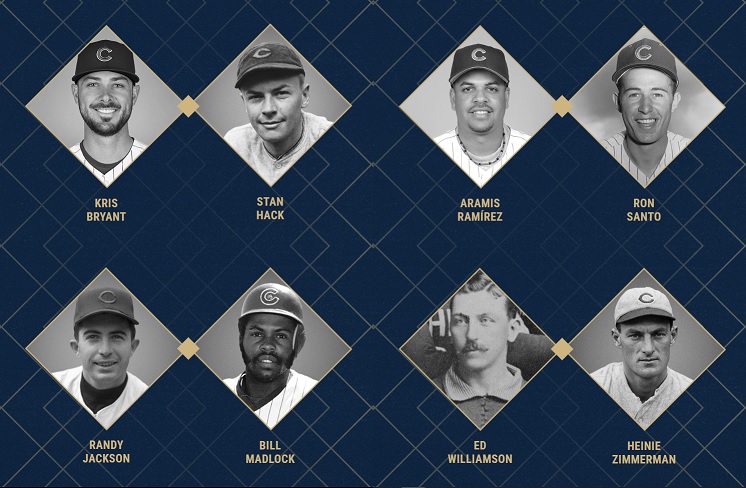
To paraphrase from a famous movie, the one constant through all the years has been baseball. With the start of the 2026 season coming next week, we start to wind down our look at the all-time leaders in both offensive and defensive categories for all 30 teams. Today, we take a deeper dive into the Chicago Cubs.
The Cubs, dating back to 1870, were charter members of the National League in 1876. I’ve seen 544 players wearing a Cub uniform in the 463 of their games that I’ve attended live at nine different stadiums across seven cities, with the earliest identified game at Wrigley Field on August 4, 1984 against the Mets, through their NLDS appearance against the Brewers last fall.
To paraphrase from a famous movie, the one constant through all the years has been baseball. With the winter meetings starting today, we continue our look at the all-time leaders in both offensive and defensive categories for all 30 teams. Today, we take a deeper dive into the Pittsburgh Pirates.
The Pirates began life in 1887 as the Alleghenys, before taking on the Pirates moniker in 1891. I’ve seen 245 players don the Pirates uniform in the 49 games of theirs that I’ve attended live, including a double header sweep in 2003, enabling the Cubs to clinch their first NL Central title and a work outing in 2008 against the White Sox.
Last week, we took our annual look at the all-time leaders in pitching stats for the now 1,149 games I’ve attended (and identified) between 1984 and 2025. With the first full squad spring training workout in the books, it’s time to move over to the other side of the ball and take a look at the offensive stat leaders for those games, starting with our first category:
It’s been six years since we last took a look at the offensive stat leaders per season for the all the games I’ve attended since 1984. While there hasn’t been a whole lot of movement for most of the categories in the last six seasons, I figured the time was right to take another look. So, without further ado, here’s the updated list. We start, as always, with everyone’s favorite offensive stat:
With their Wild Card Series tied at a game apiece, the Cubs will battle against the Padres this afternoon for the rights to move on and face the Brewers in the NLDS. With that in mind, it’s time to take an updated look at the offensive leaders from the now 33 post-season games I have attended since 2000. So, without further ado, we start off with:
First introduced in 1997, games between teams in the American and National leagues started occurring in the regular season. In 2002, it expanded between the corresponding division in the opposite league to a rotation between all of the divisions. In 2023, it expanded again with each team playing every other team regardless of league. With the Cardinals coming to town to battle the White Sox this week, let’s take a look at the offensive leaders for the 199 interleague games I have attended since the start of interleague play in 1997, including the World Series in both 2005 and 2016:
Last week, we took our annual look at the all-time leaders in pitching stats for the now 1,110 games I’ve attended (and identified) between 1984 and 2024. With the first full squad spring training workout in the books, it’s time to move over to the other side of the ball and take a look at the offensive stat leaders for those games, starting with our first category:
The battle for the 2024 Crosstown Cup kicks off tonight at Wrigley Field, with the Cubs looking to take retain possession of the cup after winning it back last year. The White Sox currently hold a slight edge in the overall series, going 74-68 over the past 27 years. Let’s take a look at the offensive leaders for the now 89 (out of 142) crosstown games I have attended since the start of interleague play in 1997:
Welcome to the first installment of what should become a recurring feature, taking a look back at some occurrence in the world, mostly sports, and trying to ascertain what the outcome would have been if just one thing, a decision or an outcome, went a different way. We start in October 2003, with game six of the NLCS where one particular play, debated for years, may have turned the tide.
On October 14, 2003, the Cubs were five outs away from winning their first National League pennant since 1945. Mark Prior was on the mound for the Cubs and had retired eight straight batters into the eighth inning when Juan Pierre doubled, bringing Luis Castillo to the plate. On the eighth pitch of the at bat, Castillo hit a high foul ball down the left field line, heading towards the stands. Moises Alou tracked the ball and reached, when the ball was touched by a fan. A visibly upset Alou, along with Prior and Cub manager Dusty Baker, pleaded for a call of fan interference, but the umpires ruled that the ball had left the field of play. Castillo returned to the plate and, on the next pitch, walked on a wild pitch, allowing Pierre to advance to third.
Ivan Rodriguez then hit an 0-2 pitch for a single, knocking in Pierre and making the score 3-1. When the next batter, Miguel Cabrera, hit a shard ground ball to shortstop Alex Gonzalez, it looked like the rally was over, but, instead of turning the ready-made double play, Gonzalez booted the ball, loading the bases. Derrek Lee then drilled the next pitch for a double, knocking in Castillo and Rodriguez and tying the score 3-3. At this point, Baker emerged from the Cub dugout to remove Prior, but the damage had been done. The Marlins scored five more times, winning the game 8-3 and forcing a Game 7.
The following night, the Marlins completed the unlikely comeback, beating the Cubs 9-6 and going on the face the Yankees in the World Series. They would wind up winning that as well, defeating the Yankees in six games to take home their second title.
But what if Alou had made that catch? How would the rest of history play out? Let’s take a trip through the multiverse to see what the outcome would have been.
OK, so Alou makes the catch for the second out of the inning. Let us assume Rodriguez still singles, scoring the speedy Pierre from second to make it a 3-1 game. Let us also assume Cabrera hits the same grounder to Alex Gonzalez, but, without the pressure of trying to make up for the missed out, he fields it cleanly, retiring Cabrera and ending the inning. Continue reading →
Last week, we took our annual look at the all-time leaders in pitching stats for the now 1,083 games I’ve attended (and identified) between 1984 and 2023. With the first full squad spring training workout in the books, it’s time to move over to the other side of the ball and take a look at the offensive stat leaders for those games, starting with our first category: