Historic Games Part Three

Last summer, the White Sox fell victim to Clayton Kershaw’s 3000th career strikeout and I decided to take a look back at the historic games I’ve attended over the years.  Here is part three, featuring another six games where an individual hit a career plateau or a team clinched a pennant.
April 11, 2011 – A’s 2, White Sox 1

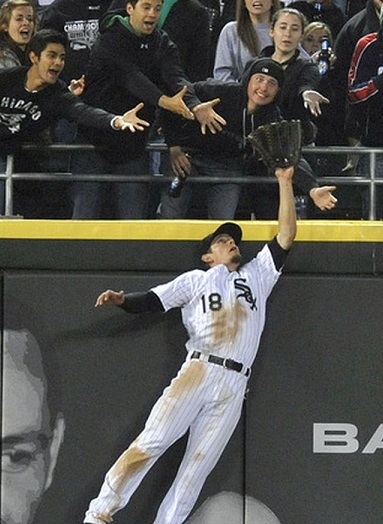
In the bottom of the fifth inning of a scoreless tie at US Cellular Field, the slugging Brent Lillibridge, he with the 19 career home runs, launched the first pitch he saw from Dallas Braden into the bleachers for the 10,000th home run in White Sox franchise history.

May 9, 2015 – Reds 10, White Sox 4

With the White Sox trailing the Reds 3-0 in the bottom of the 7th in the first game of a double header, Alexei Ramirez took the first pitch from Johnny Cueto and deposited it into the left field stands for his 100th career home run.
September 5, 2015 – Blue Jays 5, Orioles 1

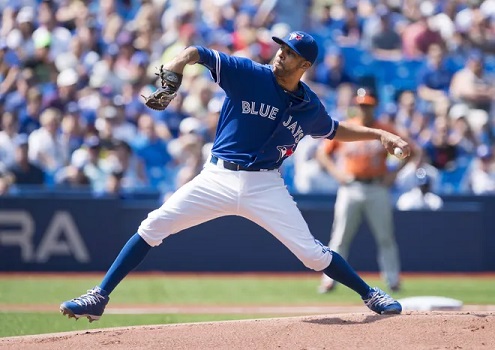
Filling in for the injured Mark Buehrle, David Price scattered three hits and struck out eight in seven innings to beat the Orioles at Rogers Centre for his 100th career victory.  The win increased Toronto’s lead to 1 1/2 games in the AL East.
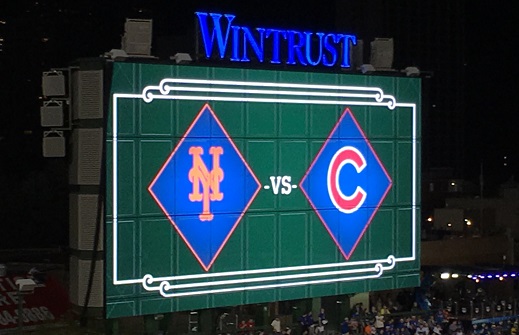
October 21, 2015 – Mets 8, Cubs 3

With an 8-3 victory over the Cubs at Wrigley Field, the Mets, in their first post-season appearance in nearly a decade, completed the sweep and won the NL pennant for the first time since 2000.  They would go on to lose the World Series in five games to the Royals.

October 22, 2016 – Cubs 5, Dodgers 0

For the first time since 1945, the Cubs won the National League pennant after defeating the Dodgers 5-0 in game 6 of the NLCS.  Behind a two hitter from Kyle Hendricks, the Cubs put to rest the painful memories of the collapse of 1969, the failure to win one of three in San Diego in 1984, and the Steve Bartman-fueled fiasco of 2003.  They would go on to face the Indians in the World Series, winning their first championship since 1908.

September 9, 2017 – White Sox 13, Giants 1

Jose Abreu hit for the cycle in the White Sox victory over the Giants, going 4-5 with 3 RBIs.  Abreu started with a home run in the first inning and a double in the third against starter Jeff Samardzija.  In the seventh, he singled against Josh Osich and, in the eighth, he finished things off with a triple to the right field corner against Roberto Gómez.  He became the first White Sox player to get the cycle since José Valentín in 2000.
Crossing Sides Of Town

So far in 2025, Brad Keller, Mike Tauchman, Nicky Lopez, and Reese McGuire pushed the total of players I’ve seen take the field in person for both the Cubs and the White Sox to 47.  With the final round of crosstown kicking off tonight at Rate Field, here’s a look at those players, in alphabetical order.

David Aardsma

After posting a decent season with the Cubs in 2006, Aardsma was traded to the White Sox for Neal Cotts.  Aardsma lasted one season with the Sox, where he was unable to duplicate his success from the year before.

Jason Bere

Drafted by the White Sox in the 36th round in 1990, Bere debuted with the big-league club in 1993, finishing 2nd in Rookie of the Year voting.  After an All Star selection in 1994, injuries marred the remainder of his tenure on the South Side, which ended in 1998.  He resurfaced with the Cubs in 2001 and had a decent season, but he went 1-10 in 2002 before being let go.

Emilio Bonifacio

Bonifacio spent back-to-back partial seasons in Chicago, first for the Cubs in 2014 after signing as a free agent, where he played decently enough to be flipped at the trade deadline, along with James Russell, to the Braves for a young catching prospect by the name of Victor Caratini.  He returned to Chicago in 2015, signing with the White Sox, where he he did not do well at all, hitting .167 in 47 games before being released in August.

Welington Castillo

Debuting with the Cubs in 2010, Castillo spent time behind the plate for the Cubs until May of 2015, when, having been replaced in the starting lineup by Miguel Montero, he was flipped to the Mariners.  He returned to Chicago in 2018 after signing with the White Sox as a free agent.  On May 24th of that season, he was suspended 80 games for a violation of the PED policy.  The White Sox then cut bait following the 2019 season, shipping him off to the Rangers.

Neal Cotts

Acquired by the White Sox in the Billy Koch trade, he debuted with the team in 2003.  He was a key contributor in the bullpen during the 2005 championship season and was the only relief pitcher to appear in all 3 rounds of the playoffs that season.  Following the 2006 season, he was traded to the Cubs for David Aardsma, and he spent the next 3 injury filled seasons on the North Side.

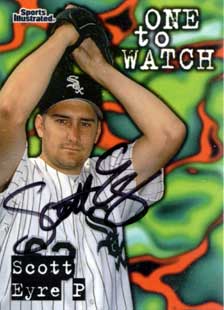
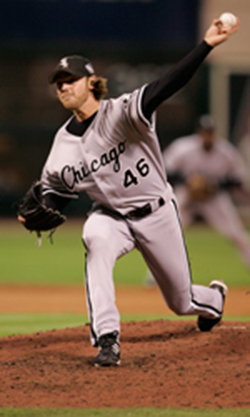
Scott Eyre

Joining the White Sox organization in a 1994 trade with the Rangers, he debuted with the big-league team in 1997.  He split the next 4 seasons between the rotation and the bullpen, not to mention between Chicago and Charlotte, before being moved to the Blue Jays following the 2000 ALDS loss to the Mariners.  He joined the Cubs as a free agent for the 2006 season and enjoyed 2 seasons of relative success, before falling apart in 2008, when he was traded to the Phillies.

Clint Frazier

After missing the second half of 2021 with an injury, Frazier was DFA’d by the Yankees.  He signed a deal with the Cubs that offseason, though he notched just 45 plate appearances before being DFA’s once again.  He chose to finish the year in the Cubs system before becoming a free agent following the season.  After failing to catch on with the Rangers, he signed a minor league deal with the White Sox, eventually hitting .197 in 33 games with the big-league club.

Kosuke Fukudome Continue reading →

By The Numbers – 18

In 1929, uniform numbers appeared on the back of baseball jerseys for the first time, thanks to the Indians and the Yankees.  By 1937, numbers finally appeared across all uniforms, both home and away, across both major leagues.  Since that time, 81 distinct numbers have been worn by members of the White Sox, while the Cubs boast 76.

Today, we continue our look at those players, picking our favorite, if not the best, player to wear each uniform number for both Chicago teams with #18.  78 different players have donned #18 while playing in Chicago, 41 for the White Sox and 37 for the Cubs.

Bill Madlock essentially replaced two of the Cubs biggest stars of the 1960s when he joined the team for his rookie season in 1974.  Acquired for future Hall of Famer Ferguson Jenkins, Madlock took the spot of Hall of Famer Ron Santo at the hot corner.  If he felt any pressure, he didn’t show it, hitting .313 with 9 home runs, good enough for a third place finish in Rookie of the Year voting.  In 1975, he broke out in a big way, earning his first All Star nod on his way to a batting title.  In 1976, Madlock repeated as batting champion, hitting .339 and beating out Ken Griffey Sr. on the final day of the season.  With the dawn of free agency on the horizon, Madlock asked the Cubs for a multi-year contract with a salary of $200,000, more than double what he had earned in 1976.  Team owner Phillip K. Wrigley had other ideas, announcing that Madlock would be traded “to anyone foolish enough to want him.”  In February of 1977, that so-called foolish team turned out to be the Giants, who sent Bobby Murcer and Steve Ontiveros, among others, to the Cubs.  In July of 2016, this would be ranked as one of the five worst trades in Cub history.

Acquired by the White Sox, along with Tyler Flowers and 2 minor leaguers, from the Braves in exchange for Javier Vazquez and Boone Logan, Brent Lillibridge donned #18 while hitting an anemic .158 in 95 at bats spread across 46 games for the 2009 White Sox.  Lillibridge stuck with the big league team in 2010, improving his average to .224 in only 64 games.  2011 was his best season, setting career highs in home runs, RBIs, batting average, and OPS.  On April 11, he hit the 10,000th home run in White Sox history off Dallas Braden and the A’s.  Lillibridge struggled again in 2012, with his average dropping down to .175 before the June 24th trade that sent him, along with Zach Stewart, to the Red Sox for Kevin Youkilis.

Against The Rays All Time Leaders – Through 2021

414_tampa_bay-rays-miscellaneous-2012In the past, we’ve looked at the all time leaders in both offensive and defensive categories for all 30 teams. This offseason, we will take our first ever look at those leaders against all 30 clubs.   We continue things today with the Tampa Bay Rays.

The Rays began life in 1998 as the Devil Rays, dropping the Devil portion of their name in 2008.  I’ve seen them play 25 times, 5 as the Devil Rays and 20 as the Rays, including the 2008 ALDS, where they defeated the White Sox.

Home Runs

Name Total
Paul Konerko 4
Jermaine Dye 4
Tim Anderson 2
Jose Abreu 2

Hits

Name Total
Paul Konerko 19
A.J. Pierzynski 13
Alexei Ramirez 13

Runs

Name Total
Paul Konerko 11
Jermaine Dye 7
Alex Rios 6

RBI

Name Total
Paul Konerko 9
Jermaine Dye 8
Tim Anderson 6
Jose Abreu 6

Doubles

Name Total
Tim Anderson 3
A.J. Pierzynski 3
Alex Rios 3
Gordon Beckham 3

Triples Continue reading →

Against The A’s All Time Leaders – Through 2021

oakland-athleticsIn the past, we’ve looked at the all time leaders in both offensive and defensive categories for all 30 teams. This offseason, we will take our first ever look at those leaders against all 30 clubs.  We continue today with the Oakland Athletics.

The A’s began life in Philadelphia in 1901, as one of the 8 charter franchises of the American League, before moving to Kansas City in 1955 and, finally, to Oakland in 1968.  I’ve seen them play at least 30 times, including twice in their home stadium.

Home Runs

Name Total
Jose Abreu 3
Mike Cameron 2
25 tied with  1

Hits

Name Total
Tim Anderson 12
Jose Abreu 10
Juan Pierre 8

Runs

Name Total
Jose Abreu 6
Tim Anderson 5
A.J. Pierzynski 5

RBI

Name Total
Jose Abreu 6
Tim Anderson 6
A.J. Pierzynski 4
Tony Clark 4
Melky Cabrera 4
Mike Cameron 4
Brent Lillibridge 4
Adam Dunn 4

Doubles

Name Total
Jose Abreu 3
Dayan Viciedo 3
Tim Anderson 2
Tony Clark 2
Paul Konerko 2
Todd Frazier 2
Carlos Quentin 2

Triples Continue reading →

Two Sides Of The Same Town

cws-chiFollowing last week’s trade deadline deals, Ryan Tepera and Craig Kimbrel became the 36th and 37th people I’ve seen play in person for both the Cubs and the White Sox.  With the first round of crosstown kicking off this afternoon at Wrigley, here’s a look at those players, in alphabetical order.

David Aardsma

After posting a decent season with the Cubs in 2006, Aardsma was traded to the White Sox for Neal Cotts.  Aardsma lasted one season with the Sox, where he was unable to duplicate his success from the year before.

Jason Bere

Drafted by the White Sox in the 36th round in 1990, Bere debuted with the big league club in 1993, finishing 2nd in Rookie of the Year voting.  After an All Star selection in 1994, injuries marred the remainder of his tenure on the South Side, which ended in 1998.  He resurfaced with the Cubs in 2001 and had a decent season, but he went 1-10 in 2002 before being let go.

Emilio Bonifacio

Bonifacio spent back-to-back partial seasons in Chicago, first for the Cubs in 2014 after signing as a free agent, where he played decently enough to be flipped at the trade deadline, along with James Russell, to the Braves for a young catching prospect by the name of Victor Caratini.  He returned to Chicago in 2015, signing with the White Sox, where he he did not do well at all, hitting .167 in 47 games before being released in August.

Welington Castillo

Debuting with the Cubs in 2010, Castillo spent time behind the plate for the Cubs until May of 2015, when, having been replaced in the starting lineup by Miguel Montero, he was flipped to the Mariners.  He returned to Chicago in 2018 after signing with the White Sox as a free agent.  On May 24th of that season, he was suspended 80 games for a violation of the PED policy.  The White Sox then cut bait following the 2019 season, shipping him off to the Rangers.

Neal Cotts

Acquired by the White Sox in the Billy Koch trade, he debuted with the team in 2003.  He was a key contributor in the bullpen during the 2005 championship season, and was the only relief pitcher to appear in all 3 rounds of the playoffs that season.  Following the 2006 season, he was traded to the Cubs for David Aardsma, and he spent the next 3 injury filled seasons on the North Side.

Scott Eyre

Joining the White Sox organization in a 1994 trade with the Rangers, he debuted with the big league team in 1997.  He split the next 4 seasons between the rotation and the bullpen, not to mention between Chicago and Charlotte, before being moved to the Blue Jays following the 2000 ALDS loss to the Mariners.  He joined the Cubs as a free agent for the 2006 season and enjoyed 2 seasons of relative success, before falling apart in 2008, when he was traded to the Phillies.

Kosuke Fukudome Continue reading →

#74 – Brent Lillibridge

lillibridgeName: Brent Lillibridge

Rank: 74

Position: 2B/OF

Years With White Sox: 2009-2012

Brent Lillibridge was acquired by the White Sox, along with Tyler Flowers and 2 minor leaguers, from the Braves in exchange for Javier Vazquez and Boone Logan on December 4, 2008.  He split the 2009 season between Triple A Charlotte and Chicago, hitting an anemic .158 in 95 at bats spread across 46 games.

Lillibridge stuck with the White Sox in 2010, improving his average to .224 in only 64 games.  2011 was his best season, setting career highs in home runs, RBIs, batting average, and OPS.  On April 11, he hit the 10,000th home run in White Sox history off Dallas Braden and the A’s.

Lillibridge struggled again in 2012, with his average dropping down to .175 before the June 24th trade that sent him, along with Zach Stewart, to the Red Sox for Kevin Youkilis.

Lillibridge’s numbers in a White Sox uniform, both for games I attended and overall, were:

Continue reading →

#120 – Tyler Flowers

tyler-flowers

Name: Tyler Flowers

Rank: 120

Position: C

Years With White Sox: 2009-2015

Tyler Flowers came to the White Sox following the 2008 season, acquired from the Braves, along with Jon Gilmore, Santos Rodriguez, and Brent Lillibridge, for Javier Vazquez and Boone Logan.  Flowers performed well in 2009, splitting time between Double A Birmingham and Triple A Charlotte, hitting .297 with 15 home runs.  He earned a call-up to the big leagues when rosters expanded on September 1, but his hot hitting did not follow.  He appeared in 10 games for the White Sox, hitting .188 without driving in a run.

Flowers opened the 2010 season back in Charlotte, where, unfortunately, his hitting woes continued.  Despite a .220 average, he got another late season call-up, this time garnering only 1 hit in 11 at bats.

Flowers returned to Charlotte to start the 2011 season, but returned to the big leagues in July when Ramon Castro went down with an injury.  Flowers got a chance to start every day in August when A.J. Pierzynski got hurt, enabling him to garner both his first home run and, later in the month, his first grand slam.

2012 saw Flowers break camp with the White Sox for the first time, becoming the backup to Pierzynski.  Appearing in 52 games, he managed to “raise” his average to .213, but saw his on base percentage fall below .300 for the first time in his short career.  Despite the troubling offensive performance he had put up to date, the White Sox decided it was time to let Flowers take control behind the plate and they allowed A.J. Pierzynski to leave as a free agent following the season.

As the starter in 2013, Flowers continued to struggle offensively, finishing with a batting average below .200, though a shoulder injury ended his season early, limiting him to 84 games.  With his shoulder recovered, he returned behind the plate as the primary receiver in 2014, appearing in 127 games and rebounding to a .241 average, though his OPS failed to break .700.

2015 was more of the same for Flowers, appearing in 112 games and struggling offensively, finishing with a .239 average and a weak .652 OPS.  Following the season, the White Sox decided not to tender him a contract for 2016, and his tenure on the south side came to an end one month ago.

Flowers’ numbers in a White Sox uniform, both for games I attended and overall, were:

Continue reading →

Crosstown Competitors

cws-chiLast Saturday, Geovany Soto and Jeff Samardzija became the 25th and 26th people I’ve seen play in person for both the Cubs and the White Sox.  Here’s a look at those players, in alphabetical order.

DavidAardsma2David Aardsma

After posting a decent season with the Cubs in 2006, Aardsma was traded to the White Sox for Neal Cotts.  Aardsma lasted one season with the Sox, where he was unable to duplicate his success from the year before.

Jason Bere

Drafted by the White Sox in the 36th round in 1990, Bere debuted with the big league club in 1993, finishing 2nd in Rookie of the Year voting.  After an All Star selection in 1994, injuries marred the remainder of his tenure on the South Side, which ended in 1998.  He resurfaced with the Cubs in 2001 and had a decent season, but he went 1-10 in 2002 before being let go.

Neal Cotts

Acquired by the White Sox in the Billy Koch trade, he debuted with the team in 2003.  He was a key contributor in the bullpen during the 2005 championship season, and was the only relief pitcher to appear in all 3 rounds of the playoffs that season.  Following the 2006 season, he was traded to the Cubs for David Aardsma, and he spent the next 3 injury filled seasons on the North Side.

scott_eyre_autographScott Eyre

Joining the White Sox organization in a 1994 trade with the Rangers, he debuted with the big league team in 1997.  He split the next 4 seasons between the rotation and the bullpen, not to mention between Chicago and Charlotte, before being moved to the Blue Jays following the 2000 ALDS loss to the Mariners.  He joined the Cubs as a free agent for the 2006 season and enjoyed 2 seasons of relative success, before falling apart in 2008, when he was traded to the Phillies.

Kosuke Fukudome Continue reading →

#161 – Zach Stewart

zstewartName: Zach Stewart

Rank: 161

Position: P

Years With White Sox: 2011-2012

Zach Stewart came to the White Sox, along with Jason Frason, from the Blue Jays in exchange for Edwin Jackson and Mark Teahen on July 27, 2011.  Stewart appeared in 10 games for the White Sox after the trade, going 2-5 with a 6.22 ERA.

Stewart was just as productive in 2012, going 1-2 with a 6.00 ERA in 18 appearances.  On June 24, he was traded, along with Brent Lillibridge, to the Red Sox in exchange for Kevin Youkilis.

Stewart returned to the White Sox organization in 2013, after being selected off waivers from the Pirates.  He spent the entire year in Triple A Charlotte, before being purchased by the Braves following the season.

Stewart’s numbers in a White Sox uniform, both for games I attended and overall, were:

Continue reading →