 Originally founded in 1869, the Chicago Cubs became a charter member of the National League in 1876. Over the next 150 seasons, the Cubs have played more than 22,000 games, scored over 103,000 runs and recorded more than 200,000 hits, more than any other team in baseball history. Nearly 2,300 players have worn a Cubs uniform, earning eight division titles, 17 NL pennants, and three World Series championships.
Fans have witnessed generations of unforgettable players, from historical heroes like Joe Tinker, Gabby Hartnett, Ernie Banks, and Billy Williams to more recent stars like Ryne Sandberg, Derrek Lee, Kerry Wood, and Anthony Rizzo. The team has called Wrigley Field home for 110 of those 150 seasons.
To celebrate this milestone, the Cubs are holding a fan vote to select the franchise’s anniversary team. Each week, we will go through the provided options for each position and declare who should, and, if different, who will, win the fan vote. We start today with the final eight selections for starting pitcher.
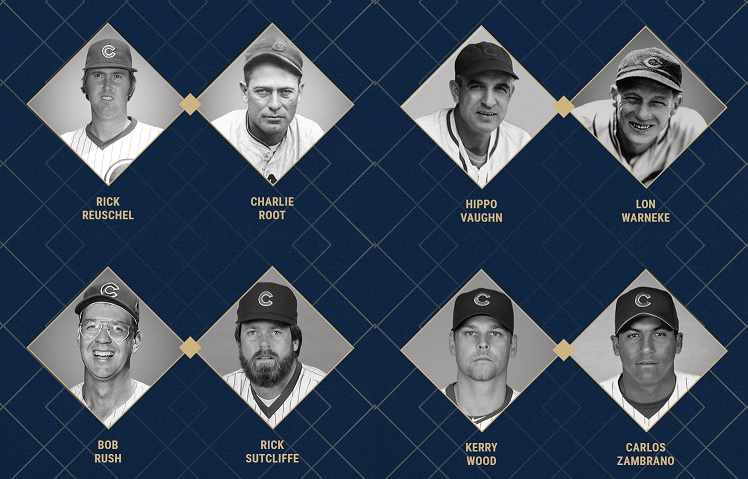
Rick Reuschel, a native of central Illinois, spent parts of twelve seasons across two stints with the Cubs, from 1972-1981 and again from 1983-1984. From 1975-1978, he was teammates with his brother Paul, also a pitcher. His best season came in 1977, when he won 20 games, made his lone All-Star team as a Cub, and finished third in Cy Young award voting. After being traded in 1981, he returned to the Cubs in 1983 following a rotator cuff injury. He is a member of the Cubs Hall of Fame.
Charlie Root spent the majority of his major league career with the Cubs, from 1926-1941. In 1927, he led the National League with 26 wins, 48 games, 309 innings pitched, and, unfortunately, 117 walks. In the 1932 World Series, Root was on the mound for Babe Ruth’s infamous called shot home run, though he would dispute the account. Overall, he appeared in four World Series as a Cub and received some MVP support in five of his sixteen seasons. He is a member of the team’s Hall of Fame.
Bob Rush debuted with the Cubs in 1948, spending ten seasons on the north side. A two-time All-Star, he led the NL with 20 losses in 1950. He was a steady, if unspectacular, mainstay of the Cub rotation during the fallow period following their final World Series appearance of the 20th century in 1945.
Rick Sutcliffe was acquired by the Cubs in mid-June of 1984 and quickly became the ace of the staff, going 16-1 with a 2.69 ERA and leading the team to their first division title, earning the NL Cy Young Award. He then homered in and won Game 1 of the NLCS, the first post-season game at Wrigley Field since the 1945 World Series. After being hampered by injuries the following two seasons, he bounced back in 1987, leading the league with 18 wins and finishing second in the Cy Young Award voting despite a last place finish for the Cubs. Another resurgence in 1989 helped lead the Cubs to their second divisional title, and he made one start against the Giants in the NLCS. Recurring arm injuries caused Sutcliffe to miss most of the 1990 and 1991 seasons and the Cubs let him leave as a free agent following the 1991 season. In addition to his Cy Young, he made two All-Star teams and was the 1987 Roberto Clemente Award winner.
Hippo Vaughn spent nine seasons with the Cubs, from 1913-1921. On May 2, 1917, he held the Reds hitless for nine innings. Unfortunately, Fred Toney did the same for the Reds, and he managed to maintain it through the 10th to win the only game in MLB history where nine innings were completed without either team getting a hit. His best season came in 1918 when he won the pitching Triple Crown, leading the league in wins, ERA, and strikeouts while leading the team to the NL pennant. He followed that strikeout crown up the following year. His career ended in 1921 when, following a rough outing against the Giants, he disappeared from the team and apparently signed a contract with a semi-pro team in Beloit, Wisconsin. While the Cubs tried to bring him back, he was suspended by commissioner Kenesaw Mountain Landis for the remainder of the season. He is a member of the team Hall of Fame.
Lon Warneke spent ten seasons with the Cubs in two different stints, from 1930-1936 and again from 1942-1945, although he missed the entire 1944 season due to military service. His best season came in 1932, when he put up 6.9 WAR by leading the NL with 22 wins and a 2.37 ERA. The following year, he participated in the first All-Star game, held at Comiskey Park as part of Chicago’s World’s Fair. All told, he was a three-time All-Star as a member of the Cubs and participated in two World Series. After being traded following the 1936 season, he was re-acquired in July of 1942. Following his retirement as a player, he became an umpire, joining the National League in 1949.
Kerry Wood was the fourth overall selection in the 1995 draft and debuted with the Cubs in April of 1998. He made history in his fifth career start, striking out 20 Astros in a one-hitter, tying the major league record and breaking the rookie record. Finishing the year 13-6, he easily won the NL Rookie of the Year award, despite missing the final month with a sore elbow. He was diagnosed with a torn UCL the following spring and missed the 1999 season completely. 2003 was easily the best season of his career, setting career highs in wins, strikeouts, ERA, and shutouts. In 2007, he moved to the bullpen to avoid further injury and, following the 2008 season, he left as a free agent. He returned to the Cubs in 2011 and, following a slow start in 2012, he abruptly retired following one final appearance against the White Sox on a Friday afternoon at Wrigley Field. He was a two-time All-Star, a member of three division winners and one Wild Card winner, and, in 2024, he was elected to the Cubs Hall of Fame.
Carlos Zambrano debuted with the Cubs in 2001 and quickly became a mainstay in the rotation for the next decade. When he was on his game, which he was for much of his early career on the Northside, he was one of the best in the game, helping the Cubs to division titles in 2003, 2007, and 2008. He was named to three All-Star teams, in 2004, 2006, and 2008, and also won three Silver Slugger awards. He led the NL in wins in 2006, and, on September 14, 2008, he tossed a no-hitter against the Astros in Milwaukee. Unfortunately, the later parts of his tenure was known more for the troubles he caused, whether it was fighting with Michael Barrett, Derrek Lee, or a Gatorade machine before finally walking out on the team after a horrid start against the Braves in the August of 2011, where he was ejected, claimed he was retiring, and then was suspended for the remainder of the season. The following January, he was traded to the Marlins.
The first four choices here seem pretty obvious: Clark Griffith, Mordecai Brown, Fergie Jenkins, and Greg Maddux. The next four are a little harder and would likely be tainted by recency bias.