Ballpark Tour: Orioles

With the 2024 season officially wrapped up and the offseason now underway, we continue our tour of all of the different baseball stadiums I’ve been to over the years. This week, we head east for a look at the Baltimore Orioles and their stadium that kicked off the retro craze.  So, without further ado, let’s take a deeper look at my one game history with Oriole Park at Camden Yards.

Stadium Name: Oriole Park at Camden Yards

Years in Service: 1992 – Present

Visits: 1

After 38 seasons at Memorial Stadium following their move from St. Louis, the Orioles opened Oriole Park at Camden Yards in 1992.  It was the first of a wave of “retro” parks that would sprout up over the following 2 decades, changing the architecture of baseball.  The Orioles took the initial contest at the park, defeating the Indians 2-0 behind a Rick Sutcliffe shutout.

The stadium hosted its first All-Star Game in 1993.  On September 6, 1995, the park witnessed Cal Ripken surpass Lou Gehrig for consecutive games played and, on the same day in 1996, saw Eddie Murray smash his 500th career home run.  On April 29, 2015, the park hosted the first game in MLB history to be closed to fans, due to riots in Baltimore.

I made my first visit to the stadium in the summer of 2019, with the Orioles taking on their longtime rival San Francisco Giants.  We had to leave early, as the train we were planning to take to Washington after the game didn’t run on weekends, so alternate plans were needed.  The game was kind of non-descript, as both teams were on a downward spiral, but I hope to make it back some day for a repeat performance.

By The Numbers – 33

In 1929, uniform numbers appeared on the back of baseball jerseys for the first time, thanks to the Indians and the Yankees.  By 1937, numbers finally appeared across all uniforms, both home and away, across both major leagues.  Since that time, 81 distinct numbers have been worn by members of the White Sox, while the Cubs boast 76.

Today, we continue our look at those players, picking our favorite, if not the best, player to wear each uniform number for both Chicago teams with #33.  60 different players have donned #33 while playing in Chicago, 22 for the White Sox and 48 for the Cubs, including a World Series champion.

Aaron Rowand joined the White Sox organization in 1998, selected in the first round of the draft.  He earned his first call up to the show on June 15, 2001 and made his major league debut the following day.  He took over as the starting center fielder in 2002 following the mid-season trade of Kenny Lofton.  Rowand switched to #33 in 2003, but earned a return trip to Triple A in 2003 after hitting .133 in his first 60 games.  After a little more than a month, he returned to the big leagues, hitting .387 the rest of the way and ending the season with a .287 average.

2004 was a breakout year for Rowand, becoming a  full time starter for the first time and setting career highs with a .310 average and .905 OPS.  The good times continued in 2005, as he hit .270 with 13 home runs and, defensively, committed only 3 errors in 394 chances.  Rowand went 4 for 10 against the Red Sox in the ALDS, driving in 2 runs and scoring 3 more in the 3 game sweep.  In the ALCS against the Angels, Rowand managed only 3 hits in the 5 game series, all doubles.  He bounced back in the World Series, going 5-17 against the Astros as the White Sox won their first title in 88 years.  Less than a month after the final out of the World Series, Rowand, among others, was traded to the Phillies for Jim Thome.

On the north side of town, a rookie donned #33 when he made his major league debut on July 30th, 1983.  Joe Carter would appear in 23 games for the Cubs that season, hitting .176 without a home run.  He made his biggest mark for the Cubs the following June, when he was packaged, along with Mel Hall, Don Schulze, and Darryl Banks, in a trade with the Indians which netted Ron Hassey, George Frazier and, of course, Rick Sutcliffe.

By The Numbers – 36

In 1929, uniform numbers appeared on the back of baseball jerseys for the first time, thanks to the Indians and the Yankees.  By 1937, numbers finally appeared across all uniforms, both home and away, across both major leagues.  Since that time, 81 distinct numbers have been worn by members of the White Sox, while the Cubs boast 76.

Today, we continue our look at those players, picking our favorite, if not the best, player to wear each uniform number for both Chicago teams with #36.  83 different players have donned #36 while playing in Chicago, 54 for the White Sox and 29 for the Cubs.

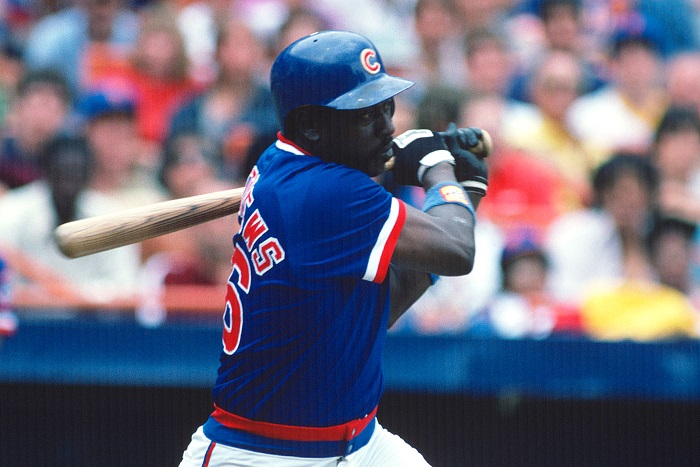
Acquired by the Cubs, along with Bob Dernier and Porfi Altamirano, from the Phillies for Bill Campbell and Mike Diaz near the end of spring training in 1984, Gary “Sarge” Matthews, wearing #36, became a spark plug that helped lead the Cubs to their first ever division title.  Leading the league in walks and OBP, Matthews set a career high with 101 runs scored and finished 5th in MVP voting, behind teammates Ryne Sandberg and Rick Sutcliffe.  He saw a big drop-off in 1985, appearing in only 97 games and hitting a career low .235.  He bounced back a bit in 1986, appearing in 123 games and hitting 21 home runs, his highest total since 1979.  Reduced to a bench player in 1987, Matthews had 42 ABs in 44 games when he was traded to the Mariners on July 11 for a minor league player to be named later.

On the south side of town, Jerry Koosman donned #36 when he joined the White Sox on August 30, 1981 after coming to the White Sox via trade from the Twins.  Koosman appeared in 8 games down the stretch, starting 3, as the White Sox finished 6th in the second half of the crazy strike season.  He returned in 1982, working mostly out of the bullpen but still starting 19 games as the White Sox squandered a quick start to finish in 3rd place.  The veteran lefty spent most of the 1983 season in the starting rotation, but saw his ERA inflate to a career high 4.77.  However, after a shaky start, the White Sox caught fire and Koosman was the starting pitcher on September 17, when the White Sox clinched their first division title.  Koosman made one relief appearance during the ALCS against the Orioles, throwing 1/3 of a disastrous inning in the Game 3 blowout, giving up 1 hit, 2 walks, and 3 runs (2 earned).  He re-upped with the White Sox following the season, but was sent to the Phillies the following spring to complete the trade for Ron Reed.

By The Numbers – 40

In 1929, uniform numbers appeared on the back of baseball jerseys for the first time, thanks to the Indians and the Yankees.  By 1937, numbers finally appeared across all uniforms, both home and away, across both major leagues.  Since that time, 81 distinct numbers have been worn by members of the White Sox, while the Cubs boast 76.

Today, we continue our look at those players, picking our favorite, if not the best, player to wear each uniform number for both Chicago teams with #40.  55 different players have donned #40 while playing in Chicago, 25 for the White Sox and 30 for the Cubs.

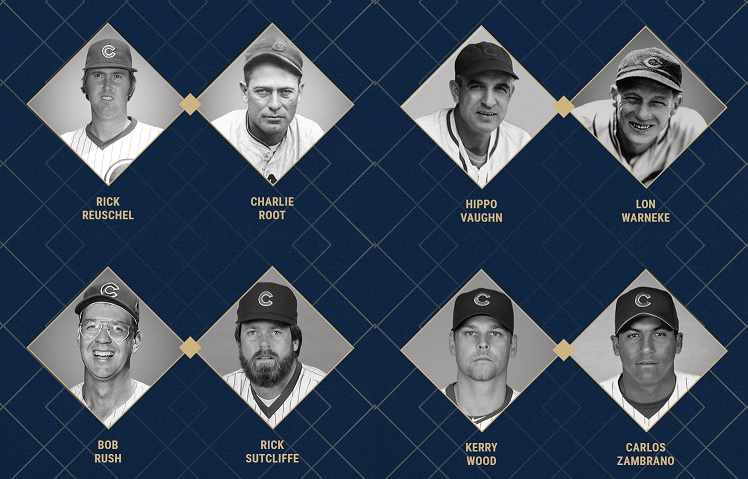
Acquired in mid-June, along with George Frazier and Ron Hassey, from the Indians in exchange for Mel Hall, Joe Carter, Don Schulze, and Darryl Banks, Rick Sutcliffe, wearing #40, quickly became the ace of the Cubs staff, going 16-1 with a 2.69 ERA in leading the Cubs to their first division title and his first Cy Young Award.  He then homered in and won Game 1 of the NLCS, the first post-season game at Wrigley Field since the 1945 World Series, before dropping the deciding Game 5 in San Diego.  A free agent after the season, Sutcliffe signed a long term deal with the Cubs.

A hamstring injury limited him to 20 starts in 1985, while arm injuries in 1986 led him to a 5-14 record with a 4.64 ERA in 28 appearances.  He bounced back in 1987, leading the league with 18 wins in 34 starts for the last place Cubs, finishing second in the Cy Young Award voting.  He went 13-14 in 1988, but did somehow manage a steal of home plate on July 29th in a victory against the Phillies.  A resurgence in 1989 helped lead the Cubs to their second divisional title, and he made one start against the Giants in the NLCS.  Recurring arm injuries caused Sutcliffe to miss most of the 1990 and 1991 seasons, with only 24 appearances between the two years, and the Cubs let him leave as a free agent following the 1991 season.

On the other side of town, Wilson Alvarez was acquired by the White Sox, along with Scott Fletcher and Sammy Sosa, for Harold Baines and Fred Manrique on July 29, 1989, making his White Sox debut on August 11, 1991 by throwing an unlikely no hitter against the Orioles at Memorial Stadium.  He made 8 additional starts for the White Sox down the stretch, finishing the year with a 3-2 record and a respectable 3.51 ERA.  1992 saw Alvarez work mostly out of the bullpen, getting only 9 starts out of his 34 appearances.  He posted a career high 1.674 WHIP, giving up 65 walks in just over 100 innings.  This led to an unfortunate 5.20 ERA, despite a 5-3 record.  In 1993, Alvarez managed to break in to the rotation full time.  Despite leading the league with 122 walks, he finished second in the AL with an ERA of 2.95 and ended up with a 15-8 record as the White Sox won the AL West title for the first time in a decade.  He was the winning pitcher in Game 3 of the ALCS, holding the Blue Jays to a single run while throwing a complete game.

Alvarez improved in 1994, earning his first (and only) All Star nod and cutting his walk total nearly in half, helped by the player strike that ended the season in August, and he finished the year with a 12-8 record and a 3.45 ERA.  When baseball returned in 1995, Alvarez struggled to regain his groove, finishing with a losing record for the first time and an ERA of 4.32.  1996 saw a nice bounce back for Alvarez.  While his ERA was still an elevated 4.22, he tied his career high with 15 wins and set career highs for innings pitched and strikeouts.  He continued to impress in 1997, putting up a 9-8 record with a 3.03 ERA by the end of July, when, with the White Sox a mere 3 games back in the standings, he, along with Danny Darwin and Roberto Hernandez, was sent to the Giants for Brian Manning, Lorenzo Barceló, Mike Caruso, Keith Foulke, Bob Howry, and Ken Vining in what would become known as the White Flag Trade.

Turn On The Marquee

Tomorrow, the Marquee Sports Network, the new home of the Cubs, goes live as the team kicks off their slate of games in the 2020 Cactus League.  Unfortunately, for the majority of homes in the Chicagoland area, the network will not be available.

Len Kasper and Jim Deshaies will continue on as the main announcing team for Cubs games.  They will occasionally be joined by one of the roving band of analysts that have been announced to date: Lou Piniella, Rick Sutcliffe, Mark Grace, Carlos Peña, Mark DeRosa, Ryan Dempster, Doug Glanville, Dan Plesac, and Jason Hammel.  Cole Wright, formerly of NFL Network, will be the studio host for pre- and post-game coverage and Taylor McGregor will be the sideline reporter, a role she previously held with the Rockies.

The one thing Marquee doesn’t have is a carriage agreement with Comcast, the dominant cable operator in the Chicago metropolitan area.  Comcast has 1.5 million home subscribers in the area, more than all the other metro area operators combined.  The Cubs hope to avoid the fate of the Dodgers, who created their own network in 2014 and still have not gotten full clearance in the Los Angeles market, after 7 years and 2 World Series appearances.  Tomorrow was a soft deadline to get a deal done.  If nothing happened by March 26, when the Cubs open the season in Milwaukee against the Brewers.

Ballpark Tour: Orioles

With the offseason underway, we continue our tour of all of the different baseball stadiums I’ve been to over the years. This week, we head east for a look at the Baltimore Orioles, who I visited for the first time this summer. So, without further ado, let’s take a deeper look at my one game history with Oriole Park at Camden Yards.


Stadium Name: Oriole Park at Camden Yards

Years in Service: 1992 – Present

Visits: 1

After 38 seasons at Memorial Stadium following their move from St. Louis, the Orioles opened Oriole Park at Camden Yards in 1992.  It was the first of a wave of “retro” parks that would sprout up over the following 2 decades, changing the architecture of baseball.  The Orioles took the initial contest at the park, defeating the Indians 2-0 behind a Rick Sutcliffe shutout.

The stadium hosted its first All-Star Game in 1993.  On September 6, 1995, the park witnessed Cal Ripken surpass Lou Gehrig for consecutive games played and, on the same day in 1996, saw Eddie Murray smash his 500th career home run.  On April 29, 2015, the park hosted the first game in MLB history to be closed to fans, due to riots in Baltimore.

I made my first visit to the stadium this past summer, with the Orioles taking on their long time rival San Francisco Giants.  The game was kind of non-descript, as both teams were on a downward spiral, but I hope to make it back some day for a repeat performance.