150 Years Of Cubs Baseball – Outfielders Part 1

Originally founded in 1869, the Chicago Cubs became a charter member of the National League in 1876.  Over the next 150 seasons, the Cubs have played more than 22,000 games, scored over 103,000 runs and recorded more than 200,000 hits, more than any other team in baseball history.  Nearly 2,300 players have worn a Cubs uniform, earning eight division titles, 17 NL pennants, and three World Series championships.

Fans have witnessed generations of unforgettable players, from historical heroes like Joe Tinker, Gabby Hartnett, Ernie Banks, and Billy Williams to more recent stars like Ryne Sandberg, Derrek Lee, Kerry Wood, and Anthony Rizzo.  The team has called Wrigley Field home for 110 of those 150 seasons.

To celebrate this milestone, the Cubs are holding a fan vote to select the franchise’s anniversary team.  Each week, we will go through the provided options for each position and declare who should, and, if different, who will, win the fan vote.  We continue today with the first eight selections for outfielder.
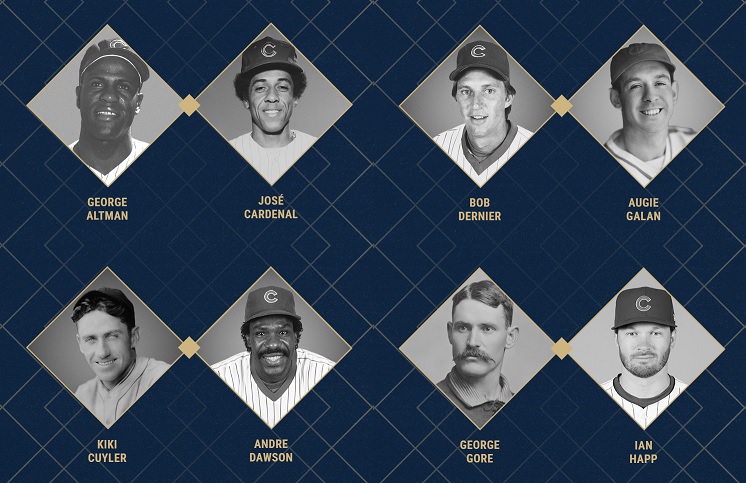
George Altman spent seven seasons with the Cubs across two stints.  Debuting with the club in 1959, he quickly emerged as one of the team’s most productive hitters, earning All-Star selections in both 1961 and 1962.  He accumulated 7.9 WAR across those two seasons while establishing himself as a dangerous power hitter.  He returned to the Cubs in 1965 but was unable to reclaim his former status and struggled to produce.  He finished his major league career in 1967, hitting just .111 in 15 games.

José Cardenal joined the Cubs for the 1972 season and stayed through 1977.  He was one of the most popular and productive players during his tenure, bridging the gap between the superstars of the 60s and the success coming in the 1980s.  He was named Cubs player of the year by local media in 1973.  His best season came in 1975, earning 3.1 WAR while hitting .317.  He was inducted into the Cubs Hall of Fame in 2022.

Kiki Cuyler joined the Cubs following the 1927 season and spent parts of eight years with the team.  During his tenure, Cuyler was one of the most dynamic offensive players in the league, helping the Cubs win two NL pennants.  He was named to his lone All-Star team in 1934 in its second year of existence.  He led the NL in three times, from 1928 through 1930.  In 1968, he was enshrined in Cooperstown as a member of the Hall of Fame.

Continue reading →

RIP Bruce Sutter

Former Cub closer Bruce Sutter died this morning at the age of 69.  Sutter, elected to the Hall of Fame in 2006, spent five seasons with the Cubs from 1976 through 1980, earning four All Star nods, numerous MVP votes, and a Cy Young Award.  He was traded to the Cardinals prior to the 1981 season, where he would become one of the most recognizable stars of the game and a World Series champion in 1982.  He signed with the Braves as a free agent after the 1984 season, where injuries would bring his career to a premature end in 1988.  His career total of 300 saves is currently tied for 30th in MLB history.

Sutter began closing games for the Cubs late in the 1976 season, earning 10 saves before season’s end.  When Herman Franks became Cubs manager in 1977, he had Sutter closing games from the get-go.  Despite an August injury, he finished the year with a 1.34 ERA, 31 saves, and a 6.5 bWAR, finishing in sixth place for Cy Young voting and seventh place in MVP voting.  In 1979, Sutter led all of MLB in saves, with 37, for the first of what would be four straight seasons, earning the Cy Young Award along the way.

Following that year, Sutter became the first Cub to enter the new arbitration system.  The Cubs offered Sutter $350,000, an increase of nearly 50 percent from his 1979 salary, while Sutter asked for $700,000.  When the arbitrator awarded the higher figure to Sutter, the Wrigley family claimed they couldn’t afford it.  While Sutter put up another great season in 1980, the Cubs lost 98 games and, after the season, he was traded to the Cardinals for Leon Durham, Ken Reitz and Ty Waller.

Sutter still had one more important role to play in Cubs lore.  In 1984, while still a member of the Cardinals, he was on the mound in the ninth inning of a nationally televised game trying to hold on to a 9-8 lead.  Ryne Sandberg, at the time a young, unheralded second baseman not known for power, hit a home run to send the game to extra innings.  After the Cardinals plated two in the top of the 10th, Sutter came back out to once again try to wrap up the victory.  After two quick outs and a walk to Bob Dernier, Sandberg once again teed off, hitting his second game-tying home run in as many innings.  The Cubs would eventually win what is now known as “The Sandberg Game” in the 11th and Ryne Sandberg was on his way to becoming a star.

By The Numbers – 36

In 1929, uniform numbers appeared on the back of baseball jerseys for the first time, thanks to the Indians and the Yankees.  By 1937, numbers finally appeared across all uniforms, both home and away, across both major leagues.  Since that time, 81 distinct numbers have been worn by members of the White Sox, while the Cubs boast 76.

Today, we continue our look at those players, picking our favorite, if not the best, player to wear each uniform number for both Chicago teams with #36.  83 different players have donned #36 while playing in Chicago, 54 for the White Sox and 29 for the Cubs.

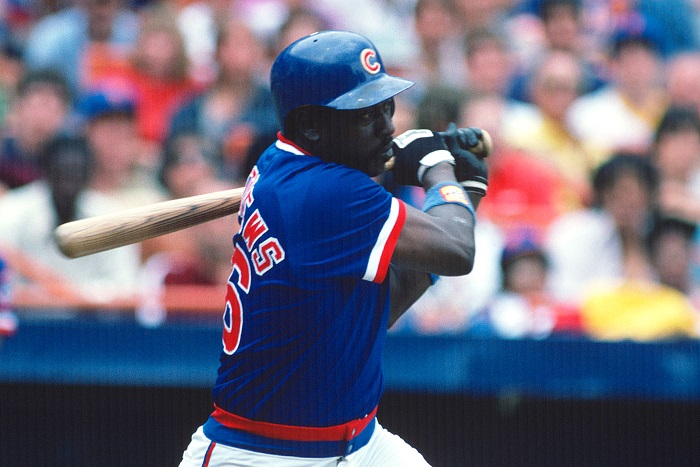
Acquired by the Cubs, along with Bob Dernier and Porfi Altamirano, from the Phillies for Bill Campbell and Mike Diaz near the end of spring training in 1984, Gary “Sarge” Matthews, wearing #36, became a spark plug that helped lead the Cubs to their first ever division title.  Leading the league in walks and OBP, Matthews set a career high with 101 runs scored and finished 5th in MVP voting, behind teammates Ryne Sandberg and Rick Sutcliffe.  He saw a big drop-off in 1985, appearing in only 97 games and hitting a career low .235.  He bounced back a bit in 1986, appearing in 123 games and hitting 21 home runs, his highest total since 1979.  Reduced to a bench player in 1987, Matthews had 42 ABs in 44 games when he was traded to the Mariners on July 11 for a minor league player to be named later.

On the south side of town, Jerry Koosman donned #36 when he joined the White Sox on August 30, 1981 after coming to the White Sox via trade from the Twins.  Koosman appeared in 8 games down the stretch, starting 3, as the White Sox finished 6th in the second half of the crazy strike season.  He returned in 1982, working mostly out of the bullpen but still starting 19 games as the White Sox squandered a quick start to finish in 3rd place.  The veteran lefty spent most of the 1983 season in the starting rotation, but saw his ERA inflate to a career high 4.77.  However, after a shaky start, the White Sox caught fire and Koosman was the starting pitcher on September 17, when the White Sox clinched their first division title.  Koosman made one relief appearance during the ALCS against the Orioles, throwing 1/3 of a disastrous inning in the Game 3 blowout, giving up 1 hit, 2 walks, and 3 runs (2 earned).  He re-upped with the White Sox following the season, but was sent to the Phillies the following spring to complete the trade for Ron Reed.

#404 – #413 – The Unknowns Part 8

Another look at the forgotten players from the White Sox past.


Name: Wayne Edwards

Rank: 413

Position: P

Years With White Sox: 1989-1991

Edwards went 5-5 over his three campaigns with the Sox.


Name: Mike Diaz

Rank: 412

Position: 1B

Year With White Sox: 1988

Acquired from the Pirates for Gary Redus, Diaz last appeared in the majors with the ’88 squad.  His greater claim to fame locally may be as part of the package the Cubs sent to the Phillies prior to the ’84 season that brought them Gary Matthews and Bob Dernier.


Name: Dane Johnson

Rank: 411

Position: P

Year With White Sox: 1994

Johnson managed 14 appearances before the premature end of the ’94 season.

Continue reading →