 Originally founded in 1869, the Chicago Cubs became a charter member of the National League in 1876. Over the next 150 seasons, the Cubs have played more than 22,000 games, scored over 103,000 runs and recorded more than 200,000 hits, more than any other team in baseball history. Nearly 2,300 players have worn a Cubs uniform, earning eight division titles, 17 NL pennants, and three World Series championships.
Fans have witnessed generations of unforgettable players, from historical heroes like Joe Tinker, Gabby Hartnett, Ernie Banks, and Billy Williams to more recent stars like Ryne Sandberg, Derrek Lee, Kerry Wood, and Anthony Rizzo. The team has called Wrigley Field home for 110 of those 150 seasons.
To celebrate this milestone, the Cubs are holding a fan vote to select the franchise’s anniversary team. Each week, we will go through the provided options for each position and declare who should, and, if different, who will, win the fan vote. We continue today with the final eight selections for relief pitcher.
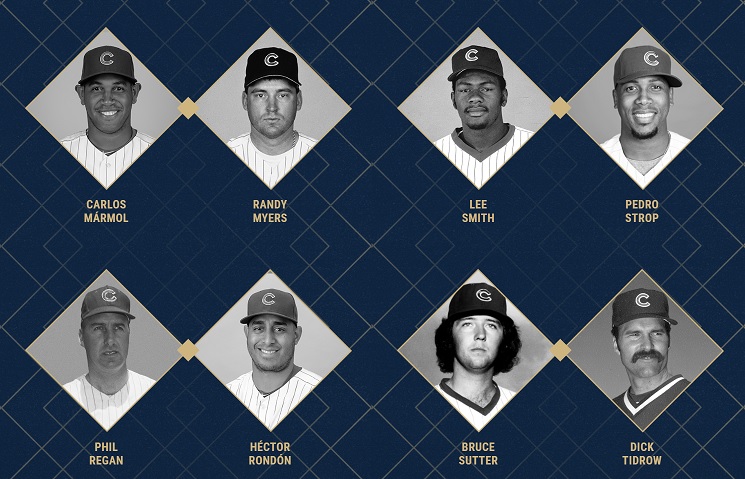 Carlos Mármol was signed by the Cubs as a catcher/outfielder in 1999 but was converted to pitcher in 2003. He debuted in 2006, working mostly as a starter in place of the injured Kerry Wood. Marmol resurfaced in 2007 as a setup man and helped the Cubs capture back-to-back division titles in 2007 and 2008. Over those two seasons, Marmol battled Ryan Dempster and Kerry Wood for the closer spot, getting his opportunity in both years thanks to injury to the incumbent. In 2009, he finally replaced an ineffective Kevin Gregg as closer, holding down that position for the remainder of his Cubs tenure. Marmol’s strength was in his ability to strike out opposing batters, averaging 16 strikeouts per nine innings pitched, setting the record for highest K/9 ratio by a pitcher with at least 50 innings pitched. Things started to go south in 2011, when he tied for the major league lead with ten blown saves. The following year, he was designated for assignment in June after continuing to struggle.
Randy Myers spent just three seasons with the Cubs, from 1993-1995. In 1993, he set a then-NL record with 53 saves. His most infamous moment came in a late September game against the Astros in 1995, when a fan jumped onto the field and ran to the pitcher’s mound to attack Myers after he gave up a go-ahead home run. Myers used his martial arts training to drop the attacker to the ground and then held him down until security could get there. He led the NL in saves twice in his three years with the Cubs and was a two-time All-Star.
Phil Regan was traded to the Cubs in late April 1968. He excelled at the back end of the Cubs bullpen, leading all of MLB with 25 saves and earning the Sporting News Reliever of the Year award. A run-in with an umpire on August 18 in his appearance versus the Reds saw Regan accused of throwing doctored balls, with fourteen pitches deemed illegal by the home plate umpire despite no evidence of any foreign substance on the balls. While later cleared by the NL President Warren Giles, Regan’s reputation was sullied for the remainder of his career. Unfortunately, he was never able to repeat that dominance and found his usage decrease each season he remained with the Cubs until he left in June of 1972.

 Acquired from the Dodgers, along with Ivan DeJesus, in exchange for Rick Monday and Mike Garman, Bill Buckner joined the Cubs, wearing #22, in 1977. A staph infection in his ankle the previous year caused the Cubs to move the former outfielder to first base, a position he would man for the rest of his career. Appearing in 122 games, he hit .284 with 11 home runs and 27 doubles. He improved in 1978, raising his average to .323 and placed 17th in MVP voting. 1979 was another steady year for Buckner. On May 17th, in the infamous slugfest where the Cubs lost 23-22 to the Phillies, he went 4–for–7 with a grand slam and a career-high seven RBIs. He finished the year hitting .284 with 14 home runs and 34 doubles, but was also described as “nuts” when manager Herman Franks resigned late in the season.