150 Years Of Cubs Baseball – Relief Pitchers Part 2

Originally founded in 1869, the Chicago Cubs became a charter member of the National League in 1876.  Over the next 150 seasons, the Cubs have played more than 22,000 games, scored over 103,000 runs and recorded more than 200,000 hits, more than any other team in baseball history.  Nearly 2,300 players have worn a Cubs uniform, earning eight division titles, 17 NL pennants, and three World Series championships.

Fans have witnessed generations of unforgettable players, from historical heroes like Joe Tinker, Gabby Hartnett, Ernie Banks, and Billy Williams to more recent stars like Ryne Sandberg, Derrek Lee, Kerry Wood, and Anthony Rizzo.  The team has called Wrigley Field home for 110 of those 150 seasons.

To celebrate this milestone, the Cubs are holding a fan vote to select the franchise’s anniversary team.  Each week, we will go through the provided options for each position and declare who should, and, if different, who will, win the fan vote.  We continue today with the final eight selections for relief pitcher.
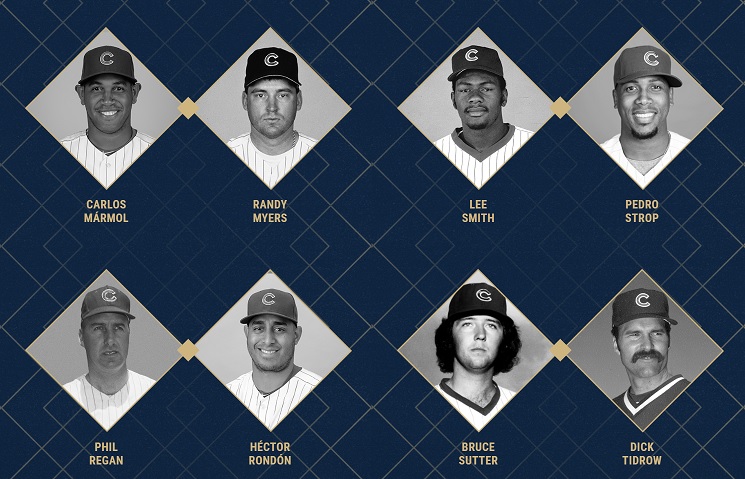
Carlos Mármol was signed by the Cubs as a catcher/outfielder in 1999 but was converted to pitcher in 2003.  He debuted in 2006, working mostly as a starter in place of the injured Kerry Wood.  Marmol resurfaced in 2007 as a setup man and helped the Cubs capture back-to-back division titles in 2007 and 2008.  Over those two seasons, Marmol battled Ryan Dempster and Kerry Wood for the closer spot, getting his opportunity in both years thanks to injury to the incumbent.  In 2009, he finally replaced an ineffective Kevin Gregg as closer, holding down that position for the remainder of his Cubs tenure.  Marmol’s strength was in his ability to strike out opposing batters, averaging 16 strikeouts per nine innings pitched, setting the record for highest K/9 ratio by a pitcher with at least 50 innings pitched.  Things started to go south in 2011, when he tied for the major league lead with ten blown saves.  The following year, he was designated for assignment in June after continuing to struggle.

Randy Myers spent just three seasons with the Cubs, from 1993-1995.  In 1993, he set a then-NL record with 53 saves.  His most infamous moment came in a late September game against the Astros in 1995, when a fan jumped onto the field and ran to the pitcher’s mound to attack Myers after he gave up a go-ahead home run.  Myers used his martial arts training to drop the attacker to the ground and then held him down until security could get there.  He led the NL in saves twice in his three years with the Cubs and was a two-time All-Star.

Phil Regan was traded to the Cubs in late April 1968.  He excelled at the back end of the Cubs bullpen, leading all of MLB with 25 saves and earning the Sporting News Reliever of the Year award.  A run-in with an umpire on August 18 in his appearance versus the Reds saw Regan accused of throwing doctored balls, with fourteen pitches deemed illegal by the home plate umpire despite no evidence of any foreign substance on the balls.  While later cleared by the NL President Warren Giles, Regan’s reputation was sullied for the remainder of his career.  Unfortunately, he was never able to repeat that dominance and found his usage decrease each season he remained with the Cubs until he left in June of 1972.
Continue reading →

150 Years Of Cubs Baseball – Relief Pitchers Part 1

Originally founded in 1869, the Chicago Cubs became a charter member of the National League in 1876.  Over the next 150 seasons, the Cubs have played more than 22,000 games, scored over 103,000 runs and recorded more than 200,000 hits, more than any other team in baseball history.  Nearly 2,300 players have worn a Cubs uniform, earning eight division titles, 17 NL pennants, and three World Series championships.

Fans have witnessed generations of unforgettable players, from historical heroes like Joe Tinker, Gabby Hartnett, Ernie Banks, and Billy Williams to more recent stars like Ryne Sandberg, Derrek Lee, Kerry Wood, and Anthony Rizzo.  The team has called Wrigley Field home for 110 of those 150 seasons.

To celebrate this milestone, the Cubs are holding a fan vote to select the franchise’s anniversary team.  Each week, we will go through the provided options for each position and declare who should, and, if different, who will, win the fan vote.  We continue today with the first eight selections for relief pitcher.

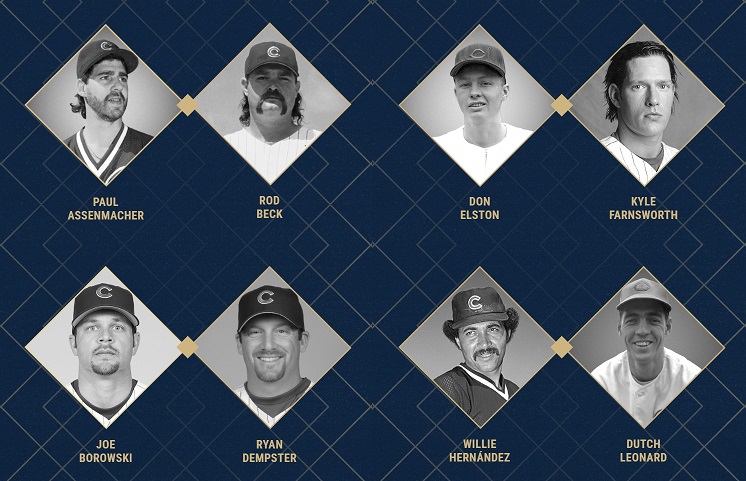
Paul Assenmacher, acquired for the stretch run in 1989 as the team was looking for their second NL East title, spent parts of five seasons as a member of the Cubs and was a perfectly reliable bullpen arm for most of that time.

Rod Beck spent less than two seasons with the Cubs.  Signed in 1998, he led the NL in games and games finished while saving 51 as the Cubs won their first NL Wild Card.  He made one appearance in the NLDS, giving up three earned runs in less than two innings of work.  Injuries combined with ineffectiveness the following year led to him being traded to the Red Sox in August.  He was re-signed by the team in 2003 while recovering from Tommy John surgery but was released before being added to the big-league roster.  Following his 2007 death, he was buried wearing his Cubs uniform.

Joe Borowski spent parts of five seasons with the Cubs, from 2001-2005.  His best year came in 2003, when he was named the closer.  He saved 33 games as the Cubs won their first division title in over a decade.  He gave up just one earned run across five games in the postseason, as the Cubs famously lost the NLCS to the Marlins in seven games.  Injuries marred his remaining time on the team, and he was designated for assignment in 2005.

Continue reading →

By The Numbers – 26

In 1929, uniform numbers appeared on the back of baseball jerseys for the first time, thanks to the Indians and the Yankees.  By 1937, numbers finally appeared across all uniforms, both home and away, across both major leagues.  Since that time, 81 distinct numbers have been worn by members of the White Sox, while the Cubs boast 76.

Today, we continue our look at those players, picking our favorite, if not the best, player to wear each uniform number for both Chicago teams with #26.  71 different players have donned #26 while playing in Chicago, 58 for the White Sox and 13 for the Cubs, who have retired it for a Hall of Fame outfielder.

Sweet-Swinging Billy Williams first wore his familiar #26 in 1961, his first full season with the Cubs, where he played in 146 games, hitting 25 home runs with 86 RBIs, while earning Rookie of the Year honors.  Williams hit at least 20 home runs and drove in 84 or more runs in every season from 1961 to 1973, earning 6 All-Star team nods along the way, in 1962, 1964, 1965, 1968, 1972, and 1973.  In 1963, he started a consecutive game streak that would last into 1970, setting the National League record with 1,117.

In 1970, Williams batted .322 with 42 homers and 129 RBI and finished second in MVP voting.  He replicated that finish in 1972, winning the batting title with a .333 average, along with a .606 slugging percentage, 37 home runs, and 122 RBIs.  That gave him his 3rd top ten finish in 5 seasons.  Following the 1974 season, Williams was traded to the A’s for, amongst others, Manny Trillo.  Williams was elected to the Hall of Fame in 1987 and his number 26 was retired by the Cubs later that summer.

On the South Side of town, nobody has really made their mark wearing #26, though one of the greatest “what ifs” in team history did don the number in 1986.  Acquired in the Rule 5 draft from the Pirates in December of 1985, Bobby Bonilla made his major league debut with the White Sox on April 9, going 0-1 as a pinch hitter in the Sox loss to the Brewers.  Bonilla was putting together a pretty decent rookie campaign, especially since he was making the jump from A ball, hitting .269 with 2 home runs in 75 games when GM Ken Harrelson decided send Bonilla back to the Pirates, in exchange for pitcher Jose DeLeon.  DeLeon went 23-22 across parts of 5 seasons in 2 stints with the White Sox, while Bonilla made 6 All Star teams, earned three Silver Slugger awards, and two top ten MVP finishes over the next 10 seasons.

By The Numbers – 68

In 1929, uniform numbers appeared on the back of baseball jerseys for the first time, thanks to the Indians and the Yankees.  By 1937, numbers finally appeared across all uniforms, both home and away, across both major leagues.  Since that time, 81 distinct numbers have been worn by members of the White Sox, while the Cubs boast 76.

Today, we continue our look at those players, picking our favorite, if not the best, player to wear each uniform number for both Chicago teams with #68.  5 players have donned #71 while playing in Chicago, 6 for the White Sox and 1 for the Cubs.

Jorge Soler was originally signed by the Cubs as an amateur free agent in 2012.  Part of the so-called Core Four, the prospects meant to finally lead the Cubs to post-season glory, Soler made his major league debut on August 27, 2014, going 2 for 4 with a home run and 2 RBIs against the Reds.  He became the primary right fielder in 2015, starting 95 games and putting up a .723 OPS as the Cubs made a surprising run to the NLCS before falling to the Mets.  With Jason Heyward on board in 2016, Soler saw most of his playing time in left field, filling in for the injured Kyle Schwarber.  While he struggled during the regular season, he made the most of his World Series opportunity, hitting .400 against the Indians in his 2 appearances.  After achieving that initial goal of a World Series title, Soler was sent to the Royals for closer Wade Davis.

The pickings are slim on the south side of town for players wearing #68.  Dylan Covey wore it the most, going 6-29 over his 3 seasons with the White Sox after being acquired as a Rule 5 draft choice out of the A’s organization.  He was thankfully let go following the 2019 season.

#153 – Bobby Bonilla

$_35Name: Bobby Bonilla

Rank: 153

Position: LF/1B

Year With White Sox: 1986

After breaking his leg and missing most of the 1985 season, Bobby Bonilla was left off the Pirates 40 man roster and was selected by the White Sox in the Rule 5 draft in December.  He opened the 1986 season with the White Sox, making his major league debut on April 9, going 0-1 as a pinch hitter in the Sox loss to the Brewers.

With the chaos of Hawk Harrelson’s lone season as GM swirling around him, Bonilla put together a pretty decent rookie campaign, especially since he was making the jump from A ball.  He was hitting .269 with 2 home runs in 75 games when, with the trade deadline approaching, Harrelson decided to blow up the team and sent Bonilla back to the Pirates, in exchange for pitcher Jose DeLeon.

Bonilla’s numbers in a White Sox uniform were:

Continue reading →