 Originally founded in 1869, the Chicago Cubs became a charter member of the National League in 1876. Over the next 150 seasons, the Cubs have played more than 22,000 games, scored over 103,000 runs and recorded more than 200,000 hits, more than any other team in baseball history. Nearly 2,300 players have worn a Cubs uniform, earning eight division titles, 17 NL pennants, and three World Series championships.
Fans have witnessed generations of unforgettable players, from historical heroes like Joe Tinker, Gabby Hartnett, Ernie Banks, and Billy Williams to more recent stars like Ryne Sandberg, Derrek Lee, Kerry Wood, and Anthony Rizzo. The team has called Wrigley Field home for 110 of those 150 seasons.
To celebrate this milestone, the Cubs are holding a fan vote to select the franchise’s anniversary team. Each week, we will go through the provided options for each position and declare who should, and, if different, who will, win the fan vote. We continue today with the final eight selections for relief pitcher.
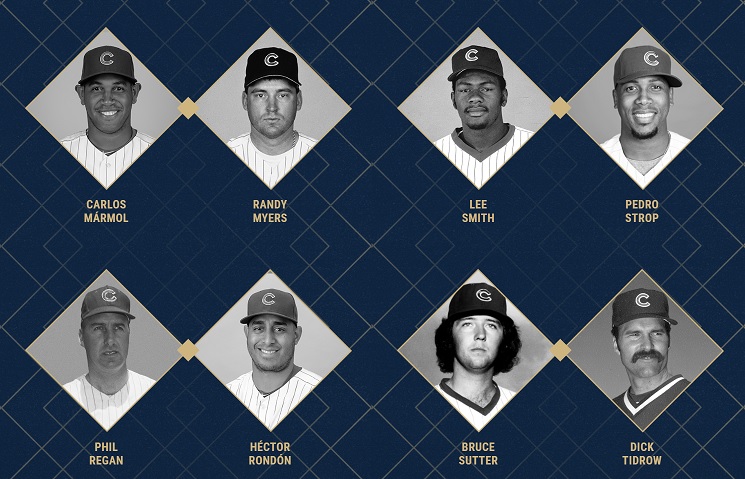 Carlos Mármol was signed by the Cubs as a catcher/outfielder in 1999 but was converted to pitcher in 2003. He debuted in 2006, working mostly as a starter in place of the injured Kerry Wood. Marmol resurfaced in 2007 as a setup man and helped the Cubs capture back-to-back division titles in 2007 and 2008. Over those two seasons, Marmol battled Ryan Dempster and Kerry Wood for the closer spot, getting his opportunity in both years thanks to injury to the incumbent. In 2009, he finally replaced an ineffective Kevin Gregg as closer, holding down that position for the remainder of his Cubs tenure. Marmol’s strength was in his ability to strike out opposing batters, averaging 16 strikeouts per nine innings pitched, setting the record for highest K/9 ratio by a pitcher with at least 50 innings pitched. Things started to go south in 2011, when he tied for the major league lead with ten blown saves. The following year, he was designated for assignment in June after continuing to struggle.
Randy Myers spent just three seasons with the Cubs, from 1993-1995. In 1993, he set a then-NL record with 53 saves. His most infamous moment came in a late September game against the Astros in 1995, when a fan jumped onto the field and ran to the pitcher’s mound to attack Myers after he gave up a go-ahead home run. Myers used his martial arts training to drop the attacker to the ground and then held him down until security could get there. He led the NL in saves twice in his three years with the Cubs and was a two-time All-Star.
Phil Regan was traded to the Cubs in late April 1968. He excelled at the back end of the Cubs bullpen, leading all of MLB with 25 saves and earning the Sporting News Reliever of the Year award. A run-in with an umpire on August 18 in his appearance versus the Reds saw Regan accused of throwing doctored balls, with fourteen pitches deemed illegal by the home plate umpire despite no evidence of any foreign substance on the balls. While later cleared by the NL President Warren Giles, Regan’s reputation was sullied for the remainder of his career. Unfortunately, he was never able to repeat that dominance and found his usage decrease each season he remained with the Cubs until he left in June of 1972.
Héctor Rondón was selected by the Cubs in the 2012 Rule 5 Draft, making the team in 2013. When closer José Veras struggled in early 2014, Rondón seized his opportunity, He had his best year in 2015, saving a career high 30 games with an ERA of 1.67 as the surprising Cubs made their way to the NLCS. He lost his closer role the following year with the acquisition of Aroldis Chapman but still helped the Cubs end their 108-year title drought. A difficult 2017, which saw his ERA jump over 4.00, led to him being non-tendered that winter.
Lee Smith was the 2nd round selection of the Cubs in the 1975 draft. He made his major league debut on September 1, 1980, quickly becoming a fixture in the Cubs bullpen. He took over the closer role in 1982 and became a force, leading the league in saves in 1983 while earning his first All-Star nod and post-season support for both the Cy Young award and MVP. Following the 1987 season, he was traded to the Red Sox, ending his Cubs career with a 40-51 record and a 2.92 ERA with 180 saves and 342 games finished. In 2019, he was elected to the Hall of Fame by the Veteran’s Committee.
Pedro Strop spent parts of ten seasons in two different stints with the Cubs after being acquired from the Orioles in July of 2013. He was a steady presence in the bullpen for eight of those ten seasons, finishing with an ERA under 3.00. In 2016, Strop made 54 appearances with a 2–2 record and a 2.85 ERA en route to the Cubs first World Series championship in 108 years. His final, and worst, full season came in 2019. Appearing in just 50 games, his ERA ballooned up to nearly 5.00. He returned to the organization in 2021, appearing in just two innings across two games before being released.
Bruce Sutter signed with the Cubs as an amateur free agent in 1971 after dropping out of college. Picking up his signature split-fingered fastball in the Cubs system, he made his big league debut in 1976 and moved into the closer’s role late in the season. When Herman Franks took over as Cubs manager the following year, Sutter cemented his position at the back of the bullpen. He finished the year with a 1.34 ERA, 31 saves, and a 6.5 bWAR, finishing in sixth place for Cy Young voting and seventh place in MVP voting. In 1979, Sutter led all of MLB in saves, with 37, for the first of what would be four straight seasons, earning the Cy Young Award along the way. Following the 1979 season, Sutter became the first Cub to enter the new arbitration system and, when the arbitrator awarded the higher salary to Sutter, the Wrigley family claimed they couldn’t afford it. While Sutter put up another great season in 1980, the Cubs lost 98 games and, after the season, he was traded to the Cardinals. In 2006, he was elected to the Hall of Fame.
Dick Tidrow was acquired by the Cubs in late May of 1979, becoming a favorite of manager Herman Franks to bridge the gap between the day’s starter and closer Bruce Sutter. Despite missing nearly two months of the season, he won eleven games and led the team with 102.2 innings pitched out of the bullpen. The following year, he led all of MLB in appearances, with 84. With Sutter gone in 1981, Tidrow took over as closer and the role did not suit him. He was 2-4 with only six saves before the strike and even worse when play resumed. Back in his familiar set-up role, his performance improved in 1982, his final year with the Cubs.
This is easily the weakest position grouping of the bunch. Once you get past Hall of Famers Bruce Sutter and Lee Smith, you get either successful closers with a short stint with the franchise or guys who were just there doing nothing spectacular for a longer period of time.