150 Years Of Cubs Baseball – Relief Pitchers Part 2

Originally founded in 1869, the Chicago Cubs became a charter member of the National League in 1876.  Over the next 150 seasons, the Cubs have played more than 22,000 games, scored over 103,000 runs and recorded more than 200,000 hits, more than any other team in baseball history.  Nearly 2,300 players have worn a Cubs uniform, earning eight division titles, 17 NL pennants, and three World Series championships.

Fans have witnessed generations of unforgettable players, from historical heroes like Joe Tinker, Gabby Hartnett, Ernie Banks, and Billy Williams to more recent stars like Ryne Sandberg, Derrek Lee, Kerry Wood, and Anthony Rizzo.  The team has called Wrigley Field home for 110 of those 150 seasons.

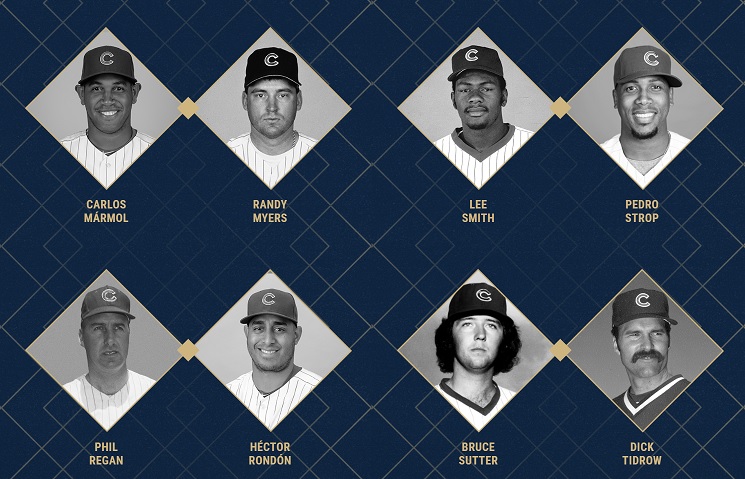
To celebrate this milestone, the Cubs are holding a fan vote to select the franchise’s anniversary team.  Each week, we will go through the provided options for each position and declare who should, and, if different, who will, win the fan vote.  We continue today with the final eight selections for relief pitcher.

Carlos Mármol was signed by the Cubs as a catcher/outfielder in 1999 but was converted to pitcher in 2003.  He debuted in 2006, working mostly as a starter in place of the injured Kerry Wood.  Marmol resurfaced in 2007 as a setup man and helped the Cubs capture back-to-back division titles in 2007 and 2008.  Over those two seasons, Marmol battled Ryan Dempster and Kerry Wood for the closer spot, getting his opportunity in both years thanks to injury to the incumbent.  In 2009, he finally replaced an ineffective Kevin Gregg as closer, holding down that position for the remainder of his Cubs tenure.  Marmol’s strength was in his ability to strike out opposing batters, averaging 16 strikeouts per nine innings pitched, setting the record for highest K/9 ratio by a pitcher with at least 50 innings pitched.  Things started to go south in 2011, when he tied for the major league lead with ten blown saves.  The following year, he was designated for assignment in June after continuing to struggle.

Randy Myers spent just three seasons with the Cubs, from 1993-1995.  In 1993, he set a then-NL record with 53 saves.  His most infamous moment came in a late September game against the Astros in 1995, when a fan jumped onto the field and ran to the pitcher’s mound to attack Myers after he gave up a go-ahead home run.  Myers used his martial arts training to drop the attacker to the ground and then held him down until security could get there.  He led the NL in saves twice in his three years with the Cubs and was a two-time All-Star.

Phil Regan was traded to the Cubs in late April 1968.  He excelled at the back end of the Cubs bullpen, leading all of MLB with 25 saves and earning the Sporting News Reliever of the Year award.  A run-in with an umpire on August 18 in his appearance versus the Reds saw Regan accused of throwing doctored balls, with fourteen pitches deemed illegal by the home plate umpire despite no evidence of any foreign substance on the balls.  While later cleared by the NL President Warren Giles, Regan’s reputation was sullied for the remainder of his career.  Unfortunately, he was never able to repeat that dominance and found his usage decrease each season he remained with the Cubs until he left in June of 1972.

Continue reading →

By The Numbers – 22

In 1929, uniform numbers appeared on the back of baseball jerseys for the first time, thanks to the Indians and the Yankees.  By 1937, numbers finally appeared across all uniforms, both home and away, across both major leagues.  Since that time, 81 distinct numbers have been worn by members of the White Sox, while the Cubs boast 76.

Today, we continue our look at those players, picking our favorite, if not the best, player to wear each uniform number for both Chicago teams with #22.  76 different players have donned #22 while playing in Chicago, 26 for the White Sox and 50 for the Cubs.

Acquired from the Dodgers, along with Ivan DeJesus, in exchange for Rick Monday and Mike Garman, Bill Buckner joined the Cubs, wearing #22, in 1977.  A staph infection in his ankle the previous year caused the Cubs to move the former outfielder to first base, a position he would man for the rest of his career.  Appearing in 122 games, he hit .284 with 11 home runs and 27 doubles.  He improved in 1978, raising his average to .323 and placed 17th in MVP voting.  1979 was another steady year for Buckner.  On May 17th, in the infamous slugfest where the Cubs lost 23-22 to the Phillies, he went 4–for–7 with a grand slam and a career-high seven RBIs.  He finished the year hitting .284 with 14 home runs and 34 doubles, but was also described as “nuts” when manager Herman Franks resigned late in the season.

In 1980, Buckner won a batting title, hitting .324 while striking out only 18 times, earning him a 14th place finish in MVP voting.  In the strike-shortened 1981 season, he was the lone Cub representative for the All Star game and batted .311 while tying Cecil Cooper for the major league lead with 35 doubles.  1982 saw Buckner hit over .300 for the fourth time as a Cub while racking up career highs in hits, with 201, RBIs, with 105, and assists at first base, setting a major league record with 159.

In 1983, Buckner again led the NL with 38 doubles, but saw his batting average drop to .280, his lowest finish as a Cub.  With the acquisition of Gary Matthews in 1984 pushing Leon Durham to first base, Buckner found himself the odd man out.  Appearing mostly as a pinch hitter, Buckner hit a paltry .209 through the end of May, when he was traded to the Red Sox, ending his Cub tenure.

Scott Podsednik was acquired by the White Sox from the Brewers for Carlos Lee on December 13, 2004.  Wearing #22, he moved in to the leadoff spot and, after putting up a .294 average with 44 steals in the first half, he earned his first All Star game nod.  While injuries slowed him in the second half, he was back to full strength when the regular season came to an end and the White Sox embarked on their first post-season appearance in 5 years.  After going the entire regular season without a home run, Podsednik went deep against the Red Sox in Game 1 of the ALDS, helping the White Sox to a 14-2 victory on their way to a 3 game sweep of the defending champions.  Podsednik continued his steady play during the ALCS, hitting .294 with a triple and 3 stolen bases in the 5 game series.  The shining moment of his career came in Game 2 of the World Series, thanks to a walkoff home run against Brad Lidge in the 9th inning, giving the White Sox a 2-0 lead on their way to a sweep and their first world championship in 88 years.  For his efforts, Podsednik finished in 12th place for MVP voting.

As the White Sox looked to repeat in 2006, Podsednik found it difficult to duplicate his efforts from the year before.  His average was down 29 points, to .261, and his stolen base total was off by 19.  Injuries limited Podsednik to 62 games in 2007.  His offensive production continued to be lacking and, after the White Sox fell completely out of contention for the first time in years, the team decided to change their approach and gave Podsednik his release.  He returned to the White Sox organization in 2009, signing a minor league deal.  Injuries to Brian Anderson, Dewayne Wise, and Carlos Quentin gave him plenty of opportunity with the big league club, and he responded by hitting .304, his highest total since 2003.  Following the season, he became a free agent.

By The Numbers – 47

In 1929, uniform numbers appeared on the back of baseball jerseys for the first time, thanks to the Indians and the Yankees.  By 1937, numbers finally appeared across all uniforms, both home and away, across both major leagues.  Since that time, 81 distinct numbers have been worn by members of the White Sox, while the Cubs boast 76.

Today, we continue our look at those players, picking our favorite, if not the best, player to wear each uniform number for both Chicago teams with #47.  73 players have donned #47 while playing in Chicago, 38 for the White Sox and 35 for the Cubs.

The somewhat unfortunately named Rusty Kuntz spent parts of 5 seasons with the White Sox, wearing #47 the entire time.  He was selected by the White Sox in the 11th round of the 1977 draft and made his major league debut 2 years later as a September call-up in 1979, starting in left field and going 0-3 in a 4-3 victory over the Tigers en route to 5 appearances and an anemic .091 average.  Kuntz split time between Triple A Iowa and Chicago in 1980, with slightly better results, before spending the entire strike-shortened 1981 season with the White Sox, appearing in 67 games and batting .255 in a mere 55 at bats.  Both 1982 and 1983 saw Kuntz back splitting time between Triple A and Chicago, until he was finally traded to the Twins for a minor leaguer.

Catcher Miguel Montero wore #47 during his 2 1/2 years on the North side.  He had a few highlights, including his Game One grand slam in the 2016 NLCS against the Dodgers to give the Cubs the win.  His tenure with the Cubs came to an abrupt end the following June when, after the Nationals stole 7 bases in one game to leave him at 0-31 at nabbing would-be base stealers for the season, he placed the blame on the pitching staff.  The next day, he was designated for assignment.

By The Numbers – 48

In 1929, uniform numbers appeared on the back of baseball jerseys for the first time, thanks to the Indians and the Yankees.  By 1937, numbers finally appeared across all uniforms, both home and away, across both major leagues.  Since that time, 81 distinct numbers have been worn by members of the White Sox, while the Cubs boast 76.

Today, we continue our look at those players, picking our favorite, if not the best, player to wear each uniform number for both Chicago teams with #48.  65 different players have donned #48 while playing in Chicago, 35 for the White Sox and 30 for the Cubs.

Rick Reuschel was selected by the Cubs in the third round of the 1970 draft.  He joined the big league team in June of 1972, donning #48.  His best season came in 1977, winning 20 games and finishing third in the Cy Young Award voting as the Cubs flirted with a pennant chase before a late season swoon.  He remained with the Cubs until he was traded to the Yankees during the 1981 strike.  He returned to the Cubs in 1983, but wearing a different number.

Acquired for Omar Narvaez, Alex Colome wore #48 during his two seasons on the south side.  He notched 42 saves in 83 games, and picked up an additional save and 2 scoreless innings in 2 appearances during the 2020 Wild Card series against the A’s.

#1 – Harold Baines

Name: Harold Baines

Rank: 1

Position: RF/DH

Years With White Sox: 1980-1989, 1996-1997, 2000-2001

Harold Baines was the first overall selection in the 1977 draft after White Sox owner Bill Veeck had seen him play little league years before.  He made his major league debut less than 3 years later, on Opening Day 1980, going 0-4 against the Orioles at old Comiskey Park.  He appeared in 141 games and finished the year hitting .255 with 13 home runs and 49 RBIs.

Baines started to break out in 1981, where the long player’s strike led him to only appearing in 82 games.  He boosted his average to .286 and hit 10 home runs with 41 RBIs in only 280 at bats.

With labor problems behind them, a full slate of games was played in 1982, with Baines appearing in all but one of them.  Hitting .271, Baines smacked 25 home runs with 105 RBIs, while setting a career high with 10 stolen bases.  His numbers were good enough to garner 9 votes for AL MVP.

1983 was a banner year on the south side, as the White Sox captured their first ever division title.  Baines was a key contributor, hitting .280 with 20 home runs and 99 RBIs.  During the ALCS against the Orioles, Baines struggled, like most of his teammates, getting only 2 hits in the 4 game series.  At season’s end, he picked up 49 votes to finish 10th in MVP voting.

Baines continued to excel in 1984, though the rest of the team did not.  On May 8, he ended the longest game in major league history (8 hours and 6 minutes over 25 innings on successive evenings) with a walk-off home run against Chuck Porter of the Brewers.  He finished the year with a .304 average, a career high 29 home runs, and 94 RBIs, while leading the league in slugging at .541.  He once again garnered MVP consideration, finishing the vote tied for 13th place.

1985 was another strong season for Baines.  He earned his first All Star selection, singling off former teammate LaMarr Hoyt in his only at bat at the Metrodome.  He finished the year hitting .309 with 22 home runs and a career high 113 RBIs.  He earned 49 votes in placing 9th in MVP voting.

Baines saw his body start to betray him for the first time in 1986.  He appeared in his second straight All Star game, going hitless in his one at bat.  A late August knee injury caused him to miss time, and a late September collision with Neal Heaton in a loss to the Twins reinjured the knee, leading to arthroscopic surgery following the season.  He finished the season hitting .296, just missing his 3rd consecutive .300 season, with 21 home runs and 88 RBIs.

Baines returned for opening day in 1987, getting two hits and knocking in the winning runs on the hard artificial turf of Royals Stadium, but was unable to walk the following day.  A second arthroscopic surgery caused him to miss 23 games before he returned, moving from right field to designated hitter.  He still was named to his 3rd straight All Star team, going hitless in the 2-0 loss by the AL.  Come year end, he had hit .293 with 20 home runs and 93 RBIs.

1988 was a down year for Baines, though he managed to appear in 158 games.  His average dropped to .277, his lowest total since 1982, while hitting only 13 home runs, his lowest total since 1981.  He made only 9 appearances in the outfield while becoming accustomed to being a full time designated hitter.

Baines bounced back in 1989.  He was named the starting DH in the All Star game, going 1-3 with an RBI in the AL’s victory at Angel Stadium.  On July 29, he was traded to the Rangers, along with Fred Manrique, for Wilson Alvarez, Scott Fletcher, and Sammy Sosa.  “It’s an unpopular decision as far as the fans are concerned, but sometimes unpopular means exactly that-unpopular,” GM Larry Himes said at the time.  “It doesn`t mean that it isn`t a good decision.  This is a decision we made as far as direction of the Chicago White Sox for today and for our future.”  Baines was hitting .321 with 13 home runs and 56 RBIs at the time of the trade.  Less than a month later, as the Rangers visited Chicago for the first time on August 20, the White Sox retired Baines’ #3, a somewhat awkward attempt to placate the enraged fanbase.

Baines returned to the White Sox as a free agent in 1996.  Appearing in 143 games, Baines hit .311 with 22 home runs and 95 RBIs.  He returned in 1997 and was putting together another fine season, putting up a .305 average with 12 home runs and 52 RBIs in 93 games when, on July 29 again, he was traded to the Orioles for a player to be named later.

Three years later, once again on July 29, the White Sox re-acquired Baines, along with Charles Johnson, from the Orioles for Miguel Felix, Juan Figueroa, Jason Lakman, and Brook Fordyce.  Appearing in 24 games down the stretch, Baines hit .213 with a single home run and 9 RBIs as the White Sox took the Central Division crown.  Baines went 1-4 in the ALDS as the White Sox were swept by the Mariners.

Baines returned to the White Sox in 2001 at the age of 42, getting extra playing time once Frank Thomas went down with an injury.  In 32 games, he hit .131, failing to homer and driving in only 6.

Baines returned to the White Sox dugout in 2004, when new manager Ozzie Guillen named him bench coach.  He would remain on staff until 2015, when he became an ambassador for the team.  On July 20, 2008, the White Sox unveiled a bronze statue of Baines at U.S. Cellular Field prior to their game against the Royals.  On December 9, 2018, Baines was elected to the National Baseball Hall of Fame Class of 2019 via the Today’s Game Era ballot.

Baines’ numbers in a White Sox uniform, both for games I attended and overall, were:

Continue reading →

#6 – Carlton Fisk

Name: Carlton Fisk

Rank: 6

Position: C

Years With White Sox: 1981-1993

Carlton Fisk became a free agent after the Red Sox failed to tender him a contract for the 1981 season in the proper time frame, and thus he signed with the White Sox on March 18, 1981.  He paid immediate dividends for his new team, hitting a 3-run home run in the 8th inning against his former team at Fenway Park on Opening Day, leading the White Sox to a 5-3 victory.  Following the strike, he started the All Star game for the AL, going 1-3 with a run scored.  He finished the year with a .263 average and only 7 home runs in 96 games.  His efforts earned him his first Silver Slugger award.

Fisk enjoyed another successful year in 1982.  For the third straight year, he started behind the plate for the AL in the All Star game.  In 135 games, he hit .267 with 14 home runs and 65 RBIs.

1983 was a magical season on the South Side, as the White Sox won their first division title.  Fisk played a big role in the team’s success, both in managing a pitching staff that featured 2 of the top 4 finishers in Cy Young Award voting and at the plate, where he hit .289 with 26 home runs and 86 RBIs.  In the ALCS against the Orioles, Fisk struggled, just like the rest of his teammates, though he did launch 2 home runs in the 4 game series.  His season was good enough to earn 3rd place in the MVP vote, coming in behind Cal Ripken and Eddie Murray.

With expectations high, 1984 turned out to be a tough year, for both Fisk and the White Sox, though there were a few high points.  On May 9, he caught all 25 innings of a 7-6 win over the Brewers, breaking the major league record of 24 innings shared by 5 players.  A little over a week later, on May 16 against the Royals, Fisk became just the third player in White Sox history to hit for the cycle.  Unfortunately, injuries befell Fisk, limiting him to just 102 games, finishing with a .231 average and only 43 RBIs.  The bright side, though, is that it led him to begin a new training regimen, which he used for the rest of his long career.

The regimen paid immediate dividends, as Fisk put up the best numbers of his career in 1985.  At the age of 37, Fisk set career highs with 37 home runs, tying Dick Allen for the White Sox single-season record, and 107 RBIs, while tying his career high with 17 stolen bases.  He was voted to his 10th All-Star team, won his second Silver Slugger award and finished 13th in the AL MVP voting.

1986 was a strange year for Fisk and the White Sox.  New General Manager Ken Harrelson thought Joel Skinner was ready to take over behind the plate and, with Fisk about to enter his age 38 season, he convinced manager Tony LaRussa to move Fisk to left field.  On May 9, with Skinner hitting in the .150s and LaRussa’s job on the line, Fisk was moved back behind the plate and the White Sox proceeded to win 10 of their next 13 games.  By the end of the year, Skinner, Harrelson, and LaRussa were all gone, and Fisk remained, putting up a .221 average with 14 home runs and 63 RBIs.

In 1987, with a new management regime in place, Fisk was back behind the plate full time.  He appeared in 135 games at age 39, hitting .256 with 23 home runs and 71 RBIs.

1988 looked to be a good year for Fisk, until a broken hand limited him to just 76 games.  Despite that, his .277 average, 19 home runs, and 50 RBIs earned him his 3rd Silver Slugger award.

At age 41, Fisk, along with pitcher Jerry Reuss, who was 39, set a record starting the 1989 season, becoming the oldest battery ever to start on opening day, surpassing pitcher Johnny Niggeling and catcher Rick Ferrell of the 1944 Washington Senators, as the White Sox beat the Angels 9-2.  Splitting time behind the plate with Ron Karkovice, Fisk appeared in 103 games, hitting .293 with 13 home runs and 68 RBIs.

In 1990, Fisk was the elder statesman on a young White Sox team that unexpectedly challenged the A’s for the division title.  On May 22, at Yankee Stadium, Fisk had a run in with two-sport star Deion Sanders.  When Sanders drew a dollar sign in the dirt before a pitch, then didn’t run out an easy out, Fisk and Sanders went back and forth, sharing expletives.  Later in the game, Sanders told Fisk that “the days of slavery are over,” infuriating Fisk.  “He comes up and wants to make it a racial issue — there’s no racial issue involved.”  During Sanders’ next at-bat, Fisk told him, “There is a right way and a wrong way to play this game. You’re playing it the wrong way. And the rest of us don’t like it. Someday, you’re going to get this game shoved right down your throat.”  Later that year, on August 17, Fisk hit his 328th home run as a catcher, breaking Johnny Bench’s career record.  As the team closed out Comiskey Park, Fisk finished the year with a .285 average, 18 home runs, and 65 RBIs, which earned him 15th place in MVP voting.

As the White Sox moved across the street to the new Comiskey Park in 1991, Fisk, at age 43, put together his last season as an everyday catcher.  He was named to his 11th, and final, All Star team, becoming the oldest player in MLB history to collect a hit in the mid-summer classic.  He finished the year having appeared in 134 games, hitting .241 with 18 home runs and 74 RBIs.

With Ron Karkovice taking over the majority of the work behind the plate, Fisk moved into a backup role in 1992.  He appeared in just 62 games, his lowest total since 1974, and hit only .229 with 3 home runs.

1993 looked to be the end of the road for Fisk, though not by his choice.  On June 22, at Comiskey Park, Fisk broke Bob Boone’s record for career games caught with his 2,226th game behind the plate.  Six days later, Fisk was abruptly released by the White Sox.  Fisk was notified of his dismissal in his hotel room in Cleveland, and was ordered to turn in his equipment and fly back to Chicago immediately and alone.  To add insult to injury, Fisk, along with former teammate Donn Pall, came to Comiskey Park before game 1 of the ALCS to wish their former teammates well.  Sadly, they were both turned away, souring Fisk’s relationship with the organization for years.  His career ended with a .189 average in only 25 games, getting a mere 53 at bats.

At the conclusion of this career, he was the all time leader in games caught and home runs for catchers, the all time leader in home runs for the White Sox, the leader in home runs hit after age 40, and the most seasons played as a catcher.  His number 72 was retired by the White Sox on September 14, 1997, and he was part of the 2000 Hall of Fame class.

Fisk’s numbers in a White Sox uniform, both for games I attended and overall, were:

Continue reading →
#19 – Greg Luzinski

Name: Greg Luzinski

Rank: 19

Position: DH

Years With White Sox: 1981-1984

With a new ownership group in place and looking to make a splash, the White Sox purchased Greg Luzinski from the Phillies on March 30, 1981.  Coming off a disappointing season, the Chicago-area native responded well to the change, hitting .265 with 21 home runs in the strike-shortened season.  He earned Comeback Player of the Year honors, beating out teammate Bill Almon by 5 votes, and finished 23rd in MVP voting.

Luzinski had another strong year in 1982.  He raised his average to .292, his highest total since 1977, while hitting 18 home runs and driving in 102 runs.

In 1983, Luzinski was a powerful cog in leading the White Sox to their first division title.  He launched the 8th, 9th, and 10th rooftop home runs in Comiskey Park history between June 26 and August 28.  While his average dropped to .255, he hit 32 home runs and drove in 95, good enough to finish 17th in MVP voting.  Like the rest of his teammates, he struggled during the ALCS against the Orioles, hitting only .133 in the 4 game series.

Those struggles carried over in to 1984.  His average dropped again, to .238, and his power output fell as well.  He finished the year with only 13 home runs, his lowest total since 1974, and 58 RBIs, though he did manage to hit his fourth rooftop blast on July 3 against the Tigers.  He became a free agent following the year and decided to retire.

Luzinski’s numbers in a White Sox uniform, both for games I attended and overall, were:

Continue reading →

#67 – Richard Dotson

dotsonName: Richard Dotson

Rank: 67

Position: P

Years With White Sox: 1979-1987, 1989

Richard Dotson joined the White Sox organization, along with Bobby Bonds and Thad Bosley, in a December 5, 1977 trade that sent Brian Downing, Dave Frost, and Chris Knapp to the Angels.  He made his major league debut on September 4, 1979 against those same Angels, going 1 and 1/3 innings and giving up 5 earned runs, leaving him with a 33.75 ERA after 1 start.  He made 4 more starts over the final month of the season, giving up just 5 additional earned runs and finishing with a 2-0 record with a 3.70 ERA.

Dotson moved into the rotation full time for the White Sox in 1980.  He finished second on the team with 12 wins, finishing 12-10 with a 4.27 ERA.  He ended up placing 7th in Rookie of the Year voting, behind winner Joe Charboneau and teammate Britt Burns.

Dotson saw improvement in the strike-shortened 1981 season.  He finished with a 9-8 record and improved his ERA to 3.77 in 24 starts, leading the league with 4 shutouts.

1982 was a disappointing season for Dotson and the White Sox.  He finished with a losing record for the first time and gave up more hits than innings pitched, yet still ended the season with a 3.84 ERA.

Dotson had his breakout season in 1983, as he helped lead the White Sox to their first division title.  He finished the regular season 22-7 with a 3.23 ERA, good enough to place 4th in Cy Young Award voting and 20th in MVP consideration.  Unfortunately, he wasn’t as successful in the ALCS, giving up 6 runs in 5 innings and earning the loss in Game 3 against the Orioles.

1984 was another good year for Dotson, as he earned his first All Star Game nod, throwing 2 scoreless innings in the mid-summer classic at Candlestick Park.  He finished with a losing record for the disappointing White Sox team, going 14-15 with a 3.59 ERA in a career high 245 2/3 innings pitched.

An injury derailed Dotson’s 1985 campaign, as he started only 9 games before undergoing surgery for a career-threatening circulatory problem in his upper chest near the right shoulder.  He returned in 1986 and was the only White Sox starter to not miss a turn in the rotation.  His results, unfortunately, were not as encouraging as he went 10-17 with a 5.48 ERA.

Dotson bounced back a little in 1987.  He went 11-12 with a 4.17 ERA for a White Sox team that finished with a losing record for the second straight year.  Following the season, he was traded, along with Scott Nielson, to the Yankees for Dan Pasqua, Steve Rosenberg, and Mark Salas.

After being released by the Yankees at the end of June in 1989, Dotson rejoined the White Sox for the last 3 months of a season in which they would lose over 90 games.  Appearing in 17 games, Dotson went 3-7 with a respectable 3.88 ERA.  At the end of the season, Dotson became a free agent and left the White Sox for good.  After retiring, Dotson rejoined the White Sox organization as a coach and has spent the last 10 seasons as pitching coach for the Charlotte Knights, the team’s Triple A affiliate.

Dotson’s numbers in a White Sox uniform, both for games I attended and overall, were:

Continue reading →

#77 – Mike Squires

squiresName: Mike Squires

Rank: 77

Position: 1B

Years With White Sox: 1975, 1977-1985

Mike Squires joined the White Sox organization as their 18th round draft pick in 1973.  He made his major league debut on September 1, 1975, going 2-3 in the White Sox loss to the Royals at Comiskey Park.  He appeared in 19 additional games down the stretch, hitting .231 in 74 plate appearances.

After spending all of 1976 back in Triple A, Squires returned to the South Side for 3 games in 1977, going hitless in 3 at bats.  He was up in the big leagues to stay in 1978, appearing in 46 games and hitting .280 in 150 at bats.

1979 saw Squires getting his most extensive playing time to date, appearing in 122 games and hitting a modest .264, including his first major league home run.  1980 was more of the same for Squires, hitting a career-high .283 in 131 games.  He also became the first left-handed catcher in the major leagues since 1961 when he replaced Bruce Kimm in the 9th inning of an 11-1 loss to the Brewers on May 4.

During the strike-shortened season of 1981, Squires hit .265 in 92 games, failing to homer for the first time since 1978 and earning the Gold Glove award for first basemen.  1982 was more of the same for Squires, as he put up a .267 average in only 195 at bats, his lowest total since 1978.  As the White Sox ran away with the division title in 1983, Squires set a career high in games played with 143, but garnered only 153 at bats, hitting a meek .222.  He became the first left handed third baseman in at least 50 years when he replaced Vance Law in the 8th inning of a 10-2 loss to the Royals.  He went 0-4 in the ALCS against the Orioles, appearing in all 4 games.

1984 was the beginning of the end for Squires, as his average slipped to a career low .183 in only 82 at bats.  He was released during spring training in 1985, before being re-signed in September, appearing in 2 games without a plate appearance.  Following the season, his career came to an end.

Squires’ numbers in a White Sox uniform were:

Continue reading →

#133 – Tony Bernazard

92-231Fr

Name: Tony Bernazard

Rank: 133

Position: 2B

Years With White Sox: 1981-1983

Tony Bernazard was traded to the White Sox from the Expos for Rich Wortham on December 12, 1980.  During the strike shortened 1981 season, Bernazard became the starting second baseman, hitting .276 with 6 home runs while leading the team with 106 games played.

In 1982, the White Sox were poised to make a run for a division title, with Bernazard leading the way.  Unfortunately, his season came to a premature end when he suffered a broken leg on September 12, and the White Sox faltered down the stretch without him, finishing in third place, 6 games behind the division-winning Angels.

Expectations for the White Sox were large in 1983, but the team got off to a slow start.  On June 15, with a record of 28-32, the White Sox looked to shake things up and shipped Bernazard to the Mariners in exchange for Julio Cruz.  The rest, as they say, is history.

Bernazard’s numbers in a White Sox uniform were:

Continue reading →