By The Numbers – 34

In 1929, uniform numbers appeared on the back of baseball jerseys for the first time, thanks to the Indians and the Yankees.  By 1937, numbers finally appeared across all uniforms, both home and away, across both major leagues.  Since that time, 81 distinct numbers have been worn by members of the White Sox, while the Cubs boast 76.

Today, we continue our look at those players, picking our favorite, if not the best, player to wear each uniform number for both Chicago teams with #35.  82 players have donned #34 on each side of town, including 50 for the White Sox and 32 for the Cubs.

Kerry Wood was the fourth overall selection in the first round of the 1995 draft, making his major league debut for the Cubs less than 3 years later.  Making his fifth major league start in May of 1998, Wood would cement his place in Cubs lore and baseball history, striking out 20 and giving up a single hit against the Astros.  Wood helped the Cubs to the Wild Card, their first post-season appearance since 1989.  An injured elbow, however, cost him the 1999 season and, just maybe, altered the course of his career.  He led the Cubs rotation as they made a surprising run towards the World Series in 2003, coming up a mere 5 outs short.  By 2007, he was moved to the bullpen full time,  After quick detours with the Indians and the Yankees, he returned to the Cubs in 2011 and retired in May of 2012, striking out Dayan Viciedo in his final appearance in a crosstown tilt.

On the south side of town, young phenom Michael Kopech may end up owning the number across both teams.  But for now, we will split the difference between three pitchers, each of whom helped lead the White Sox to a playoff appearance.  Richard Dotson switched to #34 in 1983, just in time to go 22-7 as the White Sox won their first division title.  Acquired in 2004, Freddy Garcia donned the number while winning the clinching game 4 of the 2005 World Series.  His replacement in the rotation, beginning in 2007, was Gavin Floyd, who also wore the number as the White Sox won their latest division title in 2008.

By The Numbers – 44

In 1929, uniform numbers appeared on the back of baseball jerseys for the first time, thanks to the Indians and the Yankees.  By 1937, numbers finally appeared across all uniforms, both home and away, across both major leagues.  Since that time, 81 distinct numbers have been worn by members of the White Sox, while the Cubs boast 76.

Today, we continue our look at those players, picking our favorite, if not the best, player to wear each uniform number for both Chicago teams with #44.  57 different players have donned #44 while playing in Chicago, 39 for the White Sox and a mere 18 for the Cubs.

Anthony Rizzo was acquired by the Cubs on January 6, 2012, the first piece of the rebuilding puzzle that Theo Epstein and Jed Hoyer brought to Chicago after their hiring.  He started the 2012 season in Triple A, but eventually earned the promotion and took over first base,  In 2014, he earned his first All Star nod and his first MVP votes.  In 2015, as the Cubs made a surprising run to the NLCS, Rizzo led the league in games and plate appearances and placed fourth in MVP voting.

In 2016, Rizzo replicated his fourth place MVP finish while also picking up a Gold Glove and a Silver Slugger award as he helped lead the Cubs to their first World Series title in 108 years.  On Opening Night in 2017, he walked the Commissioner’s Trophy on to the field (following a long rain delay).  He finished that year with more MVP attention as the Cubs made their third straight NLCS, losing to the Dodgers.  Rizzo added 3 additional Gold Gloves to his collection from 2018 – 2020.  The shine rubbed off of Rizzo a little in June of 2021, as he announced, on the day Chicago opened back up from COVID restrictions, that he had decided not to get vaccinated, leaving the Cubs as one of 8 teams still under restrictions for failing to reach the 85% plateau.  He was then, of course, traded to the Yankees and, just this morning, was placed on the IL with COVID.

On the other side of town, Dan Pasqua donned #44 after being acquired from the Yankees for Richard Dotson following the 1997 season.  His first season with the White Sox ended with a career high 20 home runs despite a disappointing .227 average, but a broken wrist suffered during the first week of the 1989 season limited him to just 73 games and 11 home runs.  Pasqua lost his regular slot in the lineup in 1990, as manager Jeff Torborg decided to start Sammy Sosa every day.  He appeared in 112 games, but had only 325 at bats despite a .274 average.

1991 saw Pasqua appear in a career high 134 games, with a .259 average and 18 home runs, his highest total since 1988.  A hamstring injury reduced Pasqua’s playing time again in 1992 and, with George Bell and Bo Jackson splitting time at DH in 1993, Pasqua again was the odd man out.  Pasqua’s 1994 season was cut short by arthroscopic knee surgery in May, which limited him to just 11 appearances and only 23 at bats, and he decided to retire after the season.

#59 – Dan Pasqua

pasquaName: Dan Pasqua

Rank: 59

Position: OF/1B/DH

Years With White Sox: 1988-1994

Following the 1987 season, Dan Pasqua, along with Steve Rosenberg and Mark Salas, was acquired by the White Sox from the Yankees for Richard Dotson and Scott Nielsen.

His first season with the White Sox ended with a career high 20 home runs despite a disappointing .227 average.  A broken wrist suffered during the first week of the 1989 season limited Pasqua to just 73 games, where he improved his average to .248, but only 11 home runs.

Pasqua lost his regular slot in the lineup in 1990, as manager Jeff Torborg decided to start Sammy Sosa every day.  He appeared in 112 games, but had only 325 at bats despite a .274 average.  1991 saw Pasqua appear in a career high 134 games, with a .259 average and 18 home runs, his highest total since 1988.

Pasqua saw his playing time reduced again in 1992, thanks in part to a hamstring injury that put him on the shelf for nearly a month.  His average dropped to .211 and he managed only 6 home runs.  With George Bell and Bo Jackson splitting time at DH in 1993, Pasqua again was the odd man out.  He appeared in only 78 games and his average fell again to .205.  He appeared in 2 games of the ALCS against the Blue Jays and went hitless in 6 at bats.

Pasqua’s 1994 season was cut short by arthroscopic knee surgery in May, which limited him to just 11 appearances and only 23 at bats.  When the season was called off due to the strike, he became a free agent and decided to retire.

Pasqua’s numbers in a White Sox uniform, both for games I attended and overall, were:

Continue reading →

#67 – Richard Dotson

dotsonName: Richard Dotson

Rank: 67

Position: P

Years With White Sox: 1979-1987, 1989

Richard Dotson joined the White Sox organization, along with Bobby Bonds and Thad Bosley, in a December 5, 1977 trade that sent Brian Downing, Dave Frost, and Chris Knapp to the Angels.  He made his major league debut on September 4, 1979 against those same Angels, going 1 and 1/3 innings and giving up 5 earned runs, leaving him with a 33.75 ERA after 1 start.  He made 4 more starts over the final month of the season, giving up just 5 additional earned runs and finishing with a 2-0 record with a 3.70 ERA.

Dotson moved into the rotation full time for the White Sox in 1980.  He finished second on the team with 12 wins, finishing 12-10 with a 4.27 ERA.  He ended up placing 7th in Rookie of the Year voting, behind winner Joe Charboneau and teammate Britt Burns.

Dotson saw improvement in the strike-shortened 1981 season.  He finished with a 9-8 record and improved his ERA to 3.77 in 24 starts, leading the league with 4 shutouts.

1982 was a disappointing season for Dotson and the White Sox.  He finished with a losing record for the first time and gave up more hits than innings pitched, yet still ended the season with a 3.84 ERA.

Dotson had his breakout season in 1983, as he helped lead the White Sox to their first division title.  He finished the regular season 22-7 with a 3.23 ERA, good enough to place 4th in Cy Young Award voting and 20th in MVP consideration.  Unfortunately, he wasn’t as successful in the ALCS, giving up 6 runs in 5 innings and earning the loss in Game 3 against the Orioles.

1984 was another good year for Dotson, as he earned his first All Star Game nod, throwing 2 scoreless innings in the mid-summer classic at Candlestick Park.  He finished with a losing record for the disappointing White Sox team, going 14-15 with a 3.59 ERA in a career high 245 2/3 innings pitched.

An injury derailed Dotson’s 1985 campaign, as he started only 9 games before undergoing surgery for a career-threatening circulatory problem in his upper chest near the right shoulder.  He returned in 1986 and was the only White Sox starter to not miss a turn in the rotation.  His results, unfortunately, were not as encouraging as he went 10-17 with a 5.48 ERA.

Dotson bounced back a little in 1987.  He went 11-12 with a 4.17 ERA for a White Sox team that finished with a losing record for the second straight year.  Following the season, he was traded, along with Scott Nielson, to the Yankees for Dan Pasqua, Steve Rosenberg, and Mark Salas.

After being released by the Yankees at the end of June in 1989, Dotson rejoined the White Sox for the last 3 months of a season in which they would lose over 90 games.  Appearing in 17 games, Dotson went 3-7 with a respectable 3.88 ERA.  At the end of the season, Dotson became a free agent and left the White Sox for good.  After retiring, Dotson rejoined the White Sox organization as a coach and has spent the last 10 seasons as pitching coach for the Charlotte Knights, the team’s Triple A affiliate.

Dotson’s numbers in a White Sox uniform, both for games I attended and overall, were:

Continue reading →

#137 – Mark Salas

BE2X8rMCEAA1cXO

Name: Mark Salas

Rank: 137

Position: C

Year With White Sox: 1988

Mark Salas came to the White Sox from the Yankees, along with Dan Pasqua and Steve Rosenberg, on November 12, 1987 in exchange for Richard Dotson and Scott Nielsen.  Salas backed up Carlton Fisk during the 1988 season, appearing in 75 games and hitting .250.

In spring training 1989, the White Sox decided that Ron Karkovice was ready to ascend to the big leagues for good, so they cut Salas loose in late March.  Salas returned to the White Sox in 1995 as the bullpen catcher, a position he held through 1999.  He returned again in the same role in 2007 and remains there to this day.

Salas’s numbers in a White Sox uniform were:

Continue reading →

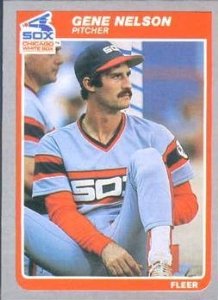
#225 – Gene Nelson

genenelson

Name: Gene Nelson

Rank: 225

Position: P

Years With White Sox: 1984-1986

With the White Sox struggling to repeat as AL West Champions in 1984, they swung a deal with the Mariners on June 27 to swap relief pitchers, sending Salome Barojas out west in exchange for Jerry Don Gleaton and Gene Nelson.  Nelson, who had been in Triple A for the Mariners, came to the big leagues with the White Sox and split his time between the rotation and bullpen, starting 9 of his 20 appearances.

In 1985, Nelson was penciled in to work strictly out of the pen.  “It was tough to adjust after starting for so long,” he said.  “It was a matter of learning the mental parts of the game in the bullpen.”  However, an injury to Richard Dotson and the ineffectiveness of Bruce Tanner forced manager Tony LaRussa to move Nelson back in to the rotation in early July.  By year’s end, Nelson had completed his first full big league season with 46 appearances, 18 of them as a starter.

1986 saw Nelson back in the bullpen full time, save one emergency start due to the death of Tom Seaver’s mother.  He appeared in a career-high 54 games and posted his best ERA to date.  In December, the White Sox packaged Nelson with Bruce Tanner and sent him to the A’s in exchange for second baseman Donnie Hill.

Nelson’s numbers in a White Sox uniform, both for games I attended and overall, were: Continue reading →

#305 – Tim Lollar

timlollarName: Tim Lollar

Rank: 305

Position: P

Year With White Sox: 1985

Tim Lollar was acquired by the White Sox in December of 1984 from the Padres along with Bill Long, Luis Salazar, and a minor league shortstop named Ozzie Guillen in exchange for 2 minor leaguers and former Cy Young award winner LaMarr Hoyt.  Lollar started the 1985 campaign in the rotation for the South Siders, but by late May, his spot was getting skipped and he started getting work out of the bullpen.  It seemed that his time with the White Sox would be short.

Trade rumors around Lollar started swirling in June, with the Red Sox looking like a likely landing spot.  Initial reports had Boston offering Wade Boggs, Bruce Hurst and Mark Clear in exchange for Richard Dotson and Luis Salazar.  The White Sox countered with Lollar, Salazar and a relief pitcher for Boggs.  While a blockbuster involving the future Hall of Famer obviously never materialized, the two Soxes eventually came to a meeting of the minds on Lollar, with him heading to Boston in early June in exchange for outfielder Reid Nichols.

Lollar’s numbers in a White Sox uniform, both for games I attended and overall, were: Continue reading →

#318 – Bruce Tanner

Bruce_Tanner_(White_Sox)_8

Name: Bruce Tanner

Rank: 318

Position: P

Year With White Sox: 1985

Bruce Tanner, the son of former White Sox manager Chuck Tanner, spent his entire major league career with the White Sox during the 1985 season.  He was the team’s 4th round draft pick in 1983 and made his major league debut nearly 2 years later, subbing for an injured Richard Dotson, on June 12, 1985, picking up the victory against the Mariners in Seattle.  Tanner appeared in 9 more games for the big league club over the year, finishing with a 5.33 ERA.

Tanner spent the entire 1986 season back in Triple A Buffalo, where he finished with a losing record.  Following the season, he was sent to Oakland as the player to be named later to complete the earlier trade that brought Donnie Hill to the White Sox in exchange for Gene Nelson.

Tanner’s numbers in a White Sox uniform were:

Continue reading →