By The Numbers – 61

In 1929, uniform numbers appeared on the back of baseball jerseys for the first time, thanks to the Indians and the Yankees.  By 1937, numbers finally appeared across all uniforms, both home and away, across both major leagues.  Since that time, 81 distinct numbers have been worn by members of the White Sox, while the Cubs boast 76.

Today, we continue our look at those players, picking our favorite, if not the best, player to wear each uniform number for both Chicago teams with #61.  18 players have donned #61 while playing in Chicago, 12 for the White Sox and 6 for the Cubs.

Joel McKeon was the White Sox first round pick in the 1982 draft and made his debut in 1986, where he appeared in 30 games out of the bullpen and had a rather successful 2.45 ERA.  His 1987 season, however, was much less successful, with his ERA jumping to 9.43 and, the following February, McKeon was shipped off to the Padres to complete an earlier trade.  While McKeon, the first #61 in White Sox history, did little to make himself memorable on a real baseball diamond, his 1986 appearance with Buffalo, the then Triple A affiliate of the White Sox, made him a superstar of our Micro League Baseball league, where he dominated as a stalwart of the team belonging to my friend Dave.

Backup catcher Babe Phelps, the first player to don #61 for the Cubs, hit .286 in his 2 seasons with the Cubs.  And no, I don’t mean his average across those 2 seasons was .286.  I mean he finished both seasons, 1933 and 1934, with a .286 average.  He would go on to more success with the Dodgers later in the decade, earning MVP votes in 1936 and earning three straight All Star nods from 1938-1940.
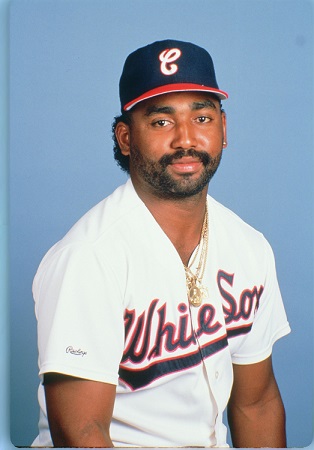
#42 – Ivan Calderon

Name: Ivan Calderon

Rank: 42

Position: RF/LF

Years With White Sox: 1986-1990, 1993

Acquired from the Mariners as the player to be named later from an earlier trade for Scott Bradley, Ivan Calderon joined the White Sox on July 1, 1986.  After spending some time in Triple A Buffalo, Calderon was called up to the big leagues, appearing in 13 games and hitting .303.

Taking over as the every day right fielder in 1987, Calderon put up impressive offensive numbers.  He hit .293 with a career high 28 home runs and .888 OPS.  He made one of the defensive plays of the year on July 27 at Tiger Stadium.  Playing left field, he jumped on top of the mini scoreboard at the bottom of the fence to rob Alan Trammel of a home run.

An injured shoulder cut short Calderon’s season in 1988, as he was placed on the disabled list on August 1 and missed the remainder of the year.  Appearing in only 73 games, he managed to hit only 14 home runs while his average dropped to .212.

A healthy Calderon returned in 1989, but the shoulder injury seemed to have sapped him of much of his power.  He appeared in 157 games and totaled 622 at bats, but managed to only hit 14 home runs, equaling his total from the injury shortened season the year before and falling well below his career high in 1987.  1990 was more of the same, with the third straight season of 14 home runs, but he did manage a career high 44 doubles.

Following the season, he was traded, along with Barry Jones, to the Expos for future Hall of Famer Tim Raines, Jeff Carter, and a player to be named later.  He returned to the White Sox on August 31, 1993 as a free agent.  He appeared in only 9 games over the final month of the season, hitting an anemic .115 no home runs and 3 RBIs.  He was left off the playoff roster and, after the season came to an end, he decided to retire at the age of 31.

Sadly, 10 years later, on December 27, 2003, he was murdered in a bar in his native Puerto Rico.

Calderon’s numbers in a White Sox uniform, both for games I attended and overall, were:

Continue reading →

#56 – Daryl Boston

bostonName: Daryl Boston

Rank: 56

Position: CF

Years With White Sox: 1984-1990

Daryl Boston was selected by the White Sox as the 7th pick in the 1st round of the 1981 draft.  He made his major league debut on May 13, 1984 in the White Sox 8-1 victory against the Rangers, going 3-5 with 2 RBIs and a stolen base while leading off and playing center field.  He ended up appearing in 35 games for a White Sox team that failed to follow up on their success of the previous year, hitting an anemic .169.

Boston split the 1985 season between Triple A Buffalo and Chicago, appearing in 95 games for the White Sox.  He managed to improve his average to .228 with the increased playing time.

1986 again saw Boston splitting time between Triple A and the big leagues.  On October 4th, he hit the 50th and final home run given up by Bert Blyleven during the season, setting the major league record.  He finished the year with 56 appearances, hitting .266 with 5 home runs.

Boston spent the majority of the 1987 season in Chicago, hitting .258 with 10 home runs in 337 at bats.  1988 was his first full season in the major leagues, but he struggled, hitting only .217 but setting a career high with 15 home runs.

Boston rebounded in 1989, raising his average to .252, but hitting only 5 home runs in 101 appearances.  1990 saw his White Sox career come to an end, appearing in 5 games and getting only one at bat before being placed on waivers towards the end of April and being selected by the Mets.

Boston rejoined the White Sox organization in 2001 as a roving minor league instructor.  In 2013, he became the first base coach for new manager Robin Ventura, a role he remains in to this day.

Boston’s numbers in a White Sox uniform, both for games I attended and overall, were:

Continue reading →

#318 – Bruce Tanner

Bruce_Tanner_(White_Sox)_8

Name: Bruce Tanner

Rank: 318

Position: P

Year With White Sox: 1985

Bruce Tanner, the son of former White Sox manager Chuck Tanner, spent his entire major league career with the White Sox during the 1985 season.  He was the team’s 4th round draft pick in 1983 and made his major league debut nearly 2 years later, subbing for an injured Richard Dotson, on June 12, 1985, picking up the victory against the Mariners in Seattle.  Tanner appeared in 9 more games for the big league club over the year, finishing with a 5.33 ERA.

Tanner spent the entire 1986 season back in Triple A Buffalo, where he finished with a losing record.  Following the season, he was sent to Oakland as the player to be named later to complete the earlier trade that brought Donnie Hill to the White Sox in exchange for Gene Nelson.

Tanner’s numbers in a White Sox uniform were:

Continue reading →

#322 – Joe DeSa

joedesaName: Joe DeSa

Rank: 322

Position: 1B

Year With White Sox: 1985

Joe DeSa joined the White Sox organization following the 1983 season.  After a strong spring training in 1985, he broke camp with the big league club.  With Greg Walker established at first base, DeSa was soon optioned back to Triple A Buffalo in order to get regular playing time.  He got another chance in August when Walker strained a knee and it became clear that Oscar Gamble’s usefulness to the team had run its course.  “I liked what Oscar did for the team,” manager Tony La Russa said.  “But he became the odd man out. Plus, DeSa has earned his shot.”

DeSa returned to Buffalo in 1986 and had another good year, being named the team MVP, but he was unable to make it back to the major leagues even with Greg Walker sidelined for half the year with a wrist injury, having been passed by Russ Morman and Bobby Bonilla.  Following the season, DeSa was released.

Sadly, DeSa would never get another chance to make it to the major leagues.  While participating in the Puerto Rican Winter League that December, DeSa died in a car accident.

DeSa’s numbers in a White Sox uniform, both for games I attended and overall, were: Continue reading →