So Long, Skipper

Former White Sox manager Jeff Torborg, who was suffering from Parkinson’s disease, died at the age of 83.  Torborg took over the White Sox following the 1988 season, replacing Jim Fregosi.  It was a tough go for the rebuilding White Sox, who finished with a record of 69–92, giving them a last place finish in the AL West.

Things got significantly better in 1990, when the young White Sox surprised the world, going 94-68 in their final season at Comiskey Park and finishing in second behind the A’s.  The 25-game improvement earned Torborg the Manager of the Year award.  As the White Sox opened the new Comiskey Park II across the street in 1991, they posted another second-place finish.  Following the season, Torborg bolted to the Mets, getting a hefty pay raise.

Torborg ended his tenure on the South Side at fifteen games over .500 and became a mentor to future manager Ozzie Guillen.  His son Dale was a roving strength and conditioning coordinator for the White Sox from 2004-22.

By The Numbers – 44

In 1929, uniform numbers appeared on the back of baseball jerseys for the first time, thanks to the Indians and the Yankees.  By 1937, numbers finally appeared across all uniforms, both home and away, across both major leagues.  Since that time, 81 distinct numbers have been worn by members of the White Sox, while the Cubs boast 76.

Today, we continue our look at those players, picking our favorite, if not the best, player to wear each uniform number for both Chicago teams with #44.  57 different players have donned #44 while playing in Chicago, 39 for the White Sox and a mere 18 for the Cubs.

Anthony Rizzo was acquired by the Cubs on January 6, 2012, the first piece of the rebuilding puzzle that Theo Epstein and Jed Hoyer brought to Chicago after their hiring.  He started the 2012 season in Triple A, but eventually earned the promotion and took over first base,  In 2014, he earned his first All Star nod and his first MVP votes.  In 2015, as the Cubs made a surprising run to the NLCS, Rizzo led the league in games and plate appearances and placed fourth in MVP voting.

In 2016, Rizzo replicated his fourth place MVP finish while also picking up a Gold Glove and a Silver Slugger award as he helped lead the Cubs to their first World Series title in 108 years.  On Opening Night in 2017, he walked the Commissioner’s Trophy on to the field (following a long rain delay).  He finished that year with more MVP attention as the Cubs made their third straight NLCS, losing to the Dodgers.  Rizzo added 3 additional Gold Gloves to his collection from 2018 – 2020.  The shine rubbed off of Rizzo a little in June of 2021, as he announced, on the day Chicago opened back up from COVID restrictions, that he had decided not to get vaccinated, leaving the Cubs as one of 8 teams still under restrictions for failing to reach the 85% plateau.  He was then, of course, traded to the Yankees and, just this morning, was placed on the IL with COVID.

On the other side of town, Dan Pasqua donned #44 after being acquired from the Yankees for Richard Dotson following the 1997 season.  His first season with the White Sox ended with a career high 20 home runs despite a disappointing .227 average, but a broken wrist suffered during the first week of the 1989 season limited him to just 73 games and 11 home runs.  Pasqua lost his regular slot in the lineup in 1990, as manager Jeff Torborg decided to start Sammy Sosa every day.  He appeared in 112 games, but had only 325 at bats despite a .274 average.

1991 saw Pasqua appear in a career high 134 games, with a .259 average and 18 home runs, his highest total since 1988.  A hamstring injury reduced Pasqua’s playing time again in 1992 and, with George Bell and Bo Jackson splitting time at DH in 1993, Pasqua again was the odd man out.  Pasqua’s 1994 season was cut short by arthroscopic knee surgery in May, which limited him to just 11 appearances and only 23 at bats, and he decided to retire after the season.

#59 – Dan Pasqua

pasquaName: Dan Pasqua

Rank: 59

Position: OF/1B/DH

Years With White Sox: 1988-1994

Following the 1987 season, Dan Pasqua, along with Steve Rosenberg and Mark Salas, was acquired by the White Sox from the Yankees for Richard Dotson and Scott Nielsen.

His first season with the White Sox ended with a career high 20 home runs despite a disappointing .227 average.  A broken wrist suffered during the first week of the 1989 season limited Pasqua to just 73 games, where he improved his average to .248, but only 11 home runs.

Pasqua lost his regular slot in the lineup in 1990, as manager Jeff Torborg decided to start Sammy Sosa every day.  He appeared in 112 games, but had only 325 at bats despite a .274 average.  1991 saw Pasqua appear in a career high 134 games, with a .259 average and 18 home runs, his highest total since 1988.

Pasqua saw his playing time reduced again in 1992, thanks in part to a hamstring injury that put him on the shelf for nearly a month.  His average dropped to .211 and he managed only 6 home runs.  With George Bell and Bo Jackson splitting time at DH in 1993, Pasqua again was the odd man out.  He appeared in only 78 games and his average fell again to .205.  He appeared in 2 games of the ALCS against the Blue Jays and went hitless in 6 at bats.

Pasqua’s 1994 season was cut short by arthroscopic knee surgery in May, which limited him to just 11 appearances and only 23 at bats.  When the season was called off due to the strike, he became a free agent and decided to retire.

Pasqua’s numbers in a White Sox uniform, both for games I attended and overall, were:

Continue reading →

#88 – Steve Lyons

stevelyons

Name: Steve Lyons

Rank: 88

Position: 3B/OF

Years With White Sox: 1986-1990

Steve Lyons was acquired by the White Sox at the end of June in 1986 in the deal that sent Tom Seaver to the Red Sox.  “I’ve liked him since he came into professional baseball,” GM Ken Harrelson said.  “The only reason we were able to get him is that Boston is in a divisional race.”  Lyons appeared in 42 games for the White Sox following the trade, starting 35 of them, and hit a disappointing .203 while finding his way into manager Jim Fregosi’s doghouse.

Lyons saw his average improve in 1987, though it didn’t necessarily add up to additional playing time.  Splitting time between Hawaii and Chicago, he appeared in only 76 games and saw a mere 193 at bats.

With an improved relationship with Fregosi in 1988, Lyons stepped in to become the regular third baseman after the Kenny Williams experiment came to an end in May.  While his offense was serviceable enough, he struggled defensively, finishing the year with 25 errors.  “It’s a huge embarrassment,” Lyons conceded.  “I’m just not doing the job. I hate to think that our pitchers are scared of me playing third base, but that would be a natural thought.”

1989 saw Lyons move primarily to second base.  The biggest moment of his season came at Yankee Stadium in June when a woman ran onto the field and accosted Lyons in the on-deck circle, giving him a big kiss.  He finished the year hitting .264 with a career high 50 RBI.

With the White Sox returning to contention in 1990, Lyons saw himself out of a starting job.  He clashed with new manager Jeff Torborg over his diminished playing time, due to the arrival of Robin Ventura at third base and the commitment to Scott Fletcher at second base.  He managed some late-inning duty at first base, until Frank Thomas joined the big league club in August.  In his new role, his average dropped to .192.  The most famous, or infamous, moment of his career came on July 16 against the Tigers, when, after sliding into first base for a bunt single, he lost track of where he was and dropped his pants to remove the dirt from his slide.  He quickly raised them back up, but the damage was done and a legend was born.

Despite his clashes with Torborg, Lyons managed to break camp with the White Sox in 1991, but lasted 4 games into the season, without getting in to any of them, before being released to make room for Charlie Hough, who was coming off the disabled list.  “I started seeing there wasn’t an opportunity for me to get on the field anywhere,” said Lyons.  “They had other guys to do the same kind of things that I was going to do.”

Lyons’ numbers in a White Sox uniform, both for games I attended and overall, were:

Continue reading →

#207 – Cory Snyder

30ebeb65e2762775597c9ab7e1ebe22eName: Cory Snyder

Rank: 207

Position: 1B/OF

Year With White Sox: 1991

Former Olympian Cory Snyder joined the White Sox on December 4, 1990 via a trade with the Indians in exchange for pitchers Shawn Hillegas and Eric King.  Things did not go smoothly for Snyder in Chicago, as he clashed with manager Jeff Torborg over playing time and with hitting coach Walt Hriniak over his approach at the plate.

“I was a power guy who had some strikeouts but I drove in runs,” Snyder would say years later.  “I wasn’t a line drive hitter. The Sox organization expected me to work with him. He was a lot different from Charlie Lau. Basically it was Walt’s way or the highway.”

On July 15, Snyder was hitting .188 and had only 3 home runs and 11 RBI.  Wi

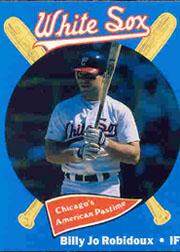
#213 – Billy Jo Robidoux

bjrName: Billy Jo Robidoux

Rank: 213

Position: 1B

Year With White Sox: 1989

Billy Jo Robidoux signed a minor league deal with the White Sox following the 1988 season and was a non-roster invitee to spring training in 1989.  Despite hitting a robust .143 during Grapefruit League play, he managed to impress manager Jeff Torborg, who decided to add Robidoux to the roster and bring him north with the big league club.  “I like Billy in pinch-hitting roles,” Torborg said.  “He makes contact.”

To say Robidoux squandered his opportunity may be putting it lightly.  He managed just 5 hits and 1 RBI in 39 at bats before being sent down to Triple A on May 7.  He would not return.  Following the season, he was allowed to leave the organization as a free agent.

Robidoux’s numbers in a White Sox uniform were:
Continue reading →

#286 – Shawn Hillegas

51DBnfWtm+L._SY300_

Name: Shawn Hillegas

Rank: 286

Position: P

Years With White Sox: 1988-1990

Shawn Hillegas joined the White Sox on August 30, 1988 from the Dodgers in exchange for Ricky Horton.  He made his White Sox debut on September 6, taking the place of an injured Jack McDowell in the starting rotation.  Hillegas ended up starting six games that September, going 3-2 with a 3.15 ERA.

Hillegas broke camp in 1989 as part of the starting rotation, but he struggled early, going 1-6 by May.  Hillegas went to manager Jeff Torborg and asked to be used in relief.  “I told him I didn’t feel like I was doing the job starting,” Hillegas told the Chicago Tribune. “I’m putting the team behind in the game.”  Hillegas moved to the bullpen, where he made 37 appearances, and finished the year with an ERA of 4.74.

Hillegas spent most of 1990 at Triple A Vancouver, only making 7 appearances for the big league club.  That December, he was packaged, along with fellow pitcher Eric King, to the Indians in exchange for Cory Snyder.

Hillegas’ numbers in a White Sox uniform were:

Continue reading →