By The Numbers – 29

In 1929, uniform numbers appeared on the back of baseball jerseys for the first time, thanks to the Indians and the Yankees.  By 1937, numbers finally appeared across all uniforms, both home and away, across both major leagues.  Since that time, 81 distinct numbers have been worn by members of the White Sox, while the Cubs boast 76.

Today, we continue our look at those players, picking our favorite, if not the best, player to wear each uniform number for both Chicago teams with #29.  85 different players have donned #30 while playing in Chicago, 35 for the White Sox and 50 for the Cubs.

Jack McDowell, selected as the fifth overall pick in the 1987 draft, switched to #29 when, after spending the entire 1989 season in Triple A, he returned to the majors for good in 1990, helping to lead a surprising White Sox team to a 94-68 record and a season long battle with the A’s for the AL West crown.  McDowell finished with a 14-9 record and a 3.82 ERA and nearly doubled his strikeout total from 1988 in only about 50 more innings.  Expectations were high as the White Sox moved into their new stadium in 1991 and McDowell was up to the challenger, earning his first All Star game selection on his way to a 17-10 record and a 3.41 ERA, good enough for a 9th place finish in Cy Young Award voting.

1992 was even better for McDowell.  He earned his second straight All Star Game nod, pitching a scoreless second inning and retiring Fred McGriff, Terry Pendleton, and Andy Van Slyke in order.  He ended up with a 20-10 record and a 3.18 ERA, good enough for a 2nd place finish in Cy Young Award voting, behind Dennis Eckersley, and 19th place in MVP voting.  Everything came together for the White Sox and McDowell in 1993.  As the team ran off to their first division title in a decade, McDowell led the league with 22 victories and 4 shutouts, ending at 22-10 with a 3.37 ERA.  He nabbed his 3rd straight All Star selection, earning the victory while throwing a scoreless 5th inning, and finally claimed his first Cy Young Award.  He also finished 9th in MVP voting, behind teammate Frank Thomas.  McDowell made 2 starts during the ALCS against the Blue Jays, losing both and giving up 10 runs total in 9 innings pitched.

The 1994 season again had high expectations for the White Sox and McDowell.  Unfortunately, those expectations would be squashed, not on the field, where the White Sox held first place in the newly formed AL Central division, but in the boardrooms, where the end of the 1994 season and the post season were cancelled due to a work stoppage.  In just 25 starts, his fewest since 1987, McDowell went 10-9 with a 3.73 ERA.  In December, with the 1995 season in doubt, McDowell was traded to the Yankees, for Keith Heberling and a player to be named later who turned out to be Lyle Mouton.

On the north side of town, the Cubs were surprise contenders in the 2001 season.  Looking to improve their chances of making the post-season, they acquired Fred McGriff from the Devil Rays.  Wearing #29, the Crime Dog held up his part of the bargain down the stretch, putting up a .942 OPS with 12 home runs in 49 games with the Cubs.  Unfortunately, the pitching did not hold up as the Cubs went 23-28 in August and September, finishing five games behind the Astros and Cardinals.  At age 38, McGriff returned to the Cubs in 2002, posting a .858 OPS and 125 OPS+ to go along with 30 homers and 103 runs batted in.  The rest of the Cubs, however, were butt, going through thee managers and finishing with a 67-95 record.  McGriff became a free agent following the season.
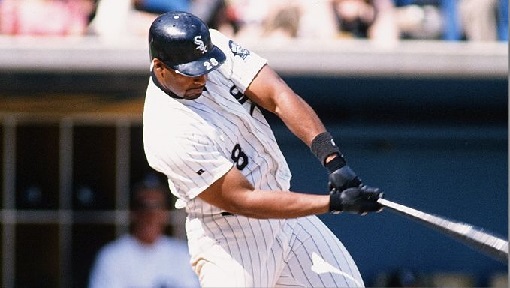
#12 – Jack McDowell

Name: Jack McDowell

Rank: 12

Position: P

Years With White Sox: 1987-1988, 1990-1994

Jack McDowell was selected as the fifth overall pick in the 1987 draft by the White Sox.  After 6 appearances split between Rookie ball and AA, he made his major league debut September 15, throwing 7 shutout innings and earning the win against the Twins at Comiskey Park.  He made 3 more starts to finish out the season, ending with a 3-0 record, a 1.93 ERA, and a seemingly bright future on the South Side.

In 1988, the success McDowell saw in his first stint in the big leagues was hard to find.  In 158.2 innings pitched, he struck out only 84 batters while walking 68.  While his ERA was a respectable 3.97, he finished with a 5-10 record.

Injuries, and a 6.13 ERA in 16 starts for AAA Vancouver, kept McDowell out of the big leagues in 1989.  He returned to the majors for good in 1990 and helped lead a surprising White Sox team to a 94-68 record and a season long battle with the A’s for the AL West crown.  McDowell finished with a 14-9 record and a 3.82 ERA and nearly doubled his strikeout total from 1988 in only about 50 more innings.

Expectations were high as the White Sox moved into their new stadium in 1991.  McDowell earned his first All Star game selection on his way to a 17-10 record and a 3.41 ERA.  Those numbers were good enough for a 9th place finish in Cy Young Award voting.

1992 was even better for McDowell.  He earned his second straight All Star Game nod, pitching a scoreless second inning and retiring Fred McGriff, Terry Pendleton, and Andy Van Slyke in order.  When all was said and done, he ended up with a 20-10 record and a 3.18 ERA, good enough for a 2nd place finish in Cy Young Award voting, behind Dennis Eckersley, and 19th place in MVP voting.

Everything came together for the White Sox and McDowell in 1993.  As the team ran off to their first division title in a decade, McDowell led the league with 22 victories and 4 shutouts, ending at 22-10 with a 3.37 ERA.  He nabbed his 3rd straight All Star selection, earning the victory while throwing a scoreless 5th inning, and finally claimed his first Cy Young Award.  He also finished 9th in MVP voting, behind teammate Frank Thomas.  McDowell made 2 starts during the ALCS against the Blue Jays, losing both and giving up 10 runs total in 9 innings pitched.

The 1994 season again had high expectations for the White Sox and McDowell.  Unfortunately, those expectations would be squashed, not on the field, where the White Sox held first place in the newly formed AL Central division, but in the boardrooms, where the end of the 1994 season and the post season were cancelled due to a work stoppage.  In just 25 starts, his fewest since 1987, McDowell went 10-9 with a 3.73 ERA.

In December, with the 1995 season in doubt, McDowell was traded to the Yankees, for Keith Heberling and a player to be named later who turned out to be Lyle Mouton.

McDowell’s numbers in a White Sox uniform, both for games I attended and overall, were:

Continue reading →

#68 – Lyle Mouton

moutonName: Lyle Mouton

Rank: 68

Position: OF

Years With White Sox: 1995-1997

Lyle Mouton joined the White Sox organization on April 22, 1995 as the player to be named later from the December 1994 trade that sent Jack McDowell to the Yankees.  Mouton made his major league debut on June 7, going 0-2 against the Blue Jays.  Mouton impressed over the remainder of the season, hitting .302 in 58 games split between left field and right.

Mouton spent all of 1996 with the White Sox, appearing in 87 games and hitting a robust .294 with an .800 OPS.  Mouton’s production dropped off a bit in 1997, finishing the year with a .269 average.  Following the season, his contract was purchased by the Yakult Swallows of the Japanese league.

Mouton’s numbers in a White Sox uniform, both for games I attended and overall, were:

Continue reading →

A Quarter Century Of Memories Part II

Last week, we looked at the first two regions of memories the White Sox had selected to celebrate the 25th anniversary of US Cellular Field.  Today, we finish the job by looking at the last 2 brackets: Records and Milestones and Honors and More.

records_milestonesThe Records and Milestones region spans the gamut of the 25 years the Comiskey Park II/US Cellular Field has been in service.  Unlike the last 2 regions, I only attended 2 of these 8 games.

We start with the most recent game, from last October, where Chris Sale set the franchise’s single season strikeout total, doing battle against a July 2000 matchup between the Sox and Cardinals, where Frank Thomas surpassed Luke Appling as the franchise’s all time RBI leader with a first inning home run.  I’ll select Thomas’ mark, as it represents a career mark over Sale’s single season record.

The second match-up is between Carlton Fisk breaking Bob Boone’s career record for games caught on June 22, 1991 against Bobby Jenks tying the MLB record for consecutive batters retires with 41, a mark that would be broken by teammate Mark Buehrle 2 years later.

Next, we have the first interleague game between the White Sox and the Cubs on June 16, 1997 versus Jim Thome’s 500th home run, a walk-off against the Angels on September 16, 2007, which just so happened to also be Jim Thome bobblehead day.  How can you beat that kind of drama?

The final battle is between Jack McDowell, picking up his 20th win of the year on September 8, 1992, against Mark Buehrle’s perfect game on July 23, 2009.  Buehrle easily takes this one.

honors_moreFinally, we have the Honors and More region, where I’ve attended at least 5 of the events in the running.

The first match-up is the afternoon in 2010 when Frank Thomas’ #35 was retired going up against the dedication of the Harold Baines statue in 2008.

Next, we have the dedication of the Luis Aparicio and Nellie Fox statues in 2006 versus the Minnie Minoso statue dedication in 2004.

The next match-up is the August 2010 game where the city’s world champions were honored following the Blackhawks winning the Stanley Cup battling the Rolling Stones concert that took place in September of 2002, the last concert to date at the ballpark.

Finally, we have the dedication of Championship Plaza in April 2008 going up against the All Star game in 2003.

None of these match-ups have anything to do with something on the field, so I don’t know how you choose one statue dedication over another.

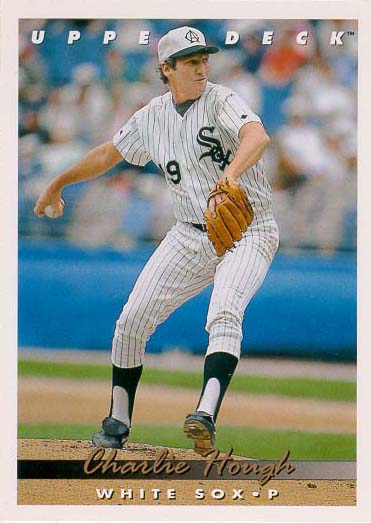
#149 – Charlie Hough

Hough_Charlie_93UD_WhiteSox

Name: Charlie Hough

Rank: 149

Position: P

Years With White Sox: 1991-1992

A month shy of his 43rd birthday, Charlie Hough signed with the White Sox as a free agent in December of 1990.  The knuckleballer filled out the rotation for a White Sox team that had surprising success in 1990 and looked to go further in their new stadium the following year.

Hough ended up going 9-10, failing to win 10 games for the first time since becoming a full-time starter in 1982.  His 4.02 ERA was second to only Jack McDowell in the starting rotation.

Hough returned to the White Sox in 1992.  He improved his ERA slightly to 3.93, but saw his record fall 7-12 in 27 starts.  He moved to the bullpen in August to make room for young starter Wilson Alvarez, but returned to the rotation to replace the struggling Greg Hibbard.

With the Marlins and Rockies joining the league for the 1993 season, the White Sox let Hough become a free agent, with the intention of bringing him back should the team lose a pitcher in the expansion draft.  They didn’t, so Hough signed elsewhere, ironically with the Marlins, ending his White Sox career.

Hough’s numbers in a White Sox uniform were:

Continue reading →

#211 – Ken Patterson

kpattersonName: Ken Patterson

Rank: 211

Position: P

Years With White Sox: 1988-1991

Ken Patterson was acquired by the White Sox in the August 1987 trade that sent Jerry Royster to the Yankees.  He made his major league debut on July 8, 1988, his 24th birthday, in a 10-7 White Sox loss to the Red Sox.  He spent 5 days with the White Sox before returning to Vancouver.  When Ricky Horton was traded to the Dodgers in late August, Patterson was recalled to take his place in the bullpen.  All told, he appeared in 9 games for the 88 White Sox, finishing with a 4.79 ERA.

Patterson made the team out of spring training in 1989 when Jack McDowell was sent back to Triple A for more seasoning.  Patterson would join him on May 21st, when he was sent back down after early struggles with the White Sox.  He returned in early June and stuck with the club for the remainder of the year, appearing in 50 games despite an uncanny inability to get left handers out.  Through August 20, the left handed hurler had “limited” left handed hitters to a .303 average.

Patterson returned to the White Sox bullpen in 1990, where he became the long man, a role he did not particularly care for.  “I don’t like it,” he said in the middle of a stretch that saw him pitch once in 16 days.  “I accept it.  But I don`t like it.”  He eventually moved to a left handed specialist role and, as the White Sox closed down Comiskey Park with a surprising 94 win season, he finished the year with a 3.39 ERA in 43 games.

In 1991, Patterson got off to an auspicious start, getting the first mock standing ovation during  the first game at New Comiskey Park after striking out Pete Incaviglia in the fourth inning.  The previous 7 batters he had faced had all reached base safely in a 16-0 thumping at the hands of the Tigers.  Patterson rebounded, however, and put together arguably his best season as a pro.  He went 3-0 with a career low 2.83 ERA in 43 games.

Despite coming off of his best season, Patterson was in a competition to earn a bullpen spot in 1992.  It was not to be, however.  With spring training winding down, Patterson was packaged along with Sammy Sosa and sent across town to the Cubs in exchange for George Bell.

Patterson’s numbers in a White Sox uniform, both for games I attended and overall, were:

Continue reading →

#226 – Scott Ruffcorn

Scott-Ruffcorn

Name: Scott Ruffcorn

Rank: 226

Position: P

Years With White Sox: 1993-1996

Scott Ruffcorn was the White Sox first round draft pick out of Baylor University in 1991.  The previous 4 White Sox first round picks, Jack McDowell, Robin Ventura, Frank Thomas, and Alex Fernandez, were leading the White Sox to their first division title in a decade when Ruffcorn made his major league debut on June 19, 1993 against the Angels, taking the place of an injured Kirk McCaskill.  When Ron Karkovice separated his shoulder during the game, Ruffcorn was sent back to the minors to make room for another catcher on the roster.  He returned to the majors in September and made two additional appearances.

When Scott Sanderson had a tremendous spring in 1994 to force his way in to the starting rotation, it forced Ruffcorn to start the year in Triple A.  As July rolled around, Sanderson had started to struggle and Ruffcorn was called up to take his slot in the rotation.  Sadly, he didn’t last long, giving up seven runs and nine hits over 4 innings.  Manager Gene Lamont said that Ruffcorn “needed to get over his nervousness,” but his next start also did not go well.  Facing the Royals, he gave up 4 runs before being pulled in the third inning.  He was demoted back to Triple A before the strike in August wiped out the remainder of the season.

After an abbreviated spring training in 1995, Ruffcorn broke camp with the White Sox, earning a spot in the bullpen.  He walked six in 1 2/3 innings against the Red Sox in his second appearance of the year, and by mid-May, he was back in Triple A, with reporter Dave Van Dyck writing that Ruffcorn was “ruined forever because the Sox rushed him to judgment.”

Ruffcorn finished his White Sox career in 1996, appearing in 3 final games but getting the same results.  He ended up with 0 wins and a career ERA of 9.68 and the “record” for most consecutive seasons with an ERA over 7.00.  In January of 1997, he was purchased by the Phillies.

Ruffcorn’s numbers in a White Sox uniform were:

Continue reading →

#286 – Shawn Hillegas

51DBnfWtm+L._SY300_

Name: Shawn Hillegas

Rank: 286

Position: P

Years With White Sox: 1988-1990

Shawn Hillegas joined the White Sox on August 30, 1988 from the Dodgers in exchange for Ricky Horton.  He made his White Sox debut on September 6, taking the place of an injured Jack McDowell in the starting rotation.  Hillegas ended up starting six games that September, going 3-2 with a 3.15 ERA.

Hillegas broke camp in 1989 as part of the starting rotation, but he struggled early, going 1-6 by May.  Hillegas went to manager Jeff Torborg and asked to be used in relief.  “I told him I didn’t feel like I was doing the job starting,” Hillegas told the Chicago Tribune. “I’m putting the team behind in the game.”  Hillegas moved to the bullpen, where he made 37 appearances, and finished the year with an ERA of 4.74.

Hillegas spent most of 1990 at Triple A Vancouver, only making 7 appearances for the big league club.  That December, he was packaged, along with fellow pitcher Eric King, to the Indians in exchange for Cory Snyder.

Hillegas’ numbers in a White Sox uniform were:

Continue reading →