So Long, Skipper

Former White Sox manager Jeff Torborg, who was suffering from Parkinson’s disease, died at the age of 83.  Torborg took over the White Sox following the 1988 season, replacing Jim Fregosi.  It was a tough go for the rebuilding White Sox, who finished with a record of 69–92, giving them a last place finish in the AL West.

Things got significantly better in 1990, when the young White Sox surprised the world, going 94-68 in their final season at Comiskey Park and finishing in second behind the A’s.  The 25-game improvement earned Torborg the Manager of the Year award.  As the White Sox opened the new Comiskey Park II across the street in 1991, they posted another second-place finish.  Following the season, Torborg bolted to the Mets, getting a hefty pay raise.

Torborg ended his tenure on the South Side at fifteen games over .500 and became a mentor to future manager Ozzie Guillen.  His son Dale was a roving strength and conditioning coordinator for the White Sox from 2004-22.

By The Numbers – 41

In 1929, uniform numbers appeared on the back of baseball jerseys for the first time, thanks to the Indians and the Yankees.  By 1937, numbers finally appeared across all uniforms, both home and away, across both major leagues.  Since that time, 81 distinct numbers have been worn by members of the White Sox, while the Cubs boast 76.

Today, we continue our look at those players, picking our favorite, if not the best, player to wear each uniform number for both Chicago teams with #41.  69 different players have donned #41 while playing in Chicago, 28 for the White Sox and 41 for the Cubs, including two future Hall of Famers.

The White Sox claimed Tom Seaver, and his familiar #41, from the Mets on January 20, 1984 as compensation for Dennis Lamp leaving as a free agent.  Seaver was a steady force in the rotation, going 15-11 with a 3.95 ERA in his first go around through the junior circuit.  The highlight of the year came on May 9, when he pitched the final inning of a suspended, 25 inning contest from the day before and then started the regularly scheduled game against the Brewers, earning the victory in both.  With LaMarr Hoyt traded in the offseason, Seaver was on the mound for his 15th opening day in 1985, breaking Walter Johnson’s record of 14 Opening Day starts.  On August 4, back in New York against the Yankees, Seaver threw a complete game to earn his 300th career victory.  He finished the year with a 16-11 record and a sterling 3.17 ERA.  Seaver again got the opening day nod in 1986, extending his record to 16.  With the White Sox going nowhere, Seaver, now 41 years old, was looking to return to the east coast to be near his family after the death of his mother in May.  When a bum shoulder put him on the disabled list, he informed the White Sox he was thinking of retiring.  When manager Tony LaRussa was fired on June 20, his replacement, Jim Fregosi, said Seaver’s wishes should be honored.  On June 29, after going 2-6 with a 4.38 ERA in 12 starts, Seaver was traded to the Red Sox for Steve Lyons.

A young Billy Williams, in his second cup of coffee with the Cubs in 1960, donned #41 for 12 games.  He hit .277 and knocked out his first two career home runs.  The following year, he would switch to his familiar #26, win the Rookie of the Year award, and kick his Hall of Fame career into high gear.

#46 – Tom Seaver

Name: Tom Seaver

Rank: 46

Position: P

Years With White Sox: 1984-1986

Looking to bolster their starting rotation for another run at the AL West crown, the White Sox claimed Tom Seaver from the Mets on January 20, 1984 as compensation for Dennis Lamp leaving as a free agent.  Seaver, upset about leaving New York and his family, contemplated walking away from the game.  “Was retirement a serious option? Sure it was,” Seaver said.  “The first thing I asked the White Sox for was a no-trade contract.  I didn’t want them to make another off-season move and send me 3,000 miles away to Seattle–and I never play an inning in a White Sox uniform.”  Getting the security he desired, Seaver reported to the White Sox.  While the team faltered in 1984, Seaver was a steady force in the rotation, going 15-11 with a 3.95 ERA in his first go around through the junior circuit.  The highlight of the year came on May 9, when he pitched the final inning of a suspended, 25 inning contest from the day before and then started the regularly scheduled game against the Brewers, earning the victory in both.

With LaMarr Hoyt traded in the offseason, Seaver was on the mound for opening day in 1985, breaking Walter Johnson’s record of 14.  On August 4, back in New York against the Yankees, Seaver threw a complete game to earn his 300th career victory.  He finished the year with a 16-11 record and a sterling 3.17 ERA.

Seaver again got the opening day nod in 1986, extending his record to 15.  With the White Sox going nowhere, Seaver, now 41 years old, was looking to return to the east coast to be near his family after the death of his mother in May.  When a bum shoulder put him on the disabled list, he informed the White Sox he was thinking of retiring.  ”Another week or so and I was going home,” Seaver said. ”I made the club aware of that. I was totally, emotionally spent. I had my mom’s death, then my shoulder went on the blink, and there was the LaRussa situation.”  When manager Tony LaRussa was fired on June 20, his replacement, Jim Fregosi, said Seaver’s wishes should be honored.  On June 29, after going 2-6 with a 4.38 ERA in 12 starts, Seaver was traded to the Red Sox for Steve Lyons.

Seaver’s numbers in a White Sox uniform, both for games I attended and overall, were:

Continue reading →

#88 – Steve Lyons

stevelyons

Name: Steve Lyons

Rank: 88

Position: 3B/OF

Years With White Sox: 1986-1990

Steve Lyons was acquired by the White Sox at the end of June in 1986 in the deal that sent Tom Seaver to the Red Sox.  “I’ve liked him since he came into professional baseball,” GM Ken Harrelson said.  “The only reason we were able to get him is that Boston is in a divisional race.”  Lyons appeared in 42 games for the White Sox following the trade, starting 35 of them, and hit a disappointing .203 while finding his way into manager Jim Fregosi’s doghouse.

Lyons saw his average improve in 1987, though it didn’t necessarily add up to additional playing time.  Splitting time between Hawaii and Chicago, he appeared in only 76 games and saw a mere 193 at bats.

With an improved relationship with Fregosi in 1988, Lyons stepped in to become the regular third baseman after the Kenny Williams experiment came to an end in May.  While his offense was serviceable enough, he struggled defensively, finishing the year with 25 errors.  “It’s a huge embarrassment,” Lyons conceded.  “I’m just not doing the job. I hate to think that our pitchers are scared of me playing third base, but that would be a natural thought.”

1989 saw Lyons move primarily to second base.  The biggest moment of his season came at Yankee Stadium in June when a woman ran onto the field and accosted Lyons in the on-deck circle, giving him a big kiss.  He finished the year hitting .264 with a career high 50 RBI.

With the White Sox returning to contention in 1990, Lyons saw himself out of a starting job.  He clashed with new manager Jeff Torborg over his diminished playing time, due to the arrival of Robin Ventura at third base and the commitment to Scott Fletcher at second base.  He managed some late-inning duty at first base, until Frank Thomas joined the big league club in August.  In his new role, his average dropped to .192.  The most famous, or infamous, moment of his career came on July 16 against the Tigers, when, after sliding into first base for a bunt single, he lost track of where he was and dropped his pants to remove the dirt from his slide.  He quickly raised them back up, but the damage was done and a legend was born.

Despite his clashes with Torborg, Lyons managed to break camp with the White Sox in 1991, but lasted 4 games into the season, without getting in to any of them, before being released to make room for Charlie Hough, who was coming off the disabled list.  “I started seeing there wasn’t an opportunity for me to get on the field anywhere,” said Lyons.  “They had other guys to do the same kind of things that I was going to do.”

Lyons’ numbers in a White Sox uniform, both for games I attended and overall, were:

Continue reading →

Franchise Four – AL West

Major League Baseball is asking its fans to vote for the four most impactful players who best represent the history of each franchise.  The winners will be announced in July at the All Star Game in Cincinnati.  Today, I will give my Franchise Four picks for the American League West.

F4Astros

The Astros, around since 1962, have 2 obvious options, and both are from their World Series team in 2005: Craig Biggio and Jeff Bagwell.  After that, there is a bit of a drop off.  Nolan Ryan would seem to be a good pick for the third slot, having spent more years with the Astros than with any other team.  For the last slot, I’ll go with J. R. Richard, whose career was cut short due to a stroke, but still came to represent the franchise in the late 70s.

F4Angels

Despite existing since the 1961 season, the Angels have a complete lack of star power in their 8 nominees.  Garret Anderson?  Tim Salmon?  Brian Downing?  While fine players, none of them would be confused with an all time great.  Of the remaining 5, I will dump Jim Fregosi and take Chuck Finley, Nolan Ryan (again!), Vladamir Guerrero, and, despite being in only his 4th season, Mike Trout.

F4As

Continue reading →

#157 – Bob James

jamesName: Bob James

Rank: 157

Position: P

Years With White Sox: 1985-1987

Bob James was acquired by the White Sox on Decmber 7, 1984 from the Expos in exchange for Vance Law.  James was installed as the team’s closer for 1985 and helped to return the White Sox to a contending club.  Manager Tony La Russa said, “We’ve had a decent bullpen since I’ve been here, but, with Bob, our bullpen can compare with anybody’s in the league.”  Broadcaster, and Hall of Fame pitcher, Don Drysdale agreed.  “They have a guy down in the bullpen now who they haven’t had for quite a few years. . .a stopper,” Drysdale said.  “Without James, I don’t know where they would be.”

The White Sox finished the season in 3rd place, with an 85-77 record, but James finished with an 8-7 record, a 2.13 ERA, and 32 saves, behind only Royals reliever Dan Quisenberry.  Things appeared to be looking up for the White Sox heading in to the 1986 season.

Sadly, things went a bit crazy in 1986, both for James and the White Sox.  While new GM Hawk Harrelson turned the organization on its head, James lost any semblance of effectiveness that he had showed the previous year.  In early August, James went down with triceps issues and was lost for the season.  His final numbers were nightmarish: a 5-4 record but an ERA of 5.25 and only 14 saves in 49 appearances.

James continued to struggle in 1987, and in May, he lost his position as the team’s closer.  “I told him he`s not throwing as well as he could be,” manager Jim Fregosi said.  “I’m going to use him as a long man so he can get back to where he`s throwing well.”  Shoulder problems put him out of commission in July, and he finished the season with a 4-6 record and a 4.67 ERA.

The White Sox released James in December, but looked to resign him to an incentive-laden deal the following spring.  “We’ve had several talks with him,” general manager Larry Himes said.  “He’s looking at other places. The Sox are interested, but he knows the conditions. We’re willing to pay for performance. Bob James has not performed up to our expectations the last couple years.”  James ended up not signing with the White Sox, or anyone else, and his major league career came to an end.

James’s numbers in a White Sox uniform, both for games I attended and overall, were:

Continue reading →
#181 – Dave Gallagher

140-532FrName: Dave Gallagher

Rank: 181

Position: CF

Years With White Sox: 1988-1990

Dave Gallagher was ready to walk away from baseball when he joined the White Sox as a minor league free agent on December 7, 1987.  Gallagher was given a non-roster invite to spring training in 1988, where he sought out manager Jim Fregosi and laid it all out on the line.  “I told him, ‘You don’t know me from anybody, but I’d really appreciate it if you could take me to every possible game,” Gallagher said.  “I’m towards the end of my run and if I don’t make it, I’m done.’”

Gallagher had a strong spring, and the final roster spot came down to him or Gary Redus.  When the White Sox were unable to trade Redus, he made the team and Gallagher was sent to Triple A Vancouver.  He hit .336 over the first month of the Triple A season while Lance Johnson hit only .190 with the White Sox, so Gallagher was recalled on May 15.  He went 2 for 3 in his first game and hit a game winning home run in the 11th inning the following day.  He finished the season with a .303 average in 101 games, committed no errors in the outfield, and finished 5th in the American League Rookie of the Year voting.

Things got contentious between Gallagher and the White Sox in 1989.  While Gallagher appeared in every game for the south siders, he battled against team management over his contract.  At the end of June, Gallagher announced that he would file a grievance against the White Sox for refusing to negotiate a contract with him.  “We did have a meeting, and when I left I had the feeling that something was going to happen,” said Gallagher.  “Here we are, late June, almost July, and nothing`s been done.”  Gallagher was hitting over .300 at the time, but had a miserable second half, including a clubhouse argument with GM Larry Himes, and ended up with a .266 average for the year.

Given all of that, Gallagher was not expecting to return to the White Sox in 1990, but return he did, albeit to greatly reduced playing time.  The White Sox tried to move him prior to the trade deadline, but were unable to strike a deal.  2 days later, he was claimed on waivers by the Orioles, drawing his White Sox career to an end.

Gallagher’s numbers in a White Sox uniform were:

Continue reading →

#195 – Dave LaPoint

MP10005566708_P255075_500X500Name: Dave LaPoint

Rank: 195

Position: P

Years With White Sox: 1987-1988

As the trade deadline drew near in July of 1987, the White Sox, 19 games under .500 and battling for last place in the AL West, sent an unknown minor leaguer to the Cardinals in exchange for Dave LaPoint.  3 days later, manager Jim Fregosi gave LaPoint the start against the Brewers, and he responded with 6 hitless innings before faltering in the 7th, getting the win in only his 3rd start of the season.

LaPoint made 11 more starts, alongside 2 relief appearances, down the stretch for the White Sox.  He finished with a 6-3 record and a 2.94 ERA as he headed to free agency.

Mere weeks before spring training began in 1988, LaPoint resigned with the White Sox.  He quickly became the statistical leader of the staff, putting up a 10-11 record with a team-leading 3.40 ERA.  On August 13, little more than a year after he was acquired, LaPoint was traded to the Pirates for reliever Barry Jones.  “I didn’t want to be traded,” LaPoint said at the time.  “This is one place I really wanted to stay.”

LaPoint’s numbers in a White Sox uniform, both for games I attended and overall, were:

Continue reading →

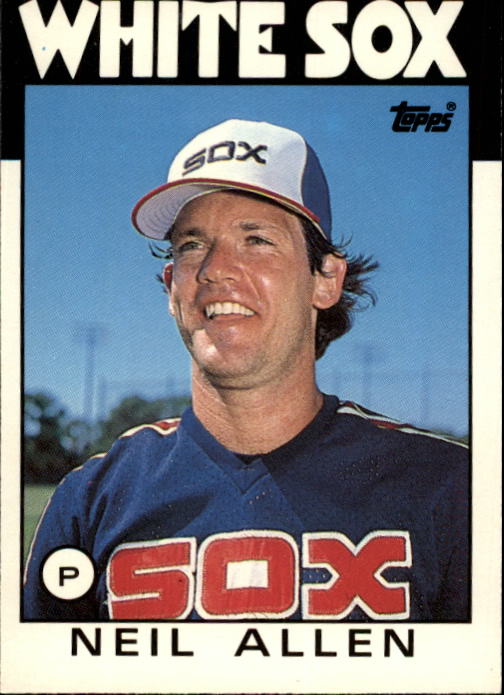
#235 – Neil Allen

frontName: Neil Allen

Rank: 235

Position: P

Years With White Sox: 1986-1987

Neil Allen joined the White Sox on February 13, 1986 along with Scott Bradley and an unknown minor leaguer from the Yankees in exchange for Ron Hassey, Matt Winters, and two additional minor leaguers who would never be heard from.  Allen started the ’86 season in the bullpen, but was given a chance to start after developing an effective offspeed pitch.  He was moved in to the starting rotation on May 4th and put up a 7-2 record with 3.82 ERA before going down with an injury that, for all intents and purposes, ended his season in July.

1987 started with Allen penciled in as manager Jim Fregosi’s third starter.  Things went south quickly, though, as Allen went 0-7 in 10 starts before being banished back to the bullpen.  Things boiled over in a shouting match with Fregosi in early August the led to Allen demanding to be released.  By the end of the month, the White Sox complied with his request, sending him on his way and ending his career on the south side.

Allen’s numbers in a White Sox uniform were:

Continue reading →

So Long, Skipper

FregosiFormer White Sox manager Jim Fregosi, who suffered multiple strokes last weekend during an MLB alumni cruise, was reportedly taken off life support tonight after Twitter rumors of his death circulated earlier this afternoon.  Fregosi took over the White Sox in June of 1986 after general manager Hawk Harrelson fired Tony LaRussa.  “The team is 9 1/2 games out, that’s nothing,” Fregosi said upon being hired.  “I don’t see any reason we can’t turn things around and compete in our division.”  The White Sox did improve slightly under Fregosi, but still finished in 5th place.

Things did not go any better in 1987, when the White Sox again finished in 5th place.  A late season surge lifted the team out of last place in the AL West and saved Fregosi’s job, at least for one more year.  Unfortunately, things got worse in 1988, as the White Sox dropped to 71-90 and their third straight 5th place finish.  GM Larry Himes, who replaced Harrelson and inherited Fregosi, fired him following the season, ending 2 years of an uncomfortable pairing.

Fregosi ended his tenure on the South Side at 36 games under .500, but kept the team steady during threats of moving to Florida and the tumultuous reign of Hawk Harrelson.  Tonight, he ends his tenure on this mortal coil.   May his family enjoy some measure of comfort in this difficult time.