By The Numbers – 33

In 1929, uniform numbers appeared on the back of baseball jerseys for the first time, thanks to the Indians and the Yankees.  By 1937, numbers finally appeared across all uniforms, both home and away, across both major leagues.  Since that time, 81 distinct numbers have been worn by members of the White Sox, while the Cubs boast 76.

Today, we continue our look at those players, picking our favorite, if not the best, player to wear each uniform number for both Chicago teams with #33.  60 different players have donned #33 while playing in Chicago, 22 for the White Sox and 48 for the Cubs, including a World Series champion.

Aaron Rowand joined the White Sox organization in 1998, selected in the first round of the draft.  He earned his first call up to the show on June 15, 2001 and made his major league debut the following day.  He took over as the starting center fielder in 2002 following the mid-season trade of Kenny Lofton.  Rowand switched to #33 in 2003, but earned a return trip to Triple A in 2003 after hitting .133 in his first 60 games.  After a little more than a month, he returned to the big leagues, hitting .387 the rest of the way and ending the season with a .287 average.

2004 was a breakout year for Rowand, becoming a  full time starter for the first time and setting career highs with a .310 average and .905 OPS.  The good times continued in 2005, as he hit .270 with 13 home runs and, defensively, committed only 3 errors in 394 chances.  Rowand went 4 for 10 against the Red Sox in the ALDS, driving in 2 runs and scoring 3 more in the 3 game sweep.  In the ALCS against the Angels, Rowand managed only 3 hits in the 5 game series, all doubles.  He bounced back in the World Series, going 5-17 against the Astros as the White Sox won their first title in 88 years.  Less than a month after the final out of the World Series, Rowand, among others, was traded to the Phillies for Jim Thome.

On the north side of town, a rookie donned #33 when he made his major league debut on July 30th, 1983.  Joe Carter would appear in 23 games for the Cubs that season, hitting .176 without a home run.  He made his biggest mark for the Cubs the following June, when he was packaged, along with Mel Hall, Don Schulze, and Darryl Banks, in a trade with the Indians which netted Ron Hassey, George Frazier and, of course, Rick Sutcliffe.

By The Numbers – 40

In 1929, uniform numbers appeared on the back of baseball jerseys for the first time, thanks to the Indians and the Yankees.  By 1937, numbers finally appeared across all uniforms, both home and away, across both major leagues.  Since that time, 81 distinct numbers have been worn by members of the White Sox, while the Cubs boast 76.

Today, we continue our look at those players, picking our favorite, if not the best, player to wear each uniform number for both Chicago teams with #40.  55 different players have donned #40 while playing in Chicago, 25 for the White Sox and 30 for the Cubs.

Acquired in mid-June, along with George Frazier and Ron Hassey, from the Indians in exchange for Mel Hall, Joe Carter, Don Schulze, and Darryl Banks, Rick Sutcliffe, wearing #40, quickly became the ace of the Cubs staff, going 16-1 with a 2.69 ERA in leading the Cubs to their first division title and his first Cy Young Award.  He then homered in and won Game 1 of the NLCS, the first post-season game at Wrigley Field since the 1945 World Series, before dropping the deciding Game 5 in San Diego.  A free agent after the season, Sutcliffe signed a long term deal with the Cubs.

A hamstring injury limited him to 20 starts in 1985, while arm injuries in 1986 led him to a 5-14 record with a 4.64 ERA in 28 appearances.  He bounced back in 1987, leading the league with 18 wins in 34 starts for the last place Cubs, finishing second in the Cy Young Award voting.  He went 13-14 in 1988, but did somehow manage a steal of home plate on July 29th in a victory against the Phillies.  A resurgence in 1989 helped lead the Cubs to their second divisional title, and he made one start against the Giants in the NLCS.  Recurring arm injuries caused Sutcliffe to miss most of the 1990 and 1991 seasons, with only 24 appearances between the two years, and the Cubs let him leave as a free agent following the 1991 season.

On the other side of town, Wilson Alvarez was acquired by the White Sox, along with Scott Fletcher and Sammy Sosa, for Harold Baines and Fred Manrique on July 29, 1989, making his White Sox debut on August 11, 1991 by throwing an unlikely no hitter against the Orioles at Memorial Stadium.  He made 8 additional starts for the White Sox down the stretch, finishing the year with a 3-2 record and a respectable 3.51 ERA.  1992 saw Alvarez work mostly out of the bullpen, getting only 9 starts out of his 34 appearances.  He posted a career high 1.674 WHIP, giving up 65 walks in just over 100 innings.  This led to an unfortunate 5.20 ERA, despite a 5-3 record.  In 1993, Alvarez managed to break in to the rotation full time.  Despite leading the league with 122 walks, he finished second in the AL with an ERA of 2.95 and ended up with a 15-8 record as the White Sox won the AL West title for the first time in a decade.  He was the winning pitcher in Game 3 of the ALCS, holding the Blue Jays to a single run while throwing a complete game.

Alvarez improved in 1994, earning his first (and only) All Star nod and cutting his walk total nearly in half, helped by the player strike that ended the season in August, and he finished the year with a 12-8 record and a 3.45 ERA.  When baseball returned in 1995, Alvarez struggled to regain his groove, finishing with a losing record for the first time and an ERA of 4.32.  1996 saw a nice bounce back for Alvarez.  While his ERA was still an elevated 4.22, he tied his career high with 15 wins and set career highs for innings pitched and strikeouts.  He continued to impress in 1997, putting up a 9-8 record with a 3.03 ERA by the end of July, when, with the White Sox a mere 3 games back in the standings, he, along with Danny Darwin and Roberto Hernandez, was sent to the Giants for Brian Manning, Lorenzo Barceló, Mike Caruso, Keith Foulke, Bob Howry, and Ken Vining in what would become known as the White Flag Trade.

By The Numbers – 42

In 1929, uniform numbers appeared on the back of baseball jerseys for the first time, thanks to the Indians and the Yankees.  By 1937, numbers finally appeared across all uniforms, both home and away, across both major leagues.  Since that time, 81 distinct numbers have been worn by members of the White Sox, while the Cubs boast 76.

Today, we continue our look at those players, picking our favorite, if not the best, player to wear each uniform number for both Chicago teams with #42.  41 different players donned #42 while playing in Chicago, 18 for the White Sox and 23 for the Cubs, prior to its league-wide retirement for Jackie Robinson in 1997.

Ron Kittle made his major league debut for the White Sox, with #42 on his back, on September 2, 1982, pinch hitting for Aurelio Rodriguez and striking out in the White Sox 6-5 victory over the Rangers at Comiskey Park.  Kittle got sporadic playing time over the final month of the season, earning just 29 at bats in 20 games while hitting .241 with a single home run.  He broke out in a big way in 1983, earning an All Star nod and finishing the year with a team rookie record of 35 home runs while hitting .254 and driving in 100 as the White Sox notched their first division title.  Kittle was knocked out of the ALCS against the Orioles after getting hit by a pitch in Game 3, finishing the series with just 2 hits in 7 at bats, but still easily earned Rookie of the Year honors.

1984 was a bit of a letdown for Kittle, as he failed to perform up to the expectations set the previous year, falling to a .215 average.  His power numbers remained, as he clubbed 32 home runs, but his OPS was down by 70 points.  There was a slight improvement in 1985, with his average improving to .230, but he hit only 26 home runs and drove in just 58 runs in 116 games.  In 1986, Kittle was hitting .213 with 17 home runs at the trade deadline when he, along with Joel Skinner and Wayne Tolleson, were sent to the Yankees for Ron Hassey, Carlos Martinez, and a player to be named later.  He re-signed with  the White Sox prior to the 1989 season, but injuries limited Kittle to just 51 games and, in 169 at bats, he hit .302 with 11 home runs and 37 RBI.  He returned in 1990, seeing his average drop to .245 with 16 home runs in 83 games when, again at the trade deadline, he was sent to the Orioles in exchange for Phil Bradley.  Kittle returned for one final hurrah with the White Sox in 1991, signing as a free agent on June 19 before being released on August 15.  In between, he appeared in 17 games and hit only .191 with 2 home runs.

On the north side, relief pitcher Bruce Sutter wore #42 during his 5 years with the Cubs from 1976 through 1980.  Over that time, he piled up 4 All Star nods, numerous MVP votes, and a Cy Young Award.  However, a lock down All Star closer is a luxury for a team that never managed to finish over .500 during those 5 years, so Sutter was dealt to the Cardinals in December of 1980, for Leon Durham, Ken Reitz, and Ty Waller.

#33 – Ron Kittle

Name: Ron Kittle

Rank: 33

Position: LF/DH

Years With White Sox: 1982-1986, 1989-1990, 1991

Ron Kittle joined the White Sox organization in Septmber of 1978.  He worked his way through the minor leagues before making his major league debut on September 2, 1982, pinch hitting for Aurelio Rodriguez and striking out in the White Sox 6-5 victory over the Rangers at Comiskey Park.  Kittle got sporadic playing time over the final month of the season, earning just 29 at bats in 20 games.  He hit .241 with a single home run.

Kittle, and the White Sox, broke out in a big way in 1983.  While the team charged towards their first division title, Kittle earned an All Star nod and finished the year with a team rookie record of 35 home runs while hitting .254 and driving in 100.  Kittle was knocked out of the ALCS against the Orioles after getting hit by a pitch in Game 3, finishing the series with just 2 hits in 7 at bats.  His season earned him Rookie of the Year honors.

1984 was a bit of a letdown for both Kittle and the White Sox.  While the team failed to perform up to the expectations set the previous year, Kittle did the same, falling to a .215 average.  His power numbers remained, as he clubbed 32 home runs, but his OPS was down by 70 points.  There was a slight improvement in 1985, with his average improving to .230, but he hit only 26 home runs and drove in just 58 runs in 116 games.

In 1986, Kittle was hitting .213 with 17 home runs at the trade deadline when he, along with Joel Skinner and Wayne Tolleson, were sent to the Yankees for Ron Hassey, Carlos Martinez, and a player to be named later.  He rejoined the White Sox a year and a half later, signing as a free agent after the 1988 season.

Injuries limited Kittle to just 51 games in 1989.  In 169 at bats, he hit .302 with 11 home runs and 37 RBI.  He returned in 1990, seeing his average drop to .245 with 16 home runs in 83 games when, again at the trade deadline, he was sent to the Orioles in exchange for Phil Bradley.

Kittle returned for one final hurrah with the White Sox in 1991, signing as a free agent on June 19 before being released on August 15.  In between, he appeared in 17 games and hit only .191 with 2 home runs.

Kittle’s numbers in a White Sox uniform, both for games I attended and overall, were:

Continue reading →

#45 – Britt Burns

Name: Britt Burns

Rank: 45

Position: P

Years With White Sox: 1978-1985

Britt Burns was selected by the White Sox in the third round of the 1978 draft.  Less than 2 months later, Burns made his major league debut, going 5 innings in a losing start against the Tigers in Detroit.  He made one other start, another loss, before returning to the minor leagues.  He finished the year 0-2 with a 12.91 ERA.

Burns spent most of 1979 starting in Double A, before getting promoted to Triple A and then, briefly, back to Chicago.  He made 6 relief appearances, giving up 10 hits in only 5 innings and finishing with a 5.40 ERA.

Burns found himself in the major leagues to stay in 1980 as he moved in to the rotation for the White Sox.  He found his first bit of success at the big league level, going 15-13 with a 2.84 ERA in 34 appearances, 32 of them starts.  He finished 5th in Rookie of the Year voting, earning 4 first place votes.

1981 saw Burns putting up a repeat performance, despite the strike that split the season.  He earned his first, and only, All Star nod and tied for 7th in Cy Young Award voting.  He finished the year 10-6 with a 2.64 ERA.

Burns regressed a bit in 1982.  His record held steady at 13-5, but his ERA rose to 4.04 in only 28 starts.

In 1983, Burns went 10-11 with a 3.58 ERA as the White Sox ran away with the AL West, earning their first division title.  Burns took the mound in game 4 of the ALCS, with the Orioles looking to clinch the series, and threw the game of his life.  Burns threw 9 scoreless innings, but Oriole pitchers Storm Davis and Tippy Martinez stymied the White Sox offense.  With one out in the 10th, Burns gave up a solo home run to Tito Landrum.  He was replaced and the Orioles tacked on 2 additional runs, ending the White Sox season.

Injuries and ineffectiveness led Burns to split time between the rotation and bullpen in 1984.  He went 4-12 with a 5.00 ERA in 34 appearances, 16 of them starts.  He also earned the only 3 saves of his career.

After an offseason conditioning program improved his physical state, Burns bounced back in 1985.  He 18-11 with a 3.96 ERA in 36 appearances, 34 of them starts, both career highs.  He finished tied for 7th in Cy Young Award voting.  Following the year, he was traded to the Yankees, along with 2 minor leaguers, for Joe Cowley and Ron Hassey.

Burns returned to the White Sox organization in 2013 as pitching coach for Double A Birmingham, a position he held through 2015.

Burns’ numbers in a White Sox uniform, both for games I attended and overall, were:

Continue reading →

#125 – Ron Hassey

hassey

Name: Ron Hassey

Rank: 125

Position: C/DH

Years With White Sox: 1986-1987

Ron Hassey was originally acquired by the White Sox, along with Joe Cowley, in a December 1985 trade with the Yankees for Britt Burns and some minor leaguers.  Two months later, just as pitchers and catchers were about to report to spring training, he was traded back to the Yankees, along with Matt Winters and 2 other minor leaguers, for Neil Allen, Scott Bradley, a minor leaguer, and cash.  5 months later, at the trade deadline, he was acquired again by the White Sox, along with Carlos Martinez and a player to be named later, for Ron Kittle, Joel Skinner, and Wayne Tolleson.  Hassey put up good numbers over the last 2 months of 1986, hitting .353 in 49 games, driving in 22 runs and scoring 20 himself.

Following off-season knee surgery, Hassey was limited in 1987.  He once again appeared in 49 games for the White Sox, but this time saw his average fall to .214.  Once the season came to an unsatisfactory end, for both Hassey and the White Sox, he became a free agent.

Hassey’s numbers in a White Sox uniform, both for games I attended and overall, were:

Continue reading →

#143 – Joe Cowley

jcow

Name: Joe Cowley

Rank: 143

Position: P

Year With White Sox: 1986

Joe Cowley joined the White Sox, along with Ron Hassey, in the December, 1985 that sent Britt Burns a couple of minor leaguers to the Yankees.  Cowley stepped in to the rotation and put together a .500 record with a 3.88 ERA.  The highlight of his season came of September 19, when he threw one of the ugliest no-hitters in major league history.  While he held the Angels hitless, he walked 7 and gave up a run on a sacrifice fly.  Cowley also goes down in history as the only pitcher to throw a no hitter in his final major league victory.

The following spring, Cowley was traded to the Phillies, in exchange for Gary Redus, ending his brief White Sox career.

Cowley’s numbers in a White Sox uniform were:

Continue reading →

#146 – Joel Skinner

joelskinnerName: Joel Skinner

Rank: 146

Position: C

Years With White Sox: 1983-1986

Acquired in 1982 by the White Sox as a free agent compensation pick from the Pirates organization, Joel Skinner made his major league debut on June 12, 1983 in a victory over the A’s.  He appeard in only 6 games for the eventual AL West champions, garnering 3 hits in 11 at bats.

Skinner again split time between the minor leagues and the major leagues in 1984, though he had more of a lasting impact at the big league level than the year before.  He appeared in 43 games for the White Sox, struggling at the plate and hitting only .213.

Skinner got another opportunity with the White Sox in 1985, when backup catcher Marc Hill went down with a hip contusion.  He appeared in 22 games and hit a surprising .341.  This convinced incoming general manager Ken Harrelson that he was ready to take over behind the plate in 1986.

To accomodate Skinner, Harrelson had manager Tony LaRussa move Carlton Fisk to left field.  The White Sox stumbled out of the gate and Skinner struggled to hit.  On May 9, with Skinner hitting in the .150s and LaRussa’s job on the line, he moved Fisk back behind the plate and the White Sox proceeded to win 10 of their next 13 games.  Skinner got another chance behind the plate in July when a virus knocked Fisk out of the lineup, but his days with the team were numbered.

As the trade deadline approached at the end of July, Skinner, along with Ron Kittle and Wayne Tolleson, were sent to the Yankees in exchange for Ron Hassey, Carlos Martinez, and a player to be named later, who eventually became Bill Lindsey.

Skinner’s numbers in a White Sox uniform, both for games I attended and overall, were:

Continue reading →

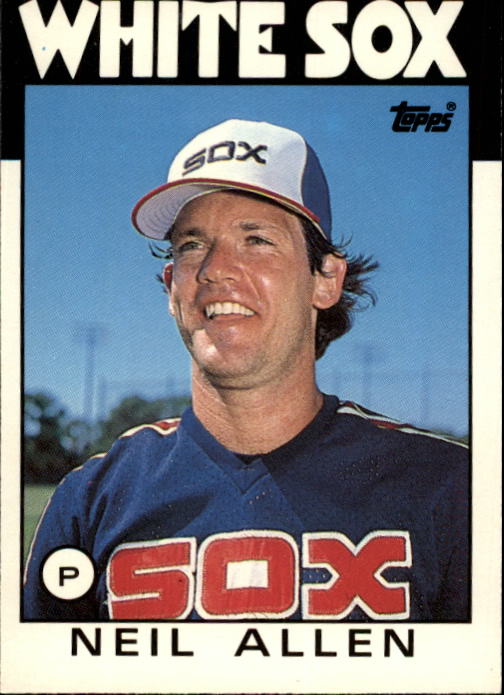
#235 – Neil Allen

frontName: Neil Allen

Rank: 235

Position: P

Years With White Sox: 1986-1987

Neil Allen joined the White Sox on February 13, 1986 along with Scott Bradley and an unknown minor leaguer from the Yankees in exchange for Ron Hassey, Matt Winters, and two additional minor leaguers who would never be heard from.  Allen started the ’86 season in the bullpen, but was given a chance to start after developing an effective offspeed pitch.  He was moved in to the starting rotation on May 4th and put up a 7-2 record with 3.82 ERA before going down with an injury that, for all intents and purposes, ended his season in July.

1987 started with Allen penciled in as manager Jim Fregosi’s third starter.  Things went south quickly, though, as Allen went 0-7 in 10 starts before being banished back to the bullpen.  Things boiled over in a shouting match with Fregosi in early August the led to Allen demanding to be released.  By the end of the month, the White Sox complied with his request, sending him on his way and ending his career on the south side.

Allen’s numbers in a White Sox uniform were:

Continue reading →

#259 – Scott Bradley

scottbradleyName: Scott Bradley

Rank: 259

Position: C

Year With White Sox: 1986

Scott Bradley joined the White Sox on February 13, 1986 along with Neil Allen and a minor leaguer who never sniffed the big leagues from the Yankees in exchange for Ron Hassey, Matt Winters, and two additional minor leaguers who would never again heard from.  Bradley spent the majority of his time with the White Sox in Triple A, earning a promotion to the big league club on May 28th after the release of Marc Hill.  With Carlton Fisk and Joel Skinner also on the roster, Bradley wasn’t going to be limited to catching.  “Wherever they want to play me is fine with me,” Bradley said. “The whole key is being here.”

He wasn’t there for long, though.  On June 26, his short stay in Chicago came to an end when he was traded to the Mariners for a player to be named later, which, 5 days later, became Ivan Calderon.

Bradley’s numbers in a White Sox uniform were:

Continue reading →