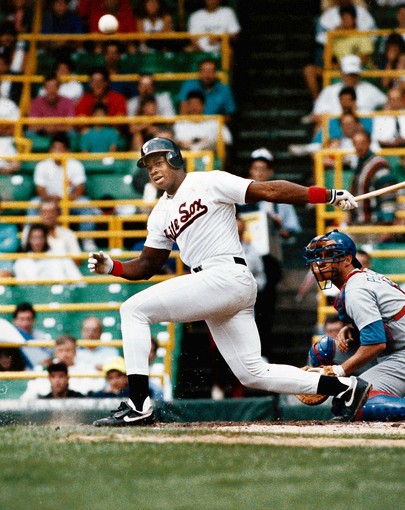
Name: Carlton Fisk
Rank: 6
Position: C
Years With White Sox: 1981-1993
Carlton Fisk became a free agent after the Red Sox failed to tender him a contract for the 1981 season in the proper time frame, and thus he signed with the White Sox on March 18, 1981. He paid immediate dividends for his new team, hitting a 3-run home run in the 8th inning against his former team at Fenway Park on Opening Day, leading the White Sox to a 5-3 victory. Following the strike, he started the All Star game for the AL, going 1-3 with a run scored. He finished the year with a .263 average and only 7 home runs in 96 games. His efforts earned him his first Silver Slugger award.
Fisk enjoyed another successful year in 1982. For the third straight year, he started behind the plate for the AL in the All Star game. In 135 games, he hit .267 with 14 home runs and 65 RBIs.
1983 was a magical season on the South Side, as the White Sox won their first division title. Fisk played a big role in the team’s success, both in managing a pitching staff that featured 2 of the top 4 finishers in Cy Young Award voting and at the plate, where he hit .289 with 26 home runs and 86 RBIs. In the ALCS against the Orioles, Fisk struggled, just like the rest of his teammates, though he did launch 2 home runs in the 4 game series. His season was good enough to earn 3rd place in the MVP vote, coming in behind Cal Ripken and Eddie Murray.
With expectations high, 1984 turned out to be a tough year, for both Fisk and the White Sox, though there were a few high points. On May 9, he caught all 25 innings of a 7-6 win over the Brewers, breaking the major league record of 24 innings shared by 5 players. A little over a week later, on May 16 against the Royals, Fisk became just the third player in White Sox history to hit for the cycle. Unfortunately, injuries befell Fisk, limiting him to just 102 games, finishing with a .231 average and only 43 RBIs. The bright side, though, is that it led him to begin a new training regimen, which he used for the rest of his long career.
The regimen paid immediate dividends, as Fisk put up the best numbers of his career in 1985. At the age of 37, Fisk set career highs with 37 home runs, tying Dick Allen for the White Sox single-season record, and 107 RBIs, while tying his career high with 17 stolen bases. He was voted to his 10th All-Star team, won his second Silver Slugger award and finished 13th in the AL MVP voting.
1986 was a strange year for Fisk and the White Sox. New General Manager Ken Harrelson thought Joel Skinner was ready to take over behind the plate and, with Fisk about to enter his age 38 season, he convinced manager Tony LaRussa to move Fisk to left field. On May 9, with Skinner hitting in the .150s and LaRussa’s job on the line, Fisk was moved back behind the plate and the White Sox proceeded to win 10 of their next 13 games. By the end of the year, Skinner, Harrelson, and LaRussa were all gone, and Fisk remained, putting up a .221 average with 14 home runs and 63 RBIs.
In 1987, with a new management regime in place, Fisk was back behind the plate full time. He appeared in 135 games at age 39, hitting .256 with 23 home runs and 71 RBIs.
1988 looked to be a good year for Fisk, until a broken hand limited him to just 76 games. Despite that, his .277 average, 19 home runs, and 50 RBIs earned him his 3rd Silver Slugger award.
At age 41, Fisk, along with pitcher Jerry Reuss, who was 39, set a record starting the 1989 season, becoming the oldest battery ever to start on opening day, surpassing pitcher Johnny Niggeling and catcher Rick Ferrell of the 1944 Washington Senators, as the White Sox beat the Angels 9-2. Splitting time behind the plate with Ron Karkovice, Fisk appeared in 103 games, hitting .293 with 13 home runs and 68 RBIs.
In 1990, Fisk was the elder statesman on a young White Sox team that unexpectedly challenged the A’s for the division title. On May 22, at Yankee Stadium, Fisk had a run in with two-sport star Deion Sanders. When Sanders drew a dollar sign in the dirt before a pitch, then didn’t run out an easy out, Fisk and Sanders went back and forth, sharing expletives. Later in the game, Sanders told Fisk that “the days of slavery are over,” infuriating Fisk. “He comes up and wants to make it a racial issue — there’s no racial issue involved.” During Sanders’ next at-bat, Fisk told him, “There is a right way and a wrong way to play this game. You’re playing it the wrong way. And the rest of us don’t like it. Someday, you’re going to get this game shoved right down your throat.” Later that year, on August 17, Fisk hit his 328th home run as a catcher, breaking Johnny Bench’s career record. As the team closed out Comiskey Park, Fisk finished the year with a .285 average, 18 home runs, and 65 RBIs, which earned him 15th place in MVP voting.
As the White Sox moved across the street to the new Comiskey Park in 1991, Fisk, at age 43, put together his last season as an everyday catcher. He was named to his 11th, and final, All Star team, becoming the oldest player in MLB history to collect a hit in the mid-summer classic. He finished the year having appeared in 134 games, hitting .241 with 18 home runs and 74 RBIs.
With Ron Karkovice taking over the majority of the work behind the plate, Fisk moved into a backup role in 1992. He appeared in just 62 games, his lowest total since 1974, and hit only .229 with 3 home runs.
1993 looked to be the end of the road for Fisk, though not by his choice. On June 22, at Comiskey Park, Fisk broke Bob Boone’s record for career games caught with his 2,226th game behind the plate. Six days later, Fisk was abruptly released by the White Sox. Fisk was notified of his dismissal in his hotel room in Cleveland, and was ordered to turn in his equipment and fly back to Chicago immediately and alone. To add insult to injury, Fisk, along with former teammate Donn Pall, came to Comiskey Park before game 1 of the ALCS to wish their former teammates well. Sadly, they were both turned away, souring Fisk’s relationship with the organization for years. His career ended with a .189 average in only 25 games, getting a mere 53 at bats.
At the conclusion of this career, he was the all time leader in games caught and home runs for catchers, the all time leader in home runs for the White Sox, the leader in home runs hit after age 40, and the most seasons played as a catcher. His number 72 was retired by the White Sox on September 14, 1997, and he was part of the 2000 Hall of Fame class.
Fisk’s numbers in a White Sox uniform, both for games I attended and overall, were:
Continue reading →
 With the 2024 season officially wrapped up and the offseason now underway, we continue our tour of all of the different baseball stadiums I’ve been to over the years. This week, we head east for a look at the Baltimore Orioles and their stadium that kicked off the retro craze. So, without further ado, let’s take a deeper look at my one game history with Oriole Park at Camden Yards.

 Today, former White Sox outfielder Ken Griffey Jr. takes his place in Cooperstown, alongside Mike Piazza. It has been 2 years since we last looked at the overall leaders amongst Hall of Famers, so let’s check back in with the inclusion of 2 classes worth of Hall of Famers on both sides of the ball for all of the games I’ve attended between 1984 and 2016, starting with the offense.