The Time Of Your Life

After a disastrous 2021 that saw his reunion with the Cubs end with his August release followed by an even worse stint with the Padres, Jake Arrieta called it a career earlier this week.  Arrieta, 36, debuted with the Orioles in 2010.  He was acquired by the Cubs in July of 2013, in what turned out to be one of the best trades in team history, in a trade for Scott Feldman and Steve Clevenger.  He left the Cubs as a free agent after the 2017 season and signed with the Phillies on a 4-year deal.

After being acquired by the Cubs, Arrieta was sent to Triple A, where he made seven starts for Iowa before being recalled to the rebuilding big league club, showing vast improvement over the pitcher he was with the Orioles.  He turned into an ace for the Cubs in 2015, winning the NL Cy Young Award, and was a key contributor to their World Series championship in 2016.  He threw two no-hitters for the team, one in 2015 against the Dodgers and the second in 2016 against the Reds.  Injuries after the 2017 season left him a shell of his former self, but the Cubs rolled the dice for 2021, hoping for a miracle.  Instead, they got a rude awakening, as Arrieta set the team record for highest ERA for a pitcher in a season with at least 20 starts.  He followed up his last game, where he gave up 8 hits and 7 runs in the first inning, with a post-game tirade where he berated a reporter for wearing a mask, which he was required to do by city regulation, during a Zoom press conference.

For a brief period of time during the 2015 and 2016 seasons, Jake Arrieta was the best pitcher in baseball.  He was a key contributor to the 2016 World Series championship, earning him a place in Cubs lore for years to come.  His horrid performance in 2021, both on the field and as a functioning member of society, did little to hurt that standing.  I’m sure later this year or next year, there will be a Jake Arrieta Day at Wrigley Field, where he will rightly be feted as he throws out a first pitch and sings during the 7th inning stretch.

All Time Team Records

After a long lockout and an abbreviated spring training, the 2022 baseball season finally gets underway today, so, to celebrate, it is time once again to look at the all-time team records for games that I have identified as having attended dating back to 1984.  Last year, I tied 2004 for my 5th highest game total of all time and managed to see 25 out of the 30 teams, so there should be some nice changes.  Thanks to a name change, the all-time record of the Cleveland Indians become static moving forward, forever stuck at 4 games over .500.

The White Sox look to once again lead an improving AL Central and move past the ALDS in the post-season, while the Cubs are neither contending nor rebuilding.  The 2022 season should be an interesting one on both sides of town, even more interesting if we are able to see it in person.

All-Time Team Records
Team Name Won Loss Winning Pctg
California Angels 2 0 1.000
Arizona Diamondbacks 14 2 0.875
Florida Marlins 15 8 0.652
Colorado Rockies 10 6 0.625
New York Yankees 17 11 0.607
Boston Red Sox 19 13 0.594
Los Angeles Angels 20 14 0.588
Toronto Blue Jays 15 11 0.577
Philadelphia Phillies 11 9 0.550
Washington Nationals 7 6 0.538
Cleveland Indians 31 27 0.534
Chicago White Sox 335 307 0.522
Chicago Cubs 224 206 0.521
Houston Astros Continue reading →

By The Numbers – 17

In 1929, uniform numbers appeared on the back of baseball jerseys for the first time, thanks to the Indians and the Yankees.  By 1937, numbers finally appeared across all uniforms, both home and away, across both major leagues.  Since that time, 81 distinct numbers have been worn by members of the White Sox, while the Cubs boast 76.

Today, we continue our look at those players, picking our favorite, if not the best, player to wear each uniform number for both Chicago teams with #17.  79 different players have donned #17 while playing in Chicago, 42 for the White Sox and 37 for the Cubs.

Mark Grace moved to his iconic #17 during his rookie campaign in 1988.  He finished second in Rookie of the Year voting while hitting .296 with 7 home runs and 57 RBIs.  In 1989, he garnered some MVP consideration as the Cubs took home a surprising NL East title.  Grace hit .314 with 13 home runs and 79 RBIs during the regular season, before hitting .647 with a 1.799 OPS during the 5 game NLCS against the Giants.

In 1990, Grace began a decade of excellence, collecting the most hits, 1,754, and doubles, 364, of any player during the decade.  He won 4 Gold Glove awards, was named to 3 All Star teams, earned down-ballot MVP support in 3 different seasons.  Following the 2000 season, he left the Cubs, finishing that portion of his career with 2201 hits, 456 doubles, 148 home runs, 1004 RBIs, and a .308 average.

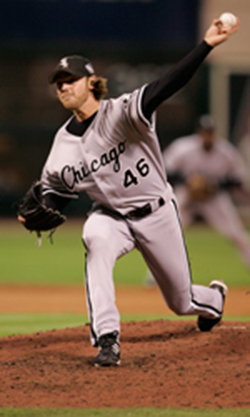
As the White Sox made their run towards the World Series title in 2005, general manager Kenny Williams attempted to acquire Ken Griffey Jr. from the Reds, but was rebuked when Reds ownership decided to veto the deal.  3 years later, with the White Sox again looking to make a run at a division title, he was finally able to acquire the aging superstar at the trade deadline in exchange for pitcher Nick Masset and second baseman Danny Richar.  At the time of the trade, the White Sox held a tenuous 1.5 game lead over the Twins.  Wearing #17, Griffey, who had spent most of the previous few seasons in right field to lessen the strain on his body, moved back to center field for the White Sox, displacing the disappointing Nick Swisher.  Griffey appeared in 41 games for the White Sox, hitting a decent .260 with only 3 home runs and 18 RBI.  His most important contribution came defensively, during the tie-breaking game 163 between the White Sox and the Twins, when he gunned down Michael Cuddyer, who was trying to score on a fly out to center, preserving the shutout and helping the White Sox win the division and advance the playoffs.  In the ALDS, Griffey appeared in 3 games against the Rays, garnering only 2 hits as the White Sox fell 3 games to 1.  Following the season, the White Sox declined Griffey’s $16 million option for 2009, making him a free agent.

Special bonus shout out to outfielder Carlos May, who played with the White Sox from 1968-1976.  May, who wore #17 for his entire White Sox career, is the only player in baseball history to wear his birthday, May 17th, on his jersey.

Against The Reds All Time Leaders – Through 2021

redsIn the past, we’ve looked at the all time leaders in both offensive and defensive categories for all 30 teams.  This offseason, we will take our first ever look at those leaders against all 30 clubs.   We continue today with the Cincinnati Reds.

The Reds began life in 1882 as a charter member of the American Association, joining the National League in 1890.  I’ve seen them play 40 times against 5 different teams at 4 separate stadiums.

Home Runs

Name Total
Derrek Lee 6
Sammy Sosa 3
Aramis Ramirez 3

Hits

Name Total
Aramis Ramirez 26
Derrek Lee 25
Ryan Theriot 17

Runs

Name Total
Derrek Lee 20
Aramis Ramirez 15
Sammy Sosa 10

RBI

Name Total
Derrek Lee 20
Aramis Ramirez 16
Todd Walker 11

Doubles

Name Total
Todd Walker 5
Derrek Lee 4
Aramis Ramirez 4
Sammy Sosa 4
Geovany Soto 4
Michael Barrett 4
Alfonso Soriano 4

Triples Continue reading →

A Disastrous Outcome

For the first time since 1995, a work stoppage will wipe the scheduled Opening Day off the schedule for Major League Baseball.  Weeks after saying that missed regular season games would be “a disastrous outcome.” Commissioner Rob Manfred, with a telling smile on his face, announced he was cancelling the first two series of the regular season after the MLBPA (rightfully) turned down the so-called final offer from the owners yesterday afternoon.  With talks breaking down, the earliest the two sides will get back together is tomorrow.

Locally, both teams would lose two series against Central division foes.  The White Sox would miss out on the opening series against the Twins at Guaranteed Rate Field and a trip to Kansas City to face the Royals.  The Cubs would avoid opening the season at Great American Ballpark against the Reds and their home opening series versus the Cardinals at Wrigley Field.  Of course, there has been no mention yet of refunds for fans who bought tickets to those cancelled games.

Who knows what will happen at this point.  The owners won’t see any real financial pressure to start the season until late April, when they will have to start returning money to their television partners for missed games.  As we saw in 2020, when the pandemic shut down the sport for months on end, there are plenty of owners who would prefer to play the fewest number of games they can get away with and still make all of their money.  Of course, they could just lift the lockout and continue negotiating while the season played out, but that is only something mature adults might do.

2021 Final Standings

The 2021 season, at least the portion which would see me attending games, has come to an end after the White Sox lost to the Astros in the ALDS 3-1.  After a year without in-person baseball thanks to the corona virus, I ended up attending the most games I’ve seen since 2009 and my 5th highest total of all time.  I also managed to travel to four different stadiums, bringing my total up to 27.  All told, I managed to see 25 of the 30 teams a year after seeing none.

2021 Team Records
Team Name Won Loss Winning Pctg
Tampa Bay Rays 3 0 1.000
New York Yankees 2 0 1.000
Arizona Diamondbacks 1 0 1.000
Washington Nationals 1 0 1.000
Philadelphia Phillies 1 0 1.000
Los Angeles Angels 1 0 1.000
San Francisco Giants 1 0 1.000
Boston Red Sox 1 0 1.000
Seattle Mariners 2 1 0.667
Chicago White Sox 29 20 0.592
Cleveland Indians 3 3 0.500
Kansas City Royals Continue reading →

Lighting It Up

A high scoring affair on the south side last night as the White Sox battled their crosstown rivals led me to think: what was the highest scoring game I’ve ever attended?  Some quick calculations have produced these top 9 scoring games that I have seen in person, starting with last night’s tilt.

30 runs

8/27/2021

After putting up 6 runs in the top half of the first, the Cubs, for the second time this season, coughed up the lead.  Yasmani Grandal, in his first game action since a knee injury on July 5th, hit two home runs and drove in 8 runs as the White Sox won 17-13.  The 17 runs are the 4th largest output I’ve seen in person, while the 13 runs put up by the Cubs was the largest I’ve seen in a losing effort.

26 runs

7/2/2006

Another high scoring crosstown tilt, as Michael Barrett and Carlos Zambrano both homered off of Mark Buehrle in a 7 run first inning.  Despite home runs from Juan Uribe, Jim Thome, Joe Crede, and Tadahito Iguchi, the Cubs held on to win 15-11 while avoiding a three game sweep.

9/2/2017

Powered by backup catcher Rene Rivera’s first career grand slam, the Cubs built an 11-4 lead heading to the 7th inning against the Braves.  The Cubs bullpen then managed to give up 8 runs over the final three innings, which would have given the Braves the victory, but they also managed to tack on 3 insurance runs, giving the Cubs a 14-12 win.

24 runs

4/30/2008

Two three-run homers from Geovany Soto led the Cubs to a 19-5 victory over the Brewers, their highest single game output since 2001.

23 runs

Continue reading →

If You Build It Twice, Will They Still Come?

Following last week’s inaugural Field of Dreams game in Dyersville, Iowa, where the White Sox defeated the Yankees in thrilling fashion, word leaked that a second go-around would be slotted for the 2022 season, with the Cubs and the Reds on tap.  Neither team has a direct tie to the movie, but both have tangential ties to either the movie or the area: the Reds were the opponents of the 1919 White Sox that were the focus of the film in the thrown World Series and the Cubs have located their Triple A franchise in Iowa since 1981.

Can the second installment reach the heights of the first?  It’s hard to imagine.  While the novelty of playing in a cornfield in Iowa will remain, the grandeur of having Kevin Costner lead the teams out of the cornfields in to the stadium may come of as hokey if it is done a second time.  Given the success of the first game, a second was all but assured, but sometimes it is ok for a thing to just exist and be a hit.

Two Sides Of The Same Town

cws-chiFollowing last week’s trade deadline deals, Ryan Tepera and Craig Kimbrel became the 36th and 37th people I’ve seen play in person for both the Cubs and the White Sox.  With the first round of crosstown kicking off this afternoon at Wrigley, here’s a look at those players, in alphabetical order.

David Aardsma

After posting a decent season with the Cubs in 2006, Aardsma was traded to the White Sox for Neal Cotts.  Aardsma lasted one season with the Sox, where he was unable to duplicate his success from the year before.

Jason Bere

Drafted by the White Sox in the 36th round in 1990, Bere debuted with the big league club in 1993, finishing 2nd in Rookie of the Year voting.  After an All Star selection in 1994, injuries marred the remainder of his tenure on the South Side, which ended in 1998.  He resurfaced with the Cubs in 2001 and had a decent season, but he went 1-10 in 2002 before being let go.

Emilio Bonifacio

Bonifacio spent back-to-back partial seasons in Chicago, first for the Cubs in 2014 after signing as a free agent, where he played decently enough to be flipped at the trade deadline, along with James Russell, to the Braves for a young catching prospect by the name of Victor Caratini.  He returned to Chicago in 2015, signing with the White Sox, where he he did not do well at all, hitting .167 in 47 games before being released in August.

Welington Castillo

Debuting with the Cubs in 2010, Castillo spent time behind the plate for the Cubs until May of 2015, when, having been replaced in the starting lineup by Miguel Montero, he was flipped to the Mariners.  He returned to Chicago in 2018 after signing with the White Sox as a free agent.  On May 24th of that season, he was suspended 80 games for a violation of the PED policy.  The White Sox then cut bait following the 2019 season, shipping him off to the Rangers.

Neal Cotts

Acquired by the White Sox in the Billy Koch trade, he debuted with the team in 2003.  He was a key contributor in the bullpen during the 2005 championship season, and was the only relief pitcher to appear in all 3 rounds of the playoffs that season.  Following the 2006 season, he was traded to the Cubs for David Aardsma, and he spent the next 3 injury filled seasons on the North Side.

Scott Eyre

Joining the White Sox organization in a 1994 trade with the Rangers, he debuted with the big league team in 1997.  He split the next 4 seasons between the rotation and the bullpen, not to mention between Chicago and Charlotte, before being moved to the Blue Jays following the 2000 ALDS loss to the Mariners.  He joined the Cubs as a free agent for the 2006 season and enjoyed 2 seasons of relative success, before falling apart in 2008, when he was traded to the Phillies.

Kosuke Fukudome Continue reading →

Keeping Our Eyes On Next Year’s Prize

With a little more than 8 weeks remaining in the 2020 season, Major League Baseball released their tentative 2021 schedule yesterday.  For the first time in quite a while, the White Sox will be looking to compete for a title while the Cubs will be “retooling” after trading off all of their stars last week.  Assuming, of course, that the 2022 season goes off as planned and the end of the collective bargaining agreement doesn’t lead to a long work stoppage.  So, for one day, at least, let’s turn our attention to next summer for both teams.

The White Sox open their season at home against the Twins on March 31 for a three game tilt before heading on the road.  Nothing like a potential snowstorm to get the season off to a good start.  They face the Guardians for the first time on April 18 in Cleveland.

The interleague schedule pits the White Sox against the NL West, with trips to San Francisco, Colorado, and San Diego and home series against the Dodgers, Diamondbacks, and Rockies. The rivalry with their north side foes continues with a 2-game series at Wrigley at the beginning of May and a follow-up at Guaranteed Rate Field Memorial Day weekend.

The season ends with a 6 game road trip to Minnesota and San Diego.

On the north side, the Cubs open their season up on the road in Cincinnati, also on March 31.  They come home the following Monday to open their home slate against the Cardinals.

The interleague schedule pits the Cubs against the AL East, with trips to Baltimore, New York, and Toronto and home series against the Rays, Red Sox, and Orioles.

Of their 28 games in September/October, only 7 are against their NL Central rivals, though, with the Cubs not likely to contend, that shouldn’t make much of a difference.  They end the year with a 6 game homestand, facing the Phillies and the Reds.