Mornings With The Peacock

On the heels of last month’s announcement of an exclusive streaming deal with Apple TV+, MLB announced another streaming deal, this time with Peacock, owned by NBC.  Worth an estimated $30 million to the poor MLB owners, the deal gives Peacock an exclusive window on Sunday mornings through 12:30 PM CT.  Games will begin at 10:30 CT through June 12, then move to an 11 AM start time for the remainder of the season.  In addition, Peacock will be the exclusive home of the Futures Game during All Star festivities and will also feature classic MLB games, award-winning documentaries from the MLB Film & Video Archive, and highlight packages available on-demand in a new MLB hub.

The Peacock slate kicks off on May 8 with the White Sox visiting the Red Sox and will be simulcast on NBC.  The south siders make an additional appearance in August while visiting the Guardians.  The Cubs, meanwhile, make their sole appearance while visiting the Phillies in July.  It is a shame that all three of these games are on the road.  It would be interesting to attend a game with an 11:00 (or earlier) start.

As I said last month, I see MLB expanding its reach into the streaming world to be a good thing.  Some will say that with these new exclusive deals, MLB is spreading their product around a little too much and they do have a point.  In order to watch every White Sox game this season as it happens, one would have to have access to NBC Sports Chicago, FOX, FS1, ESPN, Apple TV+. and Peacock.  That’s a lot of different services.  But how many fans actually try to watch every single game?  For the casual fan, MLB having a wide footprint can only be a good thing as they try to build the next generation of hard-core fans.

All Time Team Records

After a long lockout and an abbreviated spring training, the 2022 baseball season finally gets underway today, so, to celebrate, it is time once again to look at the all-time team records for games that I have identified as having attended dating back to 1984.  Last year, I tied 2004 for my 5th highest game total of all time and managed to see 25 out of the 30 teams, so there should be some nice changes.  Thanks to a name change, the all-time record of the Cleveland Indians become static moving forward, forever stuck at 4 games over .500.

The White Sox look to once again lead an improving AL Central and move past the ALDS in the post-season, while the Cubs are neither contending nor rebuilding.  The 2022 season should be an interesting one on both sides of town, even more interesting if we are able to see it in person.

All-Time Team Records
Team Name Won Loss Winning Pctg
California Angels 2 0 1.000
Arizona Diamondbacks 14 2 0.875
Florida Marlins 15 8 0.652
Colorado Rockies 10 6 0.625
New York Yankees 17 11 0.607
Boston Red Sox 19 13 0.594
Los Angeles Angels 20 14 0.588
Toronto Blue Jays 15 11 0.577
Philadelphia Phillies 11 9 0.550
Washington Nationals 7 6 0.538
Cleveland Indians 31 27 0.534
Chicago White Sox 335 307 0.522
Chicago Cubs 224 206 0.521
Houston Astros Continue reading →

2022 Predictions

After 99-day lockout and a truncated spring training schedule, the 2022 baseball season is finally scheduled to kick off tomorrow with a slate of games.  For the twelfth consecutive year, I’ve looked into the crystal ball to make my picks for the upcoming season, including an additional Wild Card pick for each league.

American League

East: Blue Jays

Central: White Sox

West: Astros

Wild Cards: Yankees, Angels, Red Sox

AL Champion: Yankees

Cy Young: Lucas Giolito

MVP: Vladimir Guerrero Jr.

National League

Continue reading →

Spring Fever

As we kick off Michael’s birthday month, we look back at a collage of him sleeping in cars during the previous year.  After contracting COVID late in 2020, his energy levels have been a bit off, and he has had a tendency to sleep way too many hours in the day.  Including on our way to the Museum of Science and Industry, a tilt between the White Sox and the Red Sox at Guaranteed Rate Field, and Purdue/Northwestern football game at Wrigley Field.

By The Numbers – 18

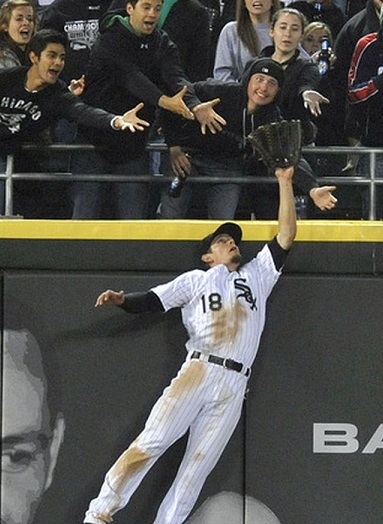
In 1929, uniform numbers appeared on the back of baseball jerseys for the first time, thanks to the Indians and the Yankees.  By 1937, numbers finally appeared across all uniforms, both home and away, across both major leagues.  Since that time, 81 distinct numbers have been worn by members of the White Sox, while the Cubs boast 76.

Today, we continue our look at those players, picking our favorite, if not the best, player to wear each uniform number for both Chicago teams with #18.  78 different players have donned #18 while playing in Chicago, 41 for the White Sox and 37 for the Cubs.

Bill Madlock essentially replaced two of the Cubs biggest stars of the 1960s when he joined the team for his rookie season in 1974.  Acquired for future Hall of Famer Ferguson Jenkins, Madlock took the spot of Hall of Famer Ron Santo at the hot corner.  If he felt any pressure, he didn’t show it, hitting .313 with 9 home runs, good enough for a third place finish in Rookie of the Year voting.  In 1975, he broke out in a big way, earning his first All Star nod on his way to a batting title.  In 1976, Madlock repeated as batting champion, hitting .339 and beating out Ken Griffey Sr. on the final day of the season.  With the dawn of free agency on the horizon, Madlock asked the Cubs for a multi-year contract with a salary of $200,000, more than double what he had earned in 1976.  Team owner Phillip K. Wrigley had other ideas, announcing that Madlock would be traded “to anyone foolish enough to want him.”  In February of 1977, that so-called foolish team turned out to be the Giants, who sent Bobby Murcer and Steve Ontiveros, among others, to the Cubs.  In July of 2016, this would be ranked as one of the five worst trades in Cub history.

Acquired by the White Sox, along with Tyler Flowers and 2 minor leaguers, from the Braves in exchange for Javier Vazquez and Boone Logan, Brent Lillibridge donned #18 while hitting an anemic .158 in 95 at bats spread across 46 games for the 2009 White Sox.  Lillibridge stuck with the big league team in 2010, improving his average to .224 in only 64 games.  2011 was his best season, setting career highs in home runs, RBIs, batting average, and OPS.  On April 11, he hit the 10,000th home run in White Sox history off Dallas Braden and the A’s.  Lillibridge struggled again in 2012, with his average dropping down to .175 before the June 24th trade that sent him, along with Zach Stewart, to the Red Sox for Kevin Youkilis.

Against The Red Sox All Time Leaders – Through 2021

redsoxIn the past, we’ve looked at the all time leaders in both offensive and defensive categories for all 30 teams. This offseason, we will take our first ever look at those leaders against all 30 clubs. We continue things today with the Boston Red Sox.

I’ve seen the Red Sox play 32 times at 4 different stadiums, first in the White Sox home opener in 1985, through the 2005 ALDS, and, most recently, this past September.  The game total would have been 2 higher, if the corona virus hadn’t put the kibosh on my April 2000 weekend trip to Fenway Park.

Home Runs

Name Total
Paul Konerko 5
Jermaine Dye 5
Tadahito Iguchi 3
Jim Thome 3
Carlos Quentin 3
A.J. Pierzynski 3

Hits

Name Total
Paul Konerko 18
Scott Podsednik 18
A.J. Pierzynski 13

Runs

Name Total
Paul Konerko 10
Scott Podsednik 7
A.J. Pierzynski 7
Jermaine Dye 7

RBI

Name Total
Paul Konerko 15
A.J. Pierzynski 9
Jermaine Dye 9

Doubles

Name Total
Paul Konerko 4
Jermaine Dye 4
Luis Robert 3

Triples Continue reading →

By The Numbers – 22

In 1929, uniform numbers appeared on the back of baseball jerseys for the first time, thanks to the Indians and the Yankees.  By 1937, numbers finally appeared across all uniforms, both home and away, across both major leagues.  Since that time, 81 distinct numbers have been worn by members of the White Sox, while the Cubs boast 76.

Today, we continue our look at those players, picking our favorite, if not the best, player to wear each uniform number for both Chicago teams with #22.  76 different players have donned #22 while playing in Chicago, 26 for the White Sox and 50 for the Cubs.

Acquired from the Dodgers, along with Ivan DeJesus, in exchange for Rick Monday and Mike Garman, Bill Buckner joined the Cubs, wearing #22, in 1977.  A staph infection in his ankle the previous year caused the Cubs to move the former outfielder to first base, a position he would man for the rest of his career.  Appearing in 122 games, he hit .284 with 11 home runs and 27 doubles.  He improved in 1978, raising his average to .323 and placed 17th in MVP voting.  1979 was another steady year for Buckner.  On May 17th, in the infamous slugfest where the Cubs lost 23-22 to the Phillies, he went 4–for–7 with a grand slam and a career-high seven RBIs.  He finished the year hitting .284 with 14 home runs and 34 doubles, but was also described as “nuts” when manager Herman Franks resigned late in the season.

In 1980, Buckner won a batting title, hitting .324 while striking out only 18 times, earning him a 14th place finish in MVP voting.  In the strike-shortened 1981 season, he was the lone Cub representative for the All Star game and batted .311 while tying Cecil Cooper for the major league lead with 35 doubles.  1982 saw Buckner hit over .300 for the fourth time as a Cub while racking up career highs in hits, with 201, RBIs, with 105, and assists at first base, setting a major league record with 159.

In 1983, Buckner again led the NL with 38 doubles, but saw his batting average drop to .280, his lowest finish as a Cub.  With the acquisition of Gary Matthews in 1984 pushing Leon Durham to first base, Buckner found himself the odd man out.  Appearing mostly as a pinch hitter, Buckner hit a paltry .209 through the end of May, when he was traded to the Red Sox, ending his Cub tenure.

Scott Podsednik was acquired by the White Sox from the Brewers for Carlos Lee on December 13, 2004.  Wearing #22, he moved in to the leadoff spot and, after putting up a .294 average with 44 steals in the first half, he earned his first All Star game nod.  While injuries slowed him in the second half, he was back to full strength when the regular season came to an end and the White Sox embarked on their first post-season appearance in 5 years.  After going the entire regular season without a home run, Podsednik went deep against the Red Sox in Game 1 of the ALDS, helping the White Sox to a 14-2 victory on their way to a 3 game sweep of the defending champions.  Podsednik continued his steady play during the ALCS, hitting .294 with a triple and 3 stolen bases in the 5 game series.  The shining moment of his career came in Game 2 of the World Series, thanks to a walkoff home run against Brad Lidge in the 9th inning, giving the White Sox a 2-0 lead on their way to a sweep and their first world championship in 88 years.  For his efforts, Podsednik finished in 12th place for MVP voting.

As the White Sox looked to repeat in 2006, Podsednik found it difficult to duplicate his efforts from the year before.  His average was down 29 points, to .261, and his stolen base total was off by 19.  Injuries limited Podsednik to 62 games in 2007.  His offensive production continued to be lacking and, after the White Sox fell completely out of contention for the first time in years, the team decided to change their approach and gave Podsednik his release.  He returned to the White Sox organization in 2009, signing a minor league deal.  Injuries to Brian Anderson, Dewayne Wise, and Carlos Quentin gave him plenty of opportunity with the big league club, and he responded by hitting .304, his highest total since 2003.  Following the season, he became a free agent.

A Class Of One

With the unneeded lockout still in full effect, the baseball world had nothing to distract it yesterday from the small hamlet of Cooperstown in upstate New York, where the votes were tallied, and the 2021 Hall of Fame class completed with one additional member.  Former Red Sox DH David Ortiz scored 77.9% of the vote to earn enshrinement in his first election.

Six others tallied greater than 50% of the vote, led by Barry Bonds, who jumped up to 66% in his final go around on the ballot.  Roger Clemens was right behind him at 65.2% and will also leave his fate to the veteran’s committee.  Scott Rolen saw another big jump, rising to 63.2% and looks like he’s on track to eventually make it.  Curt Schilling, who threw a temper tantrum after not getting elected last year, saw a bit drop and ended his 10-year run with 58.6% of the vote.  Todd Helton and Billy Wagner continued to make strides, coming in at 52% and 51%, respectively, though Helton has more time on his side to make a good run towards induction.

On the local front, former White Sox outfielder Andruw Jones saw a large increase, going up to 41.1%.  Manny Ramirez, who spent a little more than a month with the White Sox, stayed about even, finishing with 28.9% of the vote thanks to his multiple PED suspensions.  The disgraced Omar Vizquel, who added sexual abuse of an autistic teen to the spousal abuse charges that had popped up the previous year, dropped even further, to 23.9%.  In his last go-around, former Cub superstar Sammy Sosa saw a small increase to 18.5%.  Jimmy Rollins, who spent the final 41 games of his career on the south side, picked up 9.4% in his first go-around.  Mark Buehrle saw his percentage cut in half, to 5.8%. but lives to fight another day.  Justin Morneau, who spent the final 58 games of his career with the White Sox, picked up 5 votes.  A.J. Pierzynski scored 2, while his former battery mate Jake Peavy was tossed a shutout.

Fifteen players will fall off the ballot, either due to reaching 10 years or failing to score 5% of the vote.

As for the newest Hall of Famer, I’ve seen Ortiz play 24 times, including the 2005 ALDS.  He joins Bud Fowler, Gil Hodges, Jim Kaat, Minnie Minoso, Tony Oliva and Buck O’Neil, who were elected by the veteran’s committees in December, in the class of 2022.  They will all get their day in the sun on Sunday, July 24.

David Ortiz’s numbers in games I’ve attended were: Continue reading →

By The Numbers – 24

In 1929, uniform numbers appeared on the back of baseball jerseys for the first time, thanks to the Indians and the Yankees.  By 1937, numbers finally appeared across all uniforms, both home and away, across both major leagues.  Since that time, 81 distinct numbers have been worn by members of the White Sox, while the Cubs boast 76.

Today, we continue our look at those players, picking our favorite, if not the best, player to wear each uniform number for both Chicago teams with #24.  104 different players have donned #24 while playing in Chicago, 49 for the White Sox and 55 for the Cubs.
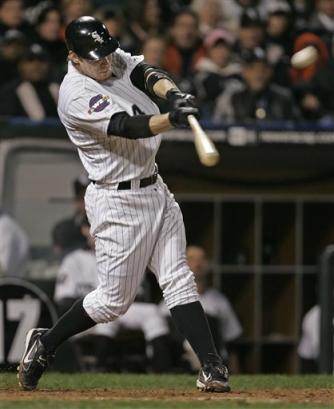
Joe Crede earned a September call-up from Double A in 2000, and, wearing #24, made his major league debut on September 12, replacing Herbert Perry and going 0-1 in the Tigers 10-3 victory at Comiskey Park.  Crede appeared in 7 games, making the most of his 14 at bats, and finished with a .357 average.  Crede got another cup of coffee with the big league club in September of 2001, earning a little more playing time, but he was less successful, finishing with a .220 average in 50 at bats over 17 games.  Crede returned to the White Sox for good in July of 2002.  On August 12, he hit his first major league home run off of former teammate James Baldwin and he finished with 12 home runs, 35 RBIs, and a .285 average.  Crede established himself as the starting third baseman in 2003.  He appeared in a career high 151 games and launched 19 home runs with 75 RBIs while posting a .261 average.  He struggled in 2004, seeing his average drop to .239 while hitting 21 home runs with 69 RBIs.

In 2005, Crede started to come in to his own.  While he improved his average to .252 and hit 22 home runs with 62 RBIs, he came alive in the second half, culminating with a game winning, and possible season saving, home run in the 10th inning against the Indians on September 20, which pushed the White Sox to a 3.5 game lead and propelled them into the playoffs.  Crede had a rough series in the ALDS against the Red Sox, getting only 1 hit in 9 at bats, but rebounded in the ALCS and World Series, hitting .368 and .294 respectively, with 2 home runs in each series.  2006 was Joe Crede’s breakout season.  He hit .283 with career highs in home runs, with 30, and RBIs, with 94, winning his first, and only, Silver Slugger award.  A back injury in 2007 limited him to 47 games and only 4 home runs.  He returned with a bang in 2008, hitting a grand slam on opening day against the Twins and parlayed a good first half into his first All Star selection, but the back injury recurred and kept him out for most of the second half of the season, including the playoffs, thus ending his White Sox career.

On the north side of town, Dexter Fowler joined Cubs via trade prior to the 2015 season.  Donning #24, he ended the year with a .250 average, 102 runs scored, 46 RBIs, 17 home runs, and 20 stolen bases as the Cubs made a surprise run for the NL Wild Card.  Fowler helped propel the Cubs to the NLDS, putting up three hits, three runs scored, a home run, and a stolen base in defeating the Pirates.  In nine postseason games, Fowler batted .396 with two home runs and three RBIs, as the Cubs made it to the NLCS against the Mets.

Fowler became a free agent after the season and was unsigned into the start of spring training.  Despite reportedly agreeing to a three-year contract with the Orioles, Fowler arrived in Cubs camp and signed a one year deal.  And what a year it was.  Fowler finished the year with a .276 average, 13 home runs, 48 RBIs, and 84 runs scored as the Cubs won the NL Central.  Fowler’s .333 average with 4 RBI helped the Cubs win the NLCS against the Dodgers, advancing to the World Series for the first time since 1945.  On October 25, 2016, Dexter Fowler became the first African-American to appear and to bat for the Cubs in a World Series game.  Fowler led off Game 7 of the World Series with a home run, becoming the first player in history to do so, and helping the Cubs win 8–7 in 10 innings, giving the team their first championship in 108 years.

By The Numbers – 33

In 1929, uniform numbers appeared on the back of baseball jerseys for the first time, thanks to the Indians and the Yankees.  By 1937, numbers finally appeared across all uniforms, both home and away, across both major leagues.  Since that time, 81 distinct numbers have been worn by members of the White Sox, while the Cubs boast 76.

Today, we continue our look at those players, picking our favorite, if not the best, player to wear each uniform number for both Chicago teams with #33.  60 different players have donned #33 while playing in Chicago, 22 for the White Sox and 48 for the Cubs, including a World Series champion.

Aaron Rowand joined the White Sox organization in 1998, selected in the first round of the draft.  He earned his first call up to the show on June 15, 2001 and made his major league debut the following day.  He took over as the starting center fielder in 2002 following the mid-season trade of Kenny Lofton.  Rowand switched to #33 in 2003, but earned a return trip to Triple A in 2003 after hitting .133 in his first 60 games.  After a little more than a month, he returned to the big leagues, hitting .387 the rest of the way and ending the season with a .287 average.

2004 was a breakout year for Rowand, becoming a  full time starter for the first time and setting career highs with a .310 average and .905 OPS.  The good times continued in 2005, as he hit .270 with 13 home runs and, defensively, committed only 3 errors in 394 chances.  Rowand went 4 for 10 against the Red Sox in the ALDS, driving in 2 runs and scoring 3 more in the 3 game sweep.  In the ALCS against the Angels, Rowand managed only 3 hits in the 5 game series, all doubles.  He bounced back in the World Series, going 5-17 against the Astros as the White Sox won their first title in 88 years.  Less than a month after the final out of the World Series, Rowand, among others, was traded to the Phillies for Jim Thome.

On the north side of town, a rookie donned #33 when he made his major league debut on July 30th, 1983.  Joe Carter would appear in 23 games for the Cubs that season, hitting .176 without a home run.  He made his biggest mark for the Cubs the following June, when he was packaged, along with Mel Hall, Don Schulze, and Darryl Banks, in a trade with the Indians which netted Ron Hassey, George Frazier and, of course, Rick Sutcliffe.