Two Sides Of The Same Town

cws-chiFollowing last week’s trade deadline deals, Ryan Tepera and Craig Kimbrel became the 36th and 37th people I’ve seen play in person for both the Cubs and the White Sox.  With the first round of crosstown kicking off this afternoon at Wrigley, here’s a look at those players, in alphabetical order.

David Aardsma

After posting a decent season with the Cubs in 2006, Aardsma was traded to the White Sox for Neal Cotts.  Aardsma lasted one season with the Sox, where he was unable to duplicate his success from the year before.

Jason Bere

Drafted by the White Sox in the 36th round in 1990, Bere debuted with the big league club in 1993, finishing 2nd in Rookie of the Year voting.  After an All Star selection in 1994, injuries marred the remainder of his tenure on the South Side, which ended in 1998.  He resurfaced with the Cubs in 2001 and had a decent season, but he went 1-10 in 2002 before being let go.

Emilio Bonifacio

Bonifacio spent back-to-back partial seasons in Chicago, first for the Cubs in 2014 after signing as a free agent, where he played decently enough to be flipped at the trade deadline, along with James Russell, to the Braves for a young catching prospect by the name of Victor Caratini.  He returned to Chicago in 2015, signing with the White Sox, where he he did not do well at all, hitting .167 in 47 games before being released in August.

Welington Castillo

Debuting with the Cubs in 2010, Castillo spent time behind the plate for the Cubs until May of 2015, when, having been replaced in the starting lineup by Miguel Montero, he was flipped to the Mariners.  He returned to Chicago in 2018 after signing with the White Sox as a free agent.  On May 24th of that season, he was suspended 80 games for a violation of the PED policy.  The White Sox then cut bait following the 2019 season, shipping him off to the Rangers.
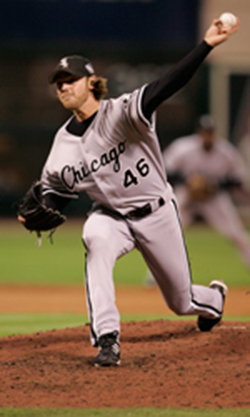
Neal Cotts

Acquired by the White Sox in the Billy Koch trade, he debuted with the team in 2003.  He was a key contributor in the bullpen during the 2005 championship season, and was the only relief pitcher to appear in all 3 rounds of the playoffs that season.  Following the 2006 season, he was traded to the Cubs for David Aardsma, and he spent the next 3 injury filled seasons on the North Side.

Scott Eyre

Joining the White Sox organization in a 1994 trade with the Rangers, he debuted with the big league team in 1997.  He split the next 4 seasons between the rotation and the bullpen, not to mention between Chicago and Charlotte, before being moved to the Blue Jays following the 2000 ALDS loss to the Mariners.  He joined the Cubs as a free agent for the 2006 season and enjoyed 2 seasons of relative success, before falling apart in 2008, when he was traded to the Phillies.

Kosuke Fukudome Continue reading →

End Of An Era

When Theo Epstein and Jed Hoyer took over baseball operations for the Cubs following the 2011 season, they started a rebuild effort that combined high draft picks with savvy trades in an effort to end the longest title drought in US professional sports.  They key to that rebuild, four prospects ranked in the Top 50 by nearly every publication prior to the 2014 season, became known as the Core Four.  Javier Baez, the 9th overall pick in the 2011 draft, Albert Almora, the 6th selection in 2012, Jorge Soler, a Cuban defector who signed a 9 year, $30 million contract in June of 2012, and Kris Bryant, the second overall pick in the 2013 draft were expected to lead the Cubs to the promised land and, in 2016, they did, each contributing to the team’s first World Series title in 108 years.

Bryant and Baez were the only two left heading into the 2021 season.  Both were traded today.

Kris Bryant is heading to the Giants, with OF Alexander Canario and RHP Caleb Killian coming back to the Cubs.  Bryant, the 2015 NL Rookie of the Year and the 2016 NL MVP, has seemingly been on the trading block for years now, ever since the Cubs won his service time grievance.  Ironically, he was the last one out the door, following yesterday’s trade of Anthony Rizzo and this afternoon’s moves with Craig Kimbrel and Javier Baez.

Canario, a top 15 prospect in the Giants’ system, showed flashes as a teenager prior to the pandemic, but has seen his strikeout rate increase as he’s gone up to higher levels of competition.  Killian, likely rated in the top 40 of the Giants system, was an 8th round pick in 2019 and has seem some success this year coming back from the pandemic.

After winning the World Series in 2016, the Cubs, with their young talent, looked to be on the verge of a dynasty.  5 years later, that dynasty is over without ever really starting, having dropped their last 4 consecutive post-season games dating back to the 2017 NLCS.  Now, 10 years after the start of the last rebuild, Jed Hoyer has to start again.

Bryant’s and Baez’s numbers in a Cubs uniform, both for games I attended and overall, were:

Continue reading →

By The Numbers – 47

In 1929, uniform numbers appeared on the back of baseball jerseys for the first time, thanks to the Indians and the Yankees.  By 1937, numbers finally appeared across all uniforms, both home and away, across both major leagues.  Since that time, 81 distinct numbers have been worn by members of the White Sox, while the Cubs boast 76.

Today, we continue our look at those players, picking our favorite, if not the best, player to wear each uniform number for both Chicago teams with #47.  73 players have donned #47 while playing in Chicago, 38 for the White Sox and 35 for the Cubs.

The somewhat unfortunately named Rusty Kuntz spent parts of 5 seasons with the White Sox, wearing #47 the entire time.  He was selected by the White Sox in the 11th round of the 1977 draft and made his major league debut 2 years later as a September call-up in 1979, starting in left field and going 0-3 in a 4-3 victory over the Tigers en route to 5 appearances and an anemic .091 average.  Kuntz split time between Triple A Iowa and Chicago in 1980, with slightly better results, before spending the entire strike-shortened 1981 season with the White Sox, appearing in 67 games and batting .255 in a mere 55 at bats.  Both 1982 and 1983 saw Kuntz back splitting time between Triple A and Chicago, until he was finally traded to the Twins for a minor leaguer.

Catcher Miguel Montero wore #47 during his 2 1/2 years on the North side.  He had a few highlights, including his Game One grand slam in the 2016 NLCS against the Dodgers to give the Cubs the win.  His tenure with the Cubs came to an abrupt end the following June when, after the Nationals stole 7 bases in one game to leave him at 0-31 at nabbing would-be base stealers for the season, he placed the blame on the pitching staff.  The next day, he was designated for assignment.

By The Numbers – 50

In 1929, uniform numbers appeared on the back of baseball jerseys for the first time, thanks to the Indians and the Yankees.  By 1937, numbers finally appeared across all uniforms, both home and away, across both major leagues.  Since that time, 81 distinct numbers have been worn by members of the White Sox, while the Cubs boast 76.

Today, we continue our look at those players, picking our favorite, if not the best, player to wear each uniform number for both Chicago teams with #50.  63 different players have donned #50 while playing in Chicago, 25 for the White Sox and 38 for the Cubs.

John Danks was acquired by the White Sox from the Rangers for Brandon McCarthy following the 2006 season.  He broke camp with the Sox in 2007, making his major league debut on April 8 against the Twins at US Cellular Field, and finished the year with a 6-13 record and a 5.50 ERA.  2008 was a different story, as he posted quite possibly the best outing of his career in game 163, throwing 8 scoreless innings of 2 hit ball against the Twins to secure the Central Division title.  He finished the year with a career-best 3.32 ERA, a 12-9 record, and the lone White Sox victory in the ALDS against the Rays.

Danks had continued success in both 2009 and 2010, combining for a 28-22 record over the two years, with an ERA in the 3.70s both years.  2011 wasn’t quite as good, as his ERA jumped to 4.33, but the White Sox signaled their faith in Danks, signing him to a 5 year extension worth $65 million.  It turned out to be ill-advised.  Danks struggled through 9 starts in 2012 before hitting the disabled list with a mysterious shoulder injury.  When he finally underwent surgery, doctors found a torn shoulder capsule.  Very few pitchers have undergone this surgery, and even fewer have successfully returned to the same level they were before the injury.

Sadly, Danks’ recovery did not happen as anyone would have wanted, though not for a lack of effort.  He returned in 2013, making 22 starts and going 4-14 with a 4.75 ERA.  2014 was more of the same, as his ERA was 4.74, though his record improved to 11-11.  And 2015, again, saw Danks put up an ERA of 4.71 in 30 starts.  In 2016, Danks, in the final season of his contract and due $14.25 million, went 0-4 with a 7.25 ERA in April.  With the surprising White Sox in first place after 1 month and with Danks accounting for half of the team’s losses, being an innings eater was no longer good enough.  He was designated for assignment on May 3, ending his White Sox career.

On the north side of town, Les Lancaster donned #50 for 5 seasons with the Cubs, making his debut on April 7, 1987 against the Cardinals.  His best season came in 1989, when he went 4-2 with a 1.36 ERA in 42 games as the surprising Cubs took home their second NL East title.  He threw 6 innings in the NLCS against the Giants, winning game 2 and losing game 3.  He was released by the Cubs at the end of spring training in 1992.

By The Numbers – 68

In 1929, uniform numbers appeared on the back of baseball jerseys for the first time, thanks to the Indians and the Yankees.  By 1937, numbers finally appeared across all uniforms, both home and away, across both major leagues.  Since that time, 81 distinct numbers have been worn by members of the White Sox, while the Cubs boast 76.

Today, we continue our look at those players, picking our favorite, if not the best, player to wear each uniform number for both Chicago teams with #68.  5 players have donned #71 while playing in Chicago, 6 for the White Sox and 1 for the Cubs.

Jorge Soler was originally signed by the Cubs as an amateur free agent in 2012.  Part of the so-called Core Four, the prospects meant to finally lead the Cubs to post-season glory, Soler made his major league debut on August 27, 2014, going 2 for 4 with a home run and 2 RBIs against the Reds.  He became the primary right fielder in 2015, starting 95 games and putting up a .723 OPS as the Cubs made a surprising run to the NLCS before falling to the Mets.  With Jason Heyward on board in 2016, Soler saw most of his playing time in left field, filling in for the injured Kyle Schwarber.  While he struggled during the regular season, he made the most of his World Series opportunity, hitting .400 against the Indians in his 2 appearances.  After achieving that initial goal of a World Series title, Soler was sent to the Royals for closer Wade Davis.

The pickings are slim on the south side of town for players wearing #68.  Dylan Covey wore it the most, going 6-29 over his 3 seasons with the White Sox after being acquired as a Rule 5 draft choice out of the A’s organization.  He was thankfully let go following the 2019 season.

All Time Playoff Team Records

For the first time since 2008, both the White Sox and the Cubs are in the post-season following this abbreviated 2020 season.  The expanded run to the World Series will start with the White Sox facing A’s in Oakland for a best of 3 series starting tonight, while the Cubs welcome the Marlins to Wrigley starting tomorrow.  Winners will advance to the LDS and enter a playoff bubble, with the AL moving to California and the NL to Texas.

With the AL Wild Card Series set to kick off today, it’s time to take an updated look at the team records for the now 30 playoff contests I have attended. These contests come from the 2018 Wild Card game, the ALDS in 2000, 2005, and 2008, the NLDS in 2003, 2007, 2008, 2015, 2016, and 2017, the NLCS in 2003, 2015, 2016, and 2017, the ALCS in 2005, and, of course, the 2005 and 2016 World Series.  Sadly, I won’t be adding any games to this list this year.  Thanks, corona virus.

Post-Season Team Records
Team Name Won Loss Winning Pctg
Florida Marlins 3 0 1.000
Seattle Mariners 2 0 1.000
New York Mets 2 0 1.000
Colorado Rockies 1 0 1.000
Arizona Diamondbacks 1 0 1.000
Chicago White Sox 5 4 0.556
Los Angeles Dodgers 3 3 0.500
Atlanta Braves 1 1 0.500
Cleveland Indians 1 1 0.500
Los Angeles Angels 1 1 0.500
Washington Nationals 1 1 0.500
Tampa Bay Rays 1 1 0.500
Chicago Cubs 9 13 0.409
San Francisco Giants 0 2 0.000
St. Louis Cardinals 0 1 0.000
Boston Red Sox 0 2 0.000
Houston Astros 0 1 0.000

Dodgers All Time Leaders – Through 2019

dodgersWith baseball shut down because of the corona virus, I thought it would be an interesting time to look at the all time leaders in both offensive and defensive categories for all 30 teams. We continue today with the Los Angeles Dodgers.

The Dodgers began life in Brooklyn in 1883, moving to their current home on the west coast , along with their rival Giants, in 1957.  I’ve seen them play 19 times, including the first two games of their 2008 NLDS sweep against the Cubs and their pennant-clinching victory in the 2017 NLCS.

Home Runs

Name Total
Kike Hernandez 5
Matt Kemp 2
James Loney 2
Manny Ramirez 2

Hits

Name Total
James Loney 20
Matt Kemp 14
Russell Martin 14

Runs

Name Total
James Loney 12
Russell Martin 8
Rafael Furcal 8

RBI

Name Total
James Loney 12
Matt Kemp 9
Kike Hernandez 9

Doubles

Name Total
James Loney 5
Matt Kemp 3
Juan Pierre 3

Triples Continue reading →

Marlins All Time Leaders – Through 2019

With baseball shut down because of the corona virus, I thought it would be an interesting time to look back at the all time leaders in both offensive and defensive categories for all 30 teams. We continue today with the Miami Marlins.

The Marlins began life in 1993, joining the National League along with the Rockies.  In 2012, they rebranded as the Miami Marlins in conjunction with the opening of their new, tax payer funded stadium in the city of Miami.  I’ve seen them play 25 times, including 3 victories during their unlikely triumph in the 2003 NLCS against the Cubs and once, as the home team against the Expos, at US Cellular Field in 2004.

Home Runs

Name Total
Miguel Cabrera 4
Cody Ross 3
Dan Uggla 3
Ivan Rodriguez 3

Hits

Name Total
Miguel Cabrera 18
Luis Castillo 17
Juan Pierre 17

Runs

Name Total
Miguel Cabrera 14
Juan Pierre 13
Luis Castillo 10

RBI

Name Total
Miguel Cabrera 13
Ivan Rodriguez 10
Alex Gonzalez 9
Dan Uggla 9

Doubles

Name Total
Alex Gonzalez 6
Derrek Lee 3
9 tied with 2

Triples Continue reading →

Mets All Time Leaders – Through 2019

21st-CENTURY-METS_01With baseball shut down because of the corona virus, I thought it would be an interesting time to look back at the all time leaders in both offensive and defensive categories for all 30 teams.  We continue today with the New York Mets.

The Mets began life in 1962, joining the National League following the abandonment of the New York market by both the Dodgers and Giants in 1957.  I’ve seen them play 15 times, including Tom Glavine’s 300th career victory, their pennant clinching victory in the 2015 NLCS, and, most recently, on June 22, 2019

Name Total
Daniel Murphy 2
Cliff Floyd 2
16 tied with 1

Hits

Name Total
David Wright 7
Daniel Murphy 6
3 tied with 5

Runs

Name Total
David Wright 7
Daniel Murphy 4
Carlos Beltran 4

RBI

Name Total
Lucas Duda 6
Cliff Floyd 5
4 tied with 4

Doubles

Name Total
Carlos Delgado 3
Lucas Duda 2
David Wright 2
Jeromy Burnitz 2

Triples Continue reading →

The Decade In Baseball – Pitching Leaders

baseballs3The 2010s have drawn to a close and its time to take a look back at the previous decade.  Today, we are finishing off our look back at 10 years worth of baseball with the pitching leaders for the 385 games I attended between 2010 and 2019.

In addition to the regular season, these totals include 2 wild card games, 3 trips to the NLDS, 3 NLCS appearances, and the 2016 World Series.  Not too many surprises on these charts.

Wins

Name Total
Chris Sale 21
Gavin Floyd 13
John Danks 11
Jon Lester  10
Jake Peavy 10

Losses

Name Total
Jose Quintana 17
Chris Sale 12
John Danks 10
James Shields 10
Gavin Floyd 9
Carlos Rodon 9

ERA (> 10 IP)

Name Total
Kyle Ryan 0.00
Colby Lewis 0.60
Brandon Kintzler 0.68
Matt Moore 0.79
Yovani Gallardo 0.82

ERA (> 20 IP)

Name Total
Kyle Gibson 1.59
Dallas Braden 1.71
Aaron Bummer 1.84
Zach Duke 2.00
Wade Davis 2.01

Strikeouts

Name Total
Chris Sale 313
Jose Quintana 208
Gavin Floyd 145
Continue reading →