By The Numbers – 13

In 1929, uniform numbers appeared on the back of baseball jerseys for the first time, thanks to the Indians and the Yankees.  By 1937, numbers finally appeared across all uniforms, both home and away, across both major leagues.  Since that time, 81 distinct numbers have been worn by members of the White Sox, while the Cubs boast 76.

Today, we continue our look at those players, picking our favorite, if not the best, player to wear each uniform number for both Chicago teams with #13.  25 different players have donned #13 while playing in Chicago, 13 for the White Sox and 12 for the Cubs.

Acquired by the White Sox on December 6, 1984, from the Padres, Ozzie Guillen made his major league debut wearing #13 on Opening Day 1985, leading off against the Brewers and going 1-5 in the 4-2 victory at County Stadium.  Settling in as the everyday shortstop, Guillen finished the year with a .273 average, 21 doubles, and 9 triples.  Those totals were good enough to score Guillen the 1985 AL Rookie of the Year trophy.  Guillen saw a slight drop off in his sophomore season, as his average dropped to .250 and he managed 19 doubles and 4 triples.  1987 was a nice bounce back for Guillen, as he raised his average back up to .279 with a .656 OPS.  For the second straight year, he led the AL, and all of baseball, in Defensive WAR.  Guillen earned his first All Star nod in 1988 and, by season’s end, he once again led all of baseball in Defensive WAR, while seeing his average drop to .261 with 7 triples, the fifth highest total in the AL.

1989 was a tough year for Guillen.  He posted his worst offensive numbers since 1986 and, on the base paths, he fell victim to the hidden ball trick.  Twice. On June 23, against the Brewers, first baseman Greg Brock held the ball after a pickoff attempt and when Guillen took his hand off the base to stand up, Brock tagged him out.  Less than 2 months later, on August 5 against the Tigers, Dave Bergman made the same play.  He finished the year with .253 average and, despite his adventures on pick off attempts, a career high 36 stolen bases.  As the surprising White Sox challenged for the AL West title while saying goodbye to Comiskey Park, Guillen put in one of the finest seasons of his career.  He was named to his second All Star team, going 0-2, finished in 17th place in MVP voting, and earned his first, and only, Gold Glove.  He raised his average back up to .279 and knocked in a career high 58 RBIs.

Expectations were high for the White Sox as they moved across the street to the new Comiskey Park in 1991.  Guillen earned his third, and final, All Star nod, getting a sacrifice in his only plate appearance.  He ended the year with a .273 average and set a career high with 3 home runs.  Guillen’s 1992 season came to an early end when, on April 21 during a loss against the Yankees, a collision with outfielder Tim Raines ended in a severe knee injury.  Guillen recovered in 1993, though he appeared in only 134 games, his lowest total to date.  However, it was his most productive season offensively, posting a .280 batting average, and career highs with 4 home runs and a .666 OPS, as the White Sox won their first division title in a decade.  He hit .273 and scored 4 runs in a losing effort, as the White Sox were defeated in 6 games by the Blue Jays in the ALCS.  1994 looked to be the year that the White Sox finally broke through.  Guillen was up to the challenge, hitting a career high .288 with a .659 OPS.  Unfortunately, the year ended early when players went on strike on August 12 with the White Sox in first place in the newly created AL Central.

The 1995 season got off to a late start and had an abbreviated schedule due to the long work stoppage.  The success of the White Sox, and for Guillen himself, didn’t survive the long layoff.  Guillen saw his average drop to .248, his lowest over a “full” season in his career to this point.  His OPS dropped to its lowest total in a full season since 1989.  1996 saw a slight improvement for Guillen.  He appeared in 150 games, his highest total since his knee injury in 1992.  He raised his average back to .263 and tied his career high with 4 home runs.  However, 1997 was easily the worst season of Guillen’s White Sox career.  He had the lowest average of his career, coming in at .245, though he did once again tie his career high with 4 home runs.  Following the season, Guillen became a free agent and his playing career with the White Sox came to an end.

Guillen returned to the White Sox organization for the 2004 season as manager.  In 2005, he led the team to their first American League pennant since 1959 and their first World Series title in 88 years.  Ongoing personal difficulties with General Manager Kenny Williams led to his leaving with 2 games left in the 2011 season as the third winningest manager in franchise history.

On the north side of town, Neifi Pérez donned #13 over parts of three seasons with the Cubs.  He signed a minor league deal after being released by the Giants in 2004.  After only ten games in Triple A, Pérez joined the big-league club and became a spark plug in the lineup, going 6 for 6 in his first 6 at-bats and providing a needed backup to the ailing Nomar Garciaparra.  Dusty Baker named Pérez the starting shortstop in 2005 to replace Garciaparra, mainly on the strength of his defensive skills.  For the 2006 season Pérez lost the starting job at shortstop to Ronny Cedeño.  As his batting average sagged to .254 and his on-base percentage, never high, had fallen to .266, the Cubs traded him to the Tigers.

By The Numbers – 14

In 1929, uniform numbers appeared on the back of baseball jerseys for the first time, thanks to the Indians and the Yankees.  By 1937, numbers finally appeared across all uniforms, both home and away, across both major leagues.  Since that time, 81 distinct numbers have been worn by members of the White Sox, while the Cubs boast 76.

Today, we continue our look at those players, picking our favorite, if not the best, player to wear each uniform number for both Chicago teams with #14, the only number to be retired by both teams.  47 different players have donned the number while playing in Chicago, and no more will for the rest of time.

With apologies to Ted Lyons, Bill Skowron, and Bill Melton, the winner here, and the man that #14 was retired for, is Paul Konerko.  Konerko was traded to the White Sox on November 11, 1998 for center fielder Mike Cameron.  In his second full season, he helped lead the surprising White Sox to their first Central Division title, their first post-season appearance since 1993.  After tremendous struggles in 2003, Konerko won the Comeback Player of the Year award in 2004.  He did himself better in 2005, winning the ALCS MVP, hitting a grand slam in Game 2 of the World Series, and catching the final putout at first base in Game 4, giving the White Sox their first World Series title since 1917.  After the series, Konerko inked a 5-year deal that would keep him on the south side through at least 2010.

2008 saw Konerko make his 3rd post-season appearance for the Sox, the only player in history to do so.  Konerko retired following the 2014 season, finishing his career as the White Sox all time leader in total bases and second all time in home runs, RBIs, and games played.  In addition, he was a 6-time All Star and had served as team captain since 2006.  His #14 was retired in 2015.

Nicknamed Mr. Cub, Ernie Banks, played his entire 19 year career with the Cubs, earning back-to-back MVP honors in 1958 and 1959.  When he retired following the 1971 season, he ranked 9th all-time in home runs, with 512.  He was elected to the Hall of Fame in 1977 and became a team ambassador, never seen without a smile on his face.  Number 14 was retired in his honor in 1982, the first number ever retired by the Cubs.

By The Numbers – 16

In 1929, uniform numbers appeared on the back of baseball jerseys for the first time, thanks to the Indians and the Yankees.  By 1937, numbers finally appeared across all uniforms, both home and away, across both major leagues.  Since that time, 81 distinct numbers have been worn by members of the White Sox, while the Cubs boast 76.

Today, we continue our look at those players, picking our favorite, if not the best, player to wear each uniform number for both Chicago teams with #16.  65 different players have donned #16 while playing in Chicago, 24 for the White Sox, who retired the number in 1987, and 41 for the Cubs.

Aramis Ramirez switched to his familiar #16 shortly after being acquired by the Cubs from the Pirates.  Ramírez finished the 2003 season strong, appearing in 63 games down the stretch and hitting 15 home runs while helping the Cubs capture their first division title since 1989.  He managed 11 hits during the post-season, including 4 home runs and 10 RBIs and hitting the first playoff grand slam in Cubs’ history during Game 4 of the NLCS.  The following year, Ramirez became the 14th player in baseball history to hit 3 home runs in 2 different games in the same season.  While his offense remained strong, posting a .951 OPS, his defense was a bit of a liability, as he posted the lowest range factor among all third basemen.

Ramirez was elected to his first All-Star Game in 2005.  He finished the season with 31 home runs and 92 RBIs despite missing the last month of the year with a strained quadriceps femoral muscle.  While his defense continued to suffer in 2006, with his third straight season with the lowest range factor, his offense continued to carry the load.  He collected his 1000th hit in July against the Mets and ended up with 38 home runs, 119 RBIs, and an OPS of .912.  A free agent at the end of the season, he re-signed with the Cubs, scoring a 5-year, $73 million contract.

In April of ’07, Ramirez launched his 200th career home run.  His continued offensive presence helped lead the Cubs back to the post-season in 2007 and 2008, winning division titles both seasons.  Unfortunately, Ramirez, like his teammates, went cold in both series as the Cubs were swept in the NLDS each season.  In 2009, Ramirez christened the season with his 250th career home run on Opening Day against Roy Oswalt.  He followed that with #300 in July of 2011 against the White Sox.  Following that season, he declined his portion of a mutual option and became a free agent.

Julio Cruz wore #16 on the southside following his June 1983 acquisition from the Mariners, when he gave the White Sox the spark they were looking for, helping the team go on a 72-31 run to finish the season and go from 6 1/2 games back to 20 games ahead.  Cruz scored the winning run on a Harold Baines sacrifice fly against, of all teams, the Mariners on September 17, clinching the first division title in White Sox history.  Cruz hit .333 during the ALCS against the Orioles, swiping 2 bases in the 4-game series.  Heading in to the 1984 season, Cruz re-signed with the White Sox with a 6-year deal, thought to be worth between $3.6 to $4.8 million.  Unfortunately, time, and injuries, were starting to take their toll.  1984 was the best year of the deal, and Cruz saw his average drop to .222 and he stole only 14 bases, a career low to date.  Following that season, Cruz changed his number from #16 to #12.

By The Numbers – 19

In 1929, uniform numbers appeared on the back of baseball jerseys for the first time, thanks to the Indians and the Yankees.  By 1937, numbers finally appeared across all uniforms, both home and away, across both major leagues.  Since that time, 81 distinct numbers have been worn by members of the White Sox, while the Cubs boast 76.

Today, we continue our look at those players, picking our favorite, if not the best, player to wear each uniform number for both Chicago teams with #19.  83 different players have donned #19 while playing in Chicago, 32 for the White Sox, one of whom had it retired in his honor, and 51 for the Cubs.

With a new ownership group in place and looking to make a quick splash, the White Sox purchased Greg Luzinski from the Phillies on March 30, 1981.  Coming off a disappointing season, the Chicago-area native, wearing his familiar #19, responded well to the change, hitting .265 with 21 home runs in the strike-shortened season.  He earned Comeback Player of the Year honors, beating out teammate Bill Almon by 5 votes, and finished 23rd in MVP voting.  Luzinski had another strong year in 1982, raising his average to .292, his highest total since 1977, while hitting 18 home runs and driving in 102 runs.

In 1983, Luzinski was a powerful cog in leading the White Sox to their first division title.  He launched the 8th, 9th, and 10th rooftop home runs in Comiskey Park history between June 26 and August 28.  While his average dropped to .255, he hit 32 home runs and drove in 95, good enough to finish 17th in MVP voting.  Like the rest of his teammates, he struggled during the ALCS against the Orioles, hitting only .133 in the 4-game series.  Unfortunately, those struggles carried over in to 1984.  His average dropped again, down to .238, and his power output fell as well, finishing the year with only 13 home runs, his lowest total since 1974, and 58 RBIs.  He did manage to hit his fourth rooftop blast on July 3 against the Tigers.  He became a free agent following the year and decided to retire.

On the north side of town, Matt Murton donned #19 when he made his major league debut for the Cubs on July 8, 2005.  He appeared in 51 games for the Cubs, hitting .321 with a .908 OPS.  That helped earn him the starting nod in left field for 2006, where he managed to post a .297 batting average with 13 home runs and 62 RBIs.  Despite his success, Murton saw his playing time diminish in 2007 after the Cubs signed Cliff Floyd, even getting sent back to Triple A in June.  He returned in late July, and finished the year with a .281 average and a .791 OPS in only 94 games.  His playing time was diminished ever further in 2008, appearing in only 19 games before being traded, 4 years to the day of his major league debut, to the A’s, as part of the haul for Rich Harden.

By The Numbers – 22

In 1929, uniform numbers appeared on the back of baseball jerseys for the first time, thanks to the Indians and the Yankees.  By 1937, numbers finally appeared across all uniforms, both home and away, across both major leagues.  Since that time, 81 distinct numbers have been worn by members of the White Sox, while the Cubs boast 76.

Today, we continue our look at those players, picking our favorite, if not the best, player to wear each uniform number for both Chicago teams with #22.  76 different players have donned #22 while playing in Chicago, 26 for the White Sox and 50 for the Cubs.

Acquired from the Dodgers, along with Ivan DeJesus, in exchange for Rick Monday and Mike Garman, Bill Buckner joined the Cubs, wearing #22, in 1977.  A staph infection in his ankle the previous year caused the Cubs to move the former outfielder to first base, a position he would man for the rest of his career.  Appearing in 122 games, he hit .284 with 11 home runs and 27 doubles.  He improved in 1978, raising his average to .323 and placed 17th in MVP voting.  1979 was another steady year for Buckner.  On May 17th, in the infamous slugfest where the Cubs lost 23-22 to the Phillies, he went 4–for–7 with a grand slam and a career-high seven RBIs.  He finished the year hitting .284 with 14 home runs and 34 doubles, but was also described as “nuts” when manager Herman Franks resigned late in the season.
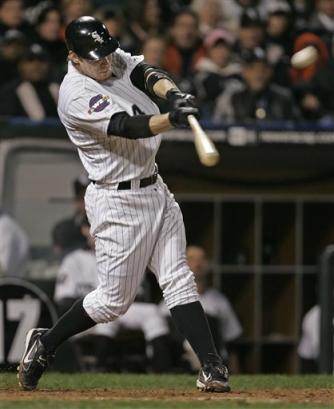
In 1980, Buckner won a batting title, hitting .324 while striking out only 18 times, earning him a 14th place finish in MVP voting.  In the strike-shortened 1981 season, he was the lone Cub representative for the All Star game and batted .311 while tying Cecil Cooper for the major league lead with 35 doubles.  1982 saw Buckner hit over .300 for the fourth time as a Cub while racking up career highs in hits, with 201, RBIs, with 105, and assists at first base, setting a major league record with 159.

In 1983, Buckner again led the NL with 38 doubles, but saw his batting average drop to .280, his lowest finish as a Cub.  With the acquisition of Gary Matthews in 1984 pushing Leon Durham to first base, Buckner found himself the odd man out.  Appearing mostly as a pinch hitter, Buckner hit a paltry .209 through the end of May, when he was traded to the Red Sox, ending his Cub tenure.

Scott Podsednik was acquired by the White Sox from the Brewers for Carlos Lee on December 13, 2004.  Wearing #22, he moved in to the leadoff spot and, after putting up a .294 average with 44 steals in the first half, he earned his first All Star game nod.  While injuries slowed him in the second half, he was back to full strength when the regular season came to an end and the White Sox embarked on their first post-season appearance in 5 years.  After going the entire regular season without a home run, Podsednik went deep against the Red Sox in Game 1 of the ALDS, helping the White Sox to a 14-2 victory on their way to a 3 game sweep of the defending champions.  Podsednik continued his steady play during the ALCS, hitting .294 with a triple and 3 stolen bases in the 5 game series.  The shining moment of his career came in Game 2 of the World Series, thanks to a walkoff home run against Brad Lidge in the 9th inning, giving the White Sox a 2-0 lead on their way to a sweep and their first world championship in 88 years.  For his efforts, Podsednik finished in 12th place for MVP voting.

As the White Sox looked to repeat in 2006, Podsednik found it difficult to duplicate his efforts from the year before.  His average was down 29 points, to .261, and his stolen base total was off by 19.  Injuries limited Podsednik to 62 games in 2007.  His offensive production continued to be lacking and, after the White Sox fell completely out of contention for the first time in years, the team decided to change their approach and gave Podsednik his release.  He returned to the White Sox organization in 2009, signing a minor league deal.  Injuries to Brian Anderson, Dewayne Wise, and Carlos Quentin gave him plenty of opportunity with the big league club, and he responded by hitting .304, his highest total since 2003.  Following the season, he became a free agent.

By The Numbers – 24

In 1929, uniform numbers appeared on the back of baseball jerseys for the first time, thanks to the Indians and the Yankees.  By 1937, numbers finally appeared across all uniforms, both home and away, across both major leagues.  Since that time, 81 distinct numbers have been worn by members of the White Sox, while the Cubs boast 76.

Today, we continue our look at those players, picking our favorite, if not the best, player to wear each uniform number for both Chicago teams with #24.  104 different players have donned #24 while playing in Chicago, 49 for the White Sox and 55 for the Cubs.

Joe Crede earned a September call-up from Double A in 2000, and, wearing #24, made his major league debut on September 12, replacing Herbert Perry and going 0-1 in the Tigers 10-3 victory at Comiskey Park.  Crede appeared in 7 games, making the most of his 14 at bats, and finished with a .357 average.  Crede got another cup of coffee with the big league club in September of 2001, earning a little more playing time, but he was less successful, finishing with a .220 average in 50 at bats over 17 games.  Crede returned to the White Sox for good in July of 2002.  On August 12, he hit his first major league home run off of former teammate James Baldwin and he finished with 12 home runs, 35 RBIs, and a .285 average.  Crede established himself as the starting third baseman in 2003.  He appeared in a career high 151 games and launched 19 home runs with 75 RBIs while posting a .261 average.  He struggled in 2004, seeing his average drop to .239 while hitting 21 home runs with 69 RBIs.

In 2005, Crede started to come in to his own.  While he improved his average to .252 and hit 22 home runs with 62 RBIs, he came alive in the second half, culminating with a game winning, and possible season saving, home run in the 10th inning against the Indians on September 20, which pushed the White Sox to a 3.5 game lead and propelled them into the playoffs.  Crede had a rough series in the ALDS against the Red Sox, getting only 1 hit in 9 at bats, but rebounded in the ALCS and World Series, hitting .368 and .294 respectively, with 2 home runs in each series.  2006 was Joe Crede’s breakout season.  He hit .283 with career highs in home runs, with 30, and RBIs, with 94, winning his first, and only, Silver Slugger award.  A back injury in 2007 limited him to 47 games and only 4 home runs.  He returned with a bang in 2008, hitting a grand slam on opening day against the Twins and parlayed a good first half into his first All Star selection, but the back injury recurred and kept him out for most of the second half of the season, including the playoffs, thus ending his White Sox career.

On the north side of town, Dexter Fowler joined Cubs via trade prior to the 2015 season.  Donning #24, he ended the year with a .250 average, 102 runs scored, 46 RBIs, 17 home runs, and 20 stolen bases as the Cubs made a surprise run for the NL Wild Card.  Fowler helped propel the Cubs to the NLDS, putting up three hits, three runs scored, a home run, and a stolen base in defeating the Pirates.  In nine postseason games, Fowler batted .396 with two home runs and three RBIs, as the Cubs made it to the NLCS against the Mets.

Fowler became a free agent after the season and was unsigned into the start of spring training.  Despite reportedly agreeing to a three-year contract with the Orioles, Fowler arrived in Cubs camp and signed a one year deal.  And what a year it was.  Fowler finished the year with a .276 average, 13 home runs, 48 RBIs, and 84 runs scored as the Cubs won the NL Central.  Fowler’s .333 average with 4 RBI helped the Cubs win the NLCS against the Dodgers, advancing to the World Series for the first time since 1945.  On October 25, 2016, Dexter Fowler became the first African-American to appear and to bat for the Cubs in a World Series game.  Fowler led off Game 7 of the World Series with a home run, becoming the first player in history to do so, and helping the Cubs win 8–7 in 10 innings, giving the team their first championship in 108 years.

By The Numbers – 28

In 1929, uniform numbers appeared on the back of baseball jerseys for the first time, thanks to the Indians and the Yankees.  By 1937, numbers finally appeared across all uniforms, both home and away, across both major leagues.  Since that time, 81 distinct numbers have been worn by members of the White Sox, while the Cubs boast 76.

Today, we continue our look at those players, picking our favorite, if not the best, player to wear each uniform number for both Chicago teams with #28.  86 different players have donned #28 while playing in Chicago, 46 for the White Sox and 40 for the Cubs.

Acquired by the Cubs prior to the 1989 season, Mitch Williams, wearing #28, quickly became a beloved cult figure on the north side.  He made an immediate impression, giving up 3 hits to load the bases in the ninth inning on Opening Day before striking out the next three batters, starting with future Hall of Famer Mike Schmidt, to close out a one-run victory.  That kickstarted an amazing season for Williams, and the Cubs, as they made a surprise run towards an NL East title.  On April 28th, Williams became the only pitcher in major league history to earn a save without throwing a pitch, entering the game with two outs and picking off runner Carmelo Martinez to end the game.  Williams made the All Star team for the only time in his career and hit his lone career home run, en route to a 4-4 record with 36 saves.  He appeared in two games of the NLCS against the Giants, giving up the game-winning hit to Will Clark in Game 5.

1990 was not quite as good for Williams.  His record dropped to 1-8 while his ERA rose to 3.93.  He earned only 16 saves, a drop of 20 from the previous season, as a knee injury bothered him throughout the year.  The next spring, with the Cubs having acquired Dave Smith to replace him as closer, Williams was traded to the Phillies just prior to Opening Day.

On the other side of town, Joey Cora switched to #28 after the 1991 season, his first with the White Sox.  Cora spent the 1992 season on the bench following the acquisition of Steve Sax, starting only 21 games at second base.  With Sax faltering, Cora became the everyday second baseman in 1993.  He set a career high with 153 games played and hit .268 with a career high 20 stolen bases as the White Sox won their final AL West crown.  Cora struggled in the ALCS, hitting an anemic .136 as the White Sox fell in 6 games to the Blue Jays.

Cora continued to improve in 1994, raising his average again to .276 and had 2 home runs and 30 RBIs when the season came to a premature end due to the player’s strike.  When baseball resumed in 1995, Cora became a free agent and his White Sox playing career came to an end.  He rejoined the organization and once again wore #28 as third base coach for the 2004 season, when Ozzie Guillen was hired as manager.  He moved to became the bench coach after the 2006 season, where he would remain until the end of the 2011 season, when he was fired with 2 games left in the season as part of Guillen’s exit from the team.

By The Numbers – 29

In 1929, uniform numbers appeared on the back of baseball jerseys for the first time, thanks to the Indians and the Yankees.  By 1937, numbers finally appeared across all uniforms, both home and away, across both major leagues.  Since that time, 81 distinct numbers have been worn by members of the White Sox, while the Cubs boast 76.

Today, we continue our look at those players, picking our favorite, if not the best, player to wear each uniform number for both Chicago teams with #29.  85 different players have donned #30 while playing in Chicago, 35 for the White Sox and 50 for the Cubs.

Jack McDowell, selected as the fifth overall pick in the 1987 draft, switched to #29 when, after spending the entire 1989 season in Triple A, he returned to the majors for good in 1990, helping to lead a surprising White Sox team to a 94-68 record and a season long battle with the A’s for the AL West crown.  McDowell finished with a 14-9 record and a 3.82 ERA and nearly doubled his strikeout total from 1988 in only about 50 more innings.  Expectations were high as the White Sox moved into their new stadium in 1991 and McDowell was up to the challenger, earning his first All Star game selection on his way to a 17-10 record and a 3.41 ERA, good enough for a 9th place finish in Cy Young Award voting.

1992 was even better for McDowell.  He earned his second straight All Star Game nod, pitching a scoreless second inning and retiring Fred McGriff, Terry Pendleton, and Andy Van Slyke in order.  He ended up with a 20-10 record and a 3.18 ERA, good enough for a 2nd place finish in Cy Young Award voting, behind Dennis Eckersley, and 19th place in MVP voting.  Everything came together for the White Sox and McDowell in 1993.  As the team ran off to their first division title in a decade, McDowell led the league with 22 victories and 4 shutouts, ending at 22-10 with a 3.37 ERA.  He nabbed his 3rd straight All Star selection, earning the victory while throwing a scoreless 5th inning, and finally claimed his first Cy Young Award.  He also finished 9th in MVP voting, behind teammate Frank Thomas.  McDowell made 2 starts during the ALCS against the Blue Jays, losing both and giving up 10 runs total in 9 innings pitched.

The 1994 season again had high expectations for the White Sox and McDowell.  Unfortunately, those expectations would be squashed, not on the field, where the White Sox held first place in the newly formed AL Central division, but in the boardrooms, where the end of the 1994 season and the post season were cancelled due to a work stoppage.  In just 25 starts, his fewest since 1987, McDowell went 10-9 with a 3.73 ERA.  In December, with the 1995 season in doubt, McDowell was traded to the Yankees, for Keith Heberling and a player to be named later who turned out to be Lyle Mouton.

On the north side of town, the Cubs were surprise contenders in the 2001 season.  Looking to improve their chances of making the post-season, they acquired Fred McGriff from the Devil Rays.  Wearing #29, the Crime Dog held up his part of the bargain down the stretch, putting up a .942 OPS with 12 home runs in 49 games with the Cubs.  Unfortunately, the pitching did not hold up as the Cubs went 23-28 in August and September, finishing five games behind the Astros and Cardinals.  At age 38, McGriff returned to the Cubs in 2002, posting a .858 OPS and 125 OPS+ to go along with 30 homers and 103 runs batted in.  The rest of the Cubs, however, were butt, going through thee managers and finishing with a 67-95 record.  McGriff became a free agent following the season.

Against The Angels All Time Leaders – Through 2021

laangelsIn the past, we’ve looked at the all time leaders in both offensive and defensive categories for all 30 teams.  This offseason, we will take our first ever look at those leaders against all 30 clubs. We continue today with the Los Angeles Angels.

The Angels began life in 1961, joining the American League along with the second incarnation of the Washington Senators.  They’ve changed their location designation multiple times, starting in Los Angeles, changing to California in 1966, moving to Anaheim in 1997 and, awkwardly incorporating both Los Angeles and Anaheim starting in 2005, and finally returning to just Los Angeles in 2016.  I’ve seen them play 38 times, including games 1 and 2 of the 2005 ALCS against the White Sox and Jim Thome’s 500th career home run in 2008.

Home Runs

Name Total
Carlos Quentin 6
Paul Konerko 6
Jim Thome 4

Hits

Name Total
Paul Konerko 22
A.J. Pierzynski 17
Alexei Ramirez 17

Runs

Name Total
Paul Konerko 14
Alexei Ramirez 8
Carlos Quentin 8

RBI

Name Total
A.J. Pierzynski 10
Paul Konerko 9
Alexei Ramirez 8
Carlos Quentin 8
Juan Uribe 8

Doubles

Name Total
Paul Konerko 4
Juan Uribe 4
Joe Crede 3
Scott Podsednik 3
Javier Baez 3

Triples Continue reading →

By The Numbers – 33

In 1929, uniform numbers appeared on the back of baseball jerseys for the first time, thanks to the Indians and the Yankees.  By 1937, numbers finally appeared across all uniforms, both home and away, across both major leagues.  Since that time, 81 distinct numbers have been worn by members of the White Sox, while the Cubs boast 76.

Today, we continue our look at those players, picking our favorite, if not the best, player to wear each uniform number for both Chicago teams with #33.  60 different players have donned #33 while playing in Chicago, 22 for the White Sox and 48 for the Cubs, including a World Series champion.

Aaron Rowand joined the White Sox organization in 1998, selected in the first round of the draft.  He earned his first call up to the show on June 15, 2001 and made his major league debut the following day.  He took over as the starting center fielder in 2002 following the mid-season trade of Kenny Lofton.  Rowand switched to #33 in 2003, but earned a return trip to Triple A in 2003 after hitting .133 in his first 60 games.  After a little more than a month, he returned to the big leagues, hitting .387 the rest of the way and ending the season with a .287 average.

2004 was a breakout year for Rowand, becoming a  full time starter for the first time and setting career highs with a .310 average and .905 OPS.  The good times continued in 2005, as he hit .270 with 13 home runs and, defensively, committed only 3 errors in 394 chances.  Rowand went 4 for 10 against the Red Sox in the ALDS, driving in 2 runs and scoring 3 more in the 3 game sweep.  In the ALCS against the Angels, Rowand managed only 3 hits in the 5 game series, all doubles.  He bounced back in the World Series, going 5-17 against the Astros as the White Sox won their first title in 88 years.  Less than a month after the final out of the World Series, Rowand, among others, was traded to the Phillies for Jim Thome.

On the north side of town, a rookie donned #33 when he made his major league debut on July 30th, 1983.  Joe Carter would appear in 23 games for the Cubs that season, hitting .176 without a home run.  He made his biggest mark for the Cubs the following June, when he was packaged, along with Mel Hall, Don Schulze, and Darryl Banks, in a trade with the Indians which netted Ron Hassey, George Frazier and, of course, Rick Sutcliffe.