Hanging Up His Platinum Glove

Former Cub Anthony Rizzo announced his retirement this morning after a fourteen-year career.  A three-time All Star, Rizzo spent ten seasons with the Cubs, ranking sixth in franchise history with 242 home runs.  He was also a four-time Gold Glove winner, winning Platinum Glove honors in 2016 as the league’s best defender.  In 2017, Rizzo was bestowed with the prestigious Roberto Clemente Award.

Rizzo, originally drafted by the Red Sox when Theo Epstein and Jed Hoyer were in their front office, was the duo’s first big acquisition when they reunited in Chicago, acquiring him from the Padres.  Beginning the 2012 season in Triple A, he was recalled at the end of June and quickly became a mainstay of the lineup and a crowd favorite.  As the Cubs were rebuilding around him, he signed a long-term contract extension in 2013.  He cemented his position in Cubs lore by catching the final out of the 2016 World Series, ending the longest championship drought in American professional sports.  However, as the Cubs struggled to repeat the team success of that season, Rizzo also struggled in later years, contributing to an offense that has severely regressed since 2016 and was one of the Cubs who refused to get the COVID vaccine, keeping the team below the 85% threshold for the 2021 season.  At the trade deadline, he was traded to the Yankees.

After re-signing with the Yankees after the 2021 season, Rizzo spent three injury-marred seasons in New York, culminating in last fall’s World Series loss to the Dodgers.  A free agent following the season, he went unsigned and sat out the 2025 season prior to today’s announcement.  He will officially retire as a Cub and join the organization as a team ambassador.
Crossing Sides Of Town

So far in 2025, Brad Keller, Mike Tauchman, Nicky Lopez, and Reese McGuire pushed the total of players I’ve seen take the field in person for both the Cubs and the White Sox to 47.  With the final round of crosstown kicking off tonight at Rate Field, here’s a look at those players, in alphabetical order.

David Aardsma

After posting a decent season with the Cubs in 2006, Aardsma was traded to the White Sox for Neal Cotts.  Aardsma lasted one season with the Sox, where he was unable to duplicate his success from the year before.

Jason Bere

Drafted by the White Sox in the 36th round in 1990, Bere debuted with the big-league club in 1993, finishing 2nd in Rookie of the Year voting.  After an All Star selection in 1994, injuries marred the remainder of his tenure on the South Side, which ended in 1998.  He resurfaced with the Cubs in 2001 and had a decent season, but he went 1-10 in 2002 before being let go.

Emilio Bonifacio

Bonifacio spent back-to-back partial seasons in Chicago, first for the Cubs in 2014 after signing as a free agent, where he played decently enough to be flipped at the trade deadline, along with James Russell, to the Braves for a young catching prospect by the name of Victor Caratini.  He returned to Chicago in 2015, signing with the White Sox, where he he did not do well at all, hitting .167 in 47 games before being released in August.

Welington Castillo

Debuting with the Cubs in 2010, Castillo spent time behind the plate for the Cubs until May of 2015, when, having been replaced in the starting lineup by Miguel Montero, he was flipped to the Mariners.  He returned to Chicago in 2018 after signing with the White Sox as a free agent.  On May 24th of that season, he was suspended 80 games for a violation of the PED policy.  The White Sox then cut bait following the 2019 season, shipping him off to the Rangers.

Neal Cotts

Acquired by the White Sox in the Billy Koch trade, he debuted with the team in 2003.  He was a key contributor in the bullpen during the 2005 championship season and was the only relief pitcher to appear in all 3 rounds of the playoffs that season.  Following the 2006 season, he was traded to the Cubs for David Aardsma, and he spent the next 3 injury filled seasons on the North Side.

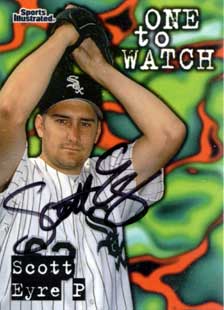
Scott Eyre

Joining the White Sox organization in a 1994 trade with the Rangers, he debuted with the big-league team in 1997.  He split the next 4 seasons between the rotation and the bullpen, not to mention between Chicago and Charlotte, before being moved to the Blue Jays following the 2000 ALDS loss to the Mariners.  He joined the Cubs as a free agent for the 2006 season and enjoyed 2 seasons of relative success, before falling apart in 2008, when he was traded to the Phillies.

Clint Frazier

After missing the second half of 2021 with an injury, Frazier was DFA’d by the Yankees.  He signed a deal with the Cubs that offseason, though he notched just 45 plate appearances before being DFA’s once again.  He chose to finish the year in the Cubs system before becoming a free agent following the season.  After failing to catch on with the Rangers, he signed a minor league deal with the White Sox, eventually hitting .197 in 33 games with the big-league club.

Kosuke Fukudome Continue reading →

Ballpark Tour: Guardians

With the spring training camps opening early next month, we continue our tour of all of the different baseball stadiums I’ve been to over the years. This week, we look at the Cleveland Guardians, the last new stadium I added to my list prior to the lockdown in 2020. So, without further ado, let’s take a deeper look at my one game history with Progressive Field.

Stadium Name: Progressive Field

Years in Service: 1994 – Present

Visits: 2

Cleveland moved into Jacobs Field for the 1994 season after calling Cleveland Stadium home since 1932.  In 1997, the park became one of the few in MLB history to host both the All-Star Game and the World Series in the same season.  2008 saw the naming rights sold to a local insurance company and the stadium was renamed Progressive Field.  Since opening, the park has seen twelve Central Division titles and three trips to the World Series.  It hosted its second All Star Game in 2019.

I almost took my first trip to the park in 2016, for Game 7 of the World Series against the Cubs, but I just couldn’t quite pull the trigger.  A Southwest credit this summer led to me booking a 2-day September trip to Cleveland for $3, so there was no second guessing this time.  I arrived on a Wednesday afternoon, in plenty of time for that evening’s tilt between the White Sox and Cleveland.  A tremendous catch on a smash by Eloy Jimenez saved the game for the then-Tribe.  The matinee performance on Thursday afternoon entailed a nice one-hitter by Reynaldo Lopez, giving the White Sox a quick victory before I had to head back to the airport.

Making A Move

Looking to make a splash of their own, the Cubs acquired outfielder Kyle Tucker from the Astros in exchange for Isaac Paredes, Hayden Wesneski, and Cam Smith.  Tucker, 27, is a three-time All-Star and has averaged over 5 WAR over the past four seasons.  He is in his final year of arbitration and will become a free agent after the season.

The price for this single season of Tucker is fairly steep.  Paredes, reacquired by the Cubs at the trade deadline last summer, was penciled in as the starting third baseman and was under cheap team control through 2027.  Wesneski split time between the bullpen and the rotation last year and was a useful piece.  Smith was the team’s 2024 first round draft choice and is the 73rd ranked prospect in baseball.

Given Tucker’s contract situation, this looks like a win-now move for a team that has been mired in mediocracy since tearing down the remnants of their championship roster in 2021.  The next steps would seem to be moving on from Cody Bellinger to free up salary.  What happens after that is anyone’s guess at this point.

And Then There Were None

The Cubs career of Kyle Hendricks officially came to an end Wednesday when the free agent pitcher signed a one-year deal with the Angels.  After an eleven-year Cubs career, he was the last remaining member of the 2016 World Series champions to remain on the roster for the North Siders.

Hendricks was first acquired by the Cubs at the trade deadline in 2012 as part of the return from the Rangers for Ryan Dempster.  He made his major league debut nearly two years later, throwing six innings against the Reds at Great American Ballpark and earning a no-decision.  2016 was his best season, winning 16 games and posting a 2.13 ERA in the regular season and making five post-season starts, giving up just two earned runs in 21 2/3 innings between the NLCS and the World Series.  He has struggled with injuries and worsening performance over the past three seasons, making his departure feel inevitable.

While Hendricks was the last continuous link to the 2016 squad, he may not be the last member of that team to suit up for the Cubs.  Rob Zastryzny, who made his major league debut for the 2016 team and made eight appearances down the stretch, was recently re-acquired off waivers from the Brewers and will be given a chance to claim a bullpen spot during spring training.

Hendricks’s numbers in a Cubs uniform, both for games I attended and overall, were:

Continue reading →

Games Per Stadium By Year

With the 2023 season officially in the rearview mirror, let’s take a look at the number of games I’ve attended each year at one of the now-29 different stadiums I’ve visited over the years.

Games Per Stadium Per Year

GameYear StadiumName TotalGames
2008 US Cellular Field 46
2003 Wrigley Field 46
Surprise playoff runs for the White Sox in 2008 and the Cubs in 2003 led to what remains my highest single season totals ever, boosted by post-season play.
2021 Guaranteed Rate Field 44
My highest-post-pandemic total, helped in part by a division champion and the desire to get back to the ballpark following the lockdown of 2020.
2007 Wrigley Field 43
2004 Wrigley Field 41
My highest non-playoff total saw me attending over half of the home games for the Cubs in 2004.
2011 US Cellular Field 40
2009 US Cellular Field 40
2010 US Cellular Field 36
2005 Wrigley Field 34
2008 Wrigley Field 34
2017 Guaranteed Rate Field 33
2016 US Cellular Field 32
2006 US Cellular Field 32
2023 Guaranteed Rate Field 32
2015 US Cellular Field 31
2012 US Cellular Field 31
2007 US Cellular Field 29
2014 US Cellular Field 28 Continue reading →

Welcoming An Old Friend

After a good run, although against some of the dregs of the major leagues, put them back over .500 and only four games behind the NL Central leading Reds, the Cubs moved from sellers to buyers, making a move this afternoon to re-acquire Jeimer Candelario from the Nationals.  Candelario made his debut with the Cubs back in 2016, earning a World Series ring for his five-game effort.  With the Cubs looking to repeat as champions, he was traded the following July to the Tigers for the immortal Alex Avila and Justin Wilson.

Six years later, he returns, in exchange for lefty pitcher D.J. Herz and shortstop Kevin Made.  Both have a good shot at sticking in the big leagues, but are from the second tier of Cub prospects.  I guess if you find yourself just four games back at the trading deadline, you have to go for it, but odds of the Cubs 1) making the playoffs and 2) doing anything even if they happen to sneak in are extremely low.  Since it doesn’t appear that they gave up too much for him, I guess you can live with this move.  But if a losing streak comes up now that the Cubs are facing upper division teams again, you have to wonder if it was worth it.

And Then There Was One

Willson Contreras’ Cubs career officially came to an end Wednesday when the free agent catcher signed a five-year contract with the Cardinals.  His departure leaves Kyle Hendricks as the last remaining member of the 2016 World Series champions to play for the North Siders.

Contreras first joined the Cub organization in 2009 as a teenaged international free agent.  He made his major league debut as a pinch runner on June 17, 2016 and, two days later, became the 30th player in modern MLB history to hit a home run on the first pitch of his first major league at bat.  Contreras made it on to the post-season roster and helped the Cubs end their 108-year title drought.

Contreras became the starting catcher in 2017 following the retirement of David Ross and the implosion of Miguel Montero’s Cub career in June.  In 2018, Contreras was elected to his first All Star team.  He replicated that feat in 2019 and 2022.

Contreras’ numbers in a Cubs uniform, both for games I attended and overall, were:

Continue reading →

The Hall Comes Calling

Cubs radio play-by-play man Pat Hughes was awarded the 2023 Ford C. Frick Award yesterday, presented annually for excellence in broadcasting by the National Baseball Hall of Fame and Museum.  Hughes, who joined the Cubs booth in 1996, will have spent 28 of his 41 seasons as a broadcaster for the Cubs after starting his career with the Twins in 1983 followed by a twelve-season run with the Brewers.

Hughes joined the Cubs booth in 1996, joining long time color commentator, and Cub legend, Ron Santo.  The chemistry between the two grew to the point where their broadcasts came to be known as “The Pat and Ron Show”.  Following Santo’s death in 2010, Hughes has worked alongside former Cubs Keith Moreland and Ron Coomer.

Along the way, Hughes has called many memorable moments, including eight no-hitters, the 25-inning contest between the White Sox and the Brewers which remains the longest game in American League history, Kerry Wood’s 20-strikeout game in 1998, Mark McGwire’s record-breaking 62nd home run in 1998, and, of course, the final out clinching the Cubs 2016 World Series title.

Hughes, 67, is the sixth announcer with ties to Chicago to earn the honor, following Ken Harrelson, Milo Hamilton, Harry Caray, Jack Brickhouse, and Bob Elson.

The Jason Heyward Era Ends

In news that was both surprising and unsurprising, Jed Hoyer announced before last night’s game that Jason Heyward was unlikely to return from his knee injury this year and that he and the Cubs would be parting ways this offseason.  Heyward, who has been on the IL with a knee injury since late June, has one year remaining on his contract.

Signed to an 8-year, $184 million contract back in December of 2015, Heyward never quite produced enough to justify his lofty contract and, as the Cubs failed to sustain their 2016 success, he became as much of a scapegoat as anyone else on the roster, seeing his playing time reduced.  However, his place in Cubs lore was set when he was credited with leading an inspiring players-only meeting during the 17-minute rain delay at the end of Game 7 of the 2016 World Series, after which the Cubs stormed out and took the lead in the 10th inning.

In addition to a World Series ring, Heyward won Gold Glove awards in both 2016 and 2017.  His numbers with the Cubs, both in games I attended and overall, were:

Continue reading →