By The Numbers – 27

In 1929, uniform numbers appeared on the back of baseball jerseys for the first time, thanks to the Indians and the Yankees.  By 1937, numbers finally appeared across all uniforms, both home and away, across both major leagues.  Since that time, 81 distinct numbers have been worn by members of the White Sox, while the Cubs boast 76.

Today, we continue our look at those players, picking our favorite, if not the best, player to wear each uniform number for both Chicago teams with #27.  103 different players have donned #27 while playing in Chicago, 52 for the White Sox and 51 for the Cubs.

Acquired on December 19, 2016 from the Nationals, Lucas Giolito made his White Sox debut the following summer donning #27.  In 7 starts, he put up a sparkling 2.38 ERA while compiling a 3-3 record.  Things went south In 2018, as Giolito was, statistically, the worst starting pitcher in baseball with a 6.13 ERA, leading the league (the bad way) in WHIP and walks per 9 innings.  That offseason, he began rebuilding his game from the ground up, leading to a 2019 All Star appearance en route to a 14-9 record with a 3.41 ERA.  In the COVID-shortened 2020 season, he held the hapless Pirates hitless on August 25th, striking out 13 while facing one batter over the minimum of 27.  He made his post-season debut in Game 1 of the Wild Card series against the A’s, retiring the first 18 batters in order before giving up 2 hits and a walk in the 7th inning, earning the victory in the White Sox only win during the series.  In 2021, Giolito made 31 starts, finishing with a record of 11-9 and a 3.53 ERA.

During his second go-around with the North Siders, Joe Girardi wore #27 for the 2001 and 2002 seasons.  On June 22, 2002, Girardi addressed a sold-out Wrigley Field to announce the day’s game was cancelled following the death of Cardinal pitcher Darryl Kile.  Following that season, he became a free agent and left the team for the second, and final, time.

By The Numbers – 29

In 1929, uniform numbers appeared on the back of baseball jerseys for the first time, thanks to the Indians and the Yankees.  By 1937, numbers finally appeared across all uniforms, both home and away, across both major leagues.  Since that time, 81 distinct numbers have been worn by members of the White Sox, while the Cubs boast 76.

Today, we continue our look at those players, picking our favorite, if not the best, player to wear each uniform number for both Chicago teams with #29.  85 different players have donned #30 while playing in Chicago, 35 for the White Sox and 50 for the Cubs.

Jack McDowell, selected as the fifth overall pick in the 1987 draft, switched to #29 when, after spending the entire 1989 season in Triple A, he returned to the majors for good in 1990, helping to lead a surprising White Sox team to a 94-68 record and a season long battle with the A’s for the AL West crown.  McDowell finished with a 14-9 record and a 3.82 ERA and nearly doubled his strikeout total from 1988 in only about 50 more innings.  Expectations were high as the White Sox moved into their new stadium in 1991 and McDowell was up to the challenger, earning his first All Star game selection on his way to a 17-10 record and a 3.41 ERA, good enough for a 9th place finish in Cy Young Award voting.

1992 was even better for McDowell.  He earned his second straight All Star Game nod, pitching a scoreless second inning and retiring Fred McGriff, Terry Pendleton, and Andy Van Slyke in order.  He ended up with a 20-10 record and a 3.18 ERA, good enough for a 2nd place finish in Cy Young Award voting, behind Dennis Eckersley, and 19th place in MVP voting.  Everything came together for the White Sox and McDowell in 1993.  As the team ran off to their first division title in a decade, McDowell led the league with 22 victories and 4 shutouts, ending at 22-10 with a 3.37 ERA.  He nabbed his 3rd straight All Star selection, earning the victory while throwing a scoreless 5th inning, and finally claimed his first Cy Young Award.  He also finished 9th in MVP voting, behind teammate Frank Thomas.  McDowell made 2 starts during the ALCS against the Blue Jays, losing both and giving up 10 runs total in 9 innings pitched.

The 1994 season again had high expectations for the White Sox and McDowell.  Unfortunately, those expectations would be squashed, not on the field, where the White Sox held first place in the newly formed AL Central division, but in the boardrooms, where the end of the 1994 season and the post season were cancelled due to a work stoppage.  In just 25 starts, his fewest since 1987, McDowell went 10-9 with a 3.73 ERA.  In December, with the 1995 season in doubt, McDowell was traded to the Yankees, for Keith Heberling and a player to be named later who turned out to be Lyle Mouton.

On the north side of town, the Cubs were surprise contenders in the 2001 season.  Looking to improve their chances of making the post-season, they acquired Fred McGriff from the Devil Rays.  Wearing #29, the Crime Dog held up his part of the bargain down the stretch, putting up a .942 OPS with 12 home runs in 49 games with the Cubs.  Unfortunately, the pitching did not hold up as the Cubs went 23-28 in August and September, finishing five games behind the Astros and Cardinals.  At age 38, McGriff returned to the Cubs in 2002, posting a .858 OPS and 125 OPS+ to go along with 30 homers and 103 runs batted in.  The rest of the Cubs, however, were butt, going through thee managers and finishing with a 67-95 record.  McGriff became a free agent following the season.

2021 Final Standings

The 2021 season, at least the portion which would see me attending games, has come to an end after the White Sox lost to the Astros in the ALDS 3-1.  After a year without in-person baseball thanks to the corona virus, I ended up attending the most games I’ve seen since 2009 and my 5th highest total of all time.  I also managed to travel to four different stadiums, bringing my total up to 27.  All told, I managed to see 25 of the 30 teams a year after seeing none.

2021 Team Records
Team Name Won Loss Winning Pctg
Tampa Bay Rays 3 0 1.000
New York Yankees 2 0 1.000
Arizona Diamondbacks 1 0 1.000
Washington Nationals 1 0 1.000
Philadelphia Phillies 1 0 1.000
Los Angeles Angels 1 0 1.000
San Francisco Giants 1 0 1.000
Boston Red Sox 1 0 1.000
Seattle Mariners 2 1 0.667
Chicago White Sox 29 20 0.592
Cleveland Indians 3 3 0.500
Kansas City Royals Continue reading →

By The Numbers – 39

In 1929, uniform numbers appeared on the back of baseball jerseys for the first time, thanks to the Indians and the Yankees.  By 1937, numbers finally appeared across all uniforms, both home and away, across both major leagues.  Since that time, 81 distinct numbers have been worn by members of the White Sox, while the Cubs boast 76.

Today, we continue our look at those players, picking our favorite, if not the best, player to wear each uniform number for both Chicago teams with #39.  77 different players have donned #39 while playing in Chicago, 31 for the White Sox and 46 for the Cubs.

First acquired in 1989, Roberto Hernandez, donning #39, made his major league debut on September 2, 1991, getting the start and going 7 innings for the victory in the White Sox win over the Royals.  He appeared in 9 games in the final month of the season, making the only 3 starts of his career, and finished the year with a 7.80 ERA.  In 1992, Hernandez split the year between Triple A and Chicago, eventually supplanting Bobby Thigpen as the team’s primary closer.  He finished the year with 12 saves and a sparkling 1.65 ERA.  Hernandez had another great year in 1993, saving 38 games in 70 appearances with a 2.29 ERA as the White Sox won their final AL West title.  During the ALCS against the Blue Jays, Hernandez threw 4 scoreless innings in 4 appearances, earning 1 save.

In the strike-shortened 1994 season, Hernandez struggled.  His ERA jumped to 4.91 and he saved only 14 games before the season ended on August 12, despite leading the league in games finished.  When baseball returned in 1995, Hernandez bounced back somewhat, once again leading the league in games finished and lowering his ERA by nearly a full run to 3.92.  1996 was a true return to form for Hernandez.  He led the league in games finished for the third straight year and lowered his ERA by 2 full runs to 1.91.  He earned his first All Star selection and, with 38 saves, finished 6th in Cy Young Award voting.  Hernandez was well on his way to another strong season in 1997, with 27 saves and a 2.44 ERA, when he was included in the infamous White Flag trade on July 31, joining Wilson Alzarez and Danny Darwin in going to the Giants for the collection of Brian Manning, Lorenzo Barcelo, Mike Caruso, Keith Foulke, Bob Howry, and Ken Vining.

On the other side of town, Andrew Chafin wore #39 for the 11 months he was a member of the Cubs.  Acquired on August 31, the trade deadline of the shortened 2020 season, Chafin pitched in 4 games over the final month, posting a 3.00 ERA and retired the only batter he faced in the Wild Card series against the Marlins.  In February, Chafin re-upped with the Cubs and became sort of a cult hero.  On June 24, he was part of a combined no-hitter against the Dodgers.  In 43 appearances for the Cubs in 2021, Chafin recorded a 2.06 ERA with 37 strikeouts in 39.1 innings of work before being traded to the A’s on July 27th.

By The Numbers – 43

In 1929, uniform numbers appeared on the back of baseball jerseys for the first time, thanks to the Indians and the Yankees.  By 1937, numbers finally appeared across all uniforms, both home and away, across both major leagues.  Since that time, 81 distinct numbers have been worn by members of the White Sox, while the Cubs boast 76.

Today, we continue our look at those players, picking our favorite, if not the best, player to wear each uniform number for both Chicago teams with #43.  71 different players have donned #43 while playing in Chicago, 23 for the White Sox and 48 for the Cubs.

Dennis Eckersley donned #43 for the Cubs after being acquired on May 25, 1984 from the Red Sox for Bill Buckner.  He went 10-8 with a 3.03 ERA while helping the Cubs into the postseason for the first time since 1945.  He lost Game 3 of the NLCS, giving up 5 runs in 5 1/3 innings pitched in his playoffs debut.  Along with the rest of the Cubs rotation in 1985, Eckersley spent time on the DL, causing the team to drop from a 4-game division lead on June 11 to finishing in 4th place, 23 1/2 games back.  Eckersley returned to full physical strength in 1986, but struggled, going 6-11 with a 4.57 ERA as he battled alcoholism.  After an offseason spent in rehab, Eckersley was traded to the A’s following spring training in 1987, where, he, of course, moved to the bullpen and became a Hall of Famer.

Known as “The Milkman”, Herbert Perry wore #43 when he joined the White Sox on April 21, 2000 after being selected off waivers from the Devil Rays.  Solid defense and a hot bat led to him getting more and more playing time, eventually becoming the everyday third baseman as the White Sox cruised to their first Central Division title.  He finished the year with a .308 average, 12 home runs, and 61 RBIs and was one of the few regulars who continued to hit in the post-season, putting up a .444 average in the ALDS against the Mariners.  Injuries and the acquisition of Royce Clayton limited Perry to 92 games in 2001, as his average dropped to .256 and his home runs fell to 7.  After the season, he was traded to the Rangers for a player to be named later.

Two Sides Of The Same Town

cws-chiFollowing last week’s trade deadline deals, Ryan Tepera and Craig Kimbrel became the 36th and 37th people I’ve seen play in person for both the Cubs and the White Sox.  With the first round of crosstown kicking off this afternoon at Wrigley, here’s a look at those players, in alphabetical order.

David Aardsma

After posting a decent season with the Cubs in 2006, Aardsma was traded to the White Sox for Neal Cotts.  Aardsma lasted one season with the Sox, where he was unable to duplicate his success from the year before.

Jason Bere

Drafted by the White Sox in the 36th round in 1990, Bere debuted with the big league club in 1993, finishing 2nd in Rookie of the Year voting.  After an All Star selection in 1994, injuries marred the remainder of his tenure on the South Side, which ended in 1998.  He resurfaced with the Cubs in 2001 and had a decent season, but he went 1-10 in 2002 before being let go.

Emilio Bonifacio

Bonifacio spent back-to-back partial seasons in Chicago, first for the Cubs in 2014 after signing as a free agent, where he played decently enough to be flipped at the trade deadline, along with James Russell, to the Braves for a young catching prospect by the name of Victor Caratini.  He returned to Chicago in 2015, signing with the White Sox, where he he did not do well at all, hitting .167 in 47 games before being released in August.

Welington Castillo

Debuting with the Cubs in 2010, Castillo spent time behind the plate for the Cubs until May of 2015, when, having been replaced in the starting lineup by Miguel Montero, he was flipped to the Mariners.  He returned to Chicago in 2018 after signing with the White Sox as a free agent.  On May 24th of that season, he was suspended 80 games for a violation of the PED policy.  The White Sox then cut bait following the 2019 season, shipping him off to the Rangers.

Neal Cotts

Acquired by the White Sox in the Billy Koch trade, he debuted with the team in 2003.  He was a key contributor in the bullpen during the 2005 championship season, and was the only relief pitcher to appear in all 3 rounds of the playoffs that season.  Following the 2006 season, he was traded to the Cubs for David Aardsma, and he spent the next 3 injury filled seasons on the North Side.

Scott Eyre

Joining the White Sox organization in a 1994 trade with the Rangers, he debuted with the big league team in 1997.  He split the next 4 seasons between the rotation and the bullpen, not to mention between Chicago and Charlotte, before being moved to the Blue Jays following the 2000 ALDS loss to the Mariners.  He joined the Cubs as a free agent for the 2006 season and enjoyed 2 seasons of relative success, before falling apart in 2008, when he was traded to the Phillies.

Kosuke Fukudome Continue reading →

By The Numbers – 46

In 1929, uniform numbers appeared on the back of baseball jerseys for the first time, thanks to the Indians and the Yankees. By 1937, numbers finally appeared across all uniforms, both home and away, across both major leagues. Since that time, 81 distinct numbers have been worn by members of the White Sox, while the Cubs boast 76.

Today, we continue our look at those players, picking our favorite, if not the best, player to wear each uniform number for both Chicago teams with #46. 40 players have donned #52 while playing in Chicago, 34 each for the White Sox and 22 for the Cubs.

Lee Arthur Smith was the 2nd round selection of the Cubs in the 1975 draft.  He made his major league debut on September 1, 1980, becoming a fixture in the Cubs bullpen wearing #46.  He took over the closer role in 1982 and became a force, leading the league in saves in 1983 while earning his first All Star nod and post-season support for both the Cy Young award and MVP.  Following the 1987 season, he was traded to the Red Sox for Al Nipper and Calvin Schiraldi, ending his Cubs career with a 40-51 record and a 2.92 ERA with 180 saves and 342 games finished.  In 2019, he was elected to the Hall of Fame by the Veteran’s Committee.

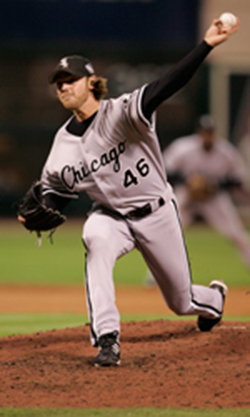
On the South side of town, Neal Cotts donned #46 after being acquired by the White Sox, along with Billy Koch and Daylan Holt, from the A’s in exchange for Keith Foulke, Mark Johnson, and Joe Valentine in December of 2002.  He made his major league debut on August 12, 2003, lasting only 2 1/3 innings in a start against the Angels, and made 3 additional starts, finishing the year with an 8.10 ERA in only 13 1/3 innings pitched.  Cotts moved to the bullpen in 2004 and, in 2005, things finally clicked.  He appeared in 69 regular season games and posted a sparkling 1.94 ERA, before facing one batter in the ALDS and becoming the only White Sox reliever to appear in the ALCS, getting the final 2 outs in the Game 1 loss to the Angels.  As the White Sox moved on to their first World Series since 1959, Cotts appeared in all 4 games, winning Game 2 and giving up only 1 hit in an inning and a third.  Cotts reverted back to his previous form in 2006 and, following the season, he was traded across town to the Cubs for fellow relief pitcher David Aardsma.