Throwback Thursday – Team Records Of The 2000s

It’s time for another trip in the wayback machine, as this week we move our focus to the start of the 21st century and see what my view of the baseball world looked like in the 2000s.  This was my first decade as a season ticket holder, starting in 2002 for the Cubs and 2005 for the White Sox.

I attended 518 contests during the 2000s, starting with my first trip to Cincinnati in April of 2000 and finishing with Daniel Hudson’s first major league victory in September of 2009.  I attended games at 13 stadiums from coast to coast and saw my first post-season action, with an ALDS in 2000, an NLCS in 2003, and a World Series game in 2005.

2021 Team Records
Team Name Won Loss Winning Pctg
Arizona Diamondbacks 11 1 0.917
Philadelphia Phillies 10 4 0.714
Toronto Blue Jays 6 3 0.667
Florida Marlins 12 7 0.632
Tampa Bay Rays 3 2 0.600
Texas Rangers 8 6 0.571
Los Angeles Dodgers 8 6 0.571
Chicago White Sox 130 107 0.549
Chicago Cubs 172 147 0.539
Baltimore Orioles 9 8 0.529
Cleveland Indians 10 9 0.526
Los Angeles Angels 10 9 0.526
Boston Red Sox 9 9 0.500
Colorado Rockies 6 6 0.500
Seattle Mariners 5 5 0.500
Anaheim Angels 1 1 0.500
Houston Astros Continue reading →

Throwback Thursday – Team Records Of The 1990s

Last week, we took a trip in the wayback machine to see all of the games that I attended during the 1980s.  This week, we turn our attention to the 1990s to see what my view of the baseball world looked like.

I’ve been able to identify 32 games I attended during the 90s, starting with a late April outing during the final season at Comiskey Park in 1990 through a September 2000 game at Wrigley Field, including my first visits to stadiums outside of Chicago starting with a July 1993 visit to County Stadium in Milwaukee.  All told, I saw games at eight different ballparks throughout the decade.

1990s Team Records
Team Name Won Loss Winning Pctg
Houston Astros 1 0 1.000
California Angels 1 0 1.000
Cincinnati Reds 1 0 1.000
Arizona Diamondbacks 1 0 1.000
Florida Marlins 1 0 1.000
New York Yankees 1 0 1.000
San Francisco Giants 1 0 1.000
Detroit Tigers 3 1 0.750
Oakland Athletics 2 1 0.667
Chicago White Sox 12 10 0.545
Chicago Cubs 6 5 0.545
Kansas City Royals Continue reading →

All Time Team Records

After a long lockout and an abbreviated spring training, the 2022 baseball season finally gets underway today, so, to celebrate, it is time once again to look at the all-time team records for games that I have identified as having attended dating back to 1984.  Last year, I tied 2004 for my 5th highest game total of all time and managed to see 25 out of the 30 teams, so there should be some nice changes.  Thanks to a name change, the all-time record of the Cleveland Indians become static moving forward, forever stuck at 4 games over .500.

The White Sox look to once again lead an improving AL Central and move past the ALDS in the post-season, while the Cubs are neither contending nor rebuilding.  The 2022 season should be an interesting one on both sides of town, even more interesting if we are able to see it in person.

All-Time Team Records
Team Name Won Loss Winning Pctg
California Angels 2 0 1.000
Arizona Diamondbacks 14 2 0.875
Florida Marlins 15 8 0.652
Colorado Rockies 10 6 0.625
New York Yankees 17 11 0.607
Boston Red Sox 19 13 0.594
Los Angeles Angels 20 14 0.588
Toronto Blue Jays 15 11 0.577
Philadelphia Phillies 11 9 0.550
Washington Nationals 7 6 0.538
Cleveland Indians 31 27 0.534
Chicago White Sox 335 307 0.522
Chicago Cubs 224 206 0.521
Houston Astros Continue reading →

What’s New For 2022

With a new collective bargaining agreement in place and a shortened spring training due to the 99-day lockout, there are plenty of changes coming to MLB for this season and beyond.  It’s time to take a deeper dive into the new CBA and see what those changes are and what impact they may have on the game, intended or unintended.

The most expected outcome of the new CBA is the expansion of the designated hitter to the National League.  In addition to this, a new rule was added that if a team wants to have the same player (*cough*Ohtani*cough*) both pitch and hit, he may be his own DH and removing him as the pitcher will not impact him continuing on as the DH.

The postseason will be expanded to twelve teams, six from each league.  The two division winners with the best records will automatically advance to the Division Series.  The remaining division champion and the three wild card teams will face off in a three-game series.  There will not be any reseeding between the rounds.

Due to Canadian law, unvaccinated players will not be allowed to cross the border and, under the terms of the new CBA, they will not be paid or receive service time for the games missed.

The lowest level of the Competitive Balance Tax (CBT) Threshold, which most teams use as a hard salary cap, will jump to $230M for 2022.  After that, there are three additional surcharge levels, which, at this point, should impact only the Dodgers, Mets, and Padres.

The minimum salary for players has increased to $700K for 2022 and will increase over each year of the CBA.  In addition, there is a new pre-arbitration bonus pool of $50M has been established to reward successful seasons by younger players under team control.  MVP and Cy Young winners would $2.5M while 2nd, 3rd, and 4/5th place finishers would receive $1.75M, $1.5M, and $1M respectively.  Rookie of the Year winners get $750K and 2nd place finishers would take home $500K.  Players named first team All-MLB get $1M while second team gets $500K.  The remaining pool of bonus money will be distributed based on WAR.  A single player can only receive one bonus per season.

Umpires will start using a microphone to announce replay review decisions to the crowd, helping fans better understand the outcomes of those reviews and why.

Double headers will move back to being nine-inning affairs.  The ghost runner starting on second base for extra-inning games was initially eliminated, but was re-instated for 2022 due to the shortened spring training and worries about the impacts of long games to pitching staffs.

Rosters will expand to 28 players for the month of April due to the shortened spring training.  Also, a limit of five has been placed on the number of times a player can be optioned to the minor leagues during a season.  After that, the player must be put on waivers in order to send him down additional times.  Players optioned prior to May 1st will not have that option count against the limit due to the expanded roster.  This new limit does not impact the number of option years a player has.

Players now have expanded rights to engage in promotional and endorsement activities with sports betting companies.  I’m sure nothing bad will come of that.  Also, the MLBPA has agreed to drop their grievance from 2020 about the owners bargaining in good faith about the pandemic-shortened season as part of the new CBA.  An older grievance, concerning how the Pirates, A’s, Marlins, and Rays spend their revenue-sharing dollars, is still ongoing.

Other rules changes that were part of the negotiations, like a pitch clock, shift restrictions, larger bases, and automated balls and strikes, will not be implemented until the 2023 season at the earliest.

Starting in 2023, a lottery will be implemented to determine who gets the first six picks of the draft.  The 18 teams who did not make the previous postseason will be eligible with the three teams with the worst records getting a 16.5% chance at the pick and the six teams with the best records getting a less than 1% chance.  Teams that receive revenue-sharing payouts will not be eligible to receive a lottery pick for more than two years in a row and those that don’t can’t get a top-six choice in consecutive drafts.  Any team that is ineligible for the lottery will not be allowed to select higher than 10th overall.  The draft itself will remain 20 rounds.  A decision on the International Draft, and the corresponding removal of draft pick compensation, will be decided by July 25th.

MLB and MLBPA agreed to stage international games or tours over the next five years.  Regular-season games will be held in Mexico City each May from 2023-26, in London in June 2023, 2024, and 2026 and in Paris in June 2025, and in San Juan, Puerto Rico, in September 2025 and 2026.  A season-opening series is planned for somewhere in Asia for 2024 and Tokyo for 2025.  Postseason tours are planned for South Korea and Taiwan this year and for Latin America in 2023.  Spring training games are being envisioned for Puerto Rico and/or the Dominican Republic in 2024, and the World Baseball Classic returns in 2023 and 2026.

Starting in 2023, teams will play at least one series against every opponent in each league.  Because of the expanded wild card, the new schedule will feature fewer divisional games, and every team will play at least one series against every other opponent, including alternating home and away series every other year against teams in the other league.

Finally, teams will be adding ad patches on their jerseys and stickers on their batting helmets starting in 2023.  Unconfirmed reports say that the jersey patches will go on the sleeve and may be on different sleeves depending on which would give it more exposure.  No word yet on how that would work with teams that already have one (or two) sleeve patches.  The jersey sponsorships are being sold at the team level and can’t go to alcohol, gambling, or media brands.  Helmet sponsorships are expected to be handled by MLB.

By The Numbers – 15

In 1929, uniform numbers appeared on the back of baseball jerseys for the first time, thanks to the Indians and the Yankees.  By 1937, numbers finally appeared across all uniforms, both home and away, across both major leagues.  Since that time, 81 distinct numbers have been worn by members of the White Sox, while the Cubs boast 76.

Today, we continue our look at those players, picking our favorite, if not the best, player to wear each uniform number for both Chicago teams with #15.  98 different players have donned #15 while playing in Chicago, 44 for the White Sox and 54 for the Cubs.

Dick Allen was acquired after the 1971 season, when attendance at Comiskey Park had cratered and the team had finished 22½ games out of first place.  The addition of Allen, donning #15, sparked an unforeseen pennant race in 1972, with the Sox in contention for most of the season, finishing 5½ games behind the A’s in the AL West and drawing more than 1.18 million fans, more than double what they drew in 1970.  Allen only spent 3 years in Chicago, making the All Star team each time.  A broken leg cut short his 1973 campaign and, with two weeks to go in the 1974 season, Allen left the team over a feud with teammate Ron Santo.  Not knowing if Allen planned to return to baseball, the Sox sold his contract to the Braves for $5000, at which point Allen temporarily retired.

Acquired by the Cubs for the stretch run in 1984, Davey Lopes switched to his familiar #15 in 1985.  Appearing in 99 games in his age 40 season, Lopes stole 47 bases, his highest total since 1977.  He made his way into 59 games in 1986 before being traded to the Astros for Frank DiPino.

Against The Royals All Time Leaders – Through 2021

royalsIn the past, we’ve looked at the all time leaders in both offensive and defensive categories for all 30 teams.  This offseason, we will take our first ever look at those leaders against all 30 clubs.  We continue today with the Kansas City Royals.

The Royals began life in 1969, joining the American League following the abandonment of the Kansas City market by the A’s following the 1967 season.  I’ve seen them play 61 times, first in 1985 at old Comiskey Park where Willie Wilson took a throw to second base off the noggin, and most recently last May, where I saw them in a 4 game series at Guaranteed Rate Field.

Home Runs

Name Total
Paul Konerko 8
Jose Abreu 6
Carlos Quentin 6

Hits

Name Total
Paul Konerko 30
Jose Abreu 29
Alexei Ramirez 28

Runs

Name Total
Paul Konerko 18
Tim Anderson 13
Jose Abreu 12
Alexei Ramirez 12

RBI

Name Total
Paul Konerko 19
Carlos Quentin 17
Jose Abreu 15

Doubles

Name Total
Paul Konerko 5
Tim Anderson 5
Adam Eaton 4
Leury Garcia 4
Melky Cabrera 4

Triples Continue reading →

By The Numbers – 18

In 1929, uniform numbers appeared on the back of baseball jerseys for the first time, thanks to the Indians and the Yankees.  By 1937, numbers finally appeared across all uniforms, both home and away, across both major leagues.  Since that time, 81 distinct numbers have been worn by members of the White Sox, while the Cubs boast 76.

Today, we continue our look at those players, picking our favorite, if not the best, player to wear each uniform number for both Chicago teams with #18.  78 different players have donned #18 while playing in Chicago, 41 for the White Sox and 37 for the Cubs.

Bill Madlock essentially replaced two of the Cubs biggest stars of the 1960s when he joined the team for his rookie season in 1974.  Acquired for future Hall of Famer Ferguson Jenkins, Madlock took the spot of Hall of Famer Ron Santo at the hot corner.  If he felt any pressure, he didn’t show it, hitting .313 with 9 home runs, good enough for a third place finish in Rookie of the Year voting.  In 1975, he broke out in a big way, earning his first All Star nod on his way to a batting title.  In 1976, Madlock repeated as batting champion, hitting .339 and beating out Ken Griffey Sr. on the final day of the season.  With the dawn of free agency on the horizon, Madlock asked the Cubs for a multi-year contract with a salary of $200,000, more than double what he had earned in 1976.  Team owner Phillip K. Wrigley had other ideas, announcing that Madlock would be traded “to anyone foolish enough to want him.”  In February of 1977, that so-called foolish team turned out to be the Giants, who sent Bobby Murcer and Steve Ontiveros, among others, to the Cubs.  In July of 2016, this would be ranked as one of the five worst trades in Cub history.
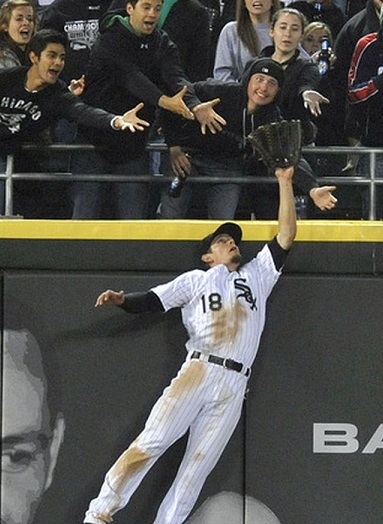
Acquired by the White Sox, along with Tyler Flowers and 2 minor leaguers, from the Braves in exchange for Javier Vazquez and Boone Logan, Brent Lillibridge donned #18 while hitting an anemic .158 in 95 at bats spread across 46 games for the 2009 White Sox.  Lillibridge stuck with the big league team in 2010, improving his average to .224 in only 64 games.  2011 was his best season, setting career highs in home runs, RBIs, batting average, and OPS.  On April 11, he hit the 10,000th home run in White Sox history off Dallas Braden and the A’s.  Lillibridge struggled again in 2012, with his average dropping down to .175 before the June 24th trade that sent him, along with Zach Stewart, to the Red Sox for Kevin Youkilis.

By The Numbers – 19

In 1929, uniform numbers appeared on the back of baseball jerseys for the first time, thanks to the Indians and the Yankees.  By 1937, numbers finally appeared across all uniforms, both home and away, across both major leagues.  Since that time, 81 distinct numbers have been worn by members of the White Sox, while the Cubs boast 76.

Today, we continue our look at those players, picking our favorite, if not the best, player to wear each uniform number for both Chicago teams with #19.  83 different players have donned #19 while playing in Chicago, 32 for the White Sox, one of whom had it retired in his honor, and 51 for the Cubs.

With a new ownership group in place and looking to make a quick splash, the White Sox purchased Greg Luzinski from the Phillies on March 30, 1981.  Coming off a disappointing season, the Chicago-area native, wearing his familiar #19, responded well to the change, hitting .265 with 21 home runs in the strike-shortened season.  He earned Comeback Player of the Year honors, beating out teammate Bill Almon by 5 votes, and finished 23rd in MVP voting.  Luzinski had another strong year in 1982, raising his average to .292, his highest total since 1977, while hitting 18 home runs and driving in 102 runs.

In 1983, Luzinski was a powerful cog in leading the White Sox to their first division title.  He launched the 8th, 9th, and 10th rooftop home runs in Comiskey Park history between June 26 and August 28.  While his average dropped to .255, he hit 32 home runs and drove in 95, good enough to finish 17th in MVP voting.  Like the rest of his teammates, he struggled during the ALCS against the Orioles, hitting only .133 in the 4-game series.  Unfortunately, those struggles carried over in to 1984.  His average dropped again, down to .238, and his power output fell as well, finishing the year with only 13 home runs, his lowest total since 1974, and 58 RBIs.  He did manage to hit his fourth rooftop blast on July 3 against the Tigers.  He became a free agent following the year and decided to retire.

On the north side of town, Matt Murton donned #19 when he made his major league debut for the Cubs on July 8, 2005.  He appeared in 51 games for the Cubs, hitting .321 with a .908 OPS.  That helped earn him the starting nod in left field for 2006, where he managed to post a .297 batting average with 13 home runs and 62 RBIs.  Despite his success, Murton saw his playing time diminish in 2007 after the Cubs signed Cliff Floyd, even getting sent back to Triple A in June.  He returned in late July, and finished the year with a .281 average and a .791 OPS in only 94 games.  His playing time was diminished ever further in 2008, appearing in only 19 games before being traded, 4 years to the day of his major league debut, to the A’s, as part of the haul for Rich Harden.

Against The A’s All Time Leaders – Through 2021

oakland-athleticsIn the past, we’ve looked at the all time leaders in both offensive and defensive categories for all 30 teams. This offseason, we will take our first ever look at those leaders against all 30 clubs.  We continue today with the Oakland Athletics.

The A’s began life in Philadelphia in 1901, as one of the 8 charter franchises of the American League, before moving to Kansas City in 1955 and, finally, to Oakland in 1968.  I’ve seen them play at least 30 times, including twice in their home stadium.

Home Runs

Name Total
Jose Abreu 3
Mike Cameron 2
25 tied with  1

Hits

Name Total
Tim Anderson 12
Jose Abreu 10
Juan Pierre 8

Runs

Name Total
Jose Abreu 6
Tim Anderson 5
A.J. Pierzynski 5

RBI

Name Total
Jose Abreu 6
Tim Anderson 6
A.J. Pierzynski 4
Tony Clark 4
Melky Cabrera 4
Mike Cameron 4
Brent Lillibridge 4
Adam Dunn 4

Doubles

Name Total
Jose Abreu 3
Dayan Viciedo 3
Tim Anderson 2
Tony Clark 2
Paul Konerko 2
Todd Frazier 2
Carlos Quentin 2

Triples Continue reading →

By The Numbers – 26

In 1929, uniform numbers appeared on the back of baseball jerseys for the first time, thanks to the Indians and the Yankees.  By 1937, numbers finally appeared across all uniforms, both home and away, across both major leagues.  Since that time, 81 distinct numbers have been worn by members of the White Sox, while the Cubs boast 76.

Today, we continue our look at those players, picking our favorite, if not the best, player to wear each uniform number for both Chicago teams with #26.  71 different players have donned #26 while playing in Chicago, 58 for the White Sox and 13 for the Cubs, who have retired it for a Hall of Fame outfielder.

Sweet-Swinging Billy Williams first wore his familiar #26 in 1961, his first full season with the Cubs, where he played in 146 games, hitting 25 home runs with 86 RBIs, while earning Rookie of the Year honors.  Williams hit at least 20 home runs and drove in 84 or more runs in every season from 1961 to 1973, earning 6 All-Star team nods along the way, in 1962, 1964, 1965, 1968, 1972, and 1973.  In 1963, he started a consecutive game streak that would last into 1970, setting the National League record with 1,117.

In 1970, Williams batted .322 with 42 homers and 129 RBI and finished second in MVP voting.  He replicated that finish in 1972, winning the batting title with a .333 average, along with a .606 slugging percentage, 37 home runs, and 122 RBIs.  That gave him his 3rd top ten finish in 5 seasons.  Following the 1974 season, Williams was traded to the A’s for, amongst others, Manny Trillo.  Williams was elected to the Hall of Fame in 1987 and his number 26 was retired by the Cubs later that summer.

On the South Side of town, nobody has really made their mark wearing #26, though one of the greatest “what ifs” in team history did don the number in 1986.  Acquired in the Rule 5 draft from the Pirates in December of 1985, Bobby Bonilla made his major league debut with the White Sox on April 9, going 0-1 as a pinch hitter in the Sox loss to the Brewers.  Bonilla was putting together a pretty decent rookie campaign, especially since he was making the jump from A ball, hitting .269 with 2 home runs in 75 games when GM Ken Harrelson decided send Bonilla back to the Pirates, in exchange for pitcher Jose DeLeon.  DeLeon went 23-22 across parts of 5 seasons in 2 stints with the White Sox, while Bonilla made 6 All Star teams, earned three Silver Slugger awards, and two top ten MVP finishes over the next 10 seasons.