Crossing Sides Of Town

So far in 2025, Brad Keller, Mike Tauchman, Nicky Lopez, and Reese McGuire pushed the total of players I’ve seen take the field in person for both the Cubs and the White Sox to 47.  With the final round of crosstown kicking off tonight at Rate Field, here’s a look at those players, in alphabetical order.

David Aardsma

After posting a decent season with the Cubs in 2006, Aardsma was traded to the White Sox for Neal Cotts.  Aardsma lasted one season with the Sox, where he was unable to duplicate his success from the year before.

Jason Bere

Drafted by the White Sox in the 36th round in 1990, Bere debuted with the big-league club in 1993, finishing 2nd in Rookie of the Year voting.  After an All Star selection in 1994, injuries marred the remainder of his tenure on the South Side, which ended in 1998.  He resurfaced with the Cubs in 2001 and had a decent season, but he went 1-10 in 2002 before being let go.

Emilio Bonifacio

Bonifacio spent back-to-back partial seasons in Chicago, first for the Cubs in 2014 after signing as a free agent, where he played decently enough to be flipped at the trade deadline, along with James Russell, to the Braves for a young catching prospect by the name of Victor Caratini.  He returned to Chicago in 2015, signing with the White Sox, where he he did not do well at all, hitting .167 in 47 games before being released in August.

Welington Castillo

Debuting with the Cubs in 2010, Castillo spent time behind the plate for the Cubs until May of 2015, when, having been replaced in the starting lineup by Miguel Montero, he was flipped to the Mariners.  He returned to Chicago in 2018 after signing with the White Sox as a free agent.  On May 24th of that season, he was suspended 80 games for a violation of the PED policy.  The White Sox then cut bait following the 2019 season, shipping him off to the Rangers.

Neal Cotts

Acquired by the White Sox in the Billy Koch trade, he debuted with the team in 2003.  He was a key contributor in the bullpen during the 2005 championship season and was the only relief pitcher to appear in all 3 rounds of the playoffs that season.  Following the 2006 season, he was traded to the Cubs for David Aardsma, and he spent the next 3 injury filled seasons on the North Side.
Scott Eyre

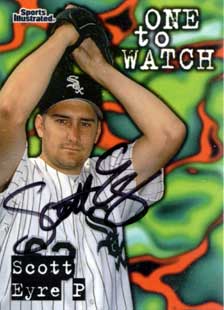
Joining the White Sox organization in a 1994 trade with the Rangers, he debuted with the big-league team in 1997.  He split the next 4 seasons between the rotation and the bullpen, not to mention between Chicago and Charlotte, before being moved to the Blue Jays following the 2000 ALDS loss to the Mariners.  He joined the Cubs as a free agent for the 2006 season and enjoyed 2 seasons of relative success, before falling apart in 2008, when he was traded to the Phillies.

Clint Frazier

After missing the second half of 2021 with an injury, Frazier was DFA’d by the Yankees.  He signed a deal with the Cubs that offseason, though he notched just 45 plate appearances before being DFA’s once again.  He chose to finish the year in the Cubs system before becoming a free agent following the season.  After failing to catch on with the Rangers, he signed a minor league deal with the White Sox, eventually hitting .197 in 33 games with the big-league club.

Kosuke Fukudome Continue reading →

The Time Of Your Life

After a disastrous 2021 that saw his reunion with the Cubs end with his August release followed by an even worse stint with the Padres, Jake Arrieta called it a career earlier this week.  Arrieta, 36, debuted with the Orioles in 2010.  He was acquired by the Cubs in July of 2013, in what turned out to be one of the best trades in team history, in a trade for Scott Feldman and Steve Clevenger.  He left the Cubs as a free agent after the 2017 season and signed with the Phillies on a 4-year deal.

After being acquired by the Cubs, Arrieta was sent to Triple A, where he made seven starts for Iowa before being recalled to the rebuilding big league club, showing vast improvement over the pitcher he was with the Orioles.  He turned into an ace for the Cubs in 2015, winning the NL Cy Young Award, and was a key contributor to their World Series championship in 2016.  He threw two no-hitters for the team, one in 2015 against the Dodgers and the second in 2016 against the Reds.  Injuries after the 2017 season left him a shell of his former self, but the Cubs rolled the dice for 2021, hoping for a miracle.  Instead, they got a rude awakening, as Arrieta set the team record for highest ERA for a pitcher in a season with at least 20 starts.  He followed up his last game, where he gave up 8 hits and 7 runs in the first inning, with a post-game tirade where he berated a reporter for wearing a mask, which he was required to do by city regulation, during a Zoom press conference.

For a brief period of time during the 2015 and 2016 seasons, Jake Arrieta was the best pitcher in baseball.  He was a key contributor to the 2016 World Series championship, earning him a place in Cubs lore for years to come.  His horrid performance in 2021, both on the field and as a functioning member of society, did little to hurt that standing.  I’m sure later this year or next year, there will be a Jake Arrieta Day at Wrigley Field, where he will rightly be feted as he throws out a first pitch and sings during the 7th inning stretch.

If You Build It Twice, Will They Still Come?

Following last week’s inaugural Field of Dreams game in Dyersville, Iowa, where the White Sox defeated the Yankees in thrilling fashion, word leaked that a second go-around would be slotted for the 2022 season, with the Cubs and the Reds on tap.  Neither team has a direct tie to the movie, but both have tangential ties to either the movie or the area: the Reds were the opponents of the 1919 White Sox that were the focus of the film in the thrown World Series and the Cubs have located their Triple A franchise in Iowa since 1981.

Can the second installment reach the heights of the first?  It’s hard to imagine.  While the novelty of playing in a cornfield in Iowa will remain, the grandeur of having Kevin Costner lead the teams out of the cornfields in to the stadium may come of as hokey if it is done a second time.  Given the success of the first game, a second was all but assured, but sometimes it is ok for a thing to just exist and be a hit.

Two Sides Of The Same Town

cws-chiFollowing last week’s trade deadline deals, Ryan Tepera and Craig Kimbrel became the 36th and 37th people I’ve seen play in person for both the Cubs and the White Sox.  With the first round of crosstown kicking off this afternoon at Wrigley, here’s a look at those players, in alphabetical order.

David Aardsma

After posting a decent season with the Cubs in 2006, Aardsma was traded to the White Sox for Neal Cotts.  Aardsma lasted one season with the Sox, where he was unable to duplicate his success from the year before.

Jason Bere

Drafted by the White Sox in the 36th round in 1990, Bere debuted with the big league club in 1993, finishing 2nd in Rookie of the Year voting.  After an All Star selection in 1994, injuries marred the remainder of his tenure on the South Side, which ended in 1998.  He resurfaced with the Cubs in 2001 and had a decent season, but he went 1-10 in 2002 before being let go.

Emilio Bonifacio

Bonifacio spent back-to-back partial seasons in Chicago, first for the Cubs in 2014 after signing as a free agent, where he played decently enough to be flipped at the trade deadline, along with James Russell, to the Braves for a young catching prospect by the name of Victor Caratini.  He returned to Chicago in 2015, signing with the White Sox, where he he did not do well at all, hitting .167 in 47 games before being released in August.

Welington Castillo

Debuting with the Cubs in 2010, Castillo spent time behind the plate for the Cubs until May of 2015, when, having been replaced in the starting lineup by Miguel Montero, he was flipped to the Mariners.  He returned to Chicago in 2018 after signing with the White Sox as a free agent.  On May 24th of that season, he was suspended 80 games for a violation of the PED policy.  The White Sox then cut bait following the 2019 season, shipping him off to the Rangers.

Neal Cotts

Acquired by the White Sox in the Billy Koch trade, he debuted with the team in 2003.  He was a key contributor in the bullpen during the 2005 championship season, and was the only relief pitcher to appear in all 3 rounds of the playoffs that season.  Following the 2006 season, he was traded to the Cubs for David Aardsma, and he spent the next 3 injury filled seasons on the North Side.

Scott Eyre

Joining the White Sox organization in a 1994 trade with the Rangers, he debuted with the big league team in 1997.  He split the next 4 seasons between the rotation and the bullpen, not to mention between Chicago and Charlotte, before being moved to the Blue Jays following the 2000 ALDS loss to the Mariners.  He joined the Cubs as a free agent for the 2006 season and enjoyed 2 seasons of relative success, before falling apart in 2008, when he was traded to the Phillies.

Kosuke Fukudome Continue reading →

Grievence Denied

After nearly 5 years, an arbitrator has ruled in favor of the Cubs in the grievance filed by the MLBPA on behalf of Kris Bryant.  The grievance, filed in May of 2015, alleged that the Cubs manipulated Bryant’s service time in an effort to keep an extra year of team control before Bryant was eligible for free agency.  The hearing took place this past October, once it became obvious that Bryant and the Cubs would not be coming to an agreement on a long term contract that would make the grievance moot.

Bryant split the 2014 season between Double A Tennessee and Triple A Iowa.  Despite hitting .325 with a combined 43 home runs and 110 RBIs between the two levels, he did not get a September call-up by the Cubs.  Determined to break camp with the big league team the next spring, Bryant slashed .425/.477/1.175 with nine home runs in 40 at-bats in the Cactus League.  However, that was not good enough to supplant Mike Olt, and Bryant was returned to Triple A to, allegedly, work on his defense.  When Olt injured his wrist on April 11, the Cubs waited until April 17 to put him on the DL and recall Bryant, the very day they gained an extra year of control.  Bryant went on to win the NL Rookie of the Year award, hitting .275 with 26 home runs and 99 RBIs while Olt, after finishing the year with the White Sox, never played in the major leagues again after the 2015 season.

So, the Cubs retain control over Bryant for an additional two years.  Whether he steps foot on the field again as a member of the team is still up in the air.  With the Cubs too close to the luxury tax threshold for Tom Ricketts’ comfort, Bryant has been rumored to be on the trading block all winter, with the result of his grievance, and the length of time before he becomes a free agent, seen as being the holdup in closing a deal.  While trading Bryant may be the best way to replenish a farm system left bare by 5 years of contention, while also lowering the team’s overall payroll commitments, doing so does not signal an intention to try and win in 2020, while the remainder of the team’s core moves closer to free agency themselves.