Celebrating Yourself

The Cubs are holding a party tonight to celebrate the end of the 1060 Project and the completion of the remodeling of Wrigley Field and the build out of the surrounding area.  The event, open to season ticket holders, includes the premiere of a new documentary about the renovations titled Saving Wrigley Field and the unveiling of two new plaques outside of the main gate: one to commemorate Wrigley Field’s official designation as a National Historic Landmark and the second to, and I quote, “commemorate the Ricketts family’s commitment to preserving Wrigley Field.”

The Cubs are also expected to unveil a new Hall of Fame, which was supposed to happen last year but was delayed due to the pandemic.  The Hall of Fame, which will be located on the left field bleacher concourse, will have its inaugural class of 56 inductees(!) announced at the event and will allow the Cubs to hold subsequent induction events on a yearly basis.  Those 56 inductees represent the 41 individuals previously enshrined in the original Cubs Hall of Fame (1982-86), nine additional individuals enshrined in the Cubs Walk of Fame (1992-98), five Cubs recently recognized by the National Baseball Hall of Fame and a new 2021 inductee, Margaret Donahue, who broke gender barriers as Major League Baseball’s first female officer who was not a team owner.  The plaques will be on display starting Friday.

I will, of course, be missing this whole hullabaloo, as I’m currently driving to Florida for vacation.  One must wonder on the timing of this event, coming on the heels of a late July tradeoff and another long losing streak, especially since it was all intended to roll out last year and was just announced a few weeks back.

Opening A New Book

The Cubs received approval this week from the Commission on Chicago Landmarks to build a two-story sportsbook at the corner of Sheffield and Addison. The 22,350-square-foot structure, which would be home to a DraftKings Sportsbook at Wrigley Field as part of a sponsorship deal the team struck with  DraftKings last year and looks to make gambling an integral part of the game day experience at the Friendly Confines. Though the new building would be connected to the ballpark, the addition would be open to anyone, as Major League Baseball rules prohibit a sportsbook operating where a game ticket is required for entry.
Yesterday’s approval is only the first step in what is sure to be a long process to get this extension put in place.  Approval is still needed from the City Council, both for the development itself but also on allowing sports betting inside the city’s stadiums. The National Park Service, which designated the restored ballpark as a National Historic Landmark, would also need to approve the plans for the new building.

While the timing is likely coincidental, it is somewhat amusing that the hearing on this came up a week after the Cubs traded off all of their star players because they couldn’t “afford” to offer them market-value extensions.  Also, it is amusing in a sad way that you must have a ticket to sit in the lovely park the Cubs built on the other side of the stadium in Gallagher Way, but you will be able to enter this new facility without one.  Like it or not, baseball, and the Cubs, have hitched their wagon to legal gambling and they will try to wring every dollar they can out of the arrangement.

Two Sides Of The Same Town

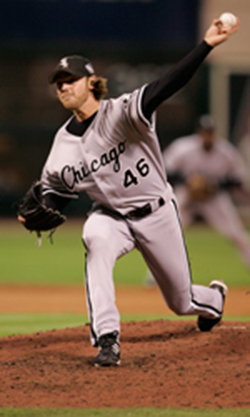
cws-chiFollowing last week’s trade deadline deals, Ryan Tepera and Craig Kimbrel became the 36th and 37th people I’ve seen play in person for both the Cubs and the White Sox.  With the first round of crosstown kicking off this afternoon at Wrigley, here’s a look at those players, in alphabetical order.

David Aardsma

After posting a decent season with the Cubs in 2006, Aardsma was traded to the White Sox for Neal Cotts.  Aardsma lasted one season with the Sox, where he was unable to duplicate his success from the year before.

Jason Bere

Drafted by the White Sox in the 36th round in 1990, Bere debuted with the big league club in 1993, finishing 2nd in Rookie of the Year voting.  After an All Star selection in 1994, injuries marred the remainder of his tenure on the South Side, which ended in 1998.  He resurfaced with the Cubs in 2001 and had a decent season, but he went 1-10 in 2002 before being let go.

Emilio Bonifacio

Bonifacio spent back-to-back partial seasons in Chicago, first for the Cubs in 2014 after signing as a free agent, where he played decently enough to be flipped at the trade deadline, along with James Russell, to the Braves for a young catching prospect by the name of Victor Caratini.  He returned to Chicago in 2015, signing with the White Sox, where he he did not do well at all, hitting .167 in 47 games before being released in August.

Welington Castillo

Debuting with the Cubs in 2010, Castillo spent time behind the plate for the Cubs until May of 2015, when, having been replaced in the starting lineup by Miguel Montero, he was flipped to the Mariners.  He returned to Chicago in 2018 after signing with the White Sox as a free agent.  On May 24th of that season, he was suspended 80 games for a violation of the PED policy.  The White Sox then cut bait following the 2019 season, shipping him off to the Rangers.

Neal Cotts

Acquired by the White Sox in the Billy Koch trade, he debuted with the team in 2003.  He was a key contributor in the bullpen during the 2005 championship season, and was the only relief pitcher to appear in all 3 rounds of the playoffs that season.  Following the 2006 season, he was traded to the Cubs for David Aardsma, and he spent the next 3 injury filled seasons on the North Side.

Scott Eyre

Joining the White Sox organization in a 1994 trade with the Rangers, he debuted with the big league team in 1997.  He split the next 4 seasons between the rotation and the bullpen, not to mention between Chicago and Charlotte, before being moved to the Blue Jays following the 2000 ALDS loss to the Mariners.  He joined the Cubs as a free agent for the 2006 season and enjoyed 2 seasons of relative success, before falling apart in 2008, when he was traded to the Phillies.

Kosuke Fukudome Continue reading →

Keeping Our Eyes On Next Year’s Prize

With a little more than 8 weeks remaining in the 2020 season, Major League Baseball released their tentative 2021 schedule yesterday.  For the first time in quite a while, the White Sox will be looking to compete for a title while the Cubs will be “retooling” after trading off all of their stars last week.  Assuming, of course, that the 2022 season goes off as planned and the end of the collective bargaining agreement doesn’t lead to a long work stoppage.  So, for one day, at least, let’s turn our attention to next summer for both teams.

The White Sox open their season at home against the Twins on March 31 for a three game tilt before heading on the road.  Nothing like a potential snowstorm to get the season off to a good start.  They face the Guardians for the first time on April 18 in Cleveland.

The interleague schedule pits the White Sox against the NL West, with trips to San Francisco, Colorado, and San Diego and home series against the Dodgers, Diamondbacks, and Rockies. The rivalry with their north side foes continues with a 2-game series at Wrigley at the beginning of May and a follow-up at Guaranteed Rate Field Memorial Day weekend.

The season ends with a 6 game road trip to Minnesota and San Diego.

On the north side, the Cubs open their season up on the road in Cincinnati, also on March 31.  They come home the following Monday to open their home slate against the Cardinals.

The interleague schedule pits the Cubs against the AL East, with trips to Baltimore, New York, and Toronto and home series against the Rays, Red Sox, and Orioles.

Of their 28 games in September/October, only 7 are against their NL Central rivals, though, with the Cubs not likely to contend, that shouldn’t make much of a difference.  They end the year with a 6 game homestand, facing the Phillies and the Reds.

Indians No More

After years of controversy and resistance, the Cleveland Indians announced today that they will officially be changing their name to the Cleveland Guardians starting with the 2022 season.  The Indians name dates back to 1915, when the team, then known as the Naps, was looking to rebrand following the departure of Nap Lajoie.  The Guardians name was inspired by a pair of stone monuments, the Guardians of Traffic, along the Hope Memorial Bridge a quarter of a mile away from Progressive Field.

The Indians name and its Chief Wahoo logo have long been criticized for perpetuating Native American stereotypes. In 2015, team owner Paul Dolan acknowledged that there were critics, the team had no plans to change either its name or its logo.  On January 29, 2018, however, Major League Baseball announced that Chief Wahoo would be removed from the Indians’ uniforms as of the 2019 season, stating that the logo was no longer appropriate for on-field use.  In completely unrelated news, Cleveland hosted the All Star game in 2019.  Last July, following a similar move by the Washington Football team, the Indians announced that they would “determine the best path forward” regarding the team’s name and, in December, the team announced they would drop the Indians name following the 2021 season.


Connecting The City

Back in April, Nike announced they would be introducing City Connect uniforms to Major League Baseball, similar to their ColorRush and City uniforms for the NFL and NBA respectively, which reimagine a teams look and “celebrates the bond between each team and its city.”  The Red Sox were the first to both announce their uniforms and to wear them, a blue and yellow monstrosity based on the finish line of the Boston Marathon which they wore against the White Sox on the weekend prior to Patriot’s Day.

Yesterday, the White Sox released their design, which they will debut next weekend against the Tigers.  The jerseys and pants are mostly black, with white pinstripes and retain the olde English S to spell out Southside rather than Sox on the jersey.  The white sock patch, currently only seen on the black alternates, graces the left sleeve.

All things considered, this could have been much worse.  They retained the team’s color scheme, which has been a constant since the end of the 1990 season.  Assuming they only appear for the weekend series and then go away for the remainder of the season, I have no complaints.  In fact, one of the videos the team posted on Twitter showed the Southside logo on a sweatshirt that may end up in my closet one day.

The Game Remains The Same… Wait

As baseball looks to start its second pandemic-impacted season, a number of rule changes were announced yesterday as part of the updated health and safety protocols.  These rules cover spring training, the regular season, and the postseason.

Each team is required to submit a list of up to 75 players eligible for spring training by February 12.  For spring training games that occur between February 27 and March 13, the “retiring the side” concept will be relaxed, allowing managers to end an inning prior to three outs following any completed plate appearance, as long as the pitcher has thrown at least 20 pitches.  In addition, substitution rules for all of spring training shall be relaxed, allowing pitchers to be eligible for re-entry.

A 26 player Opening Day roster as well as a list of up to 28 players that will be assigned either to the Class AAA affiliate or Alternate Training Site, must be submitted by noon on Opening Day.  Any player on the Injured List who does not remain with the big league club will be assigned to the Alternate Training Site, but will not count against the 28-player maximum.  Teams will also be permitted to have a five player taxi squad, which includes at least one catcher, on all road trips.

In the regular season, doubleheaders will continue to be comprised of two seven-inning games. The extra-inning rule introduced last season also will continue to be in effect.  Also, each extra-inning will continue to begin with a runner on second base.  All on-field personnel, including players, must wear face coverings over both the mouth and nose at all times in the dugout and bullpen, except for pitchers and catchers warming up in the bullpen.  Players who violate this requirement are subject to discipline by MLB.  Limitations on the number of pitchers on the active roster and the restriction on position players pitching will not be applicable.  The roster size will expand to 28 on September 1.

MLB has the right to relocate teams to neutral sites, spring training sites, or other clubs’ home ballparks, and/or reschedule games during the 2021 season for health/safety reasons, to comply with governmental restrictions, or to complete the schedule.  With the consent of the MLBPA, MLB also has the right to conduct some or all of the postseason at neutral sites or to delay the start of the postseason in order to reschedule regular season games following the planned completion of the season.  MLB shall also have the right to reschedule any game postponed due to COVID-19 as a seven-inning split or straight doubleheader.  The first four doubleheaders scheduled per team due to COVID-19 shall not count against the limitation on split doubleheaders in the CBA.

2020: The Year In Movies Part 2

Movie_Reel_22272 different people starred in the 154 movies I saw last year (starring in being the first two named stars, a tradition dating back to the old Chicago Tribune TV guide which populated the early days of my database), and 28 of them starred in more than 1 film. Those 28 thespians are:

Films Per Actor Per Year
Actor Name Films
Charles Bronson 4
Harrison Ford 4
Katie Holmes 3
Keanu Reeves 3
Bruce Willis 3
Renee Zellwegger 3
Chadwick Boseman 2
Alison Brie 2
Jessica Chastain 2
Adam Driver 2
Jesse Eisenberg 2
Karen Gillan 2
Carla Gugino 2
Tom Hanks 2
Anna Hutchison 2
Samuel L. Jackson 2
Gillian Jacobs 2
Felicity Jones 2
Ewan McGregor 2
Kumail Nanjiani 2
Al Pacino 2
Brad Pitt 2
Issa Rae 2
Arnold Schwarzenegger 2
Will Smith 2
Kristen Stewart 2
Charlize Theron 2
Jessie T. Usher 2

Now let’s take a look at the next batch of movies that I saw in 2020, following up on last Wednesday’s post.

The Prodigy (2019)
The soul of a serial killer takes over a young boy’s body, much to his mother’s chagrin.

Alex & The List (2017)
A dog trainer is given a list of things to change about himself by his fiancé before she’ll marry him.

Hide (2011)
A Boston detective investigates the mummified remains of six women.

Pretty Little Stalker (2018)
A writer takes in a troubled girl and sees her family disintegrate.

Road To Perdition (2002)
Tom Hanks and Paul Newman star in this adaptation of the graphic novel by Max Allan Collins and Richard Piers Rayner.

Jumanji: The Next Level (2019)
The kids head back into the game, this time dragging along Dannys DeVito and Glover.

Are You In The House Alone? (1978)
A supposed horror movie that turned out to be a made-for-tv movie.

My Soul To Take (2010)
A serial killer returns to his hometown to stalk the seven children born on the day he was allegedly put to rest.

Bridget Jones: The Edge Of Reason (2004)
The second installment in the series starring Renee Zellwegger.

Good People (2014)
A couple finds themselves in a pickle after discovering, and keeping, cash in their dead tenants apartment. Continue reading →

Homer History

The White Sox have been on a historic home run streak over the past few days.  Sunday, versus the Cardinals, they notched the 10th occurrence in MLB history of 4 consecutive home runs when Yoan Moncada, Yasmani Grandal, Jose Abreu, and Eloy Jimenez went deep back to back to back to back in the 5th inning.  The first three home runs also became the first time a team had 3 Cuban-born players go back to back to back.

This was the second time the White Sox have accomplished this rare feat, joining the Nationals as the only franchise to do it more than once.  Jim Thome, Paul Konerko, Alexei Ramírez, and Juan Uribe did the same on August 14, 2008 against the Royals.

The White Sox followed up on that with a little more history on Monday night.  Last week, in Detroit, Tim Anderson and Eloy Jimenez led off the game against starter Matthew Boyd with back to back home runs.  Boyd was back on the bump against the White Sox Monday night in Chicago, and again served up two home run balls to start the game, to Anderson again and Yoan Moncada.  This made the White Sox the first team to ever lead off a game with back to back home runs against the same pitcher twice.  They also halved the previous record of time between games with back to back home runs to start a game, down to 5.  The Dodgers held the previous record, at 10 games.

Looking Ahead To 2021

For reasons that I don’t entirely understand, Major League Baseball released their tentative 2021 schedule late last week, 3 weeks before the 2020 season begins. The local squads should have common goals in mind for 2021: competing for a title.  Assuming, of course, that the 2020 season goes off as planned and the pandemic winds down enough for 2021 to proceed as planned.  So, for one day, at least, let’s turn our attention to next summer for both teams.

The White Sox open their season against the Angels in (Los Angeles, California, Anaheim), the first time that has happened since 1993.  Which, I guess, is a decent sign if one’s looking for omens towards a division title.  They return home a week later, facing the Royals for the home opener.

The interleague schedule pits the White Sox against the NL Central, with trips to Cincinnati, Pittsburgh, and Milwaukee and home series against the Reds, Cardinals, and the Pirates. The rivalry with their north side foes continues with a series at Wrigley at the beginning of August and a follow-up at Guaranteed Rate Field at the end of the month.

The season ends with a 5 game homestand against the Reds and Tigers.

On the north side, the Cubs open their season up at home against the Pirates, which seems to be a familiar Opening Day foe.

The interleague schedule pits the Cubs against the AL Central, with trips to Cleveland, Detroit, and Minnesota and home series against the Indians, Royals, and the Twins.

The Cubs end the year with a 12 of their final 14 games against the NL Central, with 9 of those coming against the Brewers and the Cardinals, who are likely to challenge them for the NL Central crown.