Breaking Barriers

Later today, a woman is scheduled to umpire a regular season major league game for the first time.  Jen Pawol, who has been a minor-league umpire since 2016, is being called up for a doubleheader between the Marlins and the Braves, working the bases in place of the home plate umpires, who only work the one game.  She is then slated to work behind the plate for Sunday’s series finale.

Pawol, a 48-year-old graduate of Hofstra University, worked spring training games in 2024, becoming the first woman to do so since 2007. She is only the third woman to ever umpire a major-league spring training game.  She also became a crew chief in the International League last season.

MLB is behind the times in this area.  The NBA had its first female referee debut 28 years ago, while the NFL has had female officials for the past ten years.  Hopefully this leads to more opportunities for interested women to find a career in baseball.

And That Deadline Was A Bit Of A Dud

The MLB trade deadline has come and gone and neither the Cubs nor the White Sox made the big moves they were expected to make.  The Cubs made two late moves, adding utility man Willi Castro from the Twins and reliever Taylor Rogers from the Pirates.  The White Sox made a single move, sending Adrian Houser to the Rays.

Castro, 28, is a switch hitter who can play pretty much anywhere.  He’s posted a .742 OPS with the Twins this year and will hit free agency at year end.  Going back to the Twins are two Double A pitchers: Ryan Gallagher and Sam Armstrong.  Rogers, 34, was acquired by the Pirates on Wednesday in the Ke’Bryan Hayes trade before being flipped to the Cubs.  His walk rate this year is the highest it has been in his career, but a veteran lefty is always good to have around down the stretch.  High A outfielder Ivan Brethowr is headed back to the Pirates.  He is 22 and striking out in nearly 30% of his at bats this season.

Houser, 32, joined the White Sox in late May and has had the best stretch of his career.  In return, the Rays are sending infielder Curtis Mead, pitcher Duncan Davitt, and pitcher Ben Peoples.  Mead, 24, is a former top 100 prospect who has yet to find his way in the big leagues, spending parts of three seasons with the Rays and posting 0.4 career WAR.  Davitt, 25, and Peoples, 24, were both in Triple A for the Rays.

Despite those moves, when the bell rang at 5 PM CT yesterday, the Cubs were still lacking a proven starter who can help their beleaguered rotation, and the White Sox still employed Luis Robert, Mike Tauchman, and Aaron Civale.  None of which was the expected outcome of the day.


Crossing Sides Of Town

So far in 2025, Brad Keller, Mike Tauchman, Nicky Lopez, and Reese McGuire pushed the total of players I’ve seen take the field in person for both the Cubs and the White Sox to 47.  With the final round of crosstown kicking off tonight at Rate Field, here’s a look at those players, in alphabetical order.

David Aardsma

After posting a decent season with the Cubs in 2006, Aardsma was traded to the White Sox for Neal Cotts.  Aardsma lasted one season with the Sox, where he was unable to duplicate his success from the year before.

Jason Bere

Drafted by the White Sox in the 36th round in 1990, Bere debuted with the big-league club in 1993, finishing 2nd in Rookie of the Year voting.  After an All Star selection in 1994, injuries marred the remainder of his tenure on the South Side, which ended in 1998.  He resurfaced with the Cubs in 2001 and had a decent season, but he went 1-10 in 2002 before being let go.

Emilio Bonifacio

Bonifacio spent back-to-back partial seasons in Chicago, first for the Cubs in 2014 after signing as a free agent, where he played decently enough to be flipped at the trade deadline, along with James Russell, to the Braves for a young catching prospect by the name of Victor Caratini.  He returned to Chicago in 2015, signing with the White Sox, where he he did not do well at all, hitting .167 in 47 games before being released in August.

Welington Castillo

Debuting with the Cubs in 2010, Castillo spent time behind the plate for the Cubs until May of 2015, when, having been replaced in the starting lineup by Miguel Montero, he was flipped to the Mariners.  He returned to Chicago in 2018 after signing with the White Sox as a free agent.  On May 24th of that season, he was suspended 80 games for a violation of the PED policy.  The White Sox then cut bait following the 2019 season, shipping him off to the Rangers.

Neal Cotts

Acquired by the White Sox in the Billy Koch trade, he debuted with the team in 2003.  He was a key contributor in the bullpen during the 2005 championship season and was the only relief pitcher to appear in all 3 rounds of the playoffs that season.  Following the 2006 season, he was traded to the Cubs for David Aardsma, and he spent the next 3 injury filled seasons on the North Side.

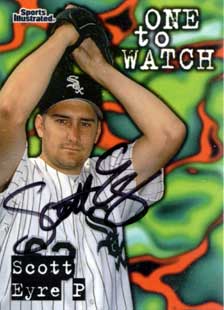
Scott Eyre

Joining the White Sox organization in a 1994 trade with the Rangers, he debuted with the big-league team in 1997.  He split the next 4 seasons between the rotation and the bullpen, not to mention between Chicago and Charlotte, before being moved to the Blue Jays following the 2000 ALDS loss to the Mariners.  He joined the Cubs as a free agent for the 2006 season and enjoyed 2 seasons of relative success, before falling apart in 2008, when he was traded to the Phillies.

Clint Frazier

After missing the second half of 2021 with an injury, Frazier was DFA’d by the Yankees.  He signed a deal with the Cubs that offseason, though he notched just 45 plate appearances before being DFA’s once again.  He chose to finish the year in the Cubs system before becoming a free agent following the season.  After failing to catch on with the Rangers, he signed a minor league deal with the White Sox, eventually hitting .197 in 33 games with the big-league club.

Kosuke Fukudome Continue reading →

Moving On… Slowly

The White Sox announced on Thursday that chairman Jerry Reinsdorf and minority shareholder Justin Ishbia have reached a “long-term investment agreement that establishes a framework” for Ishbia to obtain a controlling interest in the franchise within the next ten years.  As part of the agreement, Ishbia will make “capital infusions” into the White Sox in 2025 and 2026 that will be used to pay down existing debt and support ongoing team operations.  Following that, Reinsdorf will have the option to sell controlling interest to Ishbia between 2029 and 2033 and, following the 2034 season, Ishbia will have the option to acquire the controlling interest.

Reinsdorf, who has had controlling interest in the White Sox since purchasing the team for $19 million from Bill Veeck in 1981, will be 93 at the start of the initial transition period in 2029.  He has long claimed that he has no interest in selling while he remains in good health but would be 97 by the time Ishiba controls the option to buy.  Ishiba, a billionaire private equity investor, increased his stake in the Whtie Sox this spring to a reported 35%.  In a statement, Ishbia said, “I love Chicago, have always loved baseball, and am thrilled to marry two of my passions.”

Overall, this should be a good thing for the White Sox and their fans.  While Reinsdorf has had one of, if not the winningest ownership tenure in franchise history, he has also managed to successfully alienate most of the fan base, starting with his threats to move the team to Florida in the 1980s, followed by his appearance as one of the largest contributors to the work stoppages that wiped out the end of the 1994 season and the start of the 1995 season and, most recently, overseeing the team’s fall to setting the MLB record for most losses last year.  It is time to turn the page, and waiting for 2029, 2034, and/or Reinsdorf’s death is the price we have to pay for being White Sox fans.

Chicago White Sox Baseball Is On The Air

Over a year ago, the White Sox, Bulls, and Blackhawks announced that they were partnering with Standard Media Group to create the new television broadcast home for all three teams, which eventually became Chicago Sports Network (CHSN for short).  Starting in October, the network went live missing one small little thing: a carriage agreement with Comcast, the largest cable provider in Chicago.

Ratings for the Blackhawks this past season, their first on the new network, were down 78% from the previous year on NBC Sports Chicago.  The Bulls were looking at a 63% decrease as of February.  The White Sox, coming off a season where they set the MLB record for losses in a year, were not exactly worth the $29.99 the network was charging for streaming.

Well, that all changes today.  Word broke yesterday that the fledgling network had finally reached agreement with Comcast to be added to their channel line-up.  They are expected to be placed on the Ultimate tier plan, which will add $20 to your cable bill if you are not already subscribed.  The Cubs’ Marquee Sports Network is expected to be moved to the same tier following this season.  With live sports seemingly one of the few reasons to keep cable, it seems that providers are looking to soak their customers for as much as they can before everything moves to streaming.


Eligible For The Hall

Last week, MLB Commissioner Rob Manfred announced that anyone on the league’s permanently ineligible list that was now deceased would be removed, making them eligible for Hall of Fame consideration.  In a statement, Manfred said, “In my view, once an individual has passed away, the purposes of Rule 21 have been served.  Obviously, a person no longer with us cannot represent a threat to the integrity of the game.”  Later in the statement, he said, “I have concluded that permanent ineligibility ends upon the passing of the disciplined individual.”

The driving force behind this change was, of course, Pete Rose.  Rose, who died last September, agreed to be banned by then-Commissioner Bart Giamatti in 1989 after a report by investigator John Dowd confirmed that he had bet on Reds games while he was the manager.  That agreement prohibited Dowd from further investigation which likely would have uncovered that Rose had bet on his team to lose.  Complicating matters, Giamatti died of a heart attack eight days later, making his successors hesitant to remove Rose from the ineligible list during his lifetime.

Along with Rose, this decision applies to 16 other deceased individuals, including members of the 1919 White Sox like Shoeless Joe Jackson and Buck Weaver, among others.  2028 would be the earliest any of the newly eligible players could be inducted into the Hall of Fame, as the Classic Baseball Era Committee will next meet and vote in December 2027.  The two most likely to get any consideration are Rose and Jackson, and neither is the shoe-in their supporters may think.

Not Getting Better

37 games into the 2025 season, the White Sox hold a 10-27 record, good for a birthday but not for a record.  This is one game ahead of last year, when the White Sox started their longest winning streak of the year by defeating the Rays 4-1 to go to 9-28 on the year.  The White Sox, of course, finished last year with the most losses in modern MLB history.

Connecting The City 2.0

Back in 2021, Nike announced they would be introducing City Connect uniforms to Major League Baseball, reimagining each team’s look to “celebrate[s] the bond between each team and its city.”  The White Sox were one of the first to get a City Connect, the infamous Southside set that was widely recognized as one of, if not the best rendition of the initial go-arounds.  Each City Connect uniform combination was intended to last for three years.

Four years later, the second wave of City Connects are being released and the White Sox will likely find themselves on the bottom of most rankings.  Announced yesterday, the new uniform set is the first collaboration between the MLB and NBA, as the jerseys basically adopt the Chicago Bulls look, with red jerseys with black pinstripes, black sleeves, and Chicago across the chest in a very Bulls-like wordmark.

First, the good: I like the black hat with the winged sock logo and the red brim.  And that’s about it.  The jersey looks like a cheap generic that you would pick up at Walgreens or Osco, not something a major league team would wear.  The black pants have red stripes down the sides with “SOUTHSIDE” repeated in black within the stripe.  Overall, this seems like a lazy, bottom of the barrel idea and I can’t see how this City Connect program will last long-term if they are already down to ideas like this.

Ballpark Tour: A’s

With just under a month to go before pitchers and catchers start reporting to spring training camps, we continue our tour of all of the different baseball stadiums I’ve been to over the years. This week, we head to the Bay Area to look at the former Oakland A’s. So, without further ado, let’s take a deeper look at my history with the Oakland Coliseum.

Stadium Name: McAfee/Network Associates Coliseum

Years in Service: 1968 – Present

Visits: 2

The Oakland–Alameda County Coliseum opened in 1966 as the home of the Oakland Raiders.  Two years later, Charlie Finley moved his A’s from Kansas City to Oakland and became the baseball tenant of the stadium.  In 1998, the stadium became known as Network Associates Coliseum.  In mid-2004, Network Associates was renamed McAfee and the stadium was renamed McAfee Coliseum accordingly.  Following the 2008 season, the name reverted back to Oakland–Alameda County Coliseum until April 27, 2011, when it was renamed Overstock.com Coliseum. Just over a month later, the Coliseum was renamed O.co Coliseum, after Overstock.com’s marketing name.

Both times I’ve traveled to the Bay area, I’ve taken in both Giants and A’s games.  My first trip to what at the time was called Network Associates Coliseum was on September 6, 1999 while I was out west visiting my friend Scott.  The Tigers triumphed over the A’s that day, and my one memory of the stadium is that the seats were not necessarily positioned in such a way as to face the field for baseball purposes.

My second trip to the Bay area, for the JavaOne conference in 2008, actually started out with a BART trip out to Oakland for a 2-1 A’s victory over the Orioles on May 5th.  The A’s had opened up three sections of the third deck as designated All-You-Can-Eat seats, where, for the price of the ticket, free ballpark fare was included.  While I enjoyed the novelty of the free foodstuffs, the seats, while directly behind home plate, were horrible.  Leaving early in order to catch the train back to San Francisco led to the problem of trying to get out of the stadium, since none of the gates were open.

The A’s bid this stadium, and the city of Oakland, farewell following the 2024 season.  They plan to play their home games in Sacramento while a new stadium is being built in Las Vegas.  The funding for said stadium isn’t as secure as MLB and the A’s would lead you to believe, so the future home of this franchise is anyone’s guess.

Ballpark Tour: Red Sox

With the offseason underway, we continue our tour of all of the different baseball stadiums I’ve been to over the years. This week, we look at the Boston Red Sox, owners of the oldest stadium in Major League Baseball. So, without further ado, let’s take a deeper look at my one game history with Fenway Park.

Stadium Name: Fenway Park

Years in Service: 1912 – Present

Visits: 1

In 1911, Red Sox owner John I. Taylor purchased the land bordered by Brookline Avenue, Jersey Street, Van Ness Street and Lansdowne Street and developed it into a larger baseball stadium, which he named after the Fenway neighborhood where it was located.  The first game was played April 20, 1912, as the Red Sox defeated the New York Highlanders, who would become the Yankees the following year, 7-6 in 11 innings.

I attended my first (and, so far, only) game at Fenway Park in August of 2017, cashing in my birthday gift from the year before.  The hope was that Angelina would be moving into Boston University around that time, but her gap year put a kibosh on that.  The ballpark was… a little underwhelming.  From the outside, you could barely tell that it was a stadium.  Michael even asked where it was as we were standing outside it.

The game went about as you would expect.  With James Shields on the mound, the White Sox did not put up much of a fight.  We were sitting down the left field line, with a good view of the Green Monster.  The seats, which may or may not date back to the stadium’s opening in 1912, were not really designed for people well over 6 feet tall, so there was a lot of uncomfortable shifting as Danny and my knees were smooshed into the seats in front of us.

I would have added an additional game or two in 2020, as the plan was to take Michael to Boston for his birthday and enjoy the monster seats, but a little global pandemic got in that way of that.  Now that Angelina is done with school and working full time in Boston, there is still an opportunity to increase my number of visits in the years to come.