Hanging Up His Platinum Glove

Former Cub Anthony Rizzo announced his retirement this morning after a fourteen-year career.  A three-time All Star, Rizzo spent ten seasons with the Cubs, ranking sixth in franchise history with 242 home runs.  He was also a four-time Gold Glove winner, winning Platinum Glove honors in 2016 as the league’s best defender.  In 2017, Rizzo was bestowed with the prestigious Roberto Clemente Award.

Rizzo, originally drafted by the Red Sox when Theo Epstein and Jed Hoyer were in their front office, was the duo’s first big acquisition when they reunited in Chicago, acquiring him from the Padres.  Beginning the 2012 season in Triple A, he was recalled at the end of June and quickly became a mainstay of the lineup and a crowd favorite.  As the Cubs were rebuilding around him, he signed a long-term contract extension in 2013.  He cemented his position in Cubs lore by catching the final out of the 2016 World Series, ending the longest championship drought in American professional sports.  However, as the Cubs struggled to repeat the team success of that season, Rizzo also struggled in later years, contributing to an offense that has severely regressed since 2016 and was one of the Cubs who refused to get the COVID vaccine, keeping the team below the 85% threshold for the 2021 season.  At the trade deadline, he was traded to the Yankees.

After re-signing with the Yankees after the 2021 season, Rizzo spent three injury-marred seasons in New York, culminating in last fall’s World Series loss to the Dodgers.  A free agent following the season, he went unsigned and sat out the 2025 season prior to today’s announcement.  He will officially retire as a Cub and join the organization as a team ambassador.

A Fallen Icon

For the second time in the month, a Chicago baseball legend has lost his life prematurely due to cancer.  Former Cubs second baseman Ryne Sandberg, who had been suffering from metastatic prostate cancer for over a year, died Monday at 65.

Ryne Sandberg was acquired by the Cubs, along with Larry Bowa, from the Phillies for Ivan DeJesus in January of 1982.  He was the primary third baseman for the Cubs during the 1982 season, hitting .271 with 7 home runs and 54 RBIs, good enough to place sixth in Rookie of the Year voting.  After the Cubs acquired Ron Cey following the season, they moved Sandberg to second base, where he would become a mainstay for the next decade plus.

1983 saw Sandberg garner his first Gold Glove while hitting .261 with 8 home runs and 48 RBIs.  He blossomed in 1984, as the Cubs made a surprising run at the NL East title.  Sandberg won the MVP, Silver Slugger, and Gold Glove awards while leading the league with 114 runs and 19 triples.  He hit .368 during the NLCS against the Padres, which the Cubs dropped in 5 games.  1985 saw him win another Silver Slugger and Gold Glove, while still earning MVP support despite the Cubs falling to the bottom of the division.  He earned another Gold Glove in 1986, hitting .284 with 14 home runs.  Injuries limited him to 132 games in 1987. but he still took home his fifth consecutive Gold Glove.

Sandberg posted a .741 OPS in 1988, good enough for his third Silver Slugger award and his sixth straight Gold Glove.  The Cubs returned to the post-season in 1989, as Sandberg hit .290 with 30 home runs, which garnered him yet another Silver Slugger and Gold Glove while coming in fourth for MVP voting.  He hit .400 and drove in four in the Cubs’ NLCS loss to the Giants in five games.  In 1990, Sandberg set a career high with 40 home runs, which led the National League, and duplicated his Silver Slugger, Gold Glove, and fourth place for MVP voting results from the previous year.  1991 saw Sandberg win his ninth consecutive, and final, Gold Glove award, breaking a tie with Bill Mazeroski.  In 1992, he won his fifth straight, and seventh overall, Silver Slugger award.  1993 saw Sandberg make his tenth consecutive, and final, All-Star team.

Sandberg struggled out of the gate in 1994, and with rumored marital issues at home, he abruptly retired on June 13th, saying “I lost the desire that got me ready to play on an everyday basis for so many years. Without it, I didn’t think I could perform at the same level I had in the past, and I didn’t want to play at a level less than what was expected of me by my teammates, coaches, ownership, and most of all, myself.”  Following a divorce and a new marriage, Sandberg returned to the Cubs in 1996, hitting .244 with 25 home runs and 92 RBIs.  With his OPS dropping to .711 in 1997, his lowest total since 1983, Sandberg retired for good following the 1997 season.  He was inducted to the Hall of Fame in 2005 and, that August, the Cubs retired his #23.  Last June, a statue of Sandberg was unveiled on Gallagher Way outside Wrigley Field

2024 Hall Of Fame Ballot – The Newcomers

On Monday, the BBWAA released their ballot for the Hall of Fame class of 2023, with the results of the vote are due to be revealed on January 23rd, and induction taking place July 21st.  With Scott Rolen as the sole electee last year, the new ballot contains fourteen holdovers along with twelve newcomers.

Yesterday, we looked at the returning candidates.  Today, it’s time to look at the newcomers and who see may be thankful come January.

Jose Bautista

The long-time Blue Jays slugger will likely get enough consideration to stick around on the ballot, but has no real chance at induction.

Adrián Beltré

Beltré finished his career with 3166 hits, 477 home runs, and 5 Gold Gloves at third base.  He is the closest thing to a shoo-in we’ve seen in years.

Bartolo Colon

The all-time wins leader, with 247, among Latin American pitchers, Colon will end up on the outside looking in, thanks to a 4.12 career ERA and a PED suspension in 2012.

Adrián González

The first overall pick of the 2000 draft, González put together a very fine career.  Just not one that will get him to Cooperstown.

Matt Holliday

Again, Holliday had a very fine career, although he will get dinged for part of that career taking place in Colorado, but I don’t see him getting in.

Victor Martinez

If he spent his entire career playing against the White Sox, he would be a first ballot, all-time great.  Unfortunately, he had to play against the other teams as well, which means he has to “settle” for having a very good career, but not a Hall of Fame career.

Joe Mauer

One MVP award, three Gold Gloves, and three batting titles, as a catcher, make me think Mauer will eventually find his way to Cooperstown, but he may need to wait a while.

Brandon Phillips Continue reading →

The Jason Heyward Era Ends

In news that was both surprising and unsurprising, Jed Hoyer announced before last night’s game that Jason Heyward was unlikely to return from his knee injury this year and that he and the Cubs would be parting ways this offseason.  Heyward, who has been on the IL with a knee injury since late June, has one year remaining on his contract.

Signed to an 8-year, $184 million contract back in December of 2015, Heyward never quite produced enough to justify his lofty contract and, as the Cubs failed to sustain their 2016 success, he became as much of a scapegoat as anyone else on the roster, seeing his playing time reduced.  However, his place in Cubs lore was set when he was credited with leading an inspiring players-only meeting during the 17-minute rain delay at the end of Game 7 of the 2016 World Series, after which the Cubs stormed out and took the lead in the 10th inning.

In addition to a World Series ring, Heyward won Gold Glove awards in both 2016 and 2017.  His numbers with the Cubs, both in games I attended and overall, were:

Continue reading →

By The Numbers – 2

In 1929, uniform numbers appeared on the back of baseball jerseys for the first time, thanks to the Indians and the Yankees.  By 1937, numbers finally appeared across all uniforms, both home and away, across both major leagues.  Since that time, 81 distinct numbers have been worn by members of the White Sox, while the Cubs boast 76.

Today, we continue our look at those players, picking our favorite, if not the best, player to wear each uniform number for both Chicago teams with #2.  50 different players have donned #2 while playing in Chicago, 28 for the White Sox, who retired the number in 1976, and 22 for the Cubs.

Acquired from the A’s for Joe Tipton following the 1949 season, Nellie Fox switched to his familiar #2 starting with the 1953 season.  The White Sox finished in third place in each season between 1953 and 1956, followed by second-place finishes in 1957 and 1958 before finally breaking through in 1959, thanks in part to Fox’s best season.  He batted .306, leading the AL in singles en route to a .380 OBP.  He also started and had four hits in two All-Star games and won his second Gold Glove on his way to winning the MVP for AL champions.

In the World Series, which turned out to be his only postseason experience, Fox led the White Sox with a .375 average with three doubles.  In Game 5, Fox scored the only run when Sherm Lollar hit into a double play in the fourth inning, only the second time that a World Series game did not have an RBI. Unfortunately, the Sox dropped the next game, and the series, to the Dodgers.

All told, Fox spent 14 seasons with the White Sox, making 12 AL All-Star teams and 15 of 16 AL All-Star Game selections beginning in 1951, with two All-Star games played between 1959 and 1962.  Following the 1963 season, he was traded to the Houston Colt .45s.  He died on December 1. 1975, at the age of 47, following a bout with cancer.  His #2 was retired by the White Sox in 1976 and he was elected to the Hall of Fame in 1997.

On the north side of town, Ryan Theriot wore three different numbers after making his debut on September 13, 2005 before settling on #2 in 2007.  That year, he made the opening-day roster as a utility player, but the early-season struggles of César Izturis led to Theriot taking over as the starter.  Theriot was notably versatile throughout the 2007 season, playing multiple positions defensively and hitting all over the batting order. Despite impressive numbers from Theriot in the lead-off spot, albeit a small sample size, the return of Alfonso Soriano resulted in Theriot returning to second in the batting order.

In 2008, Theriot had the sixth-best batting average in the National League.  While not expected to hit for power, Theriot was asked to try to drive in more runs early in 2009 as the Cubs dealt with injuries and poor performance from their power hitters.  He quickly went on a tear and smacked seven home runs, including his first two ever outside Wrigley Field, as the other players regained their health.  On February 19, 2010, the Cubs went to salary arbitration with Theriot, the first time they had done so since 1993, as the two sides were separated by $800k.  He appeared in 96 games with the Cubs in 2010, hitting .284, before the July 31 trade that sent Theriot and Ted Lilly to the Dodgers for Blake DeWitt.

By The Numbers – 10

In 1929, uniform numbers appeared on the back of baseball jerseys for the first time, thanks to the Indians and the Yankees.  By 1937, numbers finally appeared across all uniforms, both home and away, across both major leagues.  Since that time, 81 distinct numbers have been worn by members of the White Sox, while the Cubs boast 76.

Today, we continue our look at those players, picking our favorite, if not the best, player to wear each uniform number for both Chicago teams with #10.  65 different players have donned #16 while playing in Chicago, 26 for the White Sox and 22 for the Cubs, who retired the number in 2003.

Alexei Ramirez signed with the White Sox on December 21, 2007 after defecting from Cuba.  He made his major league debut the following March 31, wearing #10 while going 0-4 against the Indians while playing center field.  When Juan Uribe went down with an injury in May, Ramirez settled in at second base.  On September 19, Ramirez hit his 3rd grand slam of the year, tying the major league rookie record.  10 days later, he grabbed the record for himself, hitting his 4th slam against Gary Glover to push the White Sox to an 8-2 victory and the tiebreaking game 163.  He finished the regular season with .290 average and a career high 21 home runs.  During the ALDS, he hit .250 in the 4 game series against the Rays, with 2 RBI.  Once the season came to an end, Ramirez placed second in Rookie of the Year voting, behind Evan Longoria.

With Orlando Cabrera gone, Ramirez shifted over to shortstop for the 2009 season.  On July 23, he fielded the final out in Mark Buehrle’s perfect game.  He ended the year with a .277 average, 15 home runs, and 68 RBI.  2010 saw Ramirez earn his first Silver Slugger award, thanks to 18 home runs, 70 RBI, and a .282 average.  In 2011, his average dropped somewhat, but he remained consistent, hitting .269 with 15 home runs and 70 RBI.  Ramirez saw his power numbers slip in 2012, dropping to 9 home runs, but the rest of his game remained consistent with a .265 average and 73 RBIs, though he did set a new career high with 20 stolen bases.  His power fell off even further in 2013, finishing with only 6 home runs and 48 RBI, but he logged his highest average, .284, since his rookie year.  He also set a new career high with 30 stolen bases.

2014 may have been the finest season of his career.  On May 5, he notched his 1000th career hit, off Justin Grimm and the Cubs.  In July, he earned his first All Star selection and, after the season, his second Silver Slugger award.  He finished with a .273 average, 15 home runs, and 74 RBIs.  Ramirez struggled for much of the first half in 2015.  He rebounded in the second half, but still finished the year with the lowest batting average, .249, and OPS, .642, of his career.  Following the season, the White Sox declined his option for 2016, making him a free agent.

Ron Santo spent 14 of his 15 big league seasons with the Cubs, switching to #10 during his rookie season of 1960.  He earned 9 All Star game appearances and 5 Gold Gloves and followed his playing career with a long broadcasting stint with the team.   The Cubs retired number 10 in his honor in 2003 and he was posthumously elected to the Hall of Fame in 2012.

By The Numbers – 13

In 1929, uniform numbers appeared on the back of baseball jerseys for the first time, thanks to the Indians and the Yankees.  By 1937, numbers finally appeared across all uniforms, both home and away, across both major leagues.  Since that time, 81 distinct numbers have been worn by members of the White Sox, while the Cubs boast 76.

Today, we continue our look at those players, picking our favorite, if not the best, player to wear each uniform number for both Chicago teams with #13.  25 different players have donned #13 while playing in Chicago, 13 for the White Sox and 12 for the Cubs.

Acquired by the White Sox on December 6, 1984, from the Padres, Ozzie Guillen made his major league debut wearing #13 on Opening Day 1985, leading off against the Brewers and going 1-5 in the 4-2 victory at County Stadium.  Settling in as the everyday shortstop, Guillen finished the year with a .273 average, 21 doubles, and 9 triples.  Those totals were good enough to score Guillen the 1985 AL Rookie of the Year trophy.  Guillen saw a slight drop off in his sophomore season, as his average dropped to .250 and he managed 19 doubles and 4 triples.  1987 was a nice bounce back for Guillen, as he raised his average back up to .279 with a .656 OPS.  For the second straight year, he led the AL, and all of baseball, in Defensive WAR.  Guillen earned his first All Star nod in 1988 and, by season’s end, he once again led all of baseball in Defensive WAR, while seeing his average drop to .261 with 7 triples, the fifth highest total in the AL.

1989 was a tough year for Guillen.  He posted his worst offensive numbers since 1986 and, on the base paths, he fell victim to the hidden ball trick.  Twice. On June 23, against the Brewers, first baseman Greg Brock held the ball after a pickoff attempt and when Guillen took his hand off the base to stand up, Brock tagged him out.  Less than 2 months later, on August 5 against the Tigers, Dave Bergman made the same play.  He finished the year with .253 average and, despite his adventures on pick off attempts, a career high 36 stolen bases.  As the surprising White Sox challenged for the AL West title while saying goodbye to Comiskey Park, Guillen put in one of the finest seasons of his career.  He was named to his second All Star team, going 0-2, finished in 17th place in MVP voting, and earned his first, and only, Gold Glove.  He raised his average back up to .279 and knocked in a career high 58 RBIs.

Expectations were high for the White Sox as they moved across the street to the new Comiskey Park in 1991.  Guillen earned his third, and final, All Star nod, getting a sacrifice in his only plate appearance.  He ended the year with a .273 average and set a career high with 3 home runs.  Guillen’s 1992 season came to an early end when, on April 21 during a loss against the Yankees, a collision with outfielder Tim Raines ended in a severe knee injury.  Guillen recovered in 1993, though he appeared in only 134 games, his lowest total to date.  However, it was his most productive season offensively, posting a .280 batting average, and career highs with 4 home runs and a .666 OPS, as the White Sox won their first division title in a decade.  He hit .273 and scored 4 runs in a losing effort, as the White Sox were defeated in 6 games by the Blue Jays in the ALCS.  1994 looked to be the year that the White Sox finally broke through.  Guillen was up to the challenge, hitting a career high .288 with a .659 OPS.  Unfortunately, the year ended early when players went on strike on August 12 with the White Sox in first place in the newly created AL Central.

The 1995 season got off to a late start and had an abbreviated schedule due to the long work stoppage.  The success of the White Sox, and for Guillen himself, didn’t survive the long layoff.  Guillen saw his average drop to .248, his lowest over a “full” season in his career to this point.  His OPS dropped to its lowest total in a full season since 1989.  1996 saw a slight improvement for Guillen.  He appeared in 150 games, his highest total since his knee injury in 1992.  He raised his average back to .263 and tied his career high with 4 home runs.  However, 1997 was easily the worst season of Guillen’s White Sox career.  He had the lowest average of his career, coming in at .245, though he did once again tie his career high with 4 home runs.  Following the season, Guillen became a free agent and his playing career with the White Sox came to an end.

Guillen returned to the White Sox organization for the 2004 season as manager.  In 2005, he led the team to their first American League pennant since 1959 and their first World Series title in 88 years.  Ongoing personal difficulties with General Manager Kenny Williams led to his leaving with 2 games left in the 2011 season as the third winningest manager in franchise history.

On the north side of town, Neifi Pérez donned #13 over parts of three seasons with the Cubs.  He signed a minor league deal after being released by the Giants in 2004.  After only ten games in Triple A, Pérez joined the big-league club and became a spark plug in the lineup, going 6 for 6 in his first 6 at-bats and providing a needed backup to the ailing Nomar Garciaparra.  Dusty Baker named Pérez the starting shortstop in 2005 to replace Garciaparra, mainly on the strength of his defensive skills.  For the 2006 season Pérez lost the starting job at shortstop to Ronny Cedeño.  As his batting average sagged to .254 and his on-base percentage, never high, had fallen to .266, the Cubs traded him to the Tigers.

By The Numbers – 17

In 1929, uniform numbers appeared on the back of baseball jerseys for the first time, thanks to the Indians and the Yankees.  By 1937, numbers finally appeared across all uniforms, both home and away, across both major leagues.  Since that time, 81 distinct numbers have been worn by members of the White Sox, while the Cubs boast 76.

Today, we continue our look at those players, picking our favorite, if not the best, player to wear each uniform number for both Chicago teams with #17.  79 different players have donned #17 while playing in Chicago, 42 for the White Sox and 37 for the Cubs.

Mark Grace moved to his iconic #17 during his rookie campaign in 1988.  He finished second in Rookie of the Year voting while hitting .296 with 7 home runs and 57 RBIs.  In 1989, he garnered some MVP consideration as the Cubs took home a surprising NL East title.  Grace hit .314 with 13 home runs and 79 RBIs during the regular season, before hitting .647 with a 1.799 OPS during the 5 game NLCS against the Giants.

In 1990, Grace began a decade of excellence, collecting the most hits, 1,754, and doubles, 364, of any player during the decade.  He won 4 Gold Glove awards, was named to 3 All Star teams, earned down-ballot MVP support in 3 different seasons.  Following the 2000 season, he left the Cubs, finishing that portion of his career with 2201 hits, 456 doubles, 148 home runs, 1004 RBIs, and a .308 average.

As the White Sox made their run towards the World Series title in 2005, general manager Kenny Williams attempted to acquire Ken Griffey Jr. from the Reds, but was rebuked when Reds ownership decided to veto the deal.  3 years later, with the White Sox again looking to make a run at a division title, he was finally able to acquire the aging superstar at the trade deadline in exchange for pitcher Nick Masset and second baseman Danny Richar.  At the time of the trade, the White Sox held a tenuous 1.5 game lead over the Twins.  Wearing #17, Griffey, who had spent most of the previous few seasons in right field to lessen the strain on his body, moved back to center field for the White Sox, displacing the disappointing Nick Swisher.  Griffey appeared in 41 games for the White Sox, hitting a decent .260 with only 3 home runs and 18 RBI.  His most important contribution came defensively, during the tie-breaking game 163 between the White Sox and the Twins, when he gunned down Michael Cuddyer, who was trying to score on a fly out to center, preserving the shutout and helping the White Sox win the division and advance the playoffs.  In the ALDS, Griffey appeared in 3 games against the Rays, garnering only 2 hits as the White Sox fell 3 games to 1.  Following the season, the White Sox declined Griffey’s $16 million option for 2009, making him a free agent.

Special bonus shout out to outfielder Carlos May, who played with the White Sox from 1968-1976.  May, who wore #17 for his entire White Sox career, is the only player in baseball history to wear his birthday, May 17th, on his jersey.

By The Numbers – 23

In 1929, uniform numbers appeared on the back of baseball jerseys for the first time, thanks to the Indians and the Yankees.  By 1937, numbers finally appeared across all uniforms, both home and away, across both major leagues.  Since that time, 81 distinct numbers have been worn by members of the White Sox, while the Cubs boast 76.

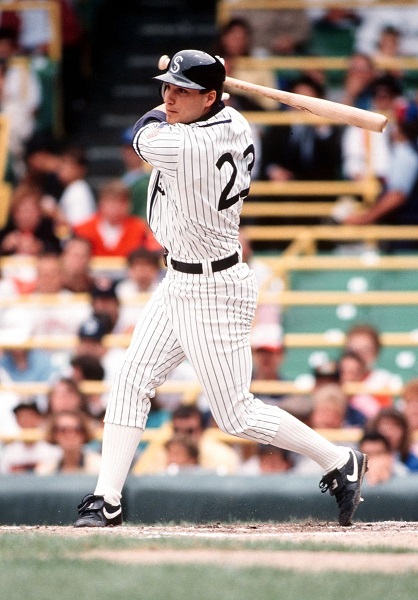
Today, we continue our look at those players, picking our favorite, if not the best, player to wear each uniform number for both Chicago teams with #23, one of the most famous and successful numbers in city history across all sports.  67 different players have donned #23 while playing in Chicago, 35 for the White Sox and 31 for the Cubs, including a familiar face for both sides of town.

Robin Ventura made his major league debut donning #23 in September of 1989, appearing in 16 games down the stretch, hitting only .178 while driving in 7 runs in 45 at bats.  A good spring in 1990 led to Ventura breaking camp with the White Sox, but he struggled both on the field and at the plate, suffering through a horrendous 0-for-41 slump while committing 25 errors over the course of the season.  He finished the year with a .249 average, 5 home runs, and 54 RBIs and placed 7th in Rookie of the Year voting and was named to the Topps All Star Rookie team.

Ventura and the White Sox moved in to the new Comiskey Park in 1991, hoping to improve on the previous year’s growth.  He improved his fielding enough to earn his first Gold Glove award and, at the plate, he set a White Sox team record for RBIs by a third baseman, finishing with an even 100.  He upped his average to .284 and hit 23 home runs.  His work was enough to garner enough MVP votes to finish in 20th place.  1992 was another good year for Ventura.  He earned his first All Star nod, going 2-2 in the AL’s victory at Jack Murphy Stadium.  He finished the year with a .282 average, 16 home runs, and 93 RBIs.  He also snagged his second consecutive Gold Glove award.  Ventura continued his successful ways in 1993, collecting his 500th hit in May and, on August 4, entering the public consciousness with an event that would come to define his entire career.  While batting against the Rangers, Ventura was hit by a pitch thrown by Nolan Ryan and charged the mound.  Ryan, 20 years Ventura’s senior, placed him in a headlock and punched him several times, starting a bench-clearing brawl that was voted the best baseball brawl of all time by SportsCenter.  After the season, he was awarded his third consecutive Gold Glove award.

The strike in 1994 saw Ventura’s streak of 90 RBI seasons and Gold Gloves come to an end.  When baseball stopped in August, Ventura was hitting .282 with 18 home runs and 78 RBIs, while posting a new career high with an .832 OPS.  When play resumed in late April 1995, Ventura struggled out of the gate, committing ten errors in the first ten games.  As the White Sox started to tear down the team that had finished the previous two seasons on top of their division, trade rumors started to follow Ventura, though nothing came to fruition.  On September 4, he became the eighth player in history to hit two grand slams in one game, and the first since Frank Robinson in 1970.  He finished the year setting career highs with a .295 average, an .882 OPS, and 26 home runs while driving in 93 runs.  Ventura had the best year of his career to date in 1996, setting White Sox team records in career home runs by a third baseman, with 142, and grand slams, with 9.  He set new career highs with 34 home runs, 105 RBIs, 2 triples, an OPS of .888, and a .974 fielding percentage at the hot corner.  He hit .287, while earning his fourth Gold Glove award.

1997 turned into a dismal year for both Ventura and the White Sox.  During a spring training game, Ventura caught his foot in the mud while sliding into home plate and suffered a broken and dislocated right ankle.  Expected to miss the entire season, he returned on July 24, collecting the game-winning hit that night, and homered in his first at-bat the next night.  With the White Sox only 3.5 games behind the Indians in the standings, a healthy Ventura might have put them over the top.  A week later, the team threw in the towel in what eventually became to be known as the White Flag Trade, sending 3 pitchers to the Giants for prospects.  “We didn’t realize Aug. 1 was the end of the season,” said an upset Ventura.  He finished the year appearing in 54 games, hitting .262 with 6 home runs and 26 RBIs.  Entering the last year of his contract in 1998, the White Sox made little attempt to sign Ventura to an extension, with owner Jerry Reinsdorf claiming his skills were “deteriorating” after his injury the year before.  With more trade rumors following him throughout the season, he finished the year with a .263 average, 21 home runs, and 91 RBIs while earning his fifth Gold Glove award.  Following the season, he became a free agent, ending his White Sox playing career.

Continue reading →

By The Numbers – 25

In 1929, uniform numbers appeared on the back of baseball jerseys for the first time, thanks to the Indians and the Yankees.  By 1937, numbers finally appeared across all uniforms, both home and away, across both major leagues.  Since that time, 81 distinct numbers have been worn by members of the White Sox, while the Cubs boast 76.

Today, we continue our look at those players, picking our favorite, if not the best, player to wear each uniform number for both Chicago teams with #25.  87 different players have donned #25 while playing in Chicago, 51 for the White Sox and 36 for the Cubs.

Acquired by the Cubs following the 2003 season for Hee Seop Choi, Derrek Lee, wearing #25, quickly became a mainstay of the Cubs lineup.  He hit .278 with 32 home runs and 98 RBIs in his first year on the north side.  2005 was a career year for Lee, and that was just in the first half.  He led the majors with a .376 average and 72 RBIs while tying for the lead with 27 home runs.  For the full season, he hit 46 home runs and a .335 average, the highest for a Cub since Bill Madlock in 1976 and he notched the first batting title for a Cub since Bill Buckner in 1980.  When it was all said and done, he had won the Gold Glove and Silver Slugger awards and finished third in MVP voting.

A broken wrist limited Lee to 50 games in 2006, but he rebounded in 2007 to hit .317 with 22 home runs as the Cubs won their first NL Central title since 2003.  Lee went 4 for 12 as the Cubs were swept in 3 games by the Diamondbacks.  Another strong season in 2008, with a .291 average, 20 home runs, and 90 RBIs helped push the Cubs back to the post-season.  Lee did all he could, hitting .545 in the NLDS against the Dodgers, but the Cubs were once again swept.  Lee overcame a slow start in 2009 thanks to a 21 game hitting streak and finished with a .306 batting average, 35 home runs and 111 RBIs, which earned him enough votes to finish ninth in MVP voting.

2010 was a strange year for Lee and the Cubs.  On June 9th, he hit his 300th career home run.  Later that month, however, he would get in to a fight in the dugout with Carlos Zambrano, which led to a suspension for Zambrano.  In the last year of his contract and with the team going nowhere fast, Lee was traded to the Braves on August 18th, ending his Cub tenure.

Looking to reload after winning their first World Series championship in 88 years, the White Sox acquired Jim Thome from the Phillies for Aaron Rowand, Gio Gonzalez, and Daniel Haigwood.  Thome, wearing his familiar #25, made an immediate impact, setting a major league record by scoring in each of Chicago’s first 17 games and setting the team record with 10 home runs in April.  By season’s end, Thome had put up a .288 average with 42 home runs, 102 RBIs, and an OPS of 1.014.  One of the few bright spots for the 2007 White Sox came in mid-September, when Thome, on his bobblehead day, launched his 500th career home run, the first player to do so on a walk-off.  For the year, Thome hit .275, with 35 home runs and 96 RBIs.  2008 was a bit of a down year for Thome, as his average and OPS both fell, but he still managed 34 home runs and 90 RBIs.  The most important of each came in the 163rd game of the year, as he hit a solo home run to give the White Sox a 1-0 victory over the Twins and the Central Division title.  With the White Sox going nowhere in 2009, Thome was traded to the Dodgers on August 31 for a warm body.