Which Way To Sacramento

As the 2024 baseball season draws to a close, so too does the era of Major League Baseball in Oakland.  The A’s, who first moved to Oakland prior to the 1968 season, will be spending the next three (or four) years based out of Sacramento while waiting for a stadium to be built in Las Vegas.  I’ve seen the A’s at least 35 times over the years, first at some unknown date at old Comiskey Park and most recently at Guaranteed Rate Field in mid-September.  In between, I saw them at two other ballparks, including trips to their home ballpark in 1999 and 2008.


Team Name Won Loss Winning Pctg
Chicago Cubs 3 0 1.000
Detroit Tigers 1 0 1.000
Chicago White Sox 16 14 0.533
Oakland Athletics 15 20 0.429
Baltimore Orioles 0 1 0.000

The A’s, who are going location-less name-wise while they are based in Sacramento, will make their first visit to Chicago in April.  They will open their stay in Sacramento against the Cubs on March 31, while the White Sox make their first visit at the end of April.

Games Per Stadium By Year

With the 2023 season officially in the rearview mirror, let’s take a look at the number of games I’ve attended each year at one of the now-29 different stadiums I’ve visited over the years.

Games Per Stadium Per Year

GameYear StadiumName TotalGames
2008 US Cellular Field 46
2003 Wrigley Field 46
Surprise playoff runs for the White Sox in 2008 and the Cubs in 2003 led to what remains my highest single season totals ever, boosted by post-season play.
2021 Guaranteed Rate Field 44
My highest-post-pandemic total, helped in part by a division champion and the desire to get back to the ballpark following the lockdown of 2020.
2007 Wrigley Field 43
2004 Wrigley Field 41
My highest non-playoff total saw me attending over half of the home games for the Cubs in 2004.
2011 US Cellular Field 40
2009 US Cellular Field 40
2010 US Cellular Field 36
2005 Wrigley Field 34
2008 Wrigley Field 34
2017 Guaranteed Rate Field 33
2016 US Cellular Field 32
2006 US Cellular Field 32
2023 Guaranteed Rate Field 32
2015 US Cellular Field 31
2012 US Cellular Field 31
2007 US Cellular Field 29
2014 US Cellular Field 28 Continue reading →

What’s New At The Old Ballpark

The 2023 baseball season is underway and there have been some changes at Guaranteed Rate Field.  Let’s start outside the stadium, where some nice, and long overdue, landscaping has been put in place.

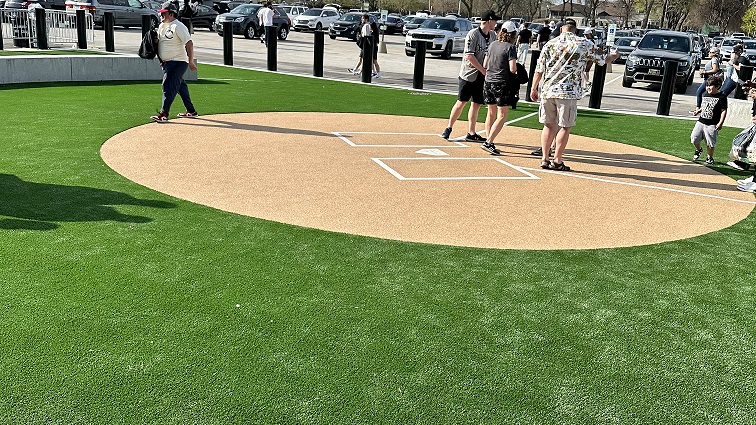
The area surrounding the home plate from old Comiskey Park in parking lot B has been surrounded by artificial turf and blocked off from the rest of the parking lot.  In addition, strips of trees and vegetation has been planted across the divider between the lot and Gate 5.  While the reduced room in the lot makes it harder for me to park there, this is an overall net positive.

Inside the park, Miller Lite continues its takeover of right field.  After replacing Goose Island and rechristening the area behind the right field as Lite Landing last year, they have added additional branding above the out of town scoreboard on the scaffolding.

The upper deck gets two new clubs, the High Life Sky Lounge down the left field line and the Blue Moon Balcony along the right field line.  Both give upper deck patrons a place to stand and watch the game while imbibing in their beverage of choice.

Travelling The 50 States – Illinois

Over my 47 years, I’ve done my fair share of travelling across these United States.  I thought it would be an interesting experiment go look back at those trips to each of the 31 states I have visited (62% isn’t bad, is it?) and see if, and when, I may be returning.  Working in alphabetical order, we continue today with the 21st state to be added to the Union: Illinois.

State: Illinois
Joined the Union: 1818
Visits: 16,000+

How do you track how often you’ve been in the state you’ve lived in your entire life, save for your time away at college?  My first “visit” came nearly 48 years ago on the day I was born at Mercy Hospital on the south side of Chicago.

I’ve managed to do 18 of the Bicentennial Bucket List: 200 Things To Do In Illinois, published by the Chicago Tribune in 2018 to celebrate the best the state has to offer in history, food, architecture, culture, sports, nature, drink, and oddities.  Among the places I visited were Water Tower, Morton Arboretum, Route 66, United Center, Skydeck at Willis Tower, the former Arlington International Racecourse, Rialto Square Theatre, Lake Michigan, The Second City, Chicago Sports Museum, and the Superman statue in downstate Metropolis.

I’ve seen baseball games at Wrigley Field, Comiskey Park, and Guaranteed Rate Field.  I’ve seen football games at Soldier Field, Memorial Stadium, Ryan Field, and Wrigley Field.  I’ve seen basketball games at the United Center, Welsh-Ryan Arena, State Farm Center, and Allstate Arena.  I’ve seen hockey games at the United Center.  I’ve seen both the White Sox and the Cubs win the World Series.  I’ve seen the Bears win a Super Bowl.  I’ve seen the Bulls win 6 NBA Championships.  I’ve even seen the Blackhawks win a Stanley Cup or two.

I’ve seen concerts at Wrigley Field, City Winery, Ravinia, the Riviera Theatre, Abbey Pub, Metro, the Chicago Theatre, United Center, Charter One Pavilion, Allstate Arena, The Vic Theatre, House of Blues, World Music Theatre, Soldier Field, and Mabel’s,

By The Numbers – 1

In 1929, uniform numbers appeared on the back of baseball jerseys for the first time, thanks to the Indians and the Yankees.  By 1937, numbers finally appeared across all uniforms, both home and away, across both major leagues.  Since that time, 81 distinct numbers have been worn by members of the White Sox, while the Cubs boast 76.

Today, we continue our look at those players, picking our favorite, if not the best, player to wear each uniform number for both Chicago teams with #1.  50 different players have donned #1 while playing in Chicago, 30 for the White Sox and 20 for the Cubs.

Lance Johnson, along with Ricky Horton, was acquired by the White Sox from the Cardinals for Jose DeLeon just before spring training in 1988.  Despite earning Most Valuable Player honors in the American Association the year before, Johnson struggled mightily after being given the starting center fielder job, hitting only .185 in 33 games before being sent back to the minor leagues.  Johnson started at Triple A in 1988, before finally returning to the White Sox, and the major leagues, for good.  In 1990, Johnson hit .285 and managed 36 stolen bases, despite leading the league with 22 caught stealings, and hit his first career home run all while patrolling centerfield for the final season at Comiskey Park.

As the team moved across the street in 1991, Johnson continued his steady presence in the lineup, hitting .274 while stealing 26 bases and hitting 13 triples, leading the American League.  Johnson hit .279 in 1992, with another 12 triples, leading the league again, and 41 stolen bases while setting a new career high with 3 home runs.  1993 saw Johnson and the White Sox finally put everything together.  Johnson raised his average to .311, hitting 14 triples and stealing 35 bases while the White Sox won their first divisional title in a decade.  Unfortunately, Johnson struggled in the ALCS against the Blue Jays, hitting only .217 in the 6 game series, though knocking in 6 runs and hitting his only home run of the season.

The strike-shortened 1994 season cut down what could have been a tremendous season for Johnson.  He again hit 14 triples, but in only 106 games, becoming the first player in Major League history to lead the league for four consecutive seasons.  When baseball resumed in 1995, Johnson turned in his finest season in a White Sox uniform.  He hit .306 and set a career high with a .766 OPS.  He led the league in at bats and hits, though he saw his streak of triples crowns end despite hitting a solid 12.  He set a career high with 10 home runs, 3 more than his previous career total.  On September 23, he became the first White Sox hitter to get 6 hits in a game since Floyd Robinson in 1962.  Following the season, he became a free agent and his White Sox career came to an end.

On the north side of town, Doug Glanville wore #1 when he made his major league debut for the Cubs in 1996, posting a .241 average over 49 games.  He became a full time presence for the Cubs in 1997, primarily in left field, hitting .300 and swiping 19 bases.  He switched from #1 to #8 at the end of August when, ironically, the Cubs acquired Lance Johnson from the Mets.

By The Numbers – 3

In 1929, uniform numbers appeared on the back of baseball jerseys for the first time, thanks to the Indians and the Yankees.  By 1937, numbers finally appeared across all uniforms, both home and away, across both major leagues.  Since that time, 81 distinct numbers have been worn by members of the White Sox, while the Cubs boast 76.

Today, we continue our look at those players, picking our favorite, if not the best, player to wear each uniform number for both Chicago teams with #3.  52 different players have donned #3 while playing in Chicago, 33 for the White Sox and 19 for the Cubs, including one who had it retired for him while he was still an active player.

Harold Baines was the first overall selection in the 1977 draft after White Sox owner Bill Veeck had seen him play little league years before.  He made his major league debut less than 3 years later, on Opening Day 1980 against the Orioles at old Comiskey Park.  Baines started to break out in 1981, but the long player’s strike limited him to only 82 games.  With a full slate of games played in 1982, Baines appeared in all but one of them, with numbers good enough to garner votes for AL MVP.

1983 was a banner year on the south side, as the White Sox captured their first ever division title.  Baines was a key contributor, hitting .280 with 20 home runs and 99 RBIs.  During the ALCS against the Orioles, Baines struggled, like most of his teammates, getting only 2 hits in the 4-game series.  At season’s end, he picked up 49 votes to finish 10th in MVP voting.

Baines continued to excel in 1984, though the rest of the team did not.  On May 8, he ended the longest game in major league history (8 hours and 6 minutes over 25 innings on successive evenings) with a walk-off home run against Chuck Porter of the Brewers.  He finished the year with a .304 average, a career high 29 home runs, and 94 RBIs, while leading the league in slugging at .541.  He once again garnered MVP consideration, finishing the vote tied for 13th place.  1985 was another strong season for Baines.  He earned his first All Star selection, singling off former teammate LaMarr Hoyt in his only at bat at the Metrodome.  He finished the year hitting .309 with 22 home runs and a career high 113 RBIs.  He earned 49 votes in placing 9th in MVP voting.

Baines saw his body start to betray him for the first time in 1986.  He appeared in his second straight All Star game, going hitless in his one at bat.  A late August knee injury caused him to miss time, and a late September collision with Neal Heaton in a loss to the Twins reinjured the knee, leading to arthroscopic surgery following the season.  He finished the season hitting .296, just missing his 3rd consecutive .300 season, with 21 home runs and 88 RBIs.  He returned for opening day in 1987, getting two hits and knocking in the winning runs on the hard artificial turf of Royals Stadium, but was unable to walk the following day.  A second arthroscopic surgery caused him to miss 23 games before he returned, moving from right field to designated hitter.  He still was named to his 3rd straight All Star team, going hitless in the 2-0 loss by the AL.  Come year end, he had hit .293 with 20 home runs and 93 RBIs.

1988 was a down year for Baines, though he managed to appear in 158 games.  His average dropped to .277, his lowest total since 1982, while hitting only 13 home runs, his lowest total since 1981.  He made only 9 appearances in the outfield while becoming accustomed to being a full-time designated hitter.  He bounced back in 1989.  He was named the starting DH in the All Star game, going 1-3 with an RBI in the AL’s victory at Angel Stadium.  On July 29, he was traded to the Rangers, along with Fred Manrique, for Wilson Alvarez, Scott Fletcher, and Sammy Sosa.  “It’s an unpopular decision as far as the fans are concerned, but sometimes unpopular means exactly that-unpopular,” GM Larry Himes said at the time.  “It doesn`t mean that it isn`t a good decision.  This is a decision we made as far as direction of the Chicago White Sox for today and for our future.”  Baines was hitting .321 with 13 home runs and 56 RBIs at the time of the trade.  Less than a month later, as the Rangers visited Chicago for the first time on August 20, the White Sox retired Baines’ #3, a somewhat awkward attempt to placate the enraged fanbase.

Baines returned to the White Sox as a free agent in 1996.  Appearing in 143 games, Baines hit .311 with 22 home runs and 95 RBIs.  He returned in 1997 and was putting together another fine season, putting up a .305 average with 12 home runs and 52 RBIs in 93 games when, on July 29 again, he was traded to the Orioles for a player to be named later.

Three years later, once again on July 29, the White Sox re-acquired Baines, along with Charles Johnson, from the Orioles for Miguel Felix, Juan Figueroa, Jason Lakman, and Brook Fordyce.  Appearing in 24 games down the stretch, Baines hit .213 with a single home run and 9 RBIs as the White Sox took the Central Division crown.  Baines went 1-4 in the ALDS as the White Sox were swept by the Mariners.  He returned to the White Sox in 2001 at the age of 42, getting extra playing time once Frank Thomas went down with an injury.  In 32 games, he hit .131, failing to homer and driving in only 6.

On July 20, 2008, the White Sox unveiled a bronze statue of Baines at U.S. Cellular Field prior to their game against the Royals.  On December 9, 2018, Baines was elected to the National Baseball Hall of Fame Class of 2019 via the Today’s Game Era ballot.

David Ross donned #3 when he joined the Cubs in 2015 on a two-year deal.  Ross announced his plans to retire following the 2016 season, after playing 15 seasons in the major leagues.  During Game 7 of the World Series, Ross hit a home run in his final at-bat, making him the oldest player to homer in World Series history.

Throwback Thursday – Team Records Of The 1990s

Last week, we took a trip in the wayback machine to see all of the games that I attended during the 1980s.  This week, we turn our attention to the 1990s to see what my view of the baseball world looked like.

I’ve been able to identify 32 games I attended during the 90s, starting with a late April outing during the final season at Comiskey Park in 1990 through a September 2000 game at Wrigley Field, including my first visits to stadiums outside of Chicago starting with a July 1993 visit to County Stadium in Milwaukee.  All told, I saw games at eight different ballparks throughout the decade.

1990s Team Records
Team Name Won Loss Winning Pctg
Houston Astros 1 0 1.000
California Angels 1 0 1.000
Cincinnati Reds 1 0 1.000
Arizona Diamondbacks 1 0 1.000
Florida Marlins 1 0 1.000
New York Yankees 1 0 1.000
San Francisco Giants 1 0 1.000
Detroit Tigers 3 1 0.750
Oakland Athletics 2 1 0.667
Chicago White Sox 12 10 0.545
Chicago Cubs 6 5 0.545
Kansas City Royals Continue reading →

By The Numbers – 13

In 1929, uniform numbers appeared on the back of baseball jerseys for the first time, thanks to the Indians and the Yankees.  By 1937, numbers finally appeared across all uniforms, both home and away, across both major leagues.  Since that time, 81 distinct numbers have been worn by members of the White Sox, while the Cubs boast 76.

Today, we continue our look at those players, picking our favorite, if not the best, player to wear each uniform number for both Chicago teams with #13.  25 different players have donned #13 while playing in Chicago, 13 for the White Sox and 12 for the Cubs.

Acquired by the White Sox on December 6, 1984, from the Padres, Ozzie Guillen made his major league debut wearing #13 on Opening Day 1985, leading off against the Brewers and going 1-5 in the 4-2 victory at County Stadium.  Settling in as the everyday shortstop, Guillen finished the year with a .273 average, 21 doubles, and 9 triples.  Those totals were good enough to score Guillen the 1985 AL Rookie of the Year trophy.  Guillen saw a slight drop off in his sophomore season, as his average dropped to .250 and he managed 19 doubles and 4 triples.  1987 was a nice bounce back for Guillen, as he raised his average back up to .279 with a .656 OPS.  For the second straight year, he led the AL, and all of baseball, in Defensive WAR.  Guillen earned his first All Star nod in 1988 and, by season’s end, he once again led all of baseball in Defensive WAR, while seeing his average drop to .261 with 7 triples, the fifth highest total in the AL.

1989 was a tough year for Guillen.  He posted his worst offensive numbers since 1986 and, on the base paths, he fell victim to the hidden ball trick.  Twice. On June 23, against the Brewers, first baseman Greg Brock held the ball after a pickoff attempt and when Guillen took his hand off the base to stand up, Brock tagged him out.  Less than 2 months later, on August 5 against the Tigers, Dave Bergman made the same play.  He finished the year with .253 average and, despite his adventures on pick off attempts, a career high 36 stolen bases.  As the surprising White Sox challenged for the AL West title while saying goodbye to Comiskey Park, Guillen put in one of the finest seasons of his career.  He was named to his second All Star team, going 0-2, finished in 17th place in MVP voting, and earned his first, and only, Gold Glove.  He raised his average back up to .279 and knocked in a career high 58 RBIs.

Expectations were high for the White Sox as they moved across the street to the new Comiskey Park in 1991.  Guillen earned his third, and final, All Star nod, getting a sacrifice in his only plate appearance.  He ended the year with a .273 average and set a career high with 3 home runs.  Guillen’s 1992 season came to an early end when, on April 21 during a loss against the Yankees, a collision with outfielder Tim Raines ended in a severe knee injury.  Guillen recovered in 1993, though he appeared in only 134 games, his lowest total to date.  However, it was his most productive season offensively, posting a .280 batting average, and career highs with 4 home runs and a .666 OPS, as the White Sox won their first division title in a decade.  He hit .273 and scored 4 runs in a losing effort, as the White Sox were defeated in 6 games by the Blue Jays in the ALCS.  1994 looked to be the year that the White Sox finally broke through.  Guillen was up to the challenge, hitting a career high .288 with a .659 OPS.  Unfortunately, the year ended early when players went on strike on August 12 with the White Sox in first place in the newly created AL Central.

The 1995 season got off to a late start and had an abbreviated schedule due to the long work stoppage.  The success of the White Sox, and for Guillen himself, didn’t survive the long layoff.  Guillen saw his average drop to .248, his lowest over a “full” season in his career to this point.  His OPS dropped to its lowest total in a full season since 1989.  1996 saw a slight improvement for Guillen.  He appeared in 150 games, his highest total since his knee injury in 1992.  He raised his average back to .263 and tied his career high with 4 home runs.  However, 1997 was easily the worst season of Guillen’s White Sox career.  He had the lowest average of his career, coming in at .245, though he did once again tie his career high with 4 home runs.  Following the season, Guillen became a free agent and his playing career with the White Sox came to an end.

Guillen returned to the White Sox organization for the 2004 season as manager.  In 2005, he led the team to their first American League pennant since 1959 and their first World Series title in 88 years.  Ongoing personal difficulties with General Manager Kenny Williams led to his leaving with 2 games left in the 2011 season as the third winningest manager in franchise history.

On the north side of town, Neifi Pérez donned #13 over parts of three seasons with the Cubs.  He signed a minor league deal after being released by the Giants in 2004.  After only ten games in Triple A, Pérez joined the big-league club and became a spark plug in the lineup, going 6 for 6 in his first 6 at-bats and providing a needed backup to the ailing Nomar Garciaparra.  Dusty Baker named Pérez the starting shortstop in 2005 to replace Garciaparra, mainly on the strength of his defensive skills.  For the 2006 season Pérez lost the starting job at shortstop to Ronny Cedeño.  As his batting average sagged to .254 and his on-base percentage, never high, had fallen to .266, the Cubs traded him to the Tigers.

The Heroes Of Opening Day

This week I attended my 21st consecutive (except for the pandemic year of 2020 that had no fans) Opening Day at Comiskey Park II/US Cellular Field/Guaranteed Rate Field, and my 38th overall.  From my first, at old Comiskey Park in 1985, to my first as a Cubs season ticket holder at Wrigley Field in 2002, to road trips to Shea Stadium, in 2003, and Great American Ballpark, in 2004 and 2006, Opening Day remains a spring holiday proclaiming the theoretical beginning of summer.  This seemed like a good time to see who the best performers were on both sides of the ball from those 38 contests.

Home Runs

Name Total
Corey Patterson 3
Paul Konerko 3
Alejandro de Aza 2
Ray Durham 2
Jose Valentin 2
Joe Crede 2
Jim Thome 2

Hits

Name Total
Paul Konerko 15
Jermaine Dye 9
Aramis Ramirez 8
Victor Martinez 8
Mark Grudzielanek 8

Runs

Name Total
Paul Konerko 7
Derrek Lee 7
Alex Gonzalez 6
Joe Crede 6

RBI

Name Total
Paul Konerko 10
Corey Patterson 8
Moises Alou 8

Doubles

Name Total
Michael Barrett 4
Paul Konerko 3
Moises Alou 3
Jose Valentin 3
Victor Marinez 3
Alex Rios 3
Jose Abreu 3
Miguel Olivo 3
Jeromy Burnitz 3
Carlos Lee 3

Triples Continue reading →

By The Numbers – 15

In 1929, uniform numbers appeared on the back of baseball jerseys for the first time, thanks to the Indians and the Yankees.  By 1937, numbers finally appeared across all uniforms, both home and away, across both major leagues.  Since that time, 81 distinct numbers have been worn by members of the White Sox, while the Cubs boast 76.

Today, we continue our look at those players, picking our favorite, if not the best, player to wear each uniform number for both Chicago teams with #15.  98 different players have donned #15 while playing in Chicago, 44 for the White Sox and 54 for the Cubs.

Dick Allen was acquired after the 1971 season, when attendance at Comiskey Park had cratered and the team had finished 22½ games out of first place.  The addition of Allen, donning #15, sparked an unforeseen pennant race in 1972, with the Sox in contention for most of the season, finishing 5½ games behind the A’s in the AL West and drawing more than 1.18 million fans, more than double what they drew in 1970.  Allen only spent 3 years in Chicago, making the All Star team each time.  A broken leg cut short his 1973 campaign and, with two weeks to go in the 1974 season, Allen left the team over a feud with teammate Ron Santo.  Not knowing if Allen planned to return to baseball, the Sox sold his contract to the Braves for $5000, at which point Allen temporarily retired.

Acquired by the Cubs for the stretch run in 1984, Davey Lopes switched to his familiar #15 in 1985.  Appearing in 99 games in his age 40 season, Lopes stole 47 bases, his highest total since 1977.  He made his way into 59 games in 1986 before being traded to the Astros for Frank DiPino.