Moving On

Last July, with an eye towards the postseason, the White Sox acquired Craig Kimbrel from the Cubs for second baseman Nick Madrigal and reliever Codi Heuer.  To put it mildly, it didn’t work out.  Working mostly as a setup man to Liam Hendriks, Kimbril posted a 5.09 ERA in 24 appearances with the White Sox down the stretch and then gave up 2 earned runs in 2 innings against the Astros in the ALDS.

The White Sox picked up Kimbrel’s $16M option for 2022, looking to trade him and recoup some of the capital they spent to acquire him.  Then, the lockout happened.  When spring training camps opened with Kimbrel still on the roster, things looked dire.  But, today, the White Sox announced they have traded Kimbrel to the Dodgers for outfielder A.J. Pollock.

Pollock should fill a hole in right field, though he has very little experience there.  He also brings some needed pop against RHP, with an .802 career OPS against righties.  Best of all, he saves the White Sox $3-6 million, which will likely come in handy come trade deadline.  Kimbrel, hopefully, can regain his form by moving back into the closer role with the Dodgers.

Kimbrel’s numbers in a White Sox uniform, both for games I attended and overall, were:

Continue reading →

By The Numbers – 17

In 1929, uniform numbers appeared on the back of baseball jerseys for the first time, thanks to the Indians and the Yankees.  By 1937, numbers finally appeared across all uniforms, both home and away, across both major leagues.  Since that time, 81 distinct numbers have been worn by members of the White Sox, while the Cubs boast 76.

Today, we continue our look at those players, picking our favorite, if not the best, player to wear each uniform number for both Chicago teams with #17.  79 different players have donned #17 while playing in Chicago, 42 for the White Sox and 37 for the Cubs.

Mark Grace moved to his iconic #17 during his rookie campaign in 1988.  He finished second in Rookie of the Year voting while hitting .296 with 7 home runs and 57 RBIs.  In 1989, he garnered some MVP consideration as the Cubs took home a surprising NL East title.  Grace hit .314 with 13 home runs and 79 RBIs during the regular season, before hitting .647 with a 1.799 OPS during the 5 game NLCS against the Giants.

In 1990, Grace began a decade of excellence, collecting the most hits, 1,754, and doubles, 364, of any player during the decade.  He won 4 Gold Glove awards, was named to 3 All Star teams, earned down-ballot MVP support in 3 different seasons.  Following the 2000 season, he left the Cubs, finishing that portion of his career with 2201 hits, 456 doubles, 148 home runs, 1004 RBIs, and a .308 average.

As the White Sox made their run towards the World Series title in 2005, general manager Kenny Williams attempted to acquire Ken Griffey Jr. from the Reds, but was rebuked when Reds ownership decided to veto the deal.  3 years later, with the White Sox again looking to make a run at a division title, he was finally able to acquire the aging superstar at the trade deadline in exchange for pitcher Nick Masset and second baseman Danny Richar.  At the time of the trade, the White Sox held a tenuous 1.5 game lead over the Twins.  Wearing #17, Griffey, who had spent most of the previous few seasons in right field to lessen the strain on his body, moved back to center field for the White Sox, displacing the disappointing Nick Swisher.  Griffey appeared in 41 games for the White Sox, hitting a decent .260 with only 3 home runs and 18 RBI.  His most important contribution came defensively, during the tie-breaking game 163 between the White Sox and the Twins, when he gunned down Michael Cuddyer, who was trying to score on a fly out to center, preserving the shutout and helping the White Sox win the division and advance the playoffs.  In the ALDS, Griffey appeared in 3 games against the Rays, garnering only 2 hits as the White Sox fell 3 games to 1.  Following the season, the White Sox declined Griffey’s $16 million option for 2009, making him a free agent.

Special bonus shout out to outfielder Carlos May, who played with the White Sox from 1968-1976.  May, who wore #17 for his entire White Sox career, is the only player in baseball history to wear his birthday, May 17th, on his jersey.

Against The Rays All Time Leaders – Through 2021

414_tampa_bay-rays-miscellaneous-2012In the past, we’ve looked at the all time leaders in both offensive and defensive categories for all 30 teams. This offseason, we will take our first ever look at those leaders against all 30 clubs.   We continue things today with the Tampa Bay Rays.

The Rays began life in 1998 as the Devil Rays, dropping the Devil portion of their name in 2008.  I’ve seen them play 25 times, 5 as the Devil Rays and 20 as the Rays, including the 2008 ALDS, where they defeated the White Sox.

Home Runs

Name Total
Paul Konerko 4
Jermaine Dye 4
Tim Anderson 2
Jose Abreu 2

Hits

Name Total
Paul Konerko 19
A.J. Pierzynski 13
Alexei Ramirez 13

Runs

Name Total
Paul Konerko 11
Jermaine Dye 7
Alex Rios 6

RBI

Name Total
Paul Konerko 9
Jermaine Dye 8
Tim Anderson 6
Jose Abreu 6

Doubles

Name Total
Tim Anderson 3
A.J. Pierzynski 3
Alex Rios 3
Gordon Beckham 3

Triples Continue reading →

By The Numbers – 20

In 1929, uniform numbers appeared on the back of baseball jerseys for the first time, thanks to the Indians and the Yankees.  By 1937, numbers finally appeared across all uniforms, both home and away, across both major leagues.  Since that time, 81 distinct numbers have been worn by members of the White Sox, while the Cubs boast 76.

Today, we continue our look at those players, picking our favorite, if not the best, player to wear each uniform number for both Chicago teams with #20.  85 different players have donned #20 while playing in Chicago, 30 for the White Sox and 55 for the Cubs.

Carlos Quentin was acquired by the White Sox in a December 2007 trade with the Diamondbacks for Chris Carter, earning the nickname “The Carlos Quentin” after general manager Kenny Williams was quoted saying that the team’s goals for the winter meetings were to “acquire Carlos Quentin, and not a guy like him but actually Carlos Quentin.”  Quentin played immediate dividends, breaking through in a big way for the 2008 White Sox.  He was leading the American League in home runs and was third in slugging percentage, OPS, and RBIs when he broke his wrist slamming his bat following a strikeout against Cliff Lee, causing him to miss the last 6 weeks of the season.  The injury likely cost him the MVP award, and certainly impacted the White Sox, as their battle with the Twins for the AL Central title came down to 163rd game and left the starting rotation is disarray before playing, and eventually losing to, the Rays in the ALDS.

Quentin continued to struggle with injuries for the remainder of his White Sox career, never appearing in more than 131 games.  A shoulder injury ended his 2011 season, and his White Sox career, at the end of August.  That December, just over 4 years since he was acquired, Quentin was shipped to the Padres, for Simon Castro and Pedro Hernandez.

On the north side of town, Corey Patterson switched to #20 when he was recalled to the Cubs in 2001, appearing in 51 games and hitting only .221.  He became a full time player in 2002, hitting .253 in 153 games and slugging 14 home runs while driving in 54.  He was breaking out in 2003, becoming the threat the Cubs had hoped he would be, with a .839 OPS, a .298 average, and 13 and 55 for the power numbers when a torn ACL ended his season on July 6.  He returned in 2004, playing 157 games and hitting .266, but was never quite the same player as before the injury.  2005 was not a good season for Patterson, as he saw himself demoted in July following an 8-game losing streak.  Following the season, he was traded to the Orioles.

Against The Red Sox All Time Leaders – Through 2021

redsoxIn the past, we’ve looked at the all time leaders in both offensive and defensive categories for all 30 teams. This offseason, we will take our first ever look at those leaders against all 30 clubs. We continue things today with the Boston Red Sox.

I’ve seen the Red Sox play 32 times at 4 different stadiums, first in the White Sox home opener in 1985, through the 2005 ALDS, and, most recently, this past September.  The game total would have been 2 higher, if the corona virus hadn’t put the kibosh on my April 2000 weekend trip to Fenway Park.

Home Runs

Name Total
Paul Konerko 5
Jermaine Dye 5
Tadahito Iguchi 3
Jim Thome 3
Carlos Quentin 3
A.J. Pierzynski 3

Hits

Name Total
Paul Konerko 18
Scott Podsednik 18
A.J. Pierzynski 13

Runs

Name Total
Paul Konerko 10
Scott Podsednik 7
A.J. Pierzynski 7
Jermaine Dye 7

RBI

Name Total
Paul Konerko 15
A.J. Pierzynski 9
Jermaine Dye 9

Doubles

Name Total
Paul Konerko 4
Jermaine Dye 4
Luis Robert 3

Triples Continue reading →

By The Numbers – 22

In 1929, uniform numbers appeared on the back of baseball jerseys for the first time, thanks to the Indians and the Yankees.  By 1937, numbers finally appeared across all uniforms, both home and away, across both major leagues.  Since that time, 81 distinct numbers have been worn by members of the White Sox, while the Cubs boast 76.

Today, we continue our look at those players, picking our favorite, if not the best, player to wear each uniform number for both Chicago teams with #22.  76 different players have donned #22 while playing in Chicago, 26 for the White Sox and 50 for the Cubs.

Acquired from the Dodgers, along with Ivan DeJesus, in exchange for Rick Monday and Mike Garman, Bill Buckner joined the Cubs, wearing #22, in 1977.  A staph infection in his ankle the previous year caused the Cubs to move the former outfielder to first base, a position he would man for the rest of his career.  Appearing in 122 games, he hit .284 with 11 home runs and 27 doubles.  He improved in 1978, raising his average to .323 and placed 17th in MVP voting.  1979 was another steady year for Buckner.  On May 17th, in the infamous slugfest where the Cubs lost 23-22 to the Phillies, he went 4–for–7 with a grand slam and a career-high seven RBIs.  He finished the year hitting .284 with 14 home runs and 34 doubles, but was also described as “nuts” when manager Herman Franks resigned late in the season.

In 1980, Buckner won a batting title, hitting .324 while striking out only 18 times, earning him a 14th place finish in MVP voting.  In the strike-shortened 1981 season, he was the lone Cub representative for the All Star game and batted .311 while tying Cecil Cooper for the major league lead with 35 doubles.  1982 saw Buckner hit over .300 for the fourth time as a Cub while racking up career highs in hits, with 201, RBIs, with 105, and assists at first base, setting a major league record with 159.

In 1983, Buckner again led the NL with 38 doubles, but saw his batting average drop to .280, his lowest finish as a Cub.  With the acquisition of Gary Matthews in 1984 pushing Leon Durham to first base, Buckner found himself the odd man out.  Appearing mostly as a pinch hitter, Buckner hit a paltry .209 through the end of May, when he was traded to the Red Sox, ending his Cub tenure.

Scott Podsednik was acquired by the White Sox from the Brewers for Carlos Lee on December 13, 2004.  Wearing #22, he moved in to the leadoff spot and, after putting up a .294 average with 44 steals in the first half, he earned his first All Star game nod.  While injuries slowed him in the second half, he was back to full strength when the regular season came to an end and the White Sox embarked on their first post-season appearance in 5 years.  After going the entire regular season without a home run, Podsednik went deep against the Red Sox in Game 1 of the ALDS, helping the White Sox to a 14-2 victory on their way to a 3 game sweep of the defending champions.  Podsednik continued his steady play during the ALCS, hitting .294 with a triple and 3 stolen bases in the 5 game series.  The shining moment of his career came in Game 2 of the World Series, thanks to a walkoff home run against Brad Lidge in the 9th inning, giving the White Sox a 2-0 lead on their way to a sweep and their first world championship in 88 years.  For his efforts, Podsednik finished in 12th place for MVP voting.

As the White Sox looked to repeat in 2006, Podsednik found it difficult to duplicate his efforts from the year before.  His average was down 29 points, to .261, and his stolen base total was off by 19.  Injuries limited Podsednik to 62 games in 2007.  His offensive production continued to be lacking and, after the White Sox fell completely out of contention for the first time in years, the team decided to change their approach and gave Podsednik his release.  He returned to the White Sox organization in 2009, signing a minor league deal.  Injuries to Brian Anderson, Dewayne Wise, and Carlos Quentin gave him plenty of opportunity with the big league club, and he responded by hitting .304, his highest total since 2003.  Following the season, he became a free agent.

A Class Of One

With the unneeded lockout still in full effect, the baseball world had nothing to distract it yesterday from the small hamlet of Cooperstown in upstate New York, where the votes were tallied, and the 2021 Hall of Fame class completed with one additional member.  Former Red Sox DH David Ortiz scored 77.9% of the vote to earn enshrinement in his first election.

Six others tallied greater than 50% of the vote, led by Barry Bonds, who jumped up to 66% in his final go around on the ballot.  Roger Clemens was right behind him at 65.2% and will also leave his fate to the veteran’s committee.  Scott Rolen saw another big jump, rising to 63.2% and looks like he’s on track to eventually make it.  Curt Schilling, who threw a temper tantrum after not getting elected last year, saw a bit drop and ended his 10-year run with 58.6% of the vote.  Todd Helton and Billy Wagner continued to make strides, coming in at 52% and 51%, respectively, though Helton has more time on his side to make a good run towards induction.

On the local front, former White Sox outfielder Andruw Jones saw a large increase, going up to 41.1%.  Manny Ramirez, who spent a little more than a month with the White Sox, stayed about even, finishing with 28.9% of the vote thanks to his multiple PED suspensions.  The disgraced Omar Vizquel, who added sexual abuse of an autistic teen to the spousal abuse charges that had popped up the previous year, dropped even further, to 23.9%.  In his last go-around, former Cub superstar Sammy Sosa saw a small increase to 18.5%.  Jimmy Rollins, who spent the final 41 games of his career on the south side, picked up 9.4% in his first go-around.  Mark Buehrle saw his percentage cut in half, to 5.8%. but lives to fight another day.  Justin Morneau, who spent the final 58 games of his career with the White Sox, picked up 5 votes.  A.J. Pierzynski scored 2, while his former battery mate Jake Peavy was tossed a shutout.

Fifteen players will fall off the ballot, either due to reaching 10 years or failing to score 5% of the vote.

As for the newest Hall of Famer, I’ve seen Ortiz play 24 times, including the 2005 ALDS.  He joins Bud Fowler, Gil Hodges, Jim Kaat, Minnie Minoso, Tony Oliva and Buck O’Neil, who were elected by the veteran’s committees in December, in the class of 2022.  They will all get their day in the sun on Sunday, July 24.

David Ortiz’s numbers in games I’ve attended were: Continue reading →

By The Numbers – 24

In 1929, uniform numbers appeared on the back of baseball jerseys for the first time, thanks to the Indians and the Yankees.  By 1937, numbers finally appeared across all uniforms, both home and away, across both major leagues.  Since that time, 81 distinct numbers have been worn by members of the White Sox, while the Cubs boast 76.

Today, we continue our look at those players, picking our favorite, if not the best, player to wear each uniform number for both Chicago teams with #24.  104 different players have donned #24 while playing in Chicago, 49 for the White Sox and 55 for the Cubs.
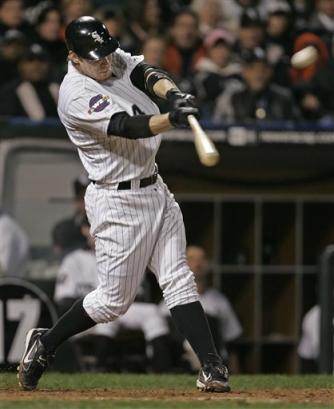
Joe Crede earned a September call-up from Double A in 2000, and, wearing #24, made his major league debut on September 12, replacing Herbert Perry and going 0-1 in the Tigers 10-3 victory at Comiskey Park.  Crede appeared in 7 games, making the most of his 14 at bats, and finished with a .357 average.  Crede got another cup of coffee with the big league club in September of 2001, earning a little more playing time, but he was less successful, finishing with a .220 average in 50 at bats over 17 games.  Crede returned to the White Sox for good in July of 2002.  On August 12, he hit his first major league home run off of former teammate James Baldwin and he finished with 12 home runs, 35 RBIs, and a .285 average.  Crede established himself as the starting third baseman in 2003.  He appeared in a career high 151 games and launched 19 home runs with 75 RBIs while posting a .261 average.  He struggled in 2004, seeing his average drop to .239 while hitting 21 home runs with 69 RBIs.

In 2005, Crede started to come in to his own.  While he improved his average to .252 and hit 22 home runs with 62 RBIs, he came alive in the second half, culminating with a game winning, and possible season saving, home run in the 10th inning against the Indians on September 20, which pushed the White Sox to a 3.5 game lead and propelled them into the playoffs.  Crede had a rough series in the ALDS against the Red Sox, getting only 1 hit in 9 at bats, but rebounded in the ALCS and World Series, hitting .368 and .294 respectively, with 2 home runs in each series.  2006 was Joe Crede’s breakout season.  He hit .283 with career highs in home runs, with 30, and RBIs, with 94, winning his first, and only, Silver Slugger award.  A back injury in 2007 limited him to 47 games and only 4 home runs.  He returned with a bang in 2008, hitting a grand slam on opening day against the Twins and parlayed a good first half into his first All Star selection, but the back injury recurred and kept him out for most of the second half of the season, including the playoffs, thus ending his White Sox career.

On the north side of town, Dexter Fowler joined Cubs via trade prior to the 2015 season.  Donning #24, he ended the year with a .250 average, 102 runs scored, 46 RBIs, 17 home runs, and 20 stolen bases as the Cubs made a surprise run for the NL Wild Card.  Fowler helped propel the Cubs to the NLDS, putting up three hits, three runs scored, a home run, and a stolen base in defeating the Pirates.  In nine postseason games, Fowler batted .396 with two home runs and three RBIs, as the Cubs made it to the NLCS against the Mets.

Fowler became a free agent after the season and was unsigned into the start of spring training.  Despite reportedly agreeing to a three-year contract with the Orioles, Fowler arrived in Cubs camp and signed a one year deal.  And what a year it was.  Fowler finished the year with a .276 average, 13 home runs, 48 RBIs, and 84 runs scored as the Cubs won the NL Central.  Fowler’s .333 average with 4 RBI helped the Cubs win the NLCS against the Dodgers, advancing to the World Series for the first time since 1945.  On October 25, 2016, Dexter Fowler became the first African-American to appear and to bat for the Cubs in a World Series game.  Fowler led off Game 7 of the World Series with a home run, becoming the first player in history to do so, and helping the Cubs win 8–7 in 10 innings, giving the team their first championship in 108 years.

Against The Astros All Time Leaders – Through 2021

astros-primaryIn the past, we’ve looked at the all time leaders in both offensive and defensive categories for all 30 teams. This offseason, we will take our first ever look at those leaders against all 30 clubs.  We continue today with the Houston Astros.

The Astros began life in 1962 as the Colt 45’s, joining the National League along with the Mets, and became the Astros 3 years later.  In 2013, they moved to the American League, becoming just the second team to switch leagues.  I’ve seen them play 47 times, including game 2 of the 2005 World Series and games 3 and 4 of the 2021 ALDS.

Home Runs

Name Total
Derrek Lee 4
Corey Patterson 3
Tim Anderson 2
Paul Konerko 2
Adam Dunn 2
Tadahito Iguchi 2
Alfonso Soriano 2

Hits

Name Total
Derrek Lee 15
Alfonso Soriano 11
Aramis Ramirez 11

Runs

Name Total
Derrek Lee 10
Alfonso Soriano 6
Aramis Ramirez 5
Paul Konerko 5
Alejandro de Aza 5

RBI

Name Total
Derrek Lee 8
Paul Konerko 7
Tadahito Iguchi 7
Adam Dunn 7

Doubles

Name Total
Derrek Lee 4
Aramis Ramirez 3
7 tied with 2

Triples Continue reading →

Against The Mariners All Time Leaders – Through 2021

marinersIn the past, we’ve looked at the all time leaders in both offensive and defensive categories for all 30 teams. This offseason, we will take our first ever look at those leaders against all 30 clubs.  We continue today with the Seattle Mariners.

The Mariners began life in 1977, joining the American League along with the Toronto Blue Jays. I’ve seen them play 39 times, including the final night game at the original Comiskey Park, the first 2 games of their sweep of the White Sox in the 2000 ALDS, and the first series back with 100% capacity last June.

Home Runs

Name Total
Paul Konerko 10
Alex Rios 4
Avisail Garcia 3
Jose Abreu 3
Dayan Viciedo 3

Hits

Name Total
Paul Konerko 17
Alexei Ramirez 17
Tim Anderson 15

Runs

Name Total
Paul Konerko 14
Tim Anderson 10
Alex Rios 9

RBI

Name Total
Paul Konerko 17
Alex Rios 9
Alexei Ramirez 8

Doubles

Name Total
Alexei Ramirez 5
A.J. Pierzynski 5
Melky Cabrera 3

Triples Continue reading →