Goodbye To The Q

Former White Sox outfielder Carlos Quentin, who finished 5th in MVP voting in 2008 despite missing the final six weeks of the season with a broken wrist, announced his retirement after 9 seasons.  After being released in spring training after being acquired by the Braves in a trade, Quentin had been playing with the Mariners’ Triple A club, but was hitting only .176 in 17 at bats.

After spending parts of the 2006 and 2007 seasons with the Diamondbacks, Quentin was acquired by the White Sox in a December 2007 trade.  He earned the nickname “The Carlos Quentin” after general manager Kenny Williams was quoted saying that the team’s goals for the winter meetings were to “acquire Carlos Quentin, and not a guy like him but actually Carlos Quentin.”

Quentin played immediate dividends, breaking through in a big way for the 2008 White Sox.  He was leading the American League in home runs and was third in slugging percentage, OPS, and RBIs when he broke his wrist following a strikeout against Cliff Lee.  The injury likely cost him the MVP award, and certainly impacted the White Sox as they battled the Twins for the AL Central title before eventually losing to the Rays in the ALDS.

Quentin continued to struggle with injuries for the remainder of his White Sox career, never appearing in more than 131 games.  A shoulder injury ended his 2011 season, and his White Sox career, at the end of August.  That December, just over 4 years since he was acquired, Quentin was shipped to the Padres.

In 3 years with the Padres, injuries continued to plague Quentin, as he failed to appear in 90 games in any season.  His most famous (or infamous) moment with the Padres was the April 11, 2013 brawl against the Dodgers, where he broke Zach Greinke’s collarbone after being hit by a pitch.

This spring, Quentin was traded to the Braves, who promptly released him.  He had signed on with the Mariners in the hopes of working his way back to the major leagues, but his history of injuries had finally caught up to him and caused him to call it a day.

Quentin’s numbers in a White Sox uniform, both for games I attended and overall, were:

Continue reading →

#156 – Tony Pena

Tony_Pena_Sr._(1997_White_Sox)_3Name: Tony Pena

Rank: 156

Position: C

Year With White Sox: 1997

Former All-Star catcher Tony Pena signed with the White Sox as a free agent on January 10, 1997.  Pena served as a backup for starter Jorge Fabergas, appearing in 31 games but batting an anemic .164.  In August, after announcing that this would be his final season, he was traded to the Astros for a minor league pitcher.  “I really appreciate the way they have been treating me,” Pena said.  “They have been treating me with a lot of respect. . . . I thought the White Sox uniform would be the last uniform I was going to wear.”

Pena’s numbers in a White Sox uniform, both for games I attended and overall, were:

Continue reading →

#157 – Bob James

jamesName: Bob James

Rank: 157

Position: P

Years With White Sox: 1985-1987

Bob James was acquired by the White Sox on Decmber 7, 1984 from the Expos in exchange for Vance Law.  James was installed as the team’s closer for 1985 and helped to return the White Sox to a contending club.  Manager Tony La Russa said, “We’ve had a decent bullpen since I’ve been here, but, with Bob, our bullpen can compare with anybody’s in the league.”  Broadcaster, and Hall of Fame pitcher, Don Drysdale agreed.  “They have a guy down in the bullpen now who they haven’t had for quite a few years. . .a stopper,” Drysdale said.  “Without James, I don’t know where they would be.”

The White Sox finished the season in 3rd place, with an 85-77 record, but James finished with an 8-7 record, a 2.13 ERA, and 32 saves, behind only Royals reliever Dan Quisenberry.  Things appeared to be looking up for the White Sox heading in to the 1986 season.

Sadly, things went a bit crazy in 1986, both for James and the White Sox.  While new GM Hawk Harrelson turned the organization on its head, James lost any semblance of effectiveness that he had showed the previous year.  In early August, James went down with triceps issues and was lost for the season.  His final numbers were nightmarish: a 5-4 record but an ERA of 5.25 and only 14 saves in 49 appearances.

James continued to struggle in 1987, and in May, he lost his position as the team’s closer.  “I told him he`s not throwing as well as he could be,” manager Jim Fregosi said.  “I’m going to use him as a long man so he can get back to where he`s throwing well.”  Shoulder problems put him out of commission in July, and he finished the season with a 4-6 record and a 4.67 ERA.

The White Sox released James in December, but looked to resign him to an incentive-laden deal the following spring.  “We’ve had several talks with him,” general manager Larry Himes said.  “He’s looking at other places. The Sox are interested, but he knows the conditions. We’re willing to pay for performance. Bob James has not performed up to our expectations the last couple years.”  James ended up not signing with the White Sox, or anyone else, and his major league career came to an end.

James’s numbers in a White Sox uniform, both for games I attended and overall, were:

Continue reading →

Tamper Free

joe-maddonNearly 6 months after word first leaked that the Cubs were going to hire Joe Maddon as their new manager, Major League Baseball announced that there was no evidence of tampering by the Cubs while Maddon was still under contract with the Rays.  After signing Maddon to a 5 year, $25 million contract shortly after opting out of his deal with the Rays, the Cubs were accused of reaching out to Maddon and letting him know that their managerial position, still occupied by Rick Renteria at the time, would become available should he opt out.

The result is somewhat surprising, if only because of the length of time it took to come to the finding.  MLB had originally promised that the investigation would be quick, and then announced that it would be wrapped up prior to the start of the season.  If there was no evidence of tampering, what have the investigators been doing for the past 6 months?

Book 13 (of 52) – Paul Konerko: Farewell To A Friend

Paul Konerko: Farewell To A Friend - Scott Reifert

Paul Konerko: Farewell To A Friend – Scott Reifert

Following the retirement of Paul Konerko last fall, the White Sox put together a book, edited by Scott Reifert, to celebrate their longtime first baseman and raise money for Chicago White Sox Charities.  To be honest, there wasn’t much reading to be done with this book, as it was mostly pictures along with a few short articles.

Paul Konerko meant a lot to the White Sox and its fan base over the past 16 years, which I covered last fall as he retired.  This book sums up his last weekend, while also hitting on a few of the highpoints of his career, especially the run to the 2005 World Series championship.

#158 – Bob Howry

howry

Name: Bob Howry

Rank: 158

Position: P

Years With White Sox: 1998-2002

Acquired in the infamous White Flag trade, Bob Howry joined the White Sox organization on July 31, 1997, along with Keith Foulke, Lorenzo Barcelo, Mike Caruso, Ken Vining, and Brian Manning, from the Giants in exchange for Wilson Alvarez, Danny Darwin, and Roberto Hernandez.  Howry made his major league debut on June 21, 1998, pitching 2 innings of scoreless relief in the White Sox loss to the Twins.

Howry stuck with the big league club and eventually became the closer, saving 9 games down the stretch.  He finished the year 0-3 with a 3.15 ERA in 44 appearances.

Howry remained as the closer for most of 1999, until he was replaced by Keith Foulke.  He finished the year with a winning record, at 5-3, and saw his ERA rise slightly to 3.59.  His 28 saves led the team and was 9th best in the AL.

His most infamous moment in a White Sox uniform came in early 2000, when the White Sox and Tigers were involved in 2 brawls during their April 23 game, which the Sox won 14-6.  Howry was ejected in the 9th inning after hitting Shane Halter, igniting the second brawl of the day and earning himself a 3 game suspension.  Many claim that the brawl united the young White Sox team, spurring them on to winning the AL Central title.  Howry finished the year with a 2-4 record and a 3.17 ERA, picking up 7 saves.  He appeared in 2 of the 3 games against the Mariners in the ALDS, giving up 1 run in 2 2/3 innings.

The White Sox faltered in their bid to repeat as division champs in 2001, and Howry was part of the problem.  His ERA ballooned to 4.69 and he blew more saves than he converted.  He finished the year with a 4-5 record and only 5 saves, giving up more hits than innings pitched for the first time in his career.

Howry bounced back somewhat in 2002, but was still above his career norms for runs and hits allowed.  As the White Sox were floundering at the trade deadline, Howry, despite still being under contract for 2003, was shipped to the Red Sox for Frank Francisco and another minor league pitcher.  “The opportunity presented itself and we told Bobby it was an offer we felt too good to pass up,” GM Kenny Williams said.

Howry’s numbers in a White Sox uniform, both for games I attended and overall, were:

Continue reading →

#159 – Oscar Gamble

Veeck4Name: Oscar Gamble

Rank: 159

Position: DH

Years With White Sox: 1977, 1985

With the 1977 season about to get underway, Oscar Gamble, along with Robert Polinsky, LaMarr Hoyt, and $200,000, was traded to the White Sox from the Yankees in exchange for Bucky Dent.  As one of the spark plugs for the team that would eventually become known as the South Side Hitmen, Gamble had a career year, hitting 31 home runs with a .297 average and a .588 slugging percentage.

Owner Bill Veeck couldn’t afford to keep Gamble past the 1977 season, so he was allowed to leave as a free agent.  But his time on the south side wasn’t done, as Gamble returned to the White Sox as a free agent in 1985.  Unfortunately, his second go around did not go as well.

Gamble split time at DH with Ron Kittle, but did not put up much offense.  He managed a paltry 4 home runs with a lowly .203 average.  He was designated for assignment on August 12 to make room for rookie Joe DeSa.  “The fact Oscar only hit four homers doesn`t mean he didn`t help us,” manager Tony LaRussa said.  “What he needed to do was hit for a higher average. He had one of the highest on-base percentages on the club with all his walks. I thought Oscar did all right with us.”

Gamble’s numbers in a White Sox uniform were:

Continue reading →

#BringBackHarry

Harry CarayNow that the Cubs have installed their brand new jumbotron, there’s been a renewed rumbling from certain corners of their fanbase to dump the tired “tradition” of guest conductors for the 7th inning stretch and to replace it with a video of former broadcaster Harry Caray.  Of course, the Cubs brass quickly shot down the suggestion, saying that fan surveys tell them that the guest conductors were “the highest-rated activity during the game” over the past 3 seasons.  Which means one of 2 things: Cub management is lying or Cub fans who fill out surveys are stupid.

Honestly, my money if on option #1.  If there’s one thing we’ve learned over the past year is that Crane Kenney and the rest of the business side of the Cubs brass are either stupid or liars, and they didn’t get to the positions they are in by being stupid.  After 18 seasons of the guest conductor, nobody really cares anymore.  Absolutely nobody looks forward to Jim Belushi or the state lacrosse champs to stick their head out the window and lead the crowd in singing Take Me Out To The Ballgame.  The time has come.  Bring back Harry.

You Get A Prospect! And You Get A Prospect!

chi-russellApparently, the joy of calling up Kris Bryant on Friday wore off for Cub nation, so they decided to dip in to the well one more time on Monday when they decided to call up Addison Russell, the stud shortstop prospect they acquired from the A’s in the Jeff Samadzija trade.  Russell, who had been moved to second base last week, replaces Arismendy Alcantara, who kicked off the prospect parade last summer but had struggled in limited playing time this year, on the roster.  Like Bryant, Russell struggled in his major league debut, going hitless in 5 at bats and garnering 3 strike outs.

AP INDIANS WHITE SOX BASEBALL S BBA USA ILNot to be outdone, the White Sox also decided to call up their top prospect on Monday.  Carlos Rodon, the team’s first round draft pick last summer, was slated to join the starting rotation at some point this season, but instead was brought up to head to the bullpen.  He also made his debut Tuesday night, and it was also a rocky one.  He gave up 2 runs on 3 hits and 3 walks in 2 and a third innings.

Chances are both will bounce back and help their respective teams this summer and for years to come.  The hopes of an entire city lie on their shoulders.

Crosstown Competitors

cws-chiLast Saturday, Geovany Soto and Jeff Samardzija became the 25th and 26th people I’ve seen play in person for both the Cubs and the White Sox.  Here’s a look at those players, in alphabetical order.

DavidAardsma2David Aardsma

After posting a decent season with the Cubs in 2006, Aardsma was traded to the White Sox for Neal Cotts.  Aardsma lasted one season with the Sox, where he was unable to duplicate his success from the year before.

Jason Bere

Drafted by the White Sox in the 36th round in 1990, Bere debuted with the big league club in 1993, finishing 2nd in Rookie of the Year voting.  After an All Star selection in 1994, injuries marred the remainder of his tenure on the South Side, which ended in 1998.  He resurfaced with the Cubs in 2001 and had a decent season, but he went 1-10 in 2002 before being let go.

Neal Cotts

Acquired by the White Sox in the Billy Koch trade, he debuted with the team in 2003.  He was a key contributor in the bullpen during the 2005 championship season, and was the only relief pitcher to appear in all 3 rounds of the playoffs that season.  Following the 2006 season, he was traded to the Cubs for David Aardsma, and he spent the next 3 injury filled seasons on the North Side.

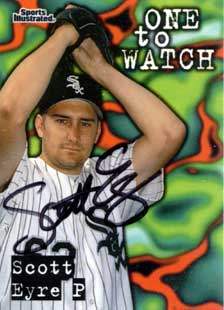
scott_eyre_autographScott Eyre

Joining the White Sox organization in a 1994 trade with the Rangers, he debuted with the big league team in 1997.  He split the next 4 seasons between the rotation and the bullpen, not to mention between Chicago and Charlotte, before being moved to the Blue Jays following the 2000 ALDS loss to the Mariners.  He joined the Cubs as a free agent for the 2006 season and enjoyed 2 seasons of relative success, before falling apart in 2008, when he was traded to the Phillies.

Kosuke Fukudome Continue reading →