#169 – Mike Caruso

mcarusoName: Mike Caruso

Rank: 169

Position: SS

Years With White Sox: 1998-1999

Mike Caruso was the centerpiece coming back to the White Sox, along with Keith Foulke, Bob Howry, Lorenzo Barcelo, Brian Manning, and Ken Vining, in the so-called White Flag trade on July 31, 1997 that sent Wilson Alvarez, Danny Darwin, and Roberto Hernandez to the Giants.  Caruso was a 20 year old in Class A who was expected to be the heir apparent to Ozzie Guillen on the left side of the White Sox infield.  He fought his way on to the opening day roster in 1998, beating out Benji Gil, and became an instant success story.

He made his major league debut on Opening Day 1998, going 1 for 5 in a White Sox victory against the Rangers.  By the time the year was over, he had compiled a .306 average, the highest rookie total by a Sox player since Minnie Minoso in 1951 and the best for a shortstop since Luis Aparicio in 1970.  He finished 3rd in Rookie of the Year voting, behind winner Ben Grieve and two spots ahead of teammate Magglio Ordonez.

Things started to go south in 1999.  Without veteran third baseman Robin Ventura to cover him, Caruso’s defense, already thought to be suspect, was exposed thanks to a strong arm and shrinking range.  Offensively, his average dropped to .250 and he managed only 17 extra base hits in 529 at bats, for a slugging percentage below .300.  Manager Jerry Manuel called out his young shortstop, for his poor production, lack of preparation, and a general lack of baseball smarts.

The 2000 season saw Caruso back in the minor leagues, thanks to the arrival of Jose Valentin.  While his former teammates went on to win the AL Central, Caruso struggled against minor league pitching before an injury ended his season prematurely.  Following the season, he was designated for assignment and was selected off of waivers by the Mariners.

Caruso’s numbers in a White Sox uniform, both for games I attended and overall, were:

Continue reading →

#171 – Tim Hulett

dpccwshule_20080716139Name: Tim Hulett

Rank: 171

Position: 2B/3B

Years With White Sox: 1983-1987

Tim Hulett joined the White Sox organization as their first round pick in the 1980 January secondary draft.  He made his major league debut on September 15, 1983, replacing Julio Cruz in the White Sox 12-0 victory over the Mariners.  Hulett ended up appearing in 6 games for the AL West champions, getting 1 hit in 5 at bats.

Hulett returned to Triple A Denver for the 1984 season, again earning a late season call-up.  This time he appeared in 8 games, going hitless in 7 at bats.

1985 saw Hulett getting his first extended shot in the big leagues.  Splitting time between second base and third base, he found his way into 141 games and hit .268.  In 1986, Hulett found himself as the opening day second baseman, but, while he set career highs in games, at bats, and home runs, his average fell to .231.

Hulett was the opening day third baseman in 1987, but things turned south quickly.  After being one of the few bright spots on the team in April, hitting .294 with 3 home runs, he fell of a cliff.  He hit .194 in May and .196 in June, before he was demoted to Triple A on June 26.  He returned for 3 games in August before returning to the minors for the rest of the year.  “I went bad at the wrong time,” said Hulett, who finished the season with a .217 batting average. “Five guys went bad the first month, but the team was still patient. I went bad the second month, but the team wasn`t patient anymore. I guess my timing was bad.”

When spring training of 1988 arrived, Hulett found himself off the 40-man roster and he was given a non-roster invite to camp.  “I have no chance here,” Hulett said.  “I`m at the stage in my career where I don`t have two or three years to waste in the minors. My confidence is a lot better this year. I know I can play in the big leagues. I just want to get a chance to prove it.”  He would not get a chance to prove it with the White Sox, though.  Prior to the start of the season, Hulett was traded to the Expos for a player to be named later.

Hulett’s numbers in a White Sox uniform, both for games I attended and overall, were:

Continue reading →

#188 – Salome Barojas

salome

Name: Salome Barojas

Rank: 188

Position: P

Years With White Sox: 1982-1984

As spring training wound down in 1982, the White Sox purchased the contract of Salome Barojas from the Mexico City Reds of the Mexican League.  Barojas quickly became the team’s closer, finishing the season with 21 saves.

In 1983, as the White Sox ran away with the AL West title, their first divisional championship, Barojas split the closing duties with Dennis Lamp, picking up 12 saves in 52 games and finishing the year with a career best 2.47 ERA.  Unfortunately, Barojas struggled during the ALCS, appearing in 2 games against the Orioles and giving up 4 hits and 2 runs in 1 inning pitched.

Like the rest of the White Sox, Barojas struggled to duplicate the success of the previous season in 1984.  His ERA had jumped over 2 runs in 24 games before he was traded to the Mariners on June 27 in exchange for pitchers Gene Nelson and Jerry Don Gleaton.

Barojas’ numbers in a White Sox uniform were:

Continue reading →

2015 Hall Of Fame Ballot – The Holdovers

mlb_hofThe BBWAA released their ballot for the Hall of Fame class of 2015 yesterday.  The results of the vote are due to be revealed on January 7th, with induction taking place next July.  After Frank Thomas, Greg Maddux, and Tom Glavine were elected in last year’s voting, the new ballot contains 17 holdovers along with 17 newcomers, which may start to cause a bit of a problem.  The current BBWAA rules continue to limit the number of votes on one ballot to 10, and there may be more than 10 deserving candidates.  To complicate things, the number of years of eligibility has been dropped from 15 to 10, with those who were between 10 and 15 grandfathered in.  So, there will be too many qualified candidates fighting for limited spots in a shorter amount of time.  Once again, the BBWAA and the Hall may find themselves with a mess on their hands.

Let’s take a look at the returning candidates today before moving on to the newcomers.

Jeff Bagwell
Years on ballot: 4
2014 Percentage: 54.3

Things have started to trend in the wrong direction for Bagwell, which may be due to the 10 vote limit.  Given the qualified list of newcomers and the continued PED rumors, I expect he will continue to be waiting for that elusive call.

Craig Biggio
Years on ballot: 2
2014 Percentage: 74.8

Narrowly missing election in last year’s vote, Biggio seems destined to make it on his third try, giving Astros fans something to look forward to next summer.

Barry Bonds
Years on ballot: 2
2014 Percentage: 34.7

The all time home run champion saw his vote percentage drop in his second year on the ballot.  While the Giants may be softening on having Bonds involved with them, having him throw out a first pitch during this year’s NLCS, the writers voting for the Hall are unlikely to have done the same.

Roger Clemens
Years on ballot: 2
2014 Percentage: 35.4

Roger Clemens, he of the 354 career victories and 7 Cy Young awards, also found himself falling after his second run through the voting process.  For some odd reason, perhaps by having played for more teams, Clemens continues to get marginally more support than his fellow PED poster child Barry Bonds.

Jeff Kent
Years on ballot: 1
2014 Percentage: 15.2

The 2000 NL MVP did not find much support in his first year of eligibility.  With the number of candidates coming down the pike, the future does not look good for him.

Edgar Martinez
Years on ballot: 5
2014 Percentage: 25.2

The longtime DH for the Mariners has had plenty of support from the Internet but not as much from the BBWAA, as his percentage dropped by over 10 percentage points.  His long career as a DH in the Pacific Northwest may be holding him back.

Don Mattingly
Continue reading →

O Captain! My Captain!

PaulKonerkoAfter an 18 seasons, including the past 16 with the White Sox, Paul Konerko’s major league career came to an end last week as the 2014 campaign wrapped up against the Royals.  Konerko, the last remaining White Sox player from their 2005 championship team, was a 6-time All Star and had served as team captain since 2006.  He also is the only White Sox player to appear in the post season 3 different times.

After brief appearances with the Dodgers and the Reds in 1997 and 1998, Paul Konerko was traded to the White Sox on November 11, 1998 for center fielder Mike Cameron.  He started at DH on opening day in 1999, an 8-2 victory over the Mariners, going 1-4 with a home run and 2 RBI.

2000 saw Konerko get off to a quick start with an inside the park home run on April 11 against the Devil Rays, the first by a White Sox player since 1990.  In his second full season, he helped lead the surprising White Sox to their first Central Division title.  He, along with the rest of the White Sox offense, struggled during the Division Series against the Mariners, going 0-9 in the three game sweep.

After steadily improving in 2001 and 2002, Konerko ran into trouble in 2003, with his average under .200 for the first half of the season.  He found himself coming off the bench as manager Jerry Manuel seemingly lost confidence in him.  He bounced back in the second half and re-established himself as the starting first baseman.

Konerko bounced back in a big way in 2004, hitting 41 home runs and knocking in over 100 RBIs en route to the Comeback Player of the Year award.  2005 saw him put up a second consecutive 40 HR, 100 RBI season as the White Sox found themselves back in the playoffs for the second time in his career.  This time, things would go much differently for both Konerko and the White Sox.

PaulKonerkoRed

Konerko homered twice and drove in 4 runs during the three game sweep against the Red Sox, catching the final out that sent the White Sox to the ALCS for the first time since 1993.  Konerko hit another 2 home runs and drove in 7 against the Angels during the 5 game series.  Once again, Konerko caught the final putout that sent the White Sox to their first World Series since 1959.  Following the victory in game 5, Konerko was named ALCS MVP.

Konerko cooled down during the World Series, hitting only one home run against the Astros, but what a home run it was.  With the White Sox trailing in the 7th inning, Konerko came up to face new pitcher Chad Qualls with the bases loaded.  Konerko made contact on the first pitch, sending it into the left field seats for a grand slam and the lead.  Like the previous 2 series, Konerko caught the final putout at first base in Game 4, giving the White Sox their first World Series title since 1917.

With the afterglow of winning the World Series starting to subside, Konerko became a free agent.  Despite rumors of him getting more lucrative offers from both the Dodgers and the Orioles, Konerko finally resigned with the White Sox, inking a 5-year, $60 million contract that would keep him on the south side through 2010.

Konerko battled through injuries in 2008, leading to his worst season since 2003, but he did manage to help the White Sox reach the post-season for the third time during his career.  He hit 2 solo home runs in the 4 game series against the Rays, in what would be his final playoff appearance.

Konerko had two more chances at free agency, signing a 3 year deal with the White Sox prior to 2011 and, finally, re-upping for one last season last fall.  He finishes his career as the White Sox all time leader in total bases and second all time in home runs, RBIs, and games played.

Konerko’s numbers in a White Sox uniform, both for games I attended and overall, were:

Continue reading →

2014 Final Standings

MLB: Cincinnati Reds at Los Angeles Dodgers

The 2014 baseball season came to an end this past Sunday.  I made it to 35 games this year, in 4 stadiums across 3 states.  Here are the final standings for those games, and the 17 different teams that I saw in person.

Team Won Loss Winning Pctg
New York Yankees 2 0 1.000
San Francisco Giants 1 0 1.000
Pittsburgh Pirates 1 0 1.000
Cleveland Indians 1 0 1.000
Arizona Diamondbacks 1 0 1.000
Kansas City Royals 3 1 0.750
Chicago Cubs 3 2 0.600
San Diego Padres 1 1 0.500
Toronto Blue Jays 1 1 0.500
Houston Astros 1 1 0.500
Detroit Tigers 1 1 0.500
Chicago White Sox 14 17 0.452
Minnesota Twins Continue reading →

#205 – Chris Singleton

1384-174FrName: Chris Singleton

Rank: 205

Position: CF

Years With White Sox: 1999-2001

Chris Singleton joined the White Sox after a December, 1998 trade with the Yankees for a player to be named later.  He made the big league club during spring training of 1999 and made his major league debut on April 10, pinch hitting in a White Sox loss to the Royals.  Later that season, on July 6, Singleton became the first White Sox player in 15 years to hit for the cycle, again in a loss to the Royals.  He finished the year with a .300 average and 17 home runs, which earned him 6th place in Rookie of the Year voting, ahead of teammate Carlos Lee.

Singleton had earned the starting job in center field entering the 2000 season, but, while the team caught fire and went on to win their first division title since 1993, Singleton’s numbers regressed.  His average dropped to .254 and he fell to 11 home runs.  His struggles intensified during the Division Series loss against the Mariners, as he went 1 for 9 in the 3 games.

2001 saw Singleton’s playing time reduced, although his average rebounded back to .298.  He appeared in only 7 fewer games as the year before, but his at bats dropped by over 100.  For the second year in a row, his power numbers fell, now down to 7.

A few weeks before spring training was set to begin in 2002, Singleton was dealt to the Orioles, in exchange for Willie Harris.  Singleton would rejoin the organization in 2006 as the new color analyst on the radio broadcasts.  He lasted for two painful seasons, teamed with fellow color man Ed Farmer, before leaving to become an analyst for ESPN on Baseball Tonight.

Singleton’s numbers in a White Sox uniform, both for games I attended and overall, were:

Continue reading →

#209 – Bill Simas

SoxName: Bill Simas

Rank: 209

Position: P

Years With White Sox: 1995-2000

Bill Simas joined the White Sox organization near the trading deadline in 1995 along with McKay Christensen, Andrew Lorraine, and John Snyder in the deal that sent Jim Abbott and Tim Fortugno to the Angels.  He made his major league debut on August 15, pitching a scoreless inning of relief against those same Angels.  He finished the season with a 2.57 ERA in 14 appearances for a disappointing White Sox squad that finished 8 games under .500.

Simas became a mainstay of the White Sox bullpen starting in 1996, when he appeared in 64 games.  His ERA, however, jumped up to a career high 4.58 in 72.2 inning pitched, also a career high.  He improved in 1997, lowering his to 4.14 in 40 games before minor shoulder surgery ended his season early in August.

Much to his chagrin, Simas started the 1998 season in Triple A to build up his arm strength.  “If spring training had been another week to 10 days, he’d be with us,” general manager Ron Schueler said.  “He’s just not quite ready yet.”  Simas did not see things the same way.  “They say my velocity’s not the same, but does that mean I can’t pitch?” Simas asked.  “I asked that question and they didn’t give me an answer. That’s the way it goes.”  He was back in the big leagues by the end of April, finishing the year with a 3.57 ERA and 18 saves.

1999 was another decent year for the bullpen workhorse.  He appeared in a career high 70 games and put up a 6-3 record with 2 saves.  As the White Sox ran away with the 2000 AL Central title, Simas again was a key part of the bullpen, appearing in 60 games and putting up a 3.46 ERA before being shut down for the final month of the season after suffering elbow pain.  He returned for the ALDS against the Mariners, appearing in 2 of the 3 games.

Following the 2000 season, he underwent Tommy John surgery and missed the entire 2001 season.  After that season, he was granted free agency, but returned to the White Sox organization on a minor league deal in May of 2002.  After the 2002 season, he again was granted free agency, but he never appeared in the major leagues again.

Simas’ numbers in a White Sox uniform, both for games I attended and overall, were:

Continue reading →

2014 All Star Break Standings

As we head in to the All Star break, it’s time to take a look at the team records for the 17 games I attended in the first half of the baseball season.

2014 Team Records

Team Won Loss Winning Pctg
New York Yankees 2 0 1.000
Kansas City Royals 2 0 1.000
San Francisco Giants 1 0 1.000
Cleveland Indians 1 0 1.000
Arizona Diamondbacks 1 0 1.000
Tampa Bay Rays 1 1 0.500
San Diego Padres 1 1 0.500
Chicago Cubs 1 1 0.500
Chicago White Sox 6 10 0.375
Seattle Mariners Continue reading →

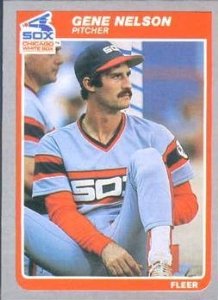
#225 – Gene Nelson

genenelson

Name: Gene Nelson

Rank: 225

Position: P

Years With White Sox: 1984-1986

With the White Sox struggling to repeat as AL West Champions in 1984, they swung a deal with the Mariners on June 27 to swap relief pitchers, sending Salome Barojas out west in exchange for Jerry Don Gleaton and Gene Nelson.  Nelson, who had been in Triple A for the Mariners, came to the big leagues with the White Sox and split his time between the rotation and bullpen, starting 9 of his 20 appearances.

In 1985, Nelson was penciled in to work strictly out of the pen.  “It was tough to adjust after starting for so long,” he said.  “It was a matter of learning the mental parts of the game in the bullpen.”  However, an injury to Richard Dotson and the ineffectiveness of Bruce Tanner forced manager Tony LaRussa to move Nelson back in to the rotation in early July.  By year’s end, Nelson had completed his first full big league season with 46 appearances, 18 of them as a starter.

1986 saw Nelson back in the bullpen full time, save one emergency start due to the death of Tom Seaver’s mother.  He appeared in a career-high 54 games and posted his best ERA to date.  In December, the White Sox packaged Nelson with Bruce Tanner and sent him to the A’s in exchange for second baseman Donnie Hill.

Nelson’s numbers in a White Sox uniform, both for games I attended and overall, were: Continue reading →