 Originally founded in 1869, the Chicago Cubs became a charter member of the National League in 1876. Over the next 150 seasons, the Cubs have played more than 22,000 games, scored over 103,000 runs and recorded more than 200,000 hits, more than any other team in baseball history. Nearly 2,300 players have worn a Cubs uniform, earning eight division titles, 17 NL pennants, and three World Series championships.
Fans have witnessed generations of unforgettable players, from historical heroes like Joe Tinker, Gabby Hartnett, Ernie Banks, and Billy Williams to more recent stars like Ryne Sandberg, Derrek Lee, Kerry Wood, and Anthony Rizzo. The team has called Wrigley Field home for 110 of those 150 seasons.
To celebrate this milestone, the Cubs are holding a fan vote to select the franchise’s anniversary team. Each week, we will go through the provided options for each position and declare who should, and, if different, who will, win the fan vote. We start today with the eight selections for manager.
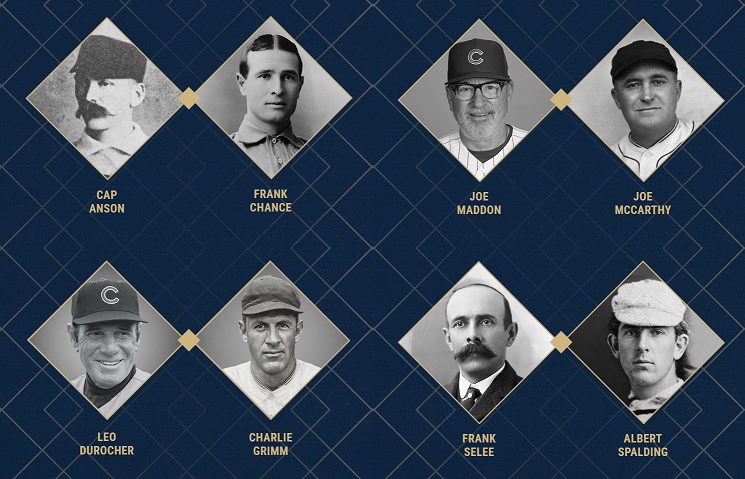 Cap Anson was one of the first superstars of professional baseball. He joined the Cubs franchise, then known as the White Stockings, in 1876, the first year of the new National League. In 1879, he became the player-manager, leading the team to five pennants between 1880 and 1886. He introduced new tactics that are commonplace today, including having a third base coach, having fielders back up one another, using signs to the batter, and having a set pitching rotation. He was fired as manager following the 1897 season, his last as a player. Off the field, Anson was an outspoken proponent of segregation in baseball and was known to gamble on games.
Frank Chance debuted with the Cubs in 1898, becoming their full-time first baseman in 1903, where he became immortalized as part of the “Tinker-to-Evers-to-Chance” trio thanks to the poem Baseball’s Sad Lexicon. He became the player-manager in 1905, becoming the first of only eight managers to lead their team to four 100-win seasons. The Cubs would win four NL pennants and two World Series championships under Chance. He was let go by the team as both a player and a manager following the 1912 season. He remains the winningest manager in Cubs history, by winning percentage.
Leo Durocher returned to major league baseball after an eleven-year break to become the manager of the Cubs in 1966. He inherited a team that had finished in eighth place the year before and, within two years, he led them to only their second winning season since 1946. 1969 appeared to be their year, as the Cubs led the new NL East for 105 days, but a late season fade left them eight games behind the so-called Miracle Mets. During his tenure, Durocher faced trouble in the locker room, nearly coming to blows with Ron Santo and dealing with the decline phase of franchise legend Ernie Banks. With a 46-44 record midway through the 1972 season, Durocher was fired. He would later state that his biggest regret in baseball was not winning a pennant for Cubs owner Phillip Wrigley.