150 Years Of Cubs Baseball – Second Basemen

Originally founded in 1869, the Chicago Cubs became a charter member of the National League in 1876.  Over the next 150 seasons, the Cubs have played more than 22,000 games, scored over 103,000 runs and recorded more than 200,000 hits, more than any other team in baseball history.  Nearly 2,300 players have worn a Cubs uniform, earning eight division titles, 17 NL pennants, and three World Series championships.

Fans have witnessed generations of unforgettable players, from historical heroes like Joe Tinker, Gabby Hartnett, Ernie Banks, and Billy Williams to more recent stars like Ryne Sandberg, Derrek Lee, Kerry Wood, and Anthony Rizzo.  The team has called Wrigley Field home for 110 of those 150 seasons.

To celebrate this milestone, the Cubs are holding a fan vote to select the franchise’s anniversary team.  Each week, we will go through the provided options for each position and declare who should, and, if different, who will, win the fan vote.  We start today with the eight selections for second baseman.
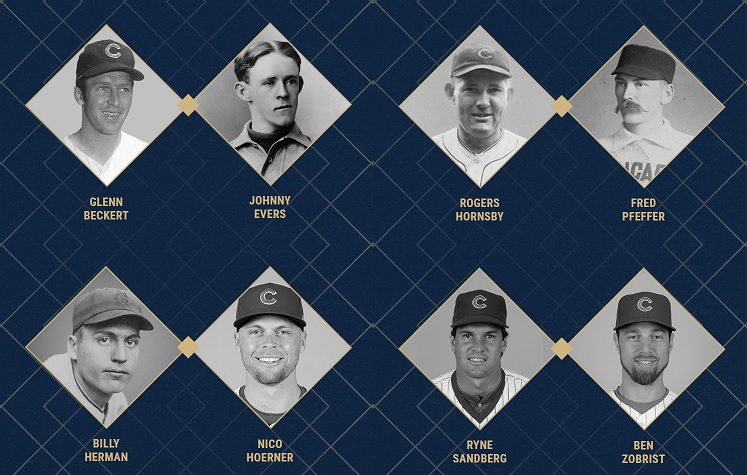
Glenn Beckert was called up by the Cubs in 1965, spending the next nine seasons as the team’s second baseman.  He won the Gold Glove in 1968 and was a four-time All-Star.  His best offensive season came in 1971, when he finished third in the NL with a career-best .342 batting average.

Johnny Evers played for the Orphans/Cubs from 1902 through 1913.  Known as “The Human Crab” for his combative play and fights with umpires, he earned a place in baseball history as part of the famous “Tinker-to-Evers-to-Chance” double-play combination thanks to the poem Baseball’s Sad Lexicon.  Evers was responsible for alerting umpires to the baserunning mistake that would come to be known as “Merkle’s Boner”.  He was part of three NL pennant winners with the Cubs, winning the championship in 1907 and 1908, and was elected to the Hall of Fame in 1946.

Billy Herman spent the first eleven years of his career with the Cubs, hitting over .300 in seven of his first nine seasons.  He led the league in games played (twice), hits, doubles, and triples across his nine full seasons.  During that time, he was named an All-Star seven straight times, beginning in 1934.  He was elected to the Hall of Fame in 1975.

Continue reading →

150 Years Of Cubs Baseball – First Basemen

Originally founded in 1869, the Chicago Cubs became a charter member of the National League in 1876.  Over the next 150 seasons, the Cubs have played more than 22,000 games, scored over 103,000 runs and recorded more than 200,000 hits, more than any other team in baseball history.  Nearly 2,300 players have worn a Cubs uniform, earning eight division titles, 17 NL pennants, and three World Series championships.

Fans have witnessed generations of unforgettable players, from historical heroes like Joe Tinker, Gabby Hartnett, Ernie Banks, and Billy Williams to more recent stars like Ryne Sandberg, Derrek Lee, Kerry Wood, and Anthony Rizzo.  The team has called Wrigley Field home for 110 of those 150 seasons.

To celebrate this milestone, the Cubs are holding a fan vote to select the franchise’s anniversary team.  Each week, we will go through the provided options for each position and declare who should, and, if different, who will, win the fan vote.  We continue today with the eight selections for first baseman.

Cap Anson was one of the first superstars of professional baseball.  He joined the Cubs franchise, then known as the White Stockings, in 1876, the first year of the new National League.  In addition to managing the team from 1879-1897, he was the NL batting champion in both 1881 and 1888 and led the league in RBI eight times between 1880 and 1891.  He helped the team to five pennants between 1880 and 1886.  He was posthumously elected to the Hall of Fame in 1939.

Bill Buckner joined the Cubs in 1977, moving to first base due to a staph infection in his ankle the previous year.  He would win the NL batting title in 1980 and be named to his lone All-Star team in 1981.  In 1982, he set the major league record for assists at first base with 159.  Following some late acquisitions in 1984, Buckner found himself the off man out and was traded at the end of May.  He is a member of the Cubs Hall of Fame.

Phil Cavarretta spent 20 seasons with the Cubs, making his debut in September of 1934, just two months past his 18thn birthday.  He was a four-time All Star and, in 1945, he won the NL batting title and the MVP award while leading the Cubs to the pennant, their last one for over 70 years.  In his final season with the Cubs, he set the modern franchise record by playing in his 1938th game.  All told, he would hit .317 in three World Series appearances for the Cubs.

Continue reading →

150 Years Of Cubs Baseball – Catchers

Originally founded in 1869, the Chicago Cubs became a charter member of the National League in 1876.  Over the next 150 seasons, the Cubs have played more than 22,000 games, scored over 103,000 runs and recorded more than 200,000 hits, more than any other team in baseball history.  Nearly 2,300 players have worn a Cubs uniform, earning eight division titles, 17 NL pennants, and three World Series championships.

Fans have witnessed generations of unforgettable players, from historical heroes like Joe Tinker, Gabby Hartnett, Ernie Banks, and Billy Williams to more recent stars like Ryne Sandberg, Derrek Lee, Kerry Wood, and Anthony Rizzo.  The team has called Wrigley Field home for 110 of those 150 seasons.

To celebrate this milestone, the Cubs are holding a fan vote to select the franchise’s anniversary team.  Each week, we will go through the provided options for each position and declare who should, and, if different, who will, win the fan vote.  We continue today with the eight selections for catcher.

Willson Contreras first joined the Cubs in 2016 and became the 30th player in modern MLB history to hit a home run on the first pitch of his first major league at bat.  Contreras made it on to the post-season roster and helped the Cubs end their 108-year title drought in winning the 2016 World Series.  He became the everyday starting catcher in 2017 and was elected to the All-Star team three times.  He spent parts of seven seasons behind the plate for the Cubs, appearing in 30 postseason games across four seasons.

Jody Davis joined the Cubs in April of 1981, quickly becoming the team’s starter.  During his Cub tenure, he was named to two All-Star teams and won the Gold Glove in 1986, a season where he set the all-time MLB record for number of baserunners caught stealing with 89.  Davis remained with the Cubs through most of the 1988 season.  He will be inducted into the team’s Hall of Fame later this year.

Silver Flint played for the White Stockings from 1879-1889.  He, alongside pitcher Larry Corcoran, is believed to have developed the first system of signs between a pitcher and catcher to indicate pitch selection.  He was the first catcher in MLB history to catch three no-hitters.  Off the field, Flint had financial difficulties that nearly got him banned from the league.

Gabby Hartnett spent the first 19 years, from 1922-1940, of his career with the Cubs, appearing in six All-Star games and earning the MVP award in 1935.  Perhaps best remembered for the “Homer in the Gloamin’” in 1938, Hartnett was considered the best National League catcher until the emergence of Johnny Bench.  He was elected to the Hall of Fame in 1955.

Continue reading →

150 Years Of Cubs Baseball – Managers

Originally founded in 1869, the Chicago Cubs became a charter member of the National League in 1876.  Over the next 150 seasons, the Cubs have played more than 22,000 games, scored over 103,000 runs and recorded more than 200,000 hits, more than any other team in baseball history.  Nearly 2,300 players have worn a Cubs uniform, earning eight division titles, 17 NL pennants, and three World Series championships.

Fans have witnessed generations of unforgettable players, from historical heroes like Joe Tinker, Gabby Hartnett, Ernie Banks, and Billy Williams to more recent stars like Ryne Sandberg, Derrek Lee, Kerry Wood, and Anthony Rizzo.  The team has called Wrigley Field home for 110 of those 150 seasons.

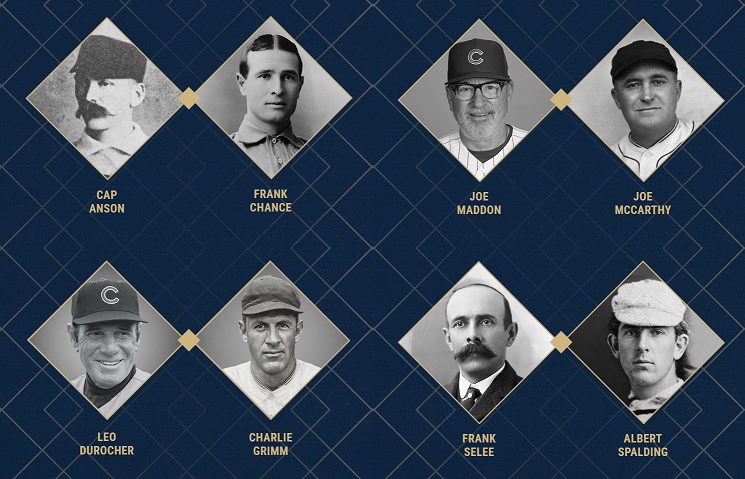
To celebrate this milestone, the Cubs are holding a fan vote to select the franchise’s anniversary team.  Each week, we will go through the provided options for each position and declare who should, and, if different, who will, win the fan vote.  We start today with the eight selections for manager.

Cap Anson was one of the first superstars of professional baseball.  He joined the Cubs franchise, then known as the White Stockings, in 1876, the first year of the new National League.  In 1879, he became the player-manager, leading the team to five pennants between 1880 and 1886.  He introduced new tactics that are commonplace today, including having a third base coach, having fielders back up one another, using signs to the batter, and having a set pitching rotation.  He was fired as manager following the 1897 season, his last as a player.  Off the field, Anson was an outspoken proponent of segregation in baseball and was known to gamble on games.

Frank Chance debuted with the Cubs in 1898, becoming their full-time first baseman in 1903, where he became immortalized as part of the “Tinker-to-Evers-to-Chance” trio thanks to the poem Baseball’s Sad Lexicon.  He became the player-manager in 1905, becoming the first of only eight managers to lead their team to four 100-win seasons.  The Cubs would win four NL pennants and two World Series championships under Chance.  He was let go by the team as both a player and a manager following the 1912 season.  He remains the winningest manager in Cubs history, by winning percentage.

Leo Durocher returned to major league baseball after an eleven-year break to become the manager of the Cubs in 1966.  He inherited a team that had finished in eighth place the year before and, within two years, he led them to only their second winning season since 1946.  1969 appeared to be their year, as the Cubs led the new NL East for 105 days, but a late season fade left them eight games behind the so-called Miracle Mets.  During his tenure, Durocher faced trouble in the locker room, nearly coming to blows with Ron Santo and dealing with the decline phase of franchise legend Ernie Banks.  With a 46-44 record midway through the 1972 season, Durocher was fired.  He would later state that his biggest regret in baseball was not winning a pennant for Cubs owner Phillip Wrigley.

Continue reading →

By The Numbers – 26

In 1929, uniform numbers appeared on the back of baseball jerseys for the first time, thanks to the Indians and the Yankees.  By 1937, numbers finally appeared across all uniforms, both home and away, across both major leagues.  Since that time, 81 distinct numbers have been worn by members of the White Sox, while the Cubs boast 76.

Today, we continue our look at those players, picking our favorite, if not the best, player to wear each uniform number for both Chicago teams with #26.  71 different players have donned #26 while playing in Chicago, 58 for the White Sox and 13 for the Cubs, who have retired it for a Hall of Fame outfielder.

Sweet-Swinging Billy Williams first wore his familiar #26 in 1961, his first full season with the Cubs, where he played in 146 games, hitting 25 home runs with 86 RBIs, while earning Rookie of the Year honors.  Williams hit at least 20 home runs and drove in 84 or more runs in every season from 1961 to 1973, earning 6 All-Star team nods along the way, in 1962, 1964, 1965, 1968, 1972, and 1973.  In 1963, he started a consecutive game streak that would last into 1970, setting the National League record with 1,117.

In 1970, Williams batted .322 with 42 homers and 129 RBI and finished second in MVP voting.  He replicated that finish in 1972, winning the batting title with a .333 average, along with a .606 slugging percentage, 37 home runs, and 122 RBIs.  That gave him his 3rd top ten finish in 5 seasons.  Following the 1974 season, Williams was traded to the A’s for, amongst others, Manny Trillo.  Williams was elected to the Hall of Fame in 1987 and his number 26 was retired by the Cubs later that summer.

On the South Side of town, nobody has really made their mark wearing #26, though one of the greatest “what ifs” in team history did don the number in 1986.  Acquired in the Rule 5 draft from the Pirates in December of 1985, Bobby Bonilla made his major league debut with the White Sox on April 9, going 0-1 as a pinch hitter in the Sox loss to the Brewers.  Bonilla was putting together a pretty decent rookie campaign, especially since he was making the jump from A ball, hitting .269 with 2 home runs in 75 games when GM Ken Harrelson decided send Bonilla back to the Pirates, in exchange for pitcher Jose DeLeon.  DeLeon went 23-22 across parts of 5 seasons in 2 stints with the White Sox, while Bonilla made 6 All Star teams, earned three Silver Slugger awards, and two top ten MVP finishes over the next 10 seasons.

By The Numbers – 41

In 1929, uniform numbers appeared on the back of baseball jerseys for the first time, thanks to the Indians and the Yankees.  By 1937, numbers finally appeared across all uniforms, both home and away, across both major leagues.  Since that time, 81 distinct numbers have been worn by members of the White Sox, while the Cubs boast 76.

Today, we continue our look at those players, picking our favorite, if not the best, player to wear each uniform number for both Chicago teams with #41.  69 different players have donned #41 while playing in Chicago, 28 for the White Sox and 41 for the Cubs, including two future Hall of Famers.

The White Sox claimed Tom Seaver, and his familiar #41, from the Mets on January 20, 1984 as compensation for Dennis Lamp leaving as a free agent.  Seaver was a steady force in the rotation, going 15-11 with a 3.95 ERA in his first go around through the junior circuit.  The highlight of the year came on May 9, when he pitched the final inning of a suspended, 25 inning contest from the day before and then started the regularly scheduled game against the Brewers, earning the victory in both.  With LaMarr Hoyt traded in the offseason, Seaver was on the mound for his 15th opening day in 1985, breaking Walter Johnson’s record of 14 Opening Day starts.  On August 4, back in New York against the Yankees, Seaver threw a complete game to earn his 300th career victory.  He finished the year with a 16-11 record and a sterling 3.17 ERA.  Seaver again got the opening day nod in 1986, extending his record to 16.  With the White Sox going nowhere, Seaver, now 41 years old, was looking to return to the east coast to be near his family after the death of his mother in May.  When a bum shoulder put him on the disabled list, he informed the White Sox he was thinking of retiring.  When manager Tony LaRussa was fired on June 20, his replacement, Jim Fregosi, said Seaver’s wishes should be honored.  On June 29, after going 2-6 with a 4.38 ERA in 12 starts, Seaver was traded to the Red Sox for Steve Lyons.

A young Billy Williams, in his second cup of coffee with the Cubs in 1960, donned #41 for 12 games.  He hit .277 and knocked out his first two career home runs.  The following year, he would switch to his familiar #26, win the Rookie of the Year award, and kick his Hall of Fame career into high gear.

Franchise Four – Chicago Cubs

Major League Baseball is asking its fans to vote for the four most impactful players who best represent the history of each franchise.  The winners will be announced in July at the All Star Game in Cincinnati.  Today, I will give my Franchise Four picks for the Chicago Cubs.

F4Cubs

EBErnie Banks, who was elected to the Hall of Fame in 1977, played his entire 19 year career with the Cubs, earning back-to-back MVP honors in 1958 and 1959.  When he retired following the 1971 season, he ranked 9th all-time in home runs, with 512.

RSRyne Sandberg joined the Cubs in 1982 and quickly became a fixture in the middle of the Cub infield, where he remained until 1997.  The 10-time all star, who earned MVP honors in 1984, was elected to the Hall of Fame in 2005.

TFBMordecai “Three Finger” Brown, who earned his nickname due to farming incident in his youth, spent 10 of his 14 seasons with the Cubs, leading them to World Series titles in 1907 and 1908.  He was elected to the Hall of Fame in 1949.

RoSRon Santo spent 14 of his 15 big league seasons with the Cubs, earning 9 All Star game appearances and 5 Gold Gloves.  He followed his playing career with a long broadcasting stint with the team.  He was posthumously elected to the Hall of Fame in 2012.

GHGabby Hartnett spent the first 19 years of his career with the Cubs, appearing in 6 All Star games and earning the MVP award in 1935.  Perhaps best remembered for the “Homer in the Gloamin'” in 1938, Hartnett was considered the best National League catcher until the emergence of Johnny Bench.  He was elected to the Hall of Fame in 1955. Continue reading →