#4 – Robin Ventura

Name: Robin Ventura

Rank: 4

Position: 3B

Years With White Sox: 1989-1998

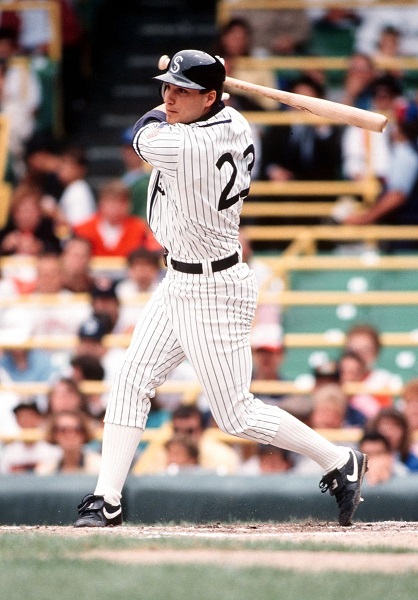
Robin Ventura joined the White Sox organization as the 10th overall pick in the 1988 draft.  He made his major league debut the following September, going 1-4 with an RBI in a 11-1 victory over the Orioles at Memorial Stadium.  He appeared in 16 games down the stretch, hitting only .178 while driving in 7 runs in 45 at bats.

A good spring in 1990 led to Ventura breaking camp with the White Sox.  He struggled, both on the field and at the plate, suffering through a horrendous 0-for-41 slump while committing 25 errors over the course of the season.  However, he did lead AL rookies with 150 games played and his 123 hits were the most by a White Sox rookie since Ozzie Guillen in 1985.  He finished the year with a .249 average, 5 home runs, and 54 RBIs.  He placed 7th in Rookie of the Year voting and was named to the Topps All Star Rookie team.

Ventura and the White Sox moved in to the new Comiskey Park in 1991, hoping to improve on the previous year’s growth.  He improved his fielding enough to earn his first Gold Glove award and led the league in putouts.  At the plate, he set a White Sox team record for RBIs by a third baseman, finishing with an even 100.  He upped his average to .284 and hit 23 home runs.  His work was enough to garner enough MVP votes to finish in 20th place.

1992 was another good year for Ventura.  He earned his first All Star nod, going 2-2 in the AL’s victory at Jack Murphy Stadium.  He finished the year with a .282 average, 16 home runs, and 93 RBIs.  He also snagged his second consecutive Gold Glove award.

Ventura continued his successful ways in 1993.  He collected his 500th hit in May and, on August 4, he entered the public consciousness with an event that would come to define his entire career.  While batting against the Rangers, Ventura was hit by a pitch thrown by Nolan Ryan and charged the mound.  Ryan, 20 years Ventura’s senior, placed him in a headlock and punched him several times, starting a bench-clearing brawl that was voted the best baseball brawl of all time by SportCenter.  Ventura saw his average drop to .262, but his OPS set a new career high.  His 94 RBIs made him the first AL third baseman with three consecutive 90-RBI seasons since Graig Nettles in the mid 70s.  During the ALCS against the Blue Jays, Ventura hit .200, with just 1 home run and 5 RBIs across the six game series.  After the season, he was awarded his third consecutive Gold Glove award.

The strike in 1994 saw Ventura’s streak of 90 RBI seasons and Gold Gloves come to an end.  When baseball stopped in August, Ventura was hitting .282 with 18 home runs and 78 RBIs, while posting a new career high with an .832 OPS.

When play resumed in late April 1995, Ventura struggled out of the gate, committing ten errors in the first ten games.  As the White Sox started to tear down the team that had finished the previous two seasons on top of their division, trade rumors started to follow Ventura, though nothing came to fruition.  On September 4, he became the eighth player in history to hit two grand slams in one game, and the first since Frank Robinson in 1970.  He finished the year setting career highs with a .295 average, an .882 OPS, and 26 home runs while driving in 93 runs.

Ventura had the best year of his career to date in 1996.  He set White Sox team records in career home runs by a third baseman, with 142, and grand slams, with 9.  He set new career highs with 34 home runs, 105 RBIs, 2 triples, an OPS of .888, and a .974 fielding percentage at the hot corner.  He hit .287, while earning his fourth Gold Glove award.

1997 turned into a dismal year for Ventura and the White Sox.  During a spring training game at Ed Smith Stadium, Ventura caught his foot in the mud while sliding into home plate and suffered a broken and dislocated right ankle.  Expected to miss the entire season, he returned on July 24, collecting the game-winning hit that night, and homered in his first at-bat the next night.  With the White Sox only 3.5 games behind the Indians in the standings, a healthy Ventura might have put them over the top.  A week later, the team threw in the towel in what eventually became to be known as the White Flag Trade, sending Wilson Alvarez, Roberto Hernandez, and Danny Darwin to the Giants for prospects.  “We didn’t realize Aug. 1 was the end of the season,” said an upset Ventura.  He finished the year appearing in 54 games, hitting .262 with 6 home runs and 26 RBIs.

As Ventura entered the last year of his contract in 1998, the White Sox made little attempt to sign him to an extension, with owner Jerry Reinsdorf claiming his skills were “deteriorating” after his injury the year before.  With more trade rumors following him throughout the season, he finished the year with a .263 average, 21 home runs, and 91 RBIs while earning his fifth Gold Glove award.  Following the season, he became a free agent, ending his White Sox playing career.

On October 6, 2011, Ventura returned to the White Sox as their 39th manager.  He resigned following the 2016 season, finishing with a career record of 375-435 for a winning percentage of .463.

For his career, Ventura ranks 6th in White Sox history with 39.4 WAR, 8th with 28.8 OWAR, 8th with 12.9 DWAR, 6th with 171 home runs, 8th with 741 RBIs, and 5th with 668 walks.

Ventura’s numbers in a White Sox uniform, both for games I attended and overall, were:

Continue reading →

#11 – Bo Jackson

Name: Bo Jackson

Rank: 11

Position: RF/DH

Years With White Sox: 1991, 1993

Vincent Edward “Bo” Jackson joined the White Sox as a free agent on April 3, 1991 after being released by the Royals following a hip injury suffered in January during the NFL playoffs as a member of the Raiders.  “In making the business decision,” owner Jerry Reinsdorf said at the time, “I assume he will not play this year. If he does, it will be a big bonus.”  Jackson did spend most of 1991 on the disabled list, rehabbing the injury, but did eventually manage to make his way back to the field.  He appeared in 23 games, hitting only .225 with 3 home runs.

Diagnosed with avascular necrosis of the hip joint and having lost all of the cartilage supporting his hip, Jackson decided to undergo a hip replacement surgery, keeping him on the shelf for the entire 1992 season.  While rehabbing, Jackson promised his mother he would return to the major leagues and hit a home run for her.

Unfortunately, Jackson’s mother died before he could return, but, in his first at bat of the 1994 season, and his first with an artificial hip, he hit a home run to right field against the Yankees at Comiskey Park.  On September 27, Jackson belted a three-run home run off of the Mariners to help the White Sox clinch their first AL West Division title in a decade.  Jackson ended up appearing in 85 games for the White Sox, hitting .232 and hitting 16 home runs while driving in 45.  He appeared in 3 of the 6 ALCS games against the Blue Jays, going hitless in 10 at bats.

Following the season, he became a free agent, ending his White Sox playing career.  In 2014, he returned to the organization as an ambassador, a role he continues to play today.

Jackson’s numbers in a White Sox uniform, both for games I attended and overall, were:

Continue reading →

#52 – Ken Williams

Name: Ken Williams

Rank: 52

Position: CF/3B

Years With White Sox: 1986-1988

Ken Williams was selected by the White Sox in the 3rd round of the 1982 draft.  He made his major league debut on September 2, 1986, going 1-4 in the White Sox 3-0 victory over the Royals in Kansas City.  He appeared in 15 games down the stretch, hitting an anemic .129.

Williams got extended playing time in 1987 and turned in his best season as a major leaguer.  He hit .281 with 11 home runs and 50 RBIs, playing primarily in center field.

Looking to keep his promising bat in the lineup, the White Sox tried to move Williams to third base for the 1988 season.  To say it did not go well would be an understatement.  Williams struggled both at the plate and in the field, hitting .159 in 220 at bats and posting a .860 fielding percentage.

The following spring, Williams was traded to the Tigers for pitcher Eric King.  Following his retirement, he rejoined the White Sox organization as a scout in November of 1992.  He served as a special assistant to Jerry Reinsdorf in 1994, director of minor league operations from 1995-1996, and vice president of player development from 1997-2000.  Following the promotion of Ron Schueler following the 2000 season, Williams was named general manager, just the third African American in baseball history to hold the position.

From 2001 through 2003, Williams and manager Jerry Manuel formed the first African American tandem to hold those positions in baseball history.  In 2005, Williams helped lead the White Sox to their first World Series title in 88 years.  Following the 2012 season, he was promoted to Executive Vice President of baseball operations, the role he still holds today.

Williams’ numbers in a White Sox uniform, both for games I attended and overall, were:

Continue reading →

#69 – Roberto Hernandez

roberto-hernandezName: Roberto Hernandez

Rank: 69

Position: P

Years With White Sox: 1991-1997

Roberto Hernandez was acquired by the White Sox, along with Mark Doran, via trade with the Angels in exchange for Mark Davis on August 4, 1989.  After falling victim to numbness in his hands caused by blood clots and emergency surgery to transplant veins from his thigh into his forearm, he made his major league debut on September 2, 1991, getting the start and going 7 innings for the victory in the White Sox win over the Royals.  He appeared in 9 games in the final month of the season, making the only 3 starts of his career, and finished the year with a 7.80 ERA.

In 1992, Hernandez split the year between Triple A Vancouver and Chicago, eventually supplanting Bobby Thigpen as the team’s primary closer.  He finished the year with 12 saves and a sparkling 1.65 ERA.

Hernandez had another great year in 1993, saving 38 games in 70 appearances with a 2.29 ERA as the White Sox won their final AL West title.  During the ALCS against the Blue Jays, Hernandez threw 4 scoreless innings in 4 appearances, earning 1 save.

In the strike-shortened 1994 season, Hernandez struggled.  His ERA jumped to 4.91 and he saved only 14 games before the season ended on August 12, despite leading the league in games finished.

When baseball returned in 1995, Hernandez bounced back somewhat, once again leading the league in games finished and lowering his ERA by nearly a full run to 3.92.

1996 was a true return to form for Hernandez.  He led the league in games finished for the third straight year and lowered his ERA by 2 full runs to 1.91.  He earned his first All Star selection and, with 38 saves, finished 6th in Cy Young Award voting.

Hernandez was well on his way to another strong season in 1997, with 27 saves and a 2.44 ERA, when he was included in the infamous White Flag trade on July 31.  With Jerry Reinsdorf announcing that “Anyone who thinks we can catch Cleveland is crazy,” Hernandez, along with Wilson Alzarez and Danny Darwin, to the Giants for Brian Manning, Lorenzo Barcelo, Mike Caruso, Keith Foulke, Bob Howry, and Ken Vining.

Hernandez’s numbers in a White Sox uniform, both for games I attended and overall, were:

Continue reading →

Small Shakeup For 2016

EP-701249829The White Sox officially announced the disappointing, but not totally unexpected news that Robin Ventura will return as manager for 2016.  Bench coach Mark Parent has been let go, and has decided to skip the final 3 games of this season.  Assistant hitting coach Harold Baines has decided to transition into a team ambassador role.  The rest of the coaching staff is expected to return in their current roles.

Given the disappointment that was this season, one would have expected heads to roll.  But Jerry Reinsdorf never follows expectations, and he has his favorites.  Ventura will be given another chance, but I don’t see him surviving a fourth straight losing season.

#151 – Albert Belle

albertbelleName: Albert Belle

Rank: 151

Position: LF

Years With White Sox: 1997-1998

Mere weeks after owner Jerry Reinsdorf argued against a labor deal that did not include salary restraints, the White Sox shocked the baseball world on November 19, 1996 by signing free agent outfielder Albert Belle to a 5 year, $55 million deal, making him the highest paid player in baseball.  Belle, joining returning stars Frank Thomas and Robin Ventura, was expected to lead the White Sox back to the post-season.

While Belle certainly lived up to his end of the bargain, things did not go as planned for the White Sox.  Ventura broke his ankle during spring training and missed nearly the first 4 months of the season.  Belle, meanwhile, tried to keep the team afloat, going on a career-high 27 game hitting streak in May.  When Ventura returned in late July, the White Sox had their intended sluggers together for the first time all season and looked like they were ready to make a run.  A week later, at the trading deadline, they were only 3.5 games behind the Indians when Reinsdorf decided to pull the plug and signed off on what has become known as the White Flag trade.

The team finished the season 1 game under .500 and in 2nd place, 6 games behind the Indians.  Belle finished the year with .274 average, 30 home runs, and 116 RBI.

The White Sox struggled again in 1998, but, once again, Albert Belle was not part of the problem.  He became the franchise’s single season leader in home runs (49) and RBIs (152), the later of which surpassed Zeke Bonura’s record from 1936.  On the last day of the season, when Cal Ripken sat out to end his record consecutive games streak, Belle became the active leader.

Following the season, Belle invoked a unique clause in his contract which entitled him to remain as one of the 3 highest paid players in baseball.  Looking at a rebuilding effort, the White Sox decided against renegotiating, which allowed Belle to become a free agent, ending his tenure on the south side.

Belle’s numbers in a White Sox uniform, both for games I attended and overall, were:

Continue reading →

#224 – Danny Darwin

DARWIN

Name: Danny Darwin

Rank: 224

Position: P

Year With White Sox: 1997

41-year old Danny Darwin signed with the White Sox for his 20th big league season on February 7, 1997.  Darwin was 4-8 with a 4.13 ERA in 17 starts for a White Sox squad that found itself only 3 1/2 games out of first place in the AL Central on July 31.  Chairman Jerry Reinsdorf did not see a bright future for the team, however, and allowed general manager Ron Schueler to pull the trigger on what would become known as the “White Flag” trade, sending Darwin, along with Wilson Alvarez and Roberto Hernandez, to the Giants in exchange for Keith Foulke, Bob Howry, Lorenzo Barcelo, Ken Vining, Mike Caruso, and Brian Manning.

Darwin called it “one of the most bizarre trades I’ve ever seen” and predicted that future free agents may think twice about joining the South Siders.  “If they need one or two players to get over the hump, it may hurt them in the future,” Darwin said. “I think (the trade) will be in the back of some guys’ minds–`Do I want to go over there?’ You hear (Reinsdorf) say: `You’ve got to be crazy to think we’re going to catch Cleveland.’ Do you want to play for someone like that?”

Darwin’s numbers in a White Sox uniform were:

Continue reading →

#237 – Rick Wrona

wronaName: Rick Wrona

Rank: 237

Position: C

Year With White Sox: 1993

Rick Wrona signed a minor league deal with the White Sox prior to the 1993 season.  When starting catcher Ron Karkovice went down with a shoulder injury in June, and with owner Jerry Reinsdorf fighting with Carlton Fisk, who would be released days later, the White Sox recalled Wrona, along with Mike LaValliere.

Wrona managed to get 1 hit is his 8 at bats in a White Sox uniform before being sent back to the minor leagues.  After the season, he was allowed to leave the organization as a free agent.

Wrona’s numbers in a White Sox uniform were: Continue reading →

100 Years Of Innovation

1976 Chicago White Sox100 years ago today, Bill Veeck, the former club treasurer for the Cubs and two-time owner of the White Sox, was born here in Chicago.  Veeck followed his father, the then president of the Cubs, into baseball.  As a 13 year old, Veeck came up with the idea of planting ivy to cover the outfield walls at Wrigley Field.  In 1937, as general manager, he oversaw the construction of the iconic hand operated scoreboard that is still in use today.

Veeck left the Cubs in 1941, striking out on his own and buying the minor league Milwaukee Brewers.  While he owned the team, he also served in the Marines during World War II, where he injured his leg, which required amputation.  After the war, Veeck sold his interests in the Brewers and bought the Cleveland Indians, returning to the major leagues.  In July of 1947, Veeck broke the color barrier in the American League by signing Larry Doby.  In 1948, the Indians won their first World Series title since 1920.  Veeck was forced to sell the Indians in 1949 due to his divorce.

2 years later, Veeck was back in business, purchasing the St. Louis Browns.  While trying to force the Cardinals out of town, Veeck came up with one of his most famous, or perhaps infamous, stunts, signing Eddie Gaedel, standing 3 feet and 7 inches tall, and sending him to the plate in the second game of a double header against the Detroit Tigers on August 19, 1951.  Gaedel walked on four pitches and was lifted for a pinch runner.  American League president Will Harridge voided Gaedel’s contract the next day, claiming that Veeck was making a mockery of the game. In response, Veeck threatened to request an official ruling on whether Yankees shortstop Phil Rizzuto, the reigning MVP, was a short ballplayer or a tall midget.

Continue reading →

Delaying The End Of An Era

r301593300The White Sox announced yesterday that Paul Konerko, the last remaining member of the 2005 World Series champions, will return to the south side for one final season in 2014.  The slugger, who struggled through an injury plagued 2013 as the White Sox fell to last place in the AL Central, will take on a reduced role with Adam Dunn still on the roster and newly signed Cuban import Jose Abreu expected to take over the reigns at first base for the foreseeable future.

The White Sox, under the leadership of Jerry Reinsdorf, have not always been so accommodating of their aging stars.  Carlton Fisk, Frank Thomas, and Ozzie Guillen are just a few who left town angry after being set loose by the team.  Very few players get to leave the game on their own terms, but it seems that Paul Konerko may get just that chance.

Reaction to the signing has been mixed, to say the least.  A large contingent of fans have been happy to see one of the best players in White Sox history return for one last go around.  A smaller group disdains the fact that sentimentality seems to be taking the place of a sound baseball decision, even though the team is not expected to compete next season.  Breaking camp next spring with Konerko, Abreu, and Dunn will hamstring the roster somewhat, but thankfully rosters do not have to be set on December 5th.

Hopefully a healthy Konerko can bounce back and become a productive member of the White Sox next season.  The longtime captain, and his fans, deserve to see his career come to a satisfying conclusion.