It Was All A Dream About Tennessee

Because they just can’t help themselves, the White Sox once again made off the field news this week when an article in Crain’s Chicago Business broke that Jerry Reinsdorf is considering selling the team and/or moving them to a new location when the lease at Guaranteed Rate Field expires in 2029.  Alternative locations mentioned in the article were elsewhere in Chicago, the suburbs, or Nashville, Tennessee.

Now, first things first.  Reinsforf, who turns 88 next February, is unlikely to sell the team in his lifetime.  Reinsdorf made his bones as a tax attorney who was known for having detailed knowledge of the tax code and the loopholes within.  It has long been speculated that the team will not sell until after his death to shield his heirs from the capital gains tax that would be owed once the team is sold.  Reinsforf and company purchased the White Sox for $19 million back in 1981.  Conservatively, the team is worth upwards of $1 billion dollars today and would likely sell for over $2 billion.  If Reinsdorf sells, he owes taxes on the difference between the selling price and his initial $19 million investment.  If his heirs sell, they will owe tax on the difference between the value when they inherited the team and the selling price.  That’s quite a difference.

As for moving, I would be shocked if the team ended up moving out of state.  Firstly, there are still six years left on the team’s lease for the current ballpark.  A ballpark that, frankly, is in a better condition today than it was the day it opened.  The most likely outcome is that Reindorf and company is just rattling the cage in the hopes of getting concessions on a new lease agreement.  In the unlikely event the team were to move, the most obvious location would be the current Soldier Field, which the Bears are looking to abandon as they head to Arlington Heights.  Tearing down the existing structure would be costly and building something new would be costly (and what about the Fire and summertime concerts?), but could use buyout money from the Bears to cover some of that cost.  Suburban locations could also be on the table.  The teams fanbase is concentrated in the south and southwest suburbs, though last time they threatened to move they were looking to the northwest.  There is too much money to be made in Nashville as an expansion franchise for me to seriously consider that MLB would allow an existing team to relocate there.

All that said, this report will likely turn out to be much ado about nothing.  Which is exactly what you want when you’re fighting for a top draft pick in a season you were expecting to be competing for the World Series.


Cleaning House

In a shocking development, the White Sox announced this afternoon that executive vice president Kenny Williams and senior vice president and general manager Rick Hahn have been relieved of their duties, effective immediately.  The team, expected to be in the middle of a contention window following a rebuild at the end of the last decade, find themselves 49-76 heading into tonight’s game.

Williams first joined the White Sox as a player via the 3rd round of the 1982 draft.  He debuted with the team in 1986 and spent parts of the following two seasons with the club.  He rejoined the White Sox organization following his retirement as a scout in November of 1992 before becoming a special assistant to Jerry Reinsdorf in 1994.  The following year, he was named director of minor league operations from 1995-1996 and served as vice president of player development from 1997-2000.  Following the 2000 season, Williams was named general manager, just the third African American in baseball history to hold the position.  He was elevated to the executive vice president role following the 2012 season, the role he served until this afternoon.

Hahn joined the White Sox organization in 2002 as the assistant general manager.  He was promoted to general manager following the 2012 season.  He was responsible for convincing Jerry Reinsdorf of the need for the rebuild and did a spectacular job of tearing down the major league team to the studs, bringing in a bevy of prospects.  It was that next step, of surrounding those prospects with the right mix of free agent veterans, where Hahn failed, either of his own accord or due to meddling from his superiors.

The announcement from the White Sox says that they plan to have a “single decision maker to lead the baseball operations department” and that they anticipate having this person in place by the end of the season.  Does Jerry Reinsdorf have it in him to bring someone new into the organization?  Or will he promote from within?  We should have the answer sometime in the next six weeks.

A Bad Year Keeps Getting Worse

The hits keep on coming for Liam Hendriks, who underwent Tommy John surgery yesterday, ending his season and potentially his time with the White Sox.  After being diagnosed with non-Hodgkins’s lymphoma this offseason, Hendriks went through treatments and was declared cancer free.  He made his season debut in May for the White Sox, but appeared in just five games before elbow inflammation caused him to be shut down.  Surgery and rehab would likely keep him out of commission through the 2024 season.

The White Sox hold a $15 million option on Hendriks for 2024, with a $15 million buyout to be paid out at $1.5 million per year for ten years.  Given what he has meant to the franchise and the fan base during his tenure on the south side, especially this year during the cancer battle, I would be surprised if Jerry Reinsdorf and company decide not to pick up the option.

The Tony LaRussa Era Has, Once Again, Come To An End

White Sox manager Tony LaRussa, who has been out with a health issue since August 29th, announced his retirement today, ending two years of controversy and underachievement.  In a written statement, LaRussa admitted to a second health problem, one he had been putting off until this offseason. and the necessary recovery time as to why he would not be returning.  His two-year stint, following a ten-year retirement, ends with one division title, one playoff victory, and a possibly one of the most disappointing seasons in the history of the franchise.  LaRussa, who turns 78 tomorrow, leaves the game for a second time as the second winningest manager in Major League history.

The announcement officially starts a new search for GM Rick Hahn, who had his plans for a new manager kiboshed two years ago when owner Jerry Reinsdorf insisted on LaRussa, who the team had fired in 1986 and which Reinsdorf considered one of his biggest regrets.  Among the likely candidates to be considered are current bench coach Miguel Cairo, who has been the acting manager in LaRussa’s absence, former big league managers Bruce Bochy, Joe Girardi, or Joe Maddon, the hot bench coaches of the moment, and, based on past history, former White Sox players with no professional coaching experience like A.J. Pierzynski, Jim Thome, or Paul Konerko.

Book 39 (of 52) – The Truth Hurts

The Truth Hurts – Jimmy Piersall with Richard Whittingham

In The Truth Hurts, Jimmy Piersall, with help from Richard Whittingham, tells the story of his major league career starting in 1953 with his return from “nervous exhaustion” through his tumultuous broadcast career with the White Sox in the late 70s and early 80s.  Of course, my interest was in the later parts, working with Harry Caray and his battles with Bill Veeck, Eddie Einhorn, Jerry Reinsdorf, and Tony LaRussa.

Piersall’s tenure in the White Sox booth was just before my time, so all I knew were a few highlights here and there and stories.  If even half of what he says about Tony LaRussa is true, then it is surprising that he ever became the “Hall of Famer baseball person” that he turned out to be.  Piersall’s association with the White Sox ended in 1983, but he continued to be a Chicago-area presence until his 2017 death.

By The Numbers – 8

In 1929, uniform numbers appeared on the back of baseball jerseys for the first time, thanks to the Indians and the Yankees.  By 1937, numbers finally appeared across all uniforms, both home and away, across both major leagues.  Since that time, 81 distinct numbers have been worn by members of the White Sox, while the Cubs boast 76.

Today, we continue our look at those players, picking our favorite, if not the best, player to wear each uniform number for both Chicago teams with #8.  82 different players have donned #8 while playing in Chicago, 40 for the White Sox and 42 for the Cubs.

Vincent Edward “Bo” Jackson joined the White Sox as a free agent on April 3, 1991 after being released by the Royals following a catastrophic hip injury suffered in January during the NFL playoffs as a member of the Raiders.  “In making the business decision,” owner Jerry Reinsdorf said at the time, “I assume he will not play this year. If he does, it will be a big bonus.”  Jackson did spend most of 1991 on the disabled list, rehabbing the injury, but did eventually manage to make his way back to the field.  He appeared in 23 games, hitting only .225 with 3 home runs.

Diagnosed with avascular necrosis of the hip joint and having lost all of the cartilage supporting his hip, Jackson decided to undergo a hip replacement surgery, keeping him on the shelf for the entire 1992 season.  While rehabbing, Jackson promised his mother he would return to the major leagues and hit a home run for her.  Unfortunately, Jackson’s mother died before he could return, but, in his first at bat of the 1993 season, and his first with an artificial hip, he hit a home run to right field against the Yankees at Comiskey Park.  On September 27, Jackson belted a three-run home run off of the Mariners to help the White Sox clinch their first AL West Division title in a decade.  Jackson ended up appearing in 85 games for the White Sox, hitting .232 and hitting 16 home runs while driving in 45.  He appeared in 3 of the 6 ALCS games against the Blue Jays, going hitless in 10 at bats.  Following the season, he became a free agent, ending his White Sox playing career.  In 2014, he returned to the organization as an ambassador, a role he continues to play today.

A free agent following the 1986 season, Andre Dawson was looking for a new home with natural grass that would be easier on his injured knees.  With MLB owners colluding against the players by agreeing not to sign free agents, Dawson found himself without takers.  When the Cubs opened their spring training camp that spring, Dawson and his agent, Dick Moss, arrived with a signed blank contract in an attempt to get a job.  GM Dallas Green derided the stunt as a “dog and pony show,” but, after reviewing the contract, Green and Moss reached an agreement on a lowball salary of $500,000, the second-lowest salary amongst the team’s starters.  The Cubs easily got their money’s worth, as Dawson became the Cubs’ starting right fielder, and hit a major league leading 49 home runs and was named NL MVP, despite the Cubs finishing in last place.

Dawson played five more seasons with the Cubs and was one of the franchise’s most popular players during that time.  His worst individual season came in 1989, when the Cubs won the NL East title.  During the NLCS, Dawson slumped terribly, hitting .105 as the Giants beat the Cubs 4 games to 1.  Dawson’s .507 career slugging percentage with the Cubs is fourth highest in team history.

By The Numbers – 23

In 1929, uniform numbers appeared on the back of baseball jerseys for the first time, thanks to the Indians and the Yankees.  By 1937, numbers finally appeared across all uniforms, both home and away, across both major leagues.  Since that time, 81 distinct numbers have been worn by members of the White Sox, while the Cubs boast 76.

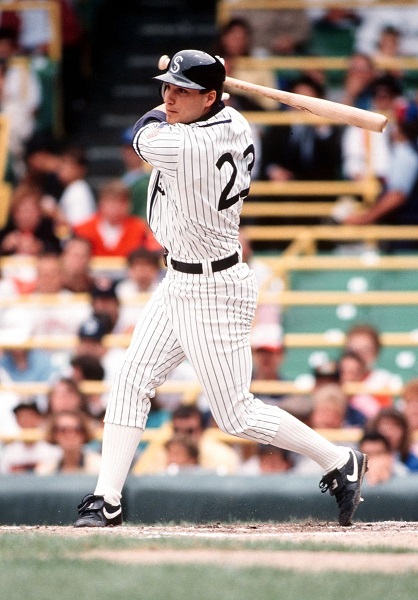
Today, we continue our look at those players, picking our favorite, if not the best, player to wear each uniform number for both Chicago teams with #23, one of the most famous and successful numbers in city history across all sports.  67 different players have donned #23 while playing in Chicago, 35 for the White Sox and 31 for the Cubs, including a familiar face for both sides of town.

Robin Ventura made his major league debut donning #23 in September of 1989, appearing in 16 games down the stretch, hitting only .178 while driving in 7 runs in 45 at bats.  A good spring in 1990 led to Ventura breaking camp with the White Sox, but he struggled both on the field and at the plate, suffering through a horrendous 0-for-41 slump while committing 25 errors over the course of the season.  He finished the year with a .249 average, 5 home runs, and 54 RBIs and placed 7th in Rookie of the Year voting and was named to the Topps All Star Rookie team.

Ventura and the White Sox moved in to the new Comiskey Park in 1991, hoping to improve on the previous year’s growth.  He improved his fielding enough to earn his first Gold Glove award and, at the plate, he set a White Sox team record for RBIs by a third baseman, finishing with an even 100.  He upped his average to .284 and hit 23 home runs.  His work was enough to garner enough MVP votes to finish in 20th place.  1992 was another good year for Ventura.  He earned his first All Star nod, going 2-2 in the AL’s victory at Jack Murphy Stadium.  He finished the year with a .282 average, 16 home runs, and 93 RBIs.  He also snagged his second consecutive Gold Glove award.  Ventura continued his successful ways in 1993, collecting his 500th hit in May and, on August 4, entering the public consciousness with an event that would come to define his entire career.  While batting against the Rangers, Ventura was hit by a pitch thrown by Nolan Ryan and charged the mound.  Ryan, 20 years Ventura’s senior, placed him in a headlock and punched him several times, starting a bench-clearing brawl that was voted the best baseball brawl of all time by SportsCenter.  After the season, he was awarded his third consecutive Gold Glove award.

The strike in 1994 saw Ventura’s streak of 90 RBI seasons and Gold Gloves come to an end.  When baseball stopped in August, Ventura was hitting .282 with 18 home runs and 78 RBIs, while posting a new career high with an .832 OPS.  When play resumed in late April 1995, Ventura struggled out of the gate, committing ten errors in the first ten games.  As the White Sox started to tear down the team that had finished the previous two seasons on top of their division, trade rumors started to follow Ventura, though nothing came to fruition.  On September 4, he became the eighth player in history to hit two grand slams in one game, and the first since Frank Robinson in 1970.  He finished the year setting career highs with a .295 average, an .882 OPS, and 26 home runs while driving in 93 runs.  Ventura had the best year of his career to date in 1996, setting White Sox team records in career home runs by a third baseman, with 142, and grand slams, with 9.  He set new career highs with 34 home runs, 105 RBIs, 2 triples, an OPS of .888, and a .974 fielding percentage at the hot corner.  He hit .287, while earning his fourth Gold Glove award.

1997 turned into a dismal year for both Ventura and the White Sox.  During a spring training game, Ventura caught his foot in the mud while sliding into home plate and suffered a broken and dislocated right ankle.  Expected to miss the entire season, he returned on July 24, collecting the game-winning hit that night, and homered in his first at-bat the next night.  With the White Sox only 3.5 games behind the Indians in the standings, a healthy Ventura might have put them over the top.  A week later, the team threw in the towel in what eventually became to be known as the White Flag Trade, sending 3 pitchers to the Giants for prospects.  “We didn’t realize Aug. 1 was the end of the season,” said an upset Ventura.  He finished the year appearing in 54 games, hitting .262 with 6 home runs and 26 RBIs.  Entering the last year of his contract in 1998, the White Sox made little attempt to sign Ventura to an extension, with owner Jerry Reinsdorf claiming his skills were “deteriorating” after his injury the year before.  With more trade rumors following him throughout the season, he finished the year with a .263 average, 21 home runs, and 91 RBIs while earning his fifth Gold Glove award.  Following the season, he became a free agent, ending his White Sox playing career.

Continue reading →

By The Numbers – 73

In 1929, uniform numbers appeared on the back of baseball jerseys for the first time, thanks to the Indians and the Yankees.  By 1937, numbers finally appeared across all uniforms, both home and away, across both major leagues.  Since that time, 81 distinct numbers have been worn by members of the White Sox, while the Cubs boast 76.

Today, we continue our look at those players, picking our favorite, if not the best, player to wear each uniform number for both Chicago teams with #73.  A single player has donned #73 for each Chicago team.

Tony Phillips had a turbulent 1996 season with the White Sox, retiring for 48 hours during spring training and getting into a fistfight with a fan at County Stadium in Milwaukee in May.  When Albert Belle signed with the White Sox prior to the 1997 season, Phillips gave up his #8 and switched to #73.  His tenure with the number, however, was short lived.  On April 21, he was ejected 3 pitches into that night’s game against the Yankees.  Phillips had to be restrained by 3 White Sox players and ended up getting suspended for 2 games.  He accused American League president Gene Budig of being a racist, which Jerry Reinsdorf called “out of line,” and, on May 13th, Phillips was traded to the Angels.

On the other side of town, young pitcher Adbert Alzolay has appeared in 10 games for the Cubs over the past 2 seasons.  He has a chance to claim a permanent slot in the rotation in 2021.

Everything Old Is New Again

About 2 1/2 weeks ago, Rick Hahn described the ideal candidate to become the next manager of the White Sox: recent post-season experience with a championship organization.  Depending on your definition of recent, the White Sox found their man today, announcing that Tony LaRussa, who retired from the dugout after leading the Cardinals to a championship in 2011, would once again take the reins on the south side of Chicago.

LaRussa, who is third all-time with 2,728 wins, first became manager of the White Sox in 1979, under owner Bill Veeck.  After leading the team to the AL Western Division title in 1983, LaRussa was fired in June of 1986 by Ken Harrelson.  This has long been cited as the biggest sports-related regret for owner Jerry Reinsdorf.


LaRussa caught on with the A’s less than a month after leaving the White Sox, staying there for 10 years, winning 3 AL pennants and one World Series championship.  He then spent 16 years on the bench for the Cardinals, winning 3 NL pennants and 2 World Series championships, retiring after the final one in 2011.  Since then, he has spent time working for MLB and in the front office for the Diamondbacks, Red Sox, and Angels.

LaRussa, who will be 76 on opening day 2021, becomes the oldest manager in the major leagues and the oldest to take over a team since Jack McKeon in 2011.

The two biggest concerns, to my mind, are 1) has the move toward analytics changed the game enough in the last 9 years that he’s been left behind and 2) will the exuberant players on the White Sox roster, namely Tim Anderson, Luis Robert, and Eloy Jimenez, chafe under an older school manager who may not appreciate the bat flips and political outspokenness.  This will either end very well, with post-season success, or will bomb spectacularly.  There really will not be a middle ground.

The Rick Renteria Era Has Come To An End

In a somewhat shocking development, the White Sox announced this morning that they have parted ways with manager Rick Renteria.  The status of the rest of the coaching staff will be determined in conjunction with the new manager, though pitching coach Don Cooper is also expected to move on.  Renteria originally joined the White Sox following the 2015 season as bench coach and was named the team’s 40th manager, replacing Robin Ventura, following the 2016 season.

General Manager Rick Hahn said that the ideal candidate to replace Renteria will have recent post-season experience with a championship organization.  Interestingly enough, two such managers, A.J. Hinch and Alex Cora, will be coming off their year-long suspensions following the completion of the World Series.  Both are thought to be on the shortlist for the opening in Detroit, though I’d be surprised if Cora doesn’t end up back with the Red Sox.  One name not in the mix is former White Sox manager Ozzie Guillen, who was told by owner Jerry Reinsdorf that he would not be considered.

In some ways, this move reminds me of one made by another Reinsdorf team back in the summer of 1989.  After reaching the Eastern Conference finals and losing to the Pistons, the Bulls fired coach Doug Collins, saying that while he had gotten the team from point A to point B, he wasn’t the right man to get them to point C.  If this move turns out half as well for the White Sox, everyone involved will be ecstatic.