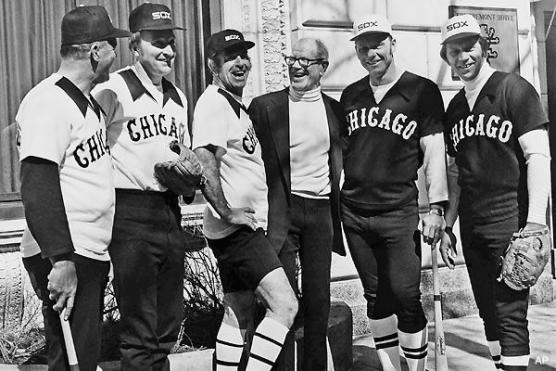
 100 years ago today, Bill Veeck, the former club treasurer for the Cubs and two-time owner of the White Sox, was born here in Chicago. Veeck followed his father, the then president of the Cubs, into baseball. As a 13 year old, Veeck came up with the idea of planting ivy to cover the outfield walls at Wrigley Field. In 1937, as general manager, he oversaw the construction of the iconic hand operated scoreboard that is still in use today.
Veeck left the Cubs in 1941, striking out on his own and buying the minor league Milwaukee Brewers. While he owned the team, he also served in the Marines during World War II, where he injured his leg, which required amputation. After the war, Veeck sold his interests in the Brewers and bought the Cleveland Indians, returning to the major leagues. In July of 1947, Veeck broke the color barrier in the American League by signing Larry Doby. In 1948, the Indians won their first World Series title since 1920. Veeck was forced to sell the Indians in 1949 due to his divorce.
2 years later, Veeck was back in business, purchasing the St. Louis Browns. While trying to force the Cardinals out of town, Veeck came up with one of his most famous, or perhaps infamous, stunts, signing Eddie Gaedel, standing 3 feet and 7 inches tall, and sending him to the plate in the second game of a double header against the Detroit Tigers on August 19, 1951. Gaedel walked on four pitches and was lifted for a pinch runner. American League president Will Harridge voided Gaedel’s contract the next day, claiming that Veeck was making a mockery of the game. In response, Veeck threatened to request an official ruling on whether Yankees shortstop Phil Rizzuto, the reigning MVP, was a short ballplayer or a tall midget.
Realizing that the he could not compete with Anheuser-Busch, the new owners of the Cardinals, Veeck sold his interest in the Browns to new owners who moved them to Baltimore, where they became the Orioles. Six years later, Veeck was back, buying the Chicago White Sox in 1959, the same year they would win their first pennant in 40 years. In 1960, Veeck came up with two innovations that would be copied by nearly all of the other teams in baseball: an exploding scoreboard that would shoot off fireworks whenever the White Sox hit a home run and putting player’s names on the backs of their road jerseys. In 1961, with his health failing, Veeck sold the White Sox and said goodbye to baseball.
With his health improved, Veeck re-purchased the White Sox in 1975, stopping a proposed move of the team to Seattle. Two weeks after he took control of the team, an arbitrator struck down the reserve clause, which brought free agency to baseball and left Veeck, and the White Sox, to struggle. In his second tour of duty, Veeck brought more innovations and stunts, including playing in shorts, bringing Minnie Minoso back (at ages 50 and 54) to become the first player to appear in four (and then five) different decades, an anti-disco promotion that may have gotten out of hand, and having his television announcer, Harry Caray, lead the crowd during the 7th inning stretch. However, outside of some success in the summer of 1977, Veeck found himself unable to compete financially in baseball’s new reality. In January of 1981, he sold the team to a group led by Jerry Reinsdorf and Eddie Einhorn, leaving baseball for the final time.
Veeck would spend his final years split between a home in Maryland and the bleachers of his youth at Wrigley Field. He died in January of 1986 after a long battle with lung cancer. Five years later, he was inducted to the Hall of Fame. With another baseball season about to get underway, the legacy of Veeck lives on, even if it isn’t noticed, or acknowledged, by those in charge of the game today.