#75 – Donn Pall

thepopeName: Donn Pall

Rank: 75

Position: P

Years With White Sox: 1988-1993

Chicago native Donn Pall joined the White Sox organization via the 23rd round of the draft in 1985.  He made his major league debut 3 years later, throwing a mop-up inning of relief at the end of the Sox 10-2 loss to the A’s on August 1 at Comiskey Park.  Pall appeared in 16 additional games down the stretch for a miserable White Sox squad, finishing the year with a respectable 3.45 ERA.

Pall returned to the White Sox bullpen in 1989, earning his first career win on April 27 in a 16 inning victory over the Red Sox.  He finished the year 4-5 with a 3.31 ERA and 6 saves in 53 appearances for the last place White Sox.

The surprising White Sox found themselves in a pennant race in 1990 as they said goodbye to Comiskey Park.  Pall continued to be a mainstay in the bullpen, going 3-5 with a 3.32 ERA in 56 appearances, including one appearance during the final weekend at the park he grew up attending.

Pall and the White Sox moved across the street for the 1991 season, where Pall put up the best numbers of his career.  He finished the year 7-2 with a sparkling 2.41 ERA in 51 appearances, including a scoreless inning of relief in the first game at new Comiskey Park.  Pall struggled in 1992, seeing his ERA jump to 4.93 and his appearances drop to 39 despite a 5-2 record.

In 1993, as the White Sox headed towards their first division title since 1983, Pall bounced back to put up 3.22 ERA in 39 appearances heading into September.  However, he found himself in a roster crunch and, to make room for the re-acquired Ivan Calderon, he was traded to the Phillies on August 31 for a player to be named later.  Pall, along with Carlton Fisk, who had been released earlier in the year, came to Comiskey Park before game 1 of the ALCS to wish their former teammates well.  Sadly, they were both turned away, souring Fisk’s relationship with the organization for years.

Pall returned to the White Sox organization in 1995, spending the entire year in Triple A before leaving at the end of the year as a free agent.

Pall’s numbers in a White Sox uniform, both for games I attended and overall, were:

Continue reading →

#85 – Scott Fletcher

fletcherName: Scott Fletcher

Rank: 85

Position: SS/2B

Years With White Sox: 1983-1985, 1989-1991

Scott Fletcher first joined the White Sox on January 25, 1983 when he was acquired from the crosstown Cubs, along with Randy Martz, Pat Tabler, and Dick Tidrow, in exchange for Warren Brusstar and Steve Trout.  He split time at shortstop with Jerry Dybzinski for the 1983 squad, who ran away and hid with the Western Division title, their first post-season appearance since the 1959 World Series.  Fletcher appeared in 114 games, hitting only .237.  During the ALCS against the Orioles, he went hitless in 7 at bats across 3 games.

Fletcher became the primary shortstop in 1984 and saw his numbers improve.  His average jumped up to .250 while appearing in 149 games.  Despite the improvement, his job became less secure over the offseason, as the White Sox acquired a young shortstop named Ozzie Guillen.  When Guillen was named the starting shortstop for 1985 during spring training, Fletcher reacted poorly.  “Taking nothing away from the way Ozzie can play,” Fletcher said, “he hasn`t been that great to take the job away from me. He hasn`t just put it on fire and clearly won it.”  Despite the reduced playing time, Fletcher once again improved his numbers, with this average rising to .256 in only 301 at bats.

Following the 1985 season, Fletcher, along with Ed Correa and Jose Mota, was traded to the Rangers for Dave Schmidt and Wayne Tolleson.  He returned at the trade deadline in 1989, when he, along with Wilson Alvarez and Sammy Sosa, were acquired from the Rangers for Harold Baines and Fred Manrique.  With his former nemesis Ozzie Guillen entrenched at shortstop, Fletcher became the team’s starting second baseman.  He hit .272 for the White Sox after the trade, despite constant criticism from the fans who were angry at the loss of Baines.

1990 was the final season for the White Sox at Comiskey Park, and Scott Fletcher again manned second base for the suddenly contending team.  Ironically, Fletcher put up his worst numbers since 1983, the last time the team contended for a division title.  Across the street in the new Comiskey Park, Fletcher again saw diminished playing time as Joey Cora established himself as the everyday second baseman.  Appearing in only 90 games, his lowest total since getting cups of coffee with the Cubs in the early 80s, Fletcher’s average dropped to .206.  Following the season, he became a free agent.

Fletcher’s numbers in a White Sox uniform, both for games I attended and overall, were:

Continue reading →

A Quarter Century Of Memories Part II

Last week, we looked at the first two regions of memories the White Sox had selected to celebrate the 25th anniversary of US Cellular Field.  Today, we finish the job by looking at the last 2 brackets: Records and Milestones and Honors and More.

records_milestonesThe Records and Milestones region spans the gamut of the 25 years the Comiskey Park II/US Cellular Field has been in service.  Unlike the last 2 regions, I only attended 2 of these 8 games.

We start with the most recent game, from last October, where Chris Sale set the franchise’s single season strikeout total, doing battle against a July 2000 matchup between the Sox and Cardinals, where Frank Thomas surpassed Luke Appling as the franchise’s all time RBI leader with a first inning home run.  I’ll select Thomas’ mark, as it represents a career mark over Sale’s single season record.

The second match-up is between Carlton Fisk breaking Bob Boone’s career record for games caught on June 22, 1991 against Bobby Jenks tying the MLB record for consecutive batters retires with 41, a mark that would be broken by teammate Mark Buehrle 2 years later.

Next, we have the first interleague game between the White Sox and the Cubs on June 16, 1997 versus Jim Thome’s 500th home run, a walk-off against the Angels on September 16, 2007, which just so happened to also be Jim Thome bobblehead day.  How can you beat that kind of drama?

The final battle is between Jack McDowell, picking up his 20th win of the year on September 8, 1992, against Mark Buehrle’s perfect game on July 23, 2009.  Buehrle easily takes this one.

honors_moreFinally, we have the Honors and More region, where I’ve attended at least 5 of the events in the running.

The first match-up is the afternoon in 2010 when Frank Thomas’ #35 was retired going up against the dedication of the Harold Baines statue in 2008.

Next, we have the dedication of the Luis Aparicio and Nellie Fox statues in 2006 versus the Minnie Minoso statue dedication in 2004.

The next match-up is the August 2010 game where the city’s world champions were honored following the Blackhawks winning the Stanley Cup battling the Rolling Stones concert that took place in September of 2002, the last concert to date at the ballpark.

Finally, we have the dedication of Championship Plaza in April 2008 going up against the All Star game in 2003.

None of these match-ups have anything to do with something on the field, so I don’t know how you choose one statue dedication over another.

A Quarter Century Of Memories

To celebrate the 25th anniversary of US Cellular Field, the White Sox are asking fans to vote for the top moment in US Cellular Field history, broken down into 4 brackets: Postseason Perks, Memorable Moments, Records and Milestones, and Honors and More.  Today, we shall take a look at the first 2 groupings of these moments and decide which is the best.

postseason_peaksThe Postseason Peaks region boasts 6 entries from or related to the 2005 World Series champions plus another 2 from the team’s last division winner in 2008.  The disappointing post-season appearances from 1993 and 2000 are left out altogether.  As an added plus, I attended all of the games in this region.

The first match-up is a no-brainer, with Scott Podsednik’s walk-off home run to win Game 2 of the World Series pitted against Alexei Ramirez’s grand slam against the Tigers to force game 163 against the Twins for the division crown.  With all due respect to Alexei, Podsednik takes this with ease.

The next battle is between the aforementioned game 163, the Blackout Game that sent the White Sox to the playoffs, against Joe Crede’s walk-off single against the Angels in Game 2 of the 2005 ALCS.  While the Blackout was great fun, it was just a regular season game.  Crede’s hit, following the A.J. Pierzynski drama, would have blown the roof off the place, if it had one.

Next, we have the unfair fight of Paul Konerko’s grand slam in Game 2 of the 2005 World Series versus Tadahito Iguchi’s go-ahead home run against the Red Sox in Game 2 of the ALDS.  No real contest here.

The final match-up is again from Game 2 of the 2005 ALCS, when Pierzynski struck out and somehow managed to get the umpires to let him take first base, going up against the second game of the 2006 season, when the White Sox received their World Series championship rings.  While the ring ceremony was indeed cool, it can’t beat the game action of one of the smartest players in baseball using his wits to outduel the opponent.

memorable_momentsWe now turn our attention to the Memorable Moments region, a more varied group of games, only 5 of which I managed to attend.

We begin with the second to last day of the 2014 season, when the White Sox honored their retiring captain with a special ceremony, doing battle against the July 7, 1999 contest against the Royals where Chris Singleton hit for the cycle.  Once again, I’ll have to give the nod to Konerko.

The next match-up pits Frank Thomas, hitting the first White Sox home run at the then-New Comiskey Park on April 22, 1991 against Bo Jackson’s home run in the division-clinching game on September 27, 1993.  You can’t really go wrong with either of these, to be honest.

The next battle is between Mark Buerhle’s kick save followed by a flip between the legs which Paul Konerko barehanded for the putout on Opening Day 2010 and the 10 year reunion of the 2005 champions last summer.  I’ll give the nod to Buehrle.

The last match-up features the White Sox game against the Yankees on September 18, 2001, the first game after the tragedy of 9/11 versus Carlos Lee’s 10th inning walk-off grand slam off Courtney Duncan in the June 8, 2001 victory over the Cubs.  While Lee’s hit is obviously the better baseball moment, the meaning of the return to the field after the attack on New York and the Pentagon have a greater meaning overall.

Coming out of these brackets, you have either Konerko or Podsednik’s home run from Game 2 of the World Series going up against Buehrle’s play against the Indians on Opening Day 2010.  We’ll check out the remaining 2 regions next week.

Tigers All Time Leaders – Through 2015

tigersWith 2 months until baseball in Chicago returns, I thought it would be interesting to look at the all time leaders in both offensive and defensive categories for all 30 teams. We continue today with the Detroit Tigers.

The Tigers began life in 1894 as part of the Western League and became a charter franchise of the American League in 1901, making them the oldest one city, one name franchise in the American League.  I’ve seen them play 38 times, including the second game ever, and my first game, at the new Comiskey Park.

Home Runs

Name Total
Miguel Cabrera 5
Ryan Raburn 3
Jhonny Peralta 3

Hits

Name Total
Ryan Raburn 19
Austin Jackson 15
Brandon Inge 15

Runs

Name Total
Miguel Cabrera 13
Austin Jackson 10
Ryan Raburn 9
Brandon Inge 9

RBI

Name Total
Ryan Raburn 13
Miguel Cabrera 10
Tony Clark 9

Doubles

Name Total
Alex Avila 4
Ryan Raburn 3
Brandon Inge 3
Johnny Damon 3

Triples Continue reading →

Games Per Stadium – All Time

20109565It’s been more than 3 years since we’ve taken a (single) look at the 18 different stadiums I’ve been to and how often I’ve been to them.  Sadly, I’ve only added 2 additional stadiums in this time, both of which were this year.  Once again, different names for the same stadium are counted separately.

Stadium Name Total Games
US Cellular Field 351
Wrigley Field 317
Comiskey Park II 38
Comiskey Park 12
Great American Ballpark 7
Ameriquest Field 4
Miller Park 4
Ballpark in Arlington, The 3
PETCO Park 3
Target Field 2
Continue reading →

Games Per Stadium By Year

With the 2014 season in the rear view mirror, let’s take a look at the number of games I’ve attended per year at a particular stadium.

Games Per Stadium Per Year

GameYear StadiumName TotalGames
2008 US Cellular Field 46
2003 Wrigley Field 46
Surprise playoff runs for the White Sox in 2008 and the Cubs in 2003 led to my highest single season totals ever, boosted by post-season play.
2007 Wrigley Field 43
2004 Wrigley Field 41
My highest non-playoff total saw me attending over half of the home games for the Cubs in 2004.
2011 US Cellular Field 40
2009 US Cellular Field 40
2010 US Cellular Field 36
2005 Wrigley Field 34
2008 Wrigley Field 34
2006 US Cellular Field 32
Post World Series championship started an attendance jump.
2012 US Cellular Field 31
2007 US Cellular Field 29
2014 US Cellular Field 29
Continue reading →

#211 – Ken Patterson

kpattersonName: Ken Patterson

Rank: 211

Position: P

Years With White Sox: 1988-1991

Ken Patterson was acquired by the White Sox in the August 1987 trade that sent Jerry Royster to the Yankees.  He made his major league debut on July 8, 1988, his 24th birthday, in a 10-7 White Sox loss to the Red Sox.  He spent 5 days with the White Sox before returning to Vancouver.  When Ricky Horton was traded to the Dodgers in late August, Patterson was recalled to take his place in the bullpen.  All told, he appeared in 9 games for the 88 White Sox, finishing with a 4.79 ERA.

Patterson made the team out of spring training in 1989 when Jack McDowell was sent back to Triple A for more seasoning.  Patterson would join him on May 21st, when he was sent back down after early struggles with the White Sox.  He returned in early June and stuck with the club for the remainder of the year, appearing in 50 games despite an uncanny inability to get left handers out.  Through August 20, the left handed hurler had “limited” left handed hitters to a .303 average.

Patterson returned to the White Sox bullpen in 1990, where he became the long man, a role he did not particularly care for.  “I don’t like it,” he said in the middle of a stretch that saw him pitch once in 16 days.  “I accept it.  But I don`t like it.”  He eventually moved to a left handed specialist role and, as the White Sox closed down Comiskey Park with a surprising 94 win season, he finished the year with a 3.39 ERA in 43 games.

In 1991, Patterson got off to an auspicious start, getting the first mock standing ovation during  the first game at New Comiskey Park after striking out Pete Incaviglia in the fourth inning.  The previous 7 batters he had faced had all reached base safely in a 16-0 thumping at the hands of the Tigers.  Patterson rebounded, however, and put together arguably his best season as a pro.  He went 3-0 with a career low 2.83 ERA in 43 games.

Despite coming off of his best season, Patterson was in a competition to earn a bullpen spot in 1992.  It was not to be, however.  With spring training winding down, Patterson was packaged along with Sammy Sosa and sent across town to the Cubs in exchange for George Bell.

Patterson’s numbers in a White Sox uniform, both for games I attended and overall, were:

Continue reading →

Ballpark Tour: Comiskey Park II/US Cellular Field

20109565

Stadium Name: Comiskey Park II/US Cellular Field

Location: Chicago

Home Team: White Sox, Marlins

Years in Service: 1991 – Present

Visits: 361

On the evening of June 30, 1988, with time literally stopped, the Illinois legislature passed a bill that provided the financing for a new stadium for the White Sox, stopping them from moving to St. Petersburg, Florida.  2 and a half years later, on April 18, 1991, Comiskey Park II opened, the first new major facility built in Chicago since the erection of the Chicago Stadium in 1929.  Sadly, the White Sox were destroyed by the Tigers 16-0 in the opening of their new park.

Unfortunately for the White Sox, the new Comiskey Park was also the last stadium to be built prior to the wave of retro ballparks that started with the opening of Camden Yards the following year.  Because of this, there have been numerous renovations to the park, starting in 2001 with the addition of nearly 2000 seats and the relocation of the bullpens.  More extensive renovations began in 2003 in preparation for that season’s All Star Game and using the money generated from selling the naming rights to US Cellular, and conrinued through 2007, when the replacement of the blue seats with green seats was completed.

In 2004, the reigning World Series champion Florida Marlins called the stadium home for a series against the Montreal Expos thanks to Hurricane Ivan, the first time the defending World Series champions had played a home game in Chicago since 1918.  One year later, the stadium hosted its first World Series game, the first to be played in Chicago since 1959, as the White Sox went on to sweep the Houston Astros and win their first World Series since 1918.

I attended my first game at the new Comiskey Park on April 20, 1991, the second game in the stadium’s history.  Since then, I’ve been to 360 other games at the stadium, the majority coming from 2005 on, when I became a season ticket holder.  I went to both games of the 2000 ALDS, which the White Sox lost to the Mariners, both games of the 2005 ALDS, which the White Sox won against the Red Sox, both games of the 2005 ALCS, which the White Sox split against the Angels, and game 2 of the 2005 World Series.  I attended game 163 of the 2008 season to break the tie between the White Sox and the Twins. and then the two ALDS games against the Rays, the first time I saw the White Sox actually end a post-season series, either in victory or defeat.

Notable regular season games I’ve seen at US Cellular Field include the September 13, 2004 game between the Marlins and the Expos, the April 16, 2005 game where Mark Buehrle defeated the Mariners in 1 hour and 39 minutes, the April 2, 2006 season opener against the Indians when the World Series championship banner was raised, the April 4, 2006 game where the players received their World Series rings, and the September 16, 2007 game where Jim Thome hit his 500th career home run against the Angels.

#289 – Jeff Carter

jeff_carter_autograph

Name: Jeff Carter

Rank: 289

Position: P

Year With White Sox: 1991

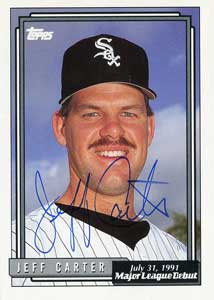
Jeff Carter came to the White Sox organization in the Decmber 23, 1990 trade that sent Tim Raines from the Expos in exchange for Ivan Calderon and Barry Jones.  Carter made it to the big leagues on July 29, 1991, replacing an ineffective Greg Hibbard on the roster.  He made his major league debut 2 days later, getting the start in the White Sox 10-8 victory over the Rangers at new Comiskey Park.

Carter appeared in 4 other games over the course of the season, finishing up with 2 innings of relief in the second game of a double header against the Twins on October 3rd, which ended up being the final appearance of his White Sox, and major league, career.

Carter’s numbers in a White Sox uniform, both for games I attended and overall, were:

Continue reading →