150 Years Of Cubs Baseball – Third Basemen

Originally founded in 1869, the Chicago Cubs became a charter member of the National League in 1876.  Over the next 150 seasons, the Cubs have played more than 22,000 games, scored over 103,000 runs and recorded more than 200,000 hits, more than any other team in baseball history.  Nearly 2,300 players have worn a Cubs uniform, earning eight division titles, 17 NL pennants, and three World Series championships.

Fans have witnessed generations of unforgettable players, from historical heroes like Joe Tinker, Gabby Hartnett, Ernie Banks, and Billy Williams to more recent stars like Ryne Sandberg, Derrek Lee, Kerry Wood, and Anthony Rizzo.  The team has called Wrigley Field home for 110 of those 150 seasons.

To celebrate this milestone, the Cubs are holding a fan vote to select the franchise’s anniversary team.  Each week, we will go through the provided options for each position and declare who should, and, if different, who will, win the fan vote.  We continue today with the eight selections for third baseman.
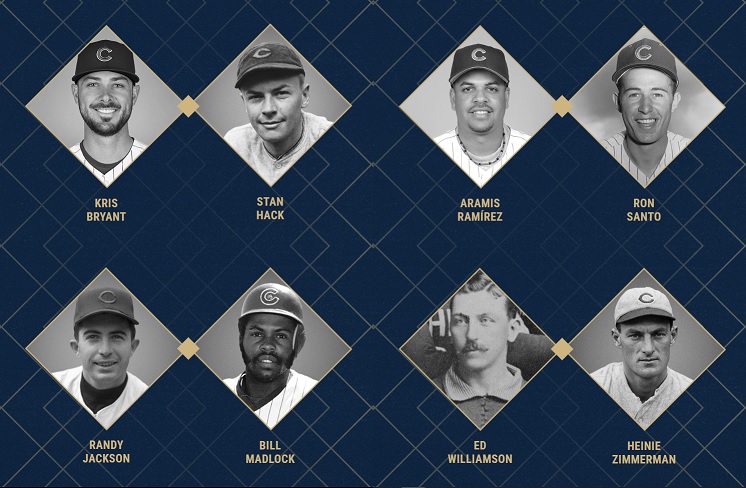
Kris Bryant was selected by the Cubs as the second-overall pick in the 2013 draft.  An injury to Mike Olt early in the 2015 season got Bryant called up to the big leagues and he did not waste time making his presence felt.  Hitting .275 with 26 HRs and 99 RBIs, Bryant won the Rookie of the Year award while leading the surprising Cubs to the NL Wild Card and an appearance in the NLCS.  Things were even better the following year, as Bryant won the NL MVP and the Cubs ended their 108-year title drought by defeating Cleveland in the World Series.  Unfortunately, neither Bryant nor the Cubs could replicate the highs of that year.  He was traded to the Giants at the trade deadline in 2021, finishing his time on the north side as a four-time All-Star and winner of the 2016 NL Hank Aaron Award.

Stan Hack spent his entire 16-year career with the Cubs, becoming the full-time third baseman in 1934.  He appeared in four World Series for the Cubs, losing efforts in 1932, 1935, 1938, and 1945.  When he retired following the 1947 season, he ranked second in team history behind Cap Anson in games played, at bats, and hits.  He twice led the National League in stolen bases and was a five-time All-Star selection.  He is a member of the Cubs Hall of Fame.

Randy Jackson spent parts of seven seasons across his two stints with the Cubs.  He debuted in 1950 and earned All-Star nods in 1954 and 1955.  Traded to the Dodgers following that 1955 season, he returned in 1959 for a final season after a knee injury derailed the trajectory of his career.

Continue reading →

Watering Down The Tournament

In an effort to line their pockets at the cost of exciting competition, the NCAA is planning to expand both the men’s and women’s basketball tournaments from 64 to 76 teams starting next year.  Effectively replacing the First Four, an additional eight at-large teams will join the fray, with the initial round of twelve games playing Tuesday and Wednesday following Selection Sunday and the winners slotting into the familiar brackets that we all know and love.

The makeup of the twelve games will be split 50/50.  The first half will be comprised of all 16-seeds and half of the 15-seeds.  The other half of the games will be a mix, depending on the quality of the teams in the field, comprised of 11-seeds, all 12-seeds and, potentially a game that will feed a 13-seed for the first round that follows on Thursday or Friday.

Along with expanded brackets comes expanded advertising partnerships to make the whole thing worthwhile.  Beer and alcohol companies, who have not been allowed to advertise during the tournament previously, are expected to be added to the fold and drive the financial aspects of this expansion.  Gambling-related advertisements are still expected to be banned.

Book 22 (of 52) – I Want My MTV

I Want My MTV: The Uncensored Story of the Music Video Revolution – Rob Tannenbaum and Craig Marks

From its inauspicious beginnings, starting with an August 1, 1981 launch that was available in less than a million households, to the end of its golden age with the launch of The Real World in 1992, MTV revitalized and revolutionized the music industry.  In I Want My MTV: The Uncensored Story of the Music Video Revolution, authors Rob Tannenbaum and Craig Marks tell the story, using the words and memories of the people who were there, from the executives and kids running the network to the bands and the neophyte directors hired to take advantage of this new format.  The more successful MTV became, the more money started to take over, which led to its eventual downfall as a place to hear music and a driver of that part of pop culture.

It would be extremely difficult to explain the power MTV had in the 1980s and early 1990s to someone today who didn’t experience it firsthand.  First, popular culture is so fragmented and self-service now that just the experience of having someone pick what videos you were going to see, whatever the genre, seems strange.  Secondly, MTV, as it exists today, has nowhere near the cultural clout that it did at the time.  I’m sure they are still making money hand over fist, but they traded their cultural cache to get it.  Maybe the rise of the internet would have forced the issue either way, but a touchpoint for the majority of Generation X died with the end of “our” MTV.

And I Would Walk 30,000,000 More

Nearly fifteen years ago, I started participating in a step tracking program through work that ““encourages you to track your steps and help you to focus on your fitness in a simple and accessible way.”  That program, utilizing the GlobalFit tracker, ran through February of 2015, where I finished more than three and a half years in the program with over 6.5 million steps.

That same week, I ordered the first of multiple Fitbits I would wear, continuing the project for myself in hopes of getting into better shape and improving my health.  Things were going well enough until 2020, when a global pandemic transitioned me to a home-based worker and my daily activity took a big hit.  Thanks to some recent weight loss, I’ve started ramping things back up recently and, yesterday, I surpassed an overall total of 30 million steps.  That averages out to a little over 2 million steps per year, which, considering it has been seven years since I’ve surpassed that total, isn’t too shabby.  Here’s hoping it doesn’t take another fifteen years to get to 60 million.

Fitbit 12 – Week 14

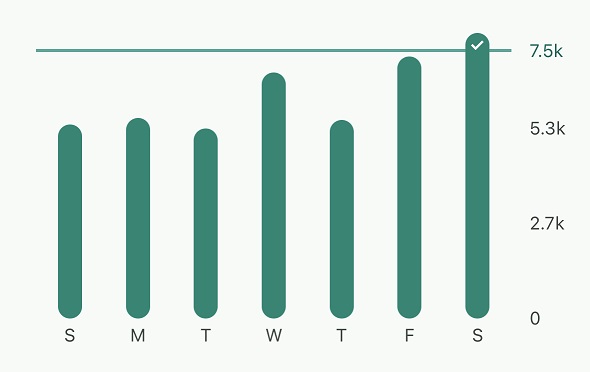
A great week as I scored my highest total in nearly two years, since my trip to Amsterdam, and cranked my 30,000-step week streak to eleven while also running my streak of 4000+ step days to 54.  The week got off to a great start on Sunday as a neighborhood walk left me with 5400 steps.  Monday was slightly better, ending with 5600 steps.  Things kept going on Tuesday, slightly falling to 5300 steps, which, if you can believe it, turned out to be my low point for the week.  A longer post-work walk on Wednesday left me just 15 steps shy of 6900.  Thursday topped out at 5500 steps.  A long walk while charging my car at lunch led to 7300 steps on Friday.  An afternoon trip to the Rate Field on Saturday wound up the week well over goal, coming just 11 steps shy of 8000.

Total steps: 44,144

Daily average: 6306.3

iTunes Top 200 Artists: #41-50

Music.  It is a powerful thing that brings people together, creates memories, and evokes emotions.  It is the universal language that speaks to the soul.  It forms the soundtrack of our lives.

It has now been five years since we last counted down the Top 200 artists in my iTunes library, featuring the songs I have listened to the most since 2007.  It is time to do so again, seeing which performers still resonate and if any newer ones have joined the fray.  So, without further ado, here are my most listened to artists, based on number of plays as of January 1, 2026.

We enter our final quarter of the list today with our next batch of ten artists, featuring a wide array of musical genres.

#50: Smashing Pumpkins
iTunes stats: 210 plays
Previous ranking: #58

65 new listens over the past five years enables the Chicago-based alternative band, led by that twat Billy Corgan, to move up eight spots in the rankings.

#49: Weird Al Yankovic
iTunes stats: 213 plays
Previous ranking: #50

The parody hit maker added 37 listens to the seven tracks in my collection over these past five years.

#48: The Cranberries
iTunes stats: 226 plays
Previous ranking: #53

Despite the untimely death of singer Dolores O’Riordan in 2018, the group scored a 68-listen increase, moving up five spots.

#47: John Morris
iTunes stats: 231 plays
Previous ranking: #46

The composer of the score from the best movie ever made, Clue: The Movie picked up 49 new plays.

#46: Boyz II Men
iTunes stats: 235 plays
Previous ranking: #48

The stars of my first concert added 58 new listens from their nine tunes in my collection, inching them up two spots in the rankings.

#45: Snoop Dogg
Continue reading →

150 Years Of Cubs Baseball – Second Basemen

Originally founded in 1869, the Chicago Cubs became a charter member of the National League in 1876.  Over the next 150 seasons, the Cubs have played more than 22,000 games, scored over 103,000 runs and recorded more than 200,000 hits, more than any other team in baseball history.  Nearly 2,300 players have worn a Cubs uniform, earning eight division titles, 17 NL pennants, and three World Series championships.

Fans have witnessed generations of unforgettable players, from historical heroes like Joe Tinker, Gabby Hartnett, Ernie Banks, and Billy Williams to more recent stars like Ryne Sandberg, Derrek Lee, Kerry Wood, and Anthony Rizzo.  The team has called Wrigley Field home for 110 of those 150 seasons.

To celebrate this milestone, the Cubs are holding a fan vote to select the franchise’s anniversary team.  Each week, we will go through the provided options for each position and declare who should, and, if different, who will, win the fan vote.  We start today with the eight selections for second baseman.

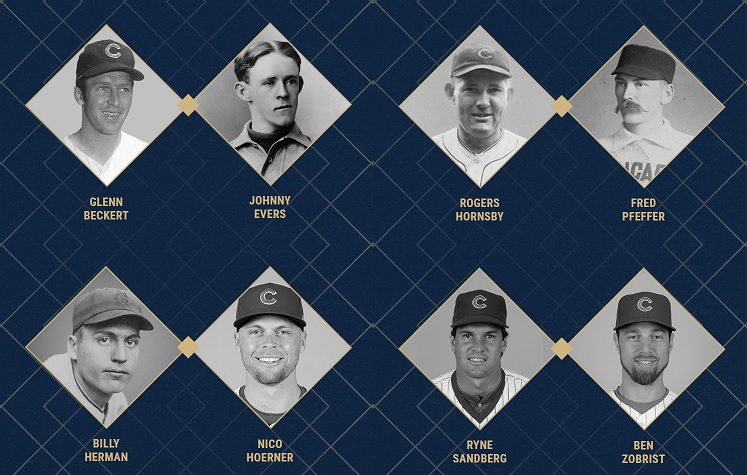
Glenn Beckert was called up by the Cubs in 1965, spending the next nine seasons as the team’s second baseman.  He won the Gold Glove in 1968 and was a four-time All-Star.  His best offensive season came in 1971, when he finished third in the NL with a career-best .342 batting average.

Johnny Evers played for the Orphans/Cubs from 1902 through 1913.  Known as “The Human Crab” for his combative play and fights with umpires, he earned a place in baseball history as part of the famous “Tinker-to-Evers-to-Chance” double-play combination thanks to the poem Baseball’s Sad Lexicon.  Evers was responsible for alerting umpires to the baserunning mistake that would come to be known as “Merkle’s Boner”.  He was part of three NL pennant winners with the Cubs, winning the championship in 1907 and 1908, and was elected to the Hall of Fame in 1946.

Billy Herman spent the first eleven years of his career with the Cubs, hitting over .300 in seven of his first nine seasons.  He led the league in games played (twice), hits, doubles, and triples across his nine full seasons.  During that time, he was named an All-Star seven straight times, beginning in 1934.  He was elected to the Hall of Fame in 1975.

Continue reading →

Setting Records

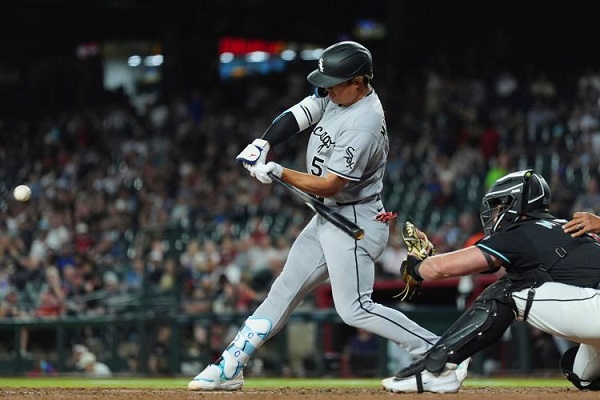
Japanese slugger Munetaka Murakami has been on a tear, tying league and team records with home runs in each of his last five games heading into yesterday’s tilt against the Diamondbacks.  That streak ties the White Sox franchise record, following A.J. Pierzynski, Paul Konerko, Carlos Lee, Frank Thomas (twice!), Ron Kittle, and Greg Luzinski.  He also pulled even with Shohei Ohtani for the longest streak by a Japanese-born player and became just the thirteenth rookie in MLB history to score a five-game homer streak.

Wednesday’s game was also the fourth straight game that both Murakami and Colson Montgomery have homered, making them the first set of teammates in MLB history to pull off that achievement.

Historic Games Part Three

Last summer, the White Sox fell victim to Clayton Kershaw’s 3000th career strikeout and I decided to take a look back at the historic games I’ve attended over the years.  Here is part three, featuring another six games where an individual hit a career plateau or a team clinched a pennant.

April 11, 2011 – A’s 2, White Sox 1

In the bottom of the fifth inning of a scoreless tie at US Cellular Field, the slugging Brent Lillibridge, he with the 19 career home runs, launched the first pitch he saw from Dallas Braden into the bleachers for the 10,000th home run in White Sox franchise history.

May 9, 2015 – Reds 10, White Sox 4

With the White Sox trailing the Reds 3-0 in the bottom of the 7th in the first game of a double header, Alexei Ramirez took the first pitch from Johnny Cueto and deposited it into the left field stands for his 100th career home run.

September 5, 2015 – Blue Jays 5, Orioles 1

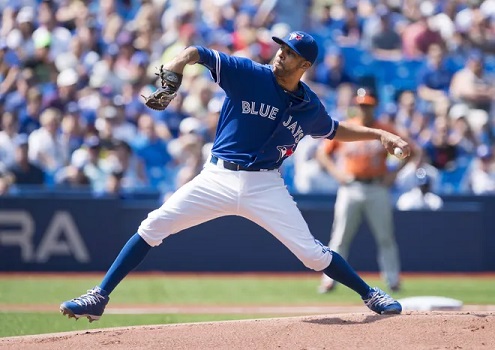
Filling in for the injured Mark Buehrle, David Price scattered three hits and struck out eight in seven innings to beat the Orioles at Rogers Centre for his 100th career victory.  The win increased Toronto’s lead to 1 1/2 games in the AL East.

October 21, 2015 – Mets 8, Cubs 3

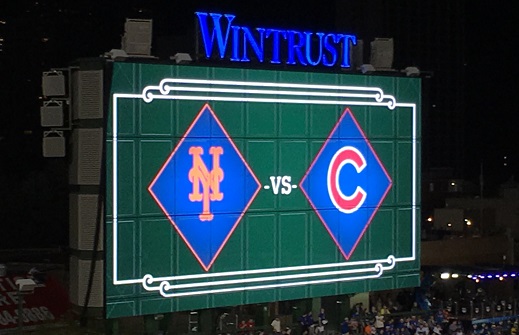
With an 8-3 victory over the Cubs at Wrigley Field, the Mets, in their first post-season appearance in nearly a decade, completed the sweep and won the NL pennant for the first time since 2000.  They would go on to lose the World Series in five games to the Royals.

October 22, 2016 – Cubs 5, Dodgers 0

For the first time since 1945, the Cubs won the National League pennant after defeating the Dodgers 5-0 in game 6 of the NLCS.  Behind a two hitter from Kyle Hendricks, the Cubs put to rest the painful memories of the collapse of 1969, the failure to win one of three in San Diego in 1984, and the Steve Bartman-fueled fiasco of 2003.  They would go on to face the Indians in the World Series, winning their first championship since 1908.

September 9, 2017 – White Sox 13, Giants 1

Jose Abreu hit for the cycle in the White Sox victory over the Giants, going 4-5 with 3 RBIs.  Abreu started with a home run in the first inning and a double in the third against starter Jeff Samardzija.  In the seventh, he singled against Josh Osich and, in the eighth, he finished things off with a triple to the right field corner against Roberto Gómez.  He became the first White Sox player to get the cycle since José Valentín in 2000.

Tired Discourse – How Early You Should Get To The Airport

In January of 2025, the good folks at Defector.com published a list of 35 topics that have been discussed to within an inch of their life here on the internet.  Lucky for me, I haven’t publicly commented on most, if not all, of these topics, so I figured why not dip my toes into the fray on occasion.  We will continue today with the second question on their list:

How Early You Should Get to the Airport

I have experienced the two complete opposite sides of this spectrum, so I think I can provide some good insight.  Once, in order to save some money on a night at the hotel in Las Vegas, I arrived at the airport the night before my early morning flight.  (Side note: I do not recommend this.)  Another time, due to an accident and unplanned for traffic, I was still on my way to the airport as my flight began boarding.  Neither situation is optimal.

The hard part is that there is no clear cut, across the board answer and, even if there were, variables like distance you are travelling to the airport and traffic conditions along the way will make hitting that target time extremely difficult.  Plus, each individual person is going to have different stressors, so even finding an ideal answer among a single travelling party may not be possible.

Anyway, this is boring.  Find what makes you comfortable and try to show up then.