Another Mix Tape Monday – Volume 8

20 years ago, during my sophomore year of high school, I put together the first of what would become a nearly 20 volume collection of mix tapes, containing my favorite songs that I had gathered either from the radio, a cassette tape, or (eventually) CD.  We last looked back at all 20 volumes three years ago to see which of my “favorite” songs still resonated in today’s digital world.  Today, we revisit those mix tapes and see how, or if, things have changed in the past 3 years.

Volume 8 covers the winter and spring of 1993 and the second semester of my freshman year of college. The alternative influence starts to become more noticable, as both Pearl Jam and Nirvana make their belated first appearances alongside old mainstays like Poison, Bon Jovi, and Def Leppard. Besides that, we are treated to a lot of hip-hop and hair metal, with a small sampling of pop, as always.

Side A

Bell Biv Devoe – Gangsta

The intended first single from the second Bell Biv Devoe record, which flopped, it was dropped from the album and now is lost to history.

Pearl Jam – Jeremy

The belated first appearance on these tapes by Pearl Jam, the song, which VH1 ranked as the 11th greatest song of the 90s, saw a modest 3 listen increase over the past 3 years, with nothing for nearly 2 years.

iTunes Stats
2012 2015 2019
6 plays 9 plays 12 plays, most recently on 4/21/2017 

Wreckx-N-Effect – Rump Shaker

Charting as the 9th biggest hit of 1993, the biggest song for butts since Sir Mix-A-Lot had a healthy 15 play increase.

iTunes Stats
2012 2015 2019
3 plays 8 plays 23 plays, most recently on 8/6/2018 

Boyz II Men – In The Still Of The Night

The cover of the old doo-wop classic, recorded for the miniseries The Jacksons: An American Dream, added 5 plays in the last 3 years.

iTunes Stats
2012 2015 2019
4 plays 9 plays 14 plays, most recently on 12/4/2018 

Arrested Development – People Everyday

Peaking at #8 on the Billboard charts, the second single for the Atlanta-based group added an additional 7 plays over the past 3 years.

iTunes Stats
2012 2015 2019
7 plays 14 plays 21 plays, most recently on 10/18/2018 

Nirvana – In Bloom

The belated first appearance of Nirvana on these tapes, the song, winner of the Best Alternative Video VMA in 1993. picked up a mere 5 new plays in the last 3 years.

iTunes Stats
2012 2015 2019
6 plays 13 plays 18 plays, most recently on 4/30/2018 

TLC – What About Your Friends

The third straight top 10 hit from TLC’s debut album added 11 new listens to its total over the past 3 years.

iTunes Stats
2012 2015 2019
3 plays 6 plays 17 plays, most recently on 11/30/2018 

Side B

Continue reading →

#5 – Frank Thomas

Name: Frank Thomas

Rank: 5

Position: 1B/DH

Years With White Sox: 1990-2005

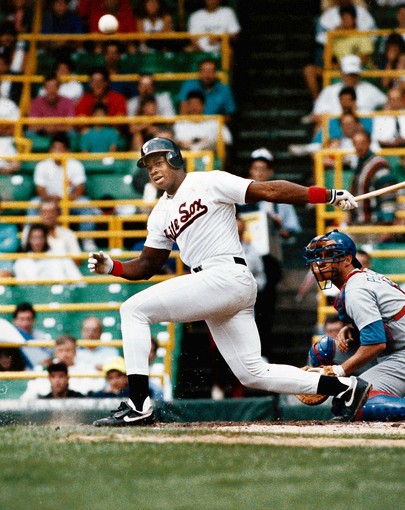
Frank Thomas was selected by the White Sox with the seventh pick in the first round of the 1989 draft.  A little more than 1 year later, he made his major league debut on August 2, 1990 against the Brewers at County Stadium, going hitless in 4 at bats with an RBI as the White Sox won 4-3.  The next night, he tripled off of Mark Knudson for his first major league hit.  On August 28, he hit the first home run of his career, off Gary Wayne, in a 12-6 loss against the Twins at the Metrodome.  He finished the year with a .330 average, with 7 home runs and 31 RBIs.

In 1991, as the White Sox moved into the new Comiskey Park, Thomas became one of the most feared hitters in the American League.  On April 22, he hit the first White Sox home run in the new stadium, in an 8-7 victory over the Orioles.  When the season ended, Thomas finished with a .318 average, 32 home runs, and 109 RBIs.  He lead the league in walks, OBP, OPS, and OPS+.  He won his first Silver Slugger award and finished 3rd in MVP voting.

Thomas continued his mastery in 1992.  He ended the year hitting .323, with 24 home runs and 115 RBIs. He led the league in doubles, walks, OBP, and OPS.  Those numbers were good enough for him to place 8th in MVP voting.

In 1993, Thomas helped the White Sox win their first division title since 1983.  He made his first All Star game appearance, getting a hit in his only at bat.  On August 31, he clubbed his 100th career home run against the Yankees at Yankee Stadium.  He finished the year batting .317 and set a club-record with 41 homers.  He added 128 RBI, 106 runs scored, and 112 walks, to join Babe Ruth, Lou Gehrig, Jimmie Foxx and Ted Williams as the only players in baseball history to eclipse .300 with more than 20 homers and more than 100 RBI, runs, and walks in three straight seasons.  In the ALCS against the Blue Jays, Thomas hit .353 in the 6 game series.  Thanks to his historic season, Thomas collected his second Silver Slugger award and all 28 first place votes for a unanimous AL MVP award, the first by a White Sox player since Dick Allen in 1972.

1994 was on track to be even better, before the strike ended the season in August.  Thomas was elected to start the All Star game and got 2 hits in his 2 at bats.  In only 113 games, Thomas had 38 home runs, 101 RBIs, 106 runs scored, and 109 walks.  He led the league in runs scored, walks, OBP, slugging percentage, OPS, and OPS+.  For the second year in a row, he took home the Silver Slugger and MVP awards, becoming just the second first baseman to earn consecutive MVP awards.

When baseball returned in 1995, Thomas picked up where he had left off.  He started his second straight All Star Game for the American League, hitting a home run off John Smiley.  At the end of the season, Thomas had hit .308 with 40 home runs and 111 RBIs while leading the league in games played, walks, sacrifice flies, and intentional walks.  He dropped to 8th place in MVP voting as the White Sox found themselves out of contention for the first time in his career.

The White Sox bounced back in 1996 and Thomas continued to be an offensive force.  He mashed his 200th career home run on June 9, going deep at Camden Yards against the Orioles.  He was named to his fourth straight All Star team, though he didn’t make it into the game.  He set a career high with a .349 average, while again hitting 40 home runs with 134 RBIs.  For the second straight year, he led the league in intentional walks and finished 8th in MVP voting.

1997 was another strong year for Thomas.  He was named to his fifth, and final, All Star team.  He led the league with a .347 average, a .456 OBP, a 1.067 OPS, and an OPS+ of 181, while hitting 35 home runs and knocking in 125.  He finished 3rd in MVP voting, his 7th top 10 finish in his 7 full seasons.

Off the field issues started to show an effect on Thomas’ production in 1998, his first as a full time designated hitter.  Marital problems messed with his head, leading him to think the umpires were screwing him, opposing pitchers were taking advantage of him, and the media were ganging up on him. “I was miserable, and I made everyone around me miserable,” Thomas said early in the 1999 season. “It was an extremely humbling season.”  He hit .265, 65 points lower than his career average entering the season, and finished with only 29 home runs, his lowest total in six years.  He started referring to himself as Five O’clock Frank, a batting-practice terror who at game time sank under the weight of self-pity and tired excuses.

Thomas, and the White Sox, hoped that he would bounce back in 1999.  “I think he had a lot on his mind, personal things that were weighing on him,” hitting coach Von Joshua said early in the season. “He didn’t talk about it, but you could just see it in his eyes. He’s a lot more settled this year.”  Unfortunately, things didn’t go well, though he did hit his 300th career home run on August 7 against the A’s.  While his average did rebound, back up to .305, he hit only 15 home runs and drove in just 77 while setting a career low with a .471 slugging percentage.  Bone spurs on his ankle limited him to just 135 games.

2000 got off to an explosive start, and not the good kind.  Thomas and manager Jerry Manuel went toe to toe in spring training over Thomas’ ability to participate in drills, following his surgery the previous September.  Once the regular season began, though, it looked like the old Thomas was back.  As the surprising White Sox ran off and won their first division title since 1993, Thomas, missing only 3 games all year, hit .328 and set career highs with 43 home runs and 143 RBIs.  Unfortunately, Thomas, like the rest of his teammates, struggled in the post-season, going hitless in the ALDS as the Mariners completed a 3 game sweep.  He won his fourth, and final, Silver Slugger award and finished 2nd in MVP voting, behind a juiced Jason Giambi.

2001 was a tough year for Thomas, both personally and professionally.  On April 27, he hurt his triceps diving for a ball while playing first base.  After spending 5 days back in Georgia due to the death of his father, Thomas returned to Chicago for tests, which revealed a muscle tear that would require surgery and end his season.  “This is the worst week of my life”, he said during a press conference. “First I lose my father, then come back and find out I’m lost for the season.”  In only 20 games, Thomas hit .221 with 4 home runs and 10 RBIs.

Thomas returned in 2002, but was obviously no longer the same player he was before the injury.  He struggled in the first half, before picking things up in the final month of the season, hitting .359 with 6 home runs in September.  He finished the season with a .252 average, 25 home runs and 92 RBIs.

2003 was a better year for Thomas, though still below his career norms.  On June 26th, he became the 36th player in history to reach the 400 career home run mark with a 5th inning shot against the Devil Rays at US Cellular Field.  At the end of the year, he had posted a .267 average with 42 home runs and 105 RBIs.

Injuries robbed Thomas of most of 2004.  He was placed on the disabled list on July 7th, with a .271 average, 18 home runs and 49 RBIs.  He underwent surgery in early October to remove debris from the ankle, perform a bone graft, and insert two screws.

Thomas began the 2005 season on the disabled list as he recovered from his ankle surgery.  He was activated on May 30, with the White Sox in first place in the AL Central.  On July 18, he clubbed his 448th and final home run with the White Sox against the Tigers at US Cellular Field.  He hit .219 with 12 home runs and 26 RBIs in 34 games before breaking his foot on July 21, causing him to miss the rest of the season and the post-season.  Thomas threw out the first pitch prior to game one of the ALDS against the Red Sox.

Thomas is the White Sox all time leader in home runs, runs scored, doubles, RBIs, walks, on-base percentage, slugging percentage, and OPS.  He is the only player in major league history to have seven consecutive seasons (1991-1997) with a .300 average and at least 100 walks, 100 runs, 100 runs batted in, and 20 home runs.  His number 35 was retired by the White Sox on August 29, 2010 and he was part of the 2014 Hall of Fame class, elected on the first ballot with 83.7% of the vote.

Thomas’s numbers in a White Sox uniform, both for games I attended and overall, were: Continue reading →

Fitbit V: Week 4

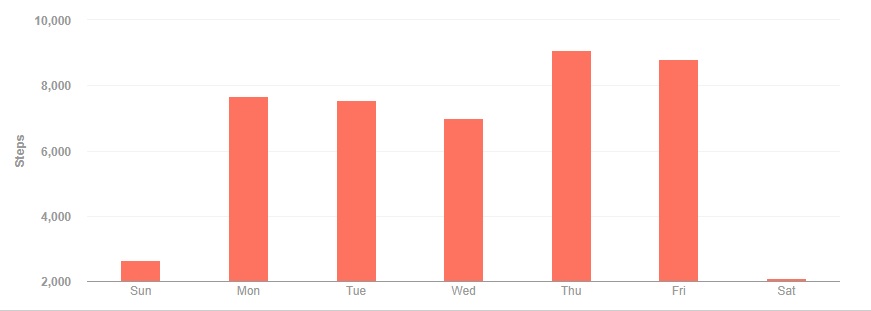
Another disappointing week, brought down by weekends of inactivity.  The week got off to a slow start on Sunday, finishing with just over 2600 steps.  Monday was a bit better, thanks to coffee trips at work, that got me up to 7600 steps.  Tuesday was about the same, finishing 47 steps over my daily goal.  Wednesday missed the afternoon coffee run, which left me just 18 steps shy of 7000.  Thursday was the big day of the week, coming in over 9000 steps.  Friday was nearly as good, coming in just 7 steps short of 8800 steps.  Saturday was another bust, finishing just over 2100 steps.

Total steps: 44,822

Daily average: 6403.1

The Marquee Sports Network

The long awaited announcement of the creation of a new Cubs-owned network finally came 2 weeks ago.  The Marquee Sports Network will launch in 2020, in time to air spring training games.  “We are excited to better serve our fans with expanded and exclusive programming showcasing our remarkable players, beloved ballpark and storied past,” president of business operations Crane Kenney said in a press release, “Our dedicated ‘Cubs-centric’ network will carry all available Cubs games and feature uncompromising, in-depth and behind-the-scenes coverage.”

The Cubs also announced that broadcasters Len Kasper and Jim Deshaies will continue to be involved with the live game broadcasts. The network will also provide extensive pregame and postgame coverage, original Cubs-related content and other live sports programming, per the release.

As rumored, the Cubs partner in the new venture is Sinclair Broadcast Group.  Sinclair has come under fire over the past couple years for its right-wing political slant and forcing its individual TV stations, of which WGN narrowly avoided becoming earlier this year, to air hard-right commentary.  “From our view, the reason Sinclair was such a good partner had to do with their technical capacity,” Kenney said on the Mully & Haugh Show on The Score.  “In terms of the programming on the channel, that will be exclusively our control. So what our fans, what the consumer sees when they turn the channel on will be something the team controls, as it should be, given that we know fan base and the team better than anyone.”  Later, Crane added, “While Sinclair’s TV stations may have a right-leaning bent, you won’t see any of that on our channel.”  This, of course, avoids the fact the Cubs fans who disagree with Sinclair’s politics may not feel good about contributing to their profits, even if their propaganda doesn’t air on the network.

The big outstanding question is carriage fees and clearance.  Industry reports say that the carriage fee that the network will request from cable operators could reach $6 per month, easily on the high end of the spectrum.  High carriage fees have led to clearance issues in the past for other teams.  When the Dodgers teamed with Time Warner to create SportsNet LA in 2014, they changed $4.90 per subscriber.  The end result was that Dodger games were, and continue to be, available to only about 30 percent of the Los Angeles market.  By June 2017, SportsNet LA’s ratings for Dodger games had dropped 49% from 2013.

Given the availability of Cubs games on WGN’s superstation for years, the team expects the new network to draw subscribers from much of the Midwest, if not the entire country.  But, convincing cable operators to add the channel on a non-premium tier and passing that $6 per month charge along to all customers, at a time when cord cutting is eroding their subscriber base, may be a tough sell.  Time will tell if this works out as well as the Cubs expect it to, or if they missed the boat on the RSN gravy train that is already showing signs of drying up.

Fitbit V: Week 3

After the best week I’ve ever had (using either GlobalFit or Fitbit), we saw a bit of a slow down, with less than half of the previous week’s steps.  Things got off to a slow start on Sunday, as I arrived back home from Hawaii and spent the day resting up, finishing up with over 4100 steps.  Things picked up on Monday, as I went back to work and finished with over 7600 steps.  Tuesday was the high point of the week, using multiple trips to North to score nearly 9300 steps.  Wednesday was nearly the same, finishing just 26 steps below Tuesday’s total.  Thursday was Valentine’s Day, and a missing trip for coffee in the morning put me just over 1000 steps below goal.  Friday bounced back, coming in 29 steps over my daily goal of 7500 steps.  Poor weather kept me indoors on Saturday, for a bad end to the week with less than 2500 steps.

Total steps: 46,787

Daily average: 6683.9

Another Mix Tape Monday – Volume 7

20 years ago, during my sophomore year of high school, I put together the first of what would become a nearly 20 volume collection of mix tapes, containing my favorite songs that I had gathered either from the radio, a cassette tape, or (eventually) CD.  We last looked back at all 20 volumes three years ago to see which of my “favorite” songs still resonated in today’s digital world.  Today, we revisit those mix tapes and see how, or if, things have changed in the past 3 years.
Volume 7 covers the fall of 1992 and the end of the first semester of my freshman year of college.  We are treated to the last gasps of hair metal and pop, with a little dance, alternative and hip-hop thrown in for good measure.

Side A

Guns N’ Roses – November Rain

The longest song ever to crack to top 10 on the Billboard charts, peaking at #3, the opus, which checks in at 3 seconds shy of 9 minutes, picked up 7 new plays in the last 3 years.

iTunes Stats
2012 2015 2019
3 plays 5 plays 12 plays, most recently on 11/14/2018 

Def Leppard – Have You Ever Needed Someone So Bad

The 86th biggest hit of 1992 picked up a mere 2 listens since 2015 and only 4 since 2012.

iTunes Stats
2012 2015 2019
4 plays 6 plays 8 plays, most recently on 12/5/2018 

Toad The Wet Sprocket – All I Want

Topping out at #15 on the Billboard charts, the first hit from Toad the Wet Sprocket only picked up 4 new listens over the past 3 years.

iTunes Stats
2012 2015 2019
10 plays 17 plays 21 plays, most recently on 12/9/2018 

Tesla – Signs

The live track, which I once owned on CD before trading it in for LL Cool J’s Mama Said Knock You Out, gained a mere 4 new listens, with the last one coming only 2 weeks after I bought the band’s namesake car.

iTunes Stats
2012 2015 2019
4 plays 5 plays 9 plays, most recently on 7/13/2017 

Soup Dragons – Divine Thing

The alternative dance single that became a moderate hit in the US gained 9 additional listens.

iTunes Stats
2012 2015 2019
9 plays 14 plays 20 plays, most recently on 9/23/2018

Ugly Kid Joe – Neighbor

Ugly Kid Joe, who debuted much too late for their 80s hairband style, saw a five-fold increase in the amount of plays this first single from their first full length album.

iTunes Stats
2012 2015 2019
1 plays 2 plays 10 plays, most recently on 11/12/2018 

The Heights – How Do You Talk To An Angel

The theme song from the short-lived FOX show The Heights, nominated for the 1993 Outstanding Individual Achievement in Music and Lyrics Emmy, picked up 6 new plays.

iTunes Stats
2012 2015 2019
4 plays 8 plays 14 plays, most recently on 7/14/2018 

Side B

Continue reading →

And The Oscar Goes To

side_oscarAs they finish polishing up the statues for tonight’s awards ceremony, it’s time to finish up our predictions with the major categories.  In a strange change of pace, I’ve actually seen one or two of these.  So, without further ado, we begin with:

Best Picture

Black Panther
BlacKkKlansman
Bohemian Rhapsody
The Favourite
Green Book
Roma
A Star Is Born
Vice

I’ve seen a grand total of one of these, so I’ll go with Green Book, which won the Golden Globe.

Best Actor

Christian Bale, Vice
Bradley Cooper, A Star Is Born
Willem Dafoe, At Eternity’s Gate
Rami Malek, Bohemian Rhapsody
Viggo Mortensen, Green Book

Having not seen any of these, I guess I’ll pick Christian Bale.

Best Actress

Yalitza Aparicio, Roma
Glenn Close, The Wife
Olivia Colman, The Favourite
Lady Gaga, A Star Is Born
Melissa McCarthy, Can You Ever Forgive Me?

Lady Gaga might be the safe bet, but I’ve heard nothing but rave reviews for Olivia Colman’s work in The Favourite, so I’m going to go with her.

Continue reading →

#6 – Carlton Fisk

Name: Carlton Fisk

Rank: 6

Position: C

Years With White Sox: 1981-1993

Carlton Fisk became a free agent after the Red Sox failed to tender him a contract for the 1981 season in the proper time frame, and thus he signed with the White Sox on March 18, 1981.  He paid immediate dividends for his new team, hitting a 3-run home run in the 8th inning against his former team at Fenway Park on Opening Day, leading the White Sox to a 5-3 victory.  Following the strike, he started the All Star game for the AL, going 1-3 with a run scored.  He finished the year with a .263 average and only 7 home runs in 96 games.  His efforts earned him his first Silver Slugger award.

Fisk enjoyed another successful year in 1982.  For the third straight year, he started behind the plate for the AL in the All Star game.  In 135 games, he hit .267 with 14 home runs and 65 RBIs.

1983 was a magical season on the South Side, as the White Sox won their first division title.  Fisk played a big role in the team’s success, both in managing a pitching staff that featured 2 of the top 4 finishers in Cy Young Award voting and at the plate, where he hit .289 with 26 home runs and 86 RBIs.  In the ALCS against the Orioles, Fisk struggled, just like the rest of his teammates, though he did launch 2 home runs in the 4 game series.  His season was good enough to earn 3rd place in the MVP vote, coming in behind Cal Ripken and Eddie Murray.

With expectations high, 1984 turned out to be a tough year, for both Fisk and the White Sox, though there were a few high points.  On May 9, he caught all 25 innings of a 7-6 win over the Brewers, breaking the major league record of 24 innings shared by 5 players.  A little over a week later, on May 16 against the Royals, Fisk became just the third player in White Sox history to hit for the cycle.  Unfortunately, injuries befell Fisk, limiting him to just 102 games, finishing with a .231 average and only 43 RBIs.  The bright side, though, is that it led him to begin a new training regimen, which he used for the rest of his long career.

The regimen paid immediate dividends, as Fisk put up the best numbers of his career in 1985.  At the age of 37, Fisk set career highs with 37 home runs, tying Dick Allen for the White Sox single-season record, and 107 RBIs, while tying his career high with 17 stolen bases.  He was voted to his 10th All-Star team, won his second Silver Slugger award and finished 13th in the AL MVP voting.

1986 was a strange year for Fisk and the White Sox.  New General Manager Ken Harrelson thought Joel Skinner was ready to take over behind the plate and, with Fisk about to enter his age 38 season, he convinced manager Tony LaRussa to move Fisk to left field.  On May 9, with Skinner hitting in the .150s and LaRussa’s job on the line, Fisk was moved back behind the plate and the White Sox proceeded to win 10 of their next 13 games.  By the end of the year, Skinner, Harrelson, and LaRussa were all gone, and Fisk remained, putting up a .221 average with 14 home runs and 63 RBIs.

In 1987, with a new management regime in place, Fisk was back behind the plate full time.  He appeared in 135 games at age 39, hitting .256 with 23 home runs and 71 RBIs.

1988 looked to be a good year for Fisk, until a broken hand limited him to just 76 games.  Despite that, his .277 average, 19 home runs, and 50 RBIs earned him his 3rd Silver Slugger award.

At age 41, Fisk, along with pitcher Jerry Reuss, who was 39, set a record starting the 1989 season, becoming the oldest battery ever to start on opening day, surpassing pitcher Johnny Niggeling and catcher Rick Ferrell of the 1944 Washington Senators, as the White Sox beat the Angels 9-2.  Splitting time behind the plate with Ron Karkovice, Fisk appeared in 103 games, hitting .293 with 13 home runs and 68 RBIs.

In 1990, Fisk was the elder statesman on a young White Sox team that unexpectedly challenged the A’s for the division title.  On May 22, at Yankee Stadium, Fisk had a run in with two-sport star Deion Sanders.  When Sanders drew a dollar sign in the dirt before a pitch, then didn’t run out an easy out, Fisk and Sanders went back and forth, sharing expletives.  Later in the game, Sanders told Fisk that “the days of slavery are over,” infuriating Fisk.  “He comes up and wants to make it a racial issue — there’s no racial issue involved.”  During Sanders’ next at-bat, Fisk told him, “There is a right way and a wrong way to play this game. You’re playing it the wrong way. And the rest of us don’t like it. Someday, you’re going to get this game shoved right down your throat.”  Later that year, on August 17, Fisk hit his 328th home run as a catcher, breaking Johnny Bench’s career record.  As the team closed out Comiskey Park, Fisk finished the year with a .285 average, 18 home runs, and 65 RBIs, which earned him 15th place in MVP voting.

As the White Sox moved across the street to the new Comiskey Park in 1991, Fisk, at age 43, put together his last season as an everyday catcher.  He was named to his 11th, and final, All Star team, becoming the oldest player in MLB history to collect a hit in the mid-summer classic.  He finished the year having appeared in 134 games, hitting .241 with 18 home runs and 74 RBIs.

With Ron Karkovice taking over the majority of the work behind the plate, Fisk moved into a backup role in 1992.  He appeared in just 62 games, his lowest total since 1974, and hit only .229 with 3 home runs.

1993 looked to be the end of the road for Fisk, though not by his choice.  On June 22, at Comiskey Park, Fisk broke Bob Boone’s record for career games caught with his 2,226th game behind the plate.  Six days later, Fisk was abruptly released by the White Sox.  Fisk was notified of his dismissal in his hotel room in Cleveland, and was ordered to turn in his equipment and fly back to Chicago immediately and alone.  To add insult to injury, Fisk, along with former teammate Donn Pall, came to Comiskey Park before game 1 of the ALCS to wish their former teammates well.  Sadly, they were both turned away, souring Fisk’s relationship with the organization for years.  His career ended with a .189 average in only 25 games, getting a mere 53 at bats.

At the conclusion of this career, he was the all time leader in games caught and home runs for catchers, the all time leader in home runs for the White Sox, the leader in home runs hit after age 40, and the most seasons played as a catcher.  His number 72 was retired by the White Sox on September 14, 1997, and he was part of the 2000 Hall of Fame class.

Fisk’s numbers in a White Sox uniform, both for games I attended and overall, were:

Continue reading →