By The Numbers – 23

In 1929, uniform numbers appeared on the back of baseball jerseys for the first time, thanks to the Indians and the Yankees.  By 1937, numbers finally appeared across all uniforms, both home and away, across both major leagues.  Since that time, 81 distinct numbers have been worn by members of the White Sox, while the Cubs boast 76.

Today, we continue our look at those players, picking our favorite, if not the best, player to wear each uniform number for both Chicago teams with #23, one of the most famous and successful numbers in city history across all sports.  67 different players have donned #23 while playing in Chicago, 35 for the White Sox and 31 for the Cubs, including a familiar face for both sides of town.
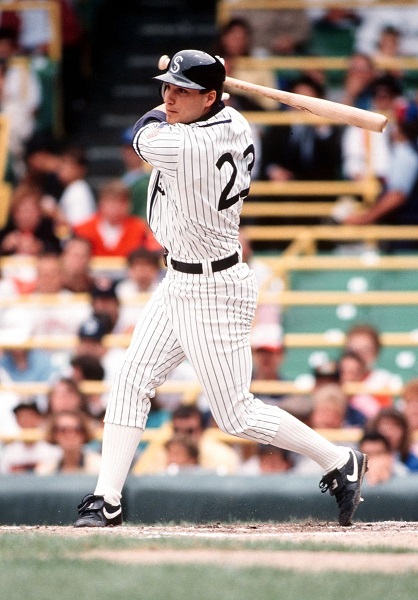
Robin Ventura made his major league debut donning #23 in September of 1989, appearing in 16 games down the stretch, hitting only .178 while driving in 7 runs in 45 at bats.  A good spring in 1990 led to Ventura breaking camp with the White Sox, but he struggled both on the field and at the plate, suffering through a horrendous 0-for-41 slump while committing 25 errors over the course of the season.  He finished the year with a .249 average, 5 home runs, and 54 RBIs and placed 7th in Rookie of the Year voting and was named to the Topps All Star Rookie team.

Ventura and the White Sox moved in to the new Comiskey Park in 1991, hoping to improve on the previous year’s growth.  He improved his fielding enough to earn his first Gold Glove award and, at the plate, he set a White Sox team record for RBIs by a third baseman, finishing with an even 100.  He upped his average to .284 and hit 23 home runs.  His work was enough to garner enough MVP votes to finish in 20th place.  1992 was another good year for Ventura.  He earned his first All Star nod, going 2-2 in the AL’s victory at Jack Murphy Stadium.  He finished the year with a .282 average, 16 home runs, and 93 RBIs.  He also snagged his second consecutive Gold Glove award.  Ventura continued his successful ways in 1993, collecting his 500th hit in May and, on August 4, entering the public consciousness with an event that would come to define his entire career.  While batting against the Rangers, Ventura was hit by a pitch thrown by Nolan Ryan and charged the mound.  Ryan, 20 years Ventura’s senior, placed him in a headlock and punched him several times, starting a bench-clearing brawl that was voted the best baseball brawl of all time by SportsCenter.  After the season, he was awarded his third consecutive Gold Glove award.

The strike in 1994 saw Ventura’s streak of 90 RBI seasons and Gold Gloves come to an end.  When baseball stopped in August, Ventura was hitting .282 with 18 home runs and 78 RBIs, while posting a new career high with an .832 OPS.  When play resumed in late April 1995, Ventura struggled out of the gate, committing ten errors in the first ten games.  As the White Sox started to tear down the team that had finished the previous two seasons on top of their division, trade rumors started to follow Ventura, though nothing came to fruition.  On September 4, he became the eighth player in history to hit two grand slams in one game, and the first since Frank Robinson in 1970.  He finished the year setting career highs with a .295 average, an .882 OPS, and 26 home runs while driving in 93 runs.  Ventura had the best year of his career to date in 1996, setting White Sox team records in career home runs by a third baseman, with 142, and grand slams, with 9.  He set new career highs with 34 home runs, 105 RBIs, 2 triples, an OPS of .888, and a .974 fielding percentage at the hot corner.  He hit .287, while earning his fourth Gold Glove award.

1997 turned into a dismal year for both Ventura and the White Sox.  During a spring training game, Ventura caught his foot in the mud while sliding into home plate and suffered a broken and dislocated right ankle.  Expected to miss the entire season, he returned on July 24, collecting the game-winning hit that night, and homered in his first at-bat the next night.  With the White Sox only 3.5 games behind the Indians in the standings, a healthy Ventura might have put them over the top.  A week later, the team threw in the towel in what eventually became to be known as the White Flag Trade, sending 3 pitchers to the Giants for prospects.  “We didn’t realize Aug. 1 was the end of the season,” said an upset Ventura.  He finished the year appearing in 54 games, hitting .262 with 6 home runs and 26 RBIs.  Entering the last year of his contract in 1998, the White Sox made little attempt to sign Ventura to an extension, with owner Jerry Reinsdorf claiming his skills were “deteriorating” after his injury the year before.  With more trade rumors following him throughout the season, he finished the year with a .263 average, 21 home runs, and 91 RBIs while earning his fifth Gold Glove award.  Following the season, he became a free agent, ending his White Sox playing career.

Continue reading →

#4 – Robin Ventura

Name: Robin Ventura

Rank: 4

Position: 3B

Years With White Sox: 1989-1998

Robin Ventura joined the White Sox organization as the 10th overall pick in the 1988 draft.  He made his major league debut the following September, going 1-4 with an RBI in a 11-1 victory over the Orioles at Memorial Stadium.  He appeared in 16 games down the stretch, hitting only .178 while driving in 7 runs in 45 at bats.

A good spring in 1990 led to Ventura breaking camp with the White Sox.  He struggled, both on the field and at the plate, suffering through a horrendous 0-for-41 slump while committing 25 errors over the course of the season.  However, he did lead AL rookies with 150 games played and his 123 hits were the most by a White Sox rookie since Ozzie Guillen in 1985.  He finished the year with a .249 average, 5 home runs, and 54 RBIs.  He placed 7th in Rookie of the Year voting and was named to the Topps All Star Rookie team.

Ventura and the White Sox moved in to the new Comiskey Park in 1991, hoping to improve on the previous year’s growth.  He improved his fielding enough to earn his first Gold Glove award and led the league in putouts.  At the plate, he set a White Sox team record for RBIs by a third baseman, finishing with an even 100.  He upped his average to .284 and hit 23 home runs.  His work was enough to garner enough MVP votes to finish in 20th place.

1992 was another good year for Ventura.  He earned his first All Star nod, going 2-2 in the AL’s victory at Jack Murphy Stadium.  He finished the year with a .282 average, 16 home runs, and 93 RBIs.  He also snagged his second consecutive Gold Glove award.

Ventura continued his successful ways in 1993.  He collected his 500th hit in May and, on August 4, he entered the public consciousness with an event that would come to define his entire career.  While batting against the Rangers, Ventura was hit by a pitch thrown by Nolan Ryan and charged the mound.  Ryan, 20 years Ventura’s senior, placed him in a headlock and punched him several times, starting a bench-clearing brawl that was voted the best baseball brawl of all time by SportCenter.  Ventura saw his average drop to .262, but his OPS set a new career high.  His 94 RBIs made him the first AL third baseman with three consecutive 90-RBI seasons since Graig Nettles in the mid 70s.  During the ALCS against the Blue Jays, Ventura hit .200, with just 1 home run and 5 RBIs across the six game series.  After the season, he was awarded his third consecutive Gold Glove award.

The strike in 1994 saw Ventura’s streak of 90 RBI seasons and Gold Gloves come to an end.  When baseball stopped in August, Ventura was hitting .282 with 18 home runs and 78 RBIs, while posting a new career high with an .832 OPS.

When play resumed in late April 1995, Ventura struggled out of the gate, committing ten errors in the first ten games.  As the White Sox started to tear down the team that had finished the previous two seasons on top of their division, trade rumors started to follow Ventura, though nothing came to fruition.  On September 4, he became the eighth player in history to hit two grand slams in one game, and the first since Frank Robinson in 1970.  He finished the year setting career highs with a .295 average, an .882 OPS, and 26 home runs while driving in 93 runs.

Ventura had the best year of his career to date in 1996.  He set White Sox team records in career home runs by a third baseman, with 142, and grand slams, with 9.  He set new career highs with 34 home runs, 105 RBIs, 2 triples, an OPS of .888, and a .974 fielding percentage at the hot corner.  He hit .287, while earning his fourth Gold Glove award.

1997 turned into a dismal year for Ventura and the White Sox.  During a spring training game at Ed Smith Stadium, Ventura caught his foot in the mud while sliding into home plate and suffered a broken and dislocated right ankle.  Expected to miss the entire season, he returned on July 24, collecting the game-winning hit that night, and homered in his first at-bat the next night.  With the White Sox only 3.5 games behind the Indians in the standings, a healthy Ventura might have put them over the top.  A week later, the team threw in the towel in what eventually became to be known as the White Flag Trade, sending Wilson Alvarez, Roberto Hernandez, and Danny Darwin to the Giants for prospects.  “We didn’t realize Aug. 1 was the end of the season,” said an upset Ventura.  He finished the year appearing in 54 games, hitting .262 with 6 home runs and 26 RBIs.

As Ventura entered the last year of his contract in 1998, the White Sox made little attempt to sign him to an extension, with owner Jerry Reinsdorf claiming his skills were “deteriorating” after his injury the year before.  With more trade rumors following him throughout the season, he finished the year with a .263 average, 21 home runs, and 91 RBIs while earning his fifth Gold Glove award.  Following the season, he became a free agent, ending his White Sox playing career.

On October 6, 2011, Ventura returned to the White Sox as their 39th manager.  He resigned following the 2016 season, finishing with a career record of 375-435 for a winning percentage of .463.

For his career, Ventura ranks 6th in White Sox history with 39.4 WAR, 8th with 28.8 OWAR, 8th with 12.9 DWAR, 6th with 171 home runs, 8th with 741 RBIs, and 5th with 668 walks.

Ventura’s numbers in a White Sox uniform, both for games I attended and overall, were:

Continue reading →

#41 – Craig Grebeck

Name: Craig Grebeck

Rank: 41

Position: SS/2B

Years With White Sox: 1990-1995

Craig Grebeck joined the White Sox as an undrafted amateur free agent On August 13, 1986.  He made his major league debut on April 13, 1990, pinch hitting for Scott Fletcher in the White Sox 6-2 loss to the Indians at Comiskey Park.  Splitting time between Triple A and the big leagues, Grebeck appeared in 59 games for the White Sox, hitting an anemic .168 in 119 at bats while playing as the smallest man in the American League.  He hit his first major league home run off Nolan Ryan on August 10.

Grebeck improved in 1991, as the White Sox moved across the street to their new digs.  Appearing in a career high 107 games, he hit .281 with a career high 6 home runs.

A severe knee injury that ended Ozzie Guillen’s season in late April saw Grebeck get significant time in the starting lineup in 1992.  While his total appearances dropped to 88 games, he started 85 of them, garnering more at bats and hitting .268 with the increased playing time.

With Guillen back and Joey Cora entrenching himself at second base, Grebeck was moved back to the bench in 1993.  His average dropped to .226 while making appearances in 72 games.  He had one at bat in the ALCS against the Blue Jays, singling in the Game 2 loss as a pinch hitter.

Grebeck bounced back in 1994, hitting .309 in only 35 games before the strike ended the season on August 12.  When baseball returned in 1995, Grebeck appeared in 53 games for the White Sox, hitting .260.  Following the season, he became a free agent.

Grebeck’s numbers in a White Sox uniform, both for games I attended and overall, were:

Continue reading →

Franchise Four – AL West

Major League Baseball is asking its fans to vote for the four most impactful players who best represent the history of each franchise.  The winners will be announced in July at the All Star Game in Cincinnati.  Today, I will give my Franchise Four picks for the American League West.

F4Astros

The Astros, around since 1962, have 2 obvious options, and both are from their World Series team in 2005: Craig Biggio and Jeff Bagwell.  After that, there is a bit of a drop off.  Nolan Ryan would seem to be a good pick for the third slot, having spent more years with the Astros than with any other team.  For the last slot, I’ll go with J. R. Richard, whose career was cut short due to a stroke, but still came to represent the franchise in the late 70s.

F4Angels

Despite existing since the 1961 season, the Angels have a complete lack of star power in their 8 nominees.  Garret Anderson?  Tim Salmon?  Brian Downing?  While fine players, none of them would be confused with an all time great.  Of the remaining 5, I will dump Jim Fregosi and take Chuck Finley, Nolan Ryan (again!), Vladamir Guerrero, and, despite being in only his 4th season, Mike Trout.

F4As

Continue reading →