#1 – Harold Baines

Name: Harold Baines

Rank: 1

Position: RF/DH

Years With White Sox: 1980-1989, 1996-1997, 2000-2001

Harold Baines was the first overall selection in the 1977 draft after White Sox owner Bill Veeck had seen him play little league years before.  He made his major league debut less than 3 years later, on Opening Day 1980, going 0-4 against the Orioles at old Comiskey Park.  He appeared in 141 games and finished the year hitting .255 with 13 home runs and 49 RBIs.

Baines started to break out in 1981, where the long player’s strike led him to only appearing in 82 games.  He boosted his average to .286 and hit 10 home runs with 41 RBIs in only 280 at bats.

With labor problems behind them, a full slate of games was played in 1982, with Baines appearing in all but one of them.  Hitting .271, Baines smacked 25 home runs with 105 RBIs, while setting a career high with 10 stolen bases.  His numbers were good enough to garner 9 votes for AL MVP.

1983 was a banner year on the south side, as the White Sox captured their first ever division title.  Baines was a key contributor, hitting .280 with 20 home runs and 99 RBIs.  During the ALCS against the Orioles, Baines struggled, like most of his teammates, getting only 2 hits in the 4 game series.  At season’s end, he picked up 49 votes to finish 10th in MVP voting.

Baines continued to excel in 1984, though the rest of the team did not.  On May 8, he ended the longest game in major league history (8 hours and 6 minutes over 25 innings on successive evenings) with a walk-off home run against Chuck Porter of the Brewers.  He finished the year with a .304 average, a career high 29 home runs, and 94 RBIs, while leading the league in slugging at .541.  He once again garnered MVP consideration, finishing the vote tied for 13th place.

1985 was another strong season for Baines.  He earned his first All Star selection, singling off former teammate LaMarr Hoyt in his only at bat at the Metrodome.  He finished the year hitting .309 with 22 home runs and a career high 113 RBIs.  He earned 49 votes in placing 9th in MVP voting.

Baines saw his body start to betray him for the first time in 1986.  He appeared in his second straight All Star game, going hitless in his one at bat.  A late August knee injury caused him to miss time, and a late September collision with Neal Heaton in a loss to the Twins reinjured the knee, leading to arthroscopic surgery following the season.  He finished the season hitting .296, just missing his 3rd consecutive .300 season, with 21 home runs and 88 RBIs.

Baines returned for opening day in 1987, getting two hits and knocking in the winning runs on the hard artificial turf of Royals Stadium, but was unable to walk the following day.  A second arthroscopic surgery caused him to miss 23 games before he returned, moving from right field to designated hitter.  He still was named to his 3rd straight All Star team, going hitless in the 2-0 loss by the AL.  Come year end, he had hit .293 with 20 home runs and 93 RBIs.

1988 was a down year for Baines, though he managed to appear in 158 games.  His average dropped to .277, his lowest total since 1982, while hitting only 13 home runs, his lowest total since 1981.  He made only 9 appearances in the outfield while becoming accustomed to being a full time designated hitter.

Baines bounced back in 1989.  He was named the starting DH in the All Star game, going 1-3 with an RBI in the AL’s victory at Angel Stadium.  On July 29, he was traded to the Rangers, along with Fred Manrique, for Wilson Alvarez, Scott Fletcher, and Sammy Sosa.  “It’s an unpopular decision as far as the fans are concerned, but sometimes unpopular means exactly that-unpopular,” GM Larry Himes said at the time.  “It doesn`t mean that it isn`t a good decision.  This is a decision we made as far as direction of the Chicago White Sox for today and for our future.”  Baines was hitting .321 with 13 home runs and 56 RBIs at the time of the trade.  Less than a month later, as the Rangers visited Chicago for the first time on August 20, the White Sox retired Baines’ #3, a somewhat awkward attempt to placate the enraged fanbase.

Baines returned to the White Sox as a free agent in 1996.  Appearing in 143 games, Baines hit .311 with 22 home runs and 95 RBIs.  He returned in 1997 and was putting together another fine season, putting up a .305 average with 12 home runs and 52 RBIs in 93 games when, on July 29 again, he was traded to the Orioles for a player to be named later.

Three years later, once again on July 29, the White Sox re-acquired Baines, along with Charles Johnson, from the Orioles for Miguel Felix, Juan Figueroa, Jason Lakman, and Brook Fordyce.  Appearing in 24 games down the stretch, Baines hit .213 with a single home run and 9 RBIs as the White Sox took the Central Division crown.  Baines went 1-4 in the ALDS as the White Sox were swept by the Mariners.

Baines returned to the White Sox in 2001 at the age of 42, getting extra playing time once Frank Thomas went down with an injury.  In 32 games, he hit .131, failing to homer and driving in only 6.

Baines returned to the White Sox dugout in 2004, when new manager Ozzie Guillen named him bench coach.  He would remain on staff until 2015, when he became an ambassador for the team.  On July 20, 2008, the White Sox unveiled a bronze statue of Baines at U.S. Cellular Field prior to their game against the Royals.  On December 9, 2018, Baines was elected to the National Baseball Hall of Fame Class of 2019 via the Today’s Game Era ballot.

Baines’ numbers in a White Sox uniform, both for games I attended and overall, were:

Continue reading →

A Shocking Development

Last night, the results of the Today’s Game Era Veteran’s Committee vote was revealed and 2 players will join the Hall of Fame class of 2019: Harold Baines and Lee Smith.  Smith was a unanimous selection by the 16 person committee, while Baines nabbed 12 votes, the minimum needed for election.

Baines, 59, was the first overall selection in the 1977 draft by then-White Sox owner Bill Veeck and reached the majors three years later.  He collected 2,866 hits, the 46th largest total in history, during a 22-year career, with parts of 14 spent with the White Sox.  He was a six-time American League All-Star selection and won the 1989 Silver Slugger award as a DH.  At the time of his retirement after the 2001 season, Baines was the all-time leader among designated hitters in games, hits, home runs and RBIs.

Smith, 61, retired in 1997 with 478 saves after an 18-year career, holding the title of all-time saves leader from 1993 until 2006, when he was surpassed by Trevor Hoffman.  He spent eight seasons with the Cubs, before becoming a journeyman and splitting his final ten seasons between seven teams.  The imposing right-hander was an All-Star seven times and saved 30 or more games 10 times.

Harold Baines’ numbers in games I’ve attended were: Continue reading →

#159 – Oscar Gamble

Veeck4Name: Oscar Gamble

Rank: 159

Position: DH

Years With White Sox: 1977, 1985

With the 1977 season about to get underway, Oscar Gamble, along with Robert Polinsky, LaMarr Hoyt, and $200,000, was traded to the White Sox from the Yankees in exchange for Bucky Dent.  As one of the spark plugs for the team that would eventually become known as the South Side Hitmen, Gamble had a career year, hitting 31 home runs with a .297 average and a .588 slugging percentage.

Owner Bill Veeck couldn’t afford to keep Gamble past the 1977 season, so he was allowed to leave as a free agent.  But his time on the south side wasn’t done, as Gamble returned to the White Sox as a free agent in 1985.  Unfortunately, his second go around did not go as well.

Gamble split time at DH with Ron Kittle, but did not put up much offense.  He managed a paltry 4 home runs with a lowly .203 average.  He was designated for assignment on August 12 to make room for rookie Joe DeSa.  “The fact Oscar only hit four homers doesn`t mean he didn`t help us,” manager Tony LaRussa said.  “What he needed to do was hit for a higher average. He had one of the highest on-base percentages on the club with all his walks. I thought Oscar did all right with us.”

Gamble’s numbers in a White Sox uniform were:

Continue reading →

RIP Minnie Minoso

minosoA little more than a month after Cub icon Ernie Banks passed away, word broke early this morning that long time White Sox great Minnie Minoso died overnight.  The 90 (or 93, depending on who you believe) year old broke the color barrier in Chicago when he debuted with the White Sox in 1951.

Minoso, born in Cuba, came to the United States in 1945 to play in the Negro Leagues.  He joined the Indians organization in September of 1948, after his contract was purchased by Bill Veeck.  He made his major league debut the following year, appearing in 9 September games for the Tribe.  After returning to the minor leagues in 1950, Minoso returned to the Indians for 8 games in 1951 before being traded to the White Sox.

He became Chicago’s first black player on May 1, 1951, getting 2 hits and driving in 2 runs in his White Sox debut.  Minoso spent the next 7 years with the White Sox, earning 4 All Star nods, 1 Gold Glove, and 3 top 10 MVP finishes.  Following the 1957 season, Minoso was traded back to the Indians, bringing Al Smith and Early Wynn, key players for the 1959 pennant winners, to the south side.

After the 1959 season, new owner Bill Veeck brought Minoso back to the White Sox.  While the Sox failed to repeat as AL champions, it was through no fault of Minoso’s, as the left fielder again made the All Star team and finished 4th in MVP voting.  After a sub-standard (for him) season in 1961, Minoso was traded to the Cardinals.

After struggling in 1962 and 1963, Minoso returned to the White Sox for the third time in 1964.  He appeared in only 30 games, batting .226, and was released in mid-July.  At 38 years old, this appeared to be the end of the line for Minoso.

In 1975, Bill Veeck bought the White Sox for the second time.  The next year, he brought back Minnie Minoso, now 50 years old, to allow him to become a four decade player.  Minoso appeared in 3 games, and managed to get a hit in 8 at bats.  The stunt was repeated 4 years later, with Minoso going 0-2 in 2 games and becoming the first person to appear in games during 5 decades.

His number 9 was retired by the White Sox in 1983.  In his later years, he became an official team ambassador for the White Sox.  As a season ticket holder, I had the opportunity to meet him on a few occasions, and, despite his age, he seemed energized to be interacting with fans.  The coming season is expected to be a good one for the White Sox.  It will seem emptier without his presence.

100 Years Of Innovation

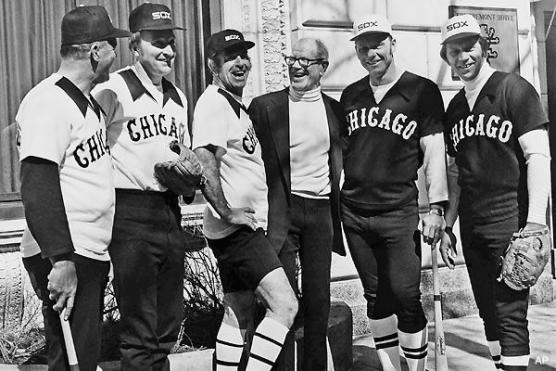
1976 Chicago White Sox100 years ago today, Bill Veeck, the former club treasurer for the Cubs and two-time owner of the White Sox, was born here in Chicago.  Veeck followed his father, the then president of the Cubs, into baseball.  As a 13 year old, Veeck came up with the idea of planting ivy to cover the outfield walls at Wrigley Field.  In 1937, as general manager, he oversaw the construction of the iconic hand operated scoreboard that is still in use today.

Veeck left the Cubs in 1941, striking out on his own and buying the minor league Milwaukee Brewers.  While he owned the team, he also served in the Marines during World War II, where he injured his leg, which required amputation.  After the war, Veeck sold his interests in the Brewers and bought the Cleveland Indians, returning to the major leagues.  In July of 1947, Veeck broke the color barrier in the American League by signing Larry Doby.  In 1948, the Indians won their first World Series title since 1920.  Veeck was forced to sell the Indians in 1949 due to his divorce.

2 years later, Veeck was back in business, purchasing the St. Louis Browns.  While trying to force the Cardinals out of town, Veeck came up with one of his most famous, or perhaps infamous, stunts, signing Eddie Gaedel, standing 3 feet and 7 inches tall, and sending him to the plate in the second game of a double header against the Detroit Tigers on August 19, 1951.  Gaedel walked on four pitches and was lifted for a pinch runner.  American League president Will Harridge voided Gaedel’s contract the next day, claiming that Veeck was making a mockery of the game. In response, Veeck threatened to request an official ruling on whether Yankees shortstop Phil Rizzuto, the reigning MVP, was a short ballplayer or a tall midget.

Continue reading →

Ballpark Tour: Comiskey Park

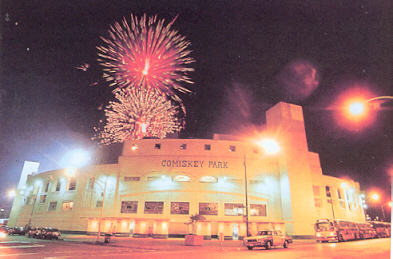
comiskeyout2

Stadium Name: Comiskey Park

Location: Chicago

Home Team: White Sox

Years in Service: 1910 – 1990

Visits: 12 (that I’m aware of)

Comiskey Park, the so-called Baseball Palace of the World, was the home of the White Sox from 1910 through the 1990 season.  Built on a former city dump at the corner of 35th Street and Shields Avenue, the stadium opened as White Sox Park on July 1, 1910, as the White Sox lost to the St. Louis Browns 2-0.  In 1913, owner Charles Comiskey renamed the stadium after himself, and Comiskey Park was born.  From 1962 until 1975, the White Sox Park name was officially re-establshed, as new ownership groups tried to separate themselves from the Comiskey name.  However, Bill Veeck, in his second tour of duty as owner of the White Sox, put the Comiskey Park name back on the stadium in 1976, where it remained until 1990.  The final game for the old ballyard occurred on September 30, 1990, a 2-1 victory over the Mariners.

Comiskey Park was the host for 4 World Series contests, including 3 in a row from 1917-1919.  The White Sox won the World Series in 1917 against the New York Giants.  The Cubs, looking for a larger seating capacity, moved their home games in the 1918 series against the Red Sox to Comiskey Park.  The 1919 World Series, of course, was the Black Sox scandal, where the White Sox threw the series against the Reds.  The White Sox returned to the World Series 40 years later in 1959, but fell to the Dodgers.  The final post-season games to be played in Comiskey Park were games 3 and 4 of the 1983 ALCS, which the White Sox lost to the Baltimore Orioles.

Comiskey Park was also the host to 3 All-Star games.  The first All-Star game ever, in 1933, was held in conjunction with Century of Progress Exposition being held on Chicago’s lakefront.  The event returned to Chicago’s south side in 1950.  The final All-Star game at Comiskey Park was in 1983, the 50th anniversary of the first game.  Comiskey Park was also the frequent home of the Negro League East-West All-Star Game from 1933 to 1960.

In addition to White Sox baseball, Comiskey Park was also the home to the Chicago American Giants of the Negro Leagues, the Chicago Cardinals of the NFL, and the Chicago Sting of the NASL.  Comiskey Park also hosted numerous boxing matches, including the 1937 heavyweight title match where Joe Louis defeated then champion James J. Braddock.  The Beatles played two concerts at Comiskey Park in August of 1965.  Other musical acts to perform there include Aerosmith, AC/DC, The Eagles, The Police, Simon & Garfunkel, and The Jacksons, who performed 3 shows during their Victory tour in October of 1984.

Looking back, I’ve been able to piece together evidence of 12 games that I attended at Comiskey Park.  I know there are more, but I have not been able to pinpoint exact games yet.  The most memorable game I can remember would be the final night game, on September 29, 1990, where, after the game, the lights were symbolically turned off for the final time.

30 For 30 – See A Game At A Classic Ballpark

Cubs_L_flag_070602The fine folks at away.com have come up with a list of 30 Things Every Traveler Must Do Before They’re 30.  Of those 30, I’ve managed to accomplish 12 of them, or roughly 40% of them, some of which was even before I turned 30.  Today we look at #20 on their list, see a game at a classic ballpark.  Thankfully, I’ve never had to travel far to do this.

From my birth in 1974 until the end of the 1990 season, I was lucky enough to have two classic ballparks right here in my own backyard.  Comiskey Park was at one time considered to be the “Baseball Palace of the World”, although it had fallen on hard times by the time I was old enough to enjoy it.  Struggling White Sox ownership groups over the years had put off necessary repairs and preventative maintenance so that, by the time the group led by Jerry Reinsdorf and Eddie Einhorn purchased the club from Bill Veeck, the stadium needed a lot of work.  After deciding that it would be prohibitavely expensive to repair the park, the new owners worked at getting funding for a new stadium and, on September 30, 1990, the White Sox defeated the Mariners in the last game ever in what is now known as Old Comiskey Park.

The almost exact opposite was happening on the other side of town.  The Cubs were also under new ownership in the early 80s, but instead of telling everyone who would listen how run down their stadium was, they sold the history of the ballpark and the experience of it to great success.  The lore of the Friendly Confines was born, and, thanks to the superstation status of WGN television, people came from all over the country to be at Wrigley Field.  For some of them, the game itself was unimportant.  Wrigley Field in general, and the bleachers specifically, became Chicago’s biggest (and most expensive) beer garden.  Time, however, doesn’t care how much fun people are having or how much Old Style is flowing, and Wrigley Field has shown its age in recent years.  As we sit here one month into the 99th year of baseball at the corner of Clark and Addison, the Cubs are working hard on a plan to renovate the stadium so that it can be used well into its second century.  Maybe the Cubs will even win a World Series there.

I’ve been able to identify 12 games that I attended at the Old Comiskey Park before they tore her down, including the final night game on September 29, 1990.  My Wrigley Field attendance is currently at 312 games and counting.