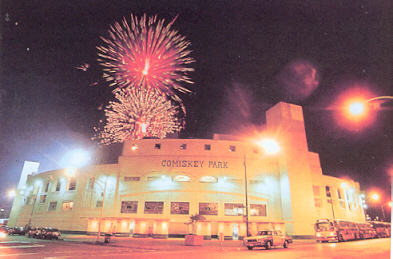
Stadium Name: Comiskey Park
Location: Chicago
Home Team: White Sox
Years in Service: 1910 – 1990
Visits: 12 (that I’m aware of)
Comiskey Park, the so-called Baseball Palace of the World, was the home of the White Sox from 1910 through the 1990 season. Built on a former city dump at the corner of 35th Street and Shields Avenue, the stadium opened as White Sox Park on July 1, 1910, as the White Sox lost to the St. Louis Browns 2-0. In 1913, owner Charles Comiskey renamed the stadium after himself, and Comiskey Park was born. From 1962 until 1975, the White Sox Park name was officially re-establshed, as new ownership groups tried to separate themselves from the Comiskey name. However, Bill Veeck, in his second tour of duty as owner of the White Sox, put the Comiskey Park name back on the stadium in 1976, where it remained until 1990. The final game for the old ballyard occurred on September 30, 1990, a 2-1 victory over the Mariners.
Comiskey Park was the host for 4 World Series contests, including 3 in a row from 1917-1919. The White Sox won the World Series in 1917 against the New York Giants. The Cubs, looking for a larger seating capacity, moved their home games in the 1918 series against the Red Sox to Comiskey Park. The 1919 World Series, of course, was the Black Sox scandal, where the White Sox threw the series against the Reds. The White Sox returned to the World Series 40 years later in 1959, but fell to the Dodgers. The final post-season games to be played in Comiskey Park were games 3 and 4 of the 1983 ALCS, which the White Sox lost to the Baltimore Orioles.
Comiskey Park was also the host to 3 All-Star games. The first All-Star game ever, in 1933, was held in conjunction with Century of Progress Exposition being held on Chicago’s lakefront. The event returned to Chicago’s south side in 1950. The final All-Star game at Comiskey Park was in 1983, the 50th anniversary of the first game. Comiskey Park was also the frequent home of the Negro League East-West All-Star Game from 1933 to 1960.
In addition to White Sox baseball, Comiskey Park was also the home to the Chicago American Giants of the Negro Leagues, the Chicago Cardinals of the NFL, and the Chicago Sting of the NASL. Comiskey Park also hosted numerous boxing matches, including the 1937 heavyweight title match where Joe Louis defeated then champion James J. Braddock. The Beatles played two concerts at Comiskey Park in August of 1965. Other musical acts to perform there include Aerosmith, AC/DC, The Eagles, The Police, Simon & Garfunkel, and The Jacksons, who performed 3 shows during their Victory tour in October of 1984.
Looking back, I’ve been able to piece together evidence of 12 games that I attended at Comiskey Park. I know there are more, but I have not been able to pinpoint exact games yet. The most memorable game I can remember would be the final night game, on September 29, 1990, where, after the game, the lights were symbolically turned off for the final time.
