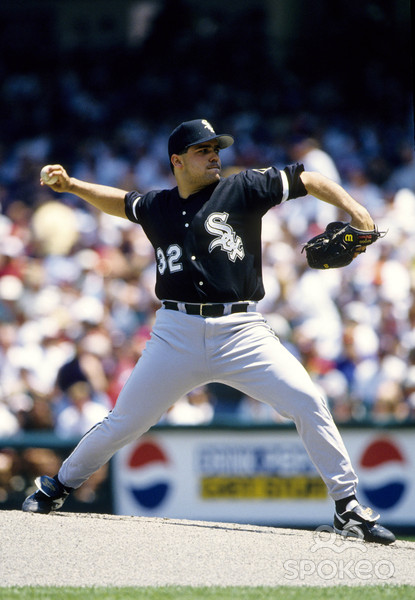
#12 – Jack McDowell

Name: Jack McDowell

Rank: 12

Position: P

Years With White Sox: 1987-1988, 1990-1994

Jack McDowell was selected as the fifth overall pick in the 1987 draft by the White Sox.  After 6 appearances split between Rookie ball and AA, he made his major league debut September 15, throwing 7 shutout innings and earning the win against the Twins at Comiskey Park.  He made 3 more starts to finish out the season, ending with a 3-0 record, a 1.93 ERA, and a seemingly bright future on the South Side.

In 1988, the success McDowell saw in his first stint in the big leagues was hard to find.  In 158.2 innings pitched, he struck out only 84 batters while walking 68.  While his ERA was a respectable 3.97, he finished with a 5-10 record.

Injuries, and a 6.13 ERA in 16 starts for AAA Vancouver, kept McDowell out of the big leagues in 1989.  He returned to the majors for good in 1990 and helped lead a surprising White Sox team to a 94-68 record and a season long battle with the A’s for the AL West crown.  McDowell finished with a 14-9 record and a 3.82 ERA and nearly doubled his strikeout total from 1988 in only about 50 more innings.

Expectations were high as the White Sox moved into their new stadium in 1991.  McDowell earned his first All Star game selection on his way to a 17-10 record and a 3.41 ERA.  Those numbers were good enough for a 9th place finish in Cy Young Award voting.

1992 was even better for McDowell.  He earned his second straight All Star Game nod, pitching a scoreless second inning and retiring Fred McGriff, Terry Pendleton, and Andy Van Slyke in order.  When all was said and done, he ended up with a 20-10 record and a 3.18 ERA, good enough for a 2nd place finish in Cy Young Award voting, behind Dennis Eckersley, and 19th place in MVP voting.

Everything came together for the White Sox and McDowell in 1993.  As the team ran off to their first division title in a decade, McDowell led the league with 22 victories and 4 shutouts, ending at 22-10 with a 3.37 ERA.  He nabbed his 3rd straight All Star selection, earning the victory while throwing a scoreless 5th inning, and finally claimed his first Cy Young Award.  He also finished 9th in MVP voting, behind teammate Frank Thomas.  McDowell made 2 starts during the ALCS against the Blue Jays, losing both and giving up 10 runs total in 9 innings pitched.

The 1994 season again had high expectations for the White Sox and McDowell.  Unfortunately, those expectations would be squashed, not on the field, where the White Sox held first place in the newly formed AL Central division, but in the boardrooms, where the end of the 1994 season and the post season were cancelled due to a work stoppage.  In just 25 starts, his fewest since 1987, McDowell went 10-9 with a 3.73 ERA.

In December, with the 1995 season in doubt, McDowell was traded to the Yankees, for Keith Heberling and a player to be named later who turned out to be Lyle Mouton.

McDowell’s numbers in a White Sox uniform, both for games I attended and overall, were:
Continue reading →

#21 – Alex Fernandez

Name: Alex Fernandez

Rank: 21

Position: P

Years With White Sox: 1990-1996

Selected 4th overall by the White Sox in the 1990 draft, Alex Fernandez started 8 games in the minor leagues before making his major league debut on August 2, getting a no decision despite throwing 7 strong innings against the Brewers at County Stadium.  Over the last 2 months of the season, he made a total of 13 starts for the White Sox, going 5-5 with a 3.80 ERA.

Fernandez struggled in 1991, setting career highs in walks, WHIP, and ERA.  He finished the year 9-13 with a 4.51 ERA.  1992 saw a slight improvement, thanks to a drastic reduction in walks.  While he still had a losing record, at 8-11, his ERA fell to 4.27.

1993 was Fernandez’s breakout season.  He went 18-9 with a 3.13 ERA as the White Sox took home their first division championship in a decade.  He set a career high with over 247 innings and a career low WHIP of 1.164.  Despite giving up only 3 earned runs in 15 innings, he lost 2 games in the ALCS against the Blue Jays.  His season was good enough to earn 4 MVP votes from the BBWAA.

Fernandez was having another strong year in 1994.  He was 11-7 with a 3.86 ERA in 24 starts when the season came to a premature end thanks to the strike.  When baseball resumed in 1995, he picked up where he had left off, going 12-8 with a 3.80 ERA.

1996 was another strong year for Fernandez, his best since 1993.  He went 16-10 with a 3.45 ERA in a career high 35 starts.  He finished 6th in Cy Young Award voting.  Following the season, he became a free agent.

Fernandez’s numbers in a White Sox uniform, both for games I attended and overall, were:

Continue reading →

#25 – Wilson Alvarez

Name: Wilson Alvarez

Rank: 25

Position: P

Years With White Sox: 1991-1997

Five days after making his major league debut for the Rangers, Wilson Alvarez was acquired by the White Sox, along with Scott Fletcher and Sammy Sosa, for Harold Baines and Fred Manrique on July 29, 1989.  After spending the next 2 calendar years in the minor leagues, Alvarez returned to the big leagues and made his White Sox debut on August 11, 1991, throwing an unlikely no hitter against the Orioles at Memorial Stadium.  With nowhere to go but down from there, he made 8 additional starts for the White Sox down the stretch, finishing the year with a 3-2 record and a respectable 3.51 ERA.

After tossing nearly 300 innings the previous year between winter league, Triple A, and the big leagues, 1992 saw Alvarez work mostly out of the bullpen, getting only 9 starts out of his 34 appearances.  He posted a career high 1.674 WHIP, giving up 65 walks in just over 100 innings.  This led to an unfortunate 5.20 ERA, despite a 5-3 record.

In 1993, Alvarez managed to break in to the rotation full time.  Despite leading the league with 122 walks, he finished second in the AL with an ERA of 2.95 and ended up with a 15-8 record as the White Sox won the AL West title for the first time in a decade.  He was the winning pitcher in Game 3 of the ALCS, holding the Blue Jays to a single run while throwing a complete game.

Alvarez improved in 1994, earning his first (and only) All Star nod and cutting his walk total nearly in half.  Part of that, of course, was due to the player strike that ended the season in August, and he finished the year with a 12-8 record and a 3.45 ERA.  When baseball returned in 1995, Alvarez struggled to regain his groove, finishing with a losing record for the first time and an ERA of 4.32.

1996 saw a nice bounce back for Alvarez.  While his ERA was still an elevated 4.22, he tied his career high with 15 wins and set career highs for innings pitched and strikeouts.  He continued to impress in 1997, putting up a 9-8 record with a 3.03 ERA by the end of July, when, with the White Sox a mere 3 games back in the standings, he, along with Danny Darwin and Roberto Hernandez, was sent to the Giants for Brian Manning, Lorenzo Barceló, Mike Caruso, Keith Foulke, Bob Howry, and Ken Vining in what would become known as the White Flag Trade.

Alvarez’s numbers in a White Sox uniform, both for games I attended and overall, were:

Continue reading →

#28 – Tim Raines

Name: Tim Raines

Rank: 28

Position: LF

Years With White Sox: 1991-1995

Acquired in December of 1990 from the Expos, along with Jeff Carter and a player to be named later, for Ivan Calderon and Barry Jones, Tim Raines took over left field, and the lead off spot, as the White Sox moved in to the new Comiskey Park.  At the age of 31, Raines appeared in 155 games, his highest total since 1984, while hitting .268 with 51 stolen bases.

In 1992, Raines had another strong season, putting up a .294 average with 7 home runs, 54 RBIs, and 45 stolen bases.

Limited to 115 games in 1993 due to a torn thumb ligament, Raines had the best season of his post-Expos career, hitting .306 and posting a .401 OBP, adding 16 home runs and 21 stolen bases.  During the ALCS against the Blue Jays, Raines hit .444 with an OPS of 1.038 as the White Sox dropped the series in 6 games.

Raines saw his production drop off a bit in 1994, his average dropping to .266 but with 10 home runs when the season ended early due to the player’s strike.  When baseball returned in 1995, so did Raines.  He bounced back with a .285 average and a .796 OPS, his second highest total as a member of the White Sox.  Following the season, Raines was traded to the Yankees for an unheralded player to be named later.

Raines rejoined the White Sox organization in November of 2004 when he was named the first base coach, a position he would hold for the championship season in 2005.  For 2006, he was moved to bench coach and, after the season, his services were not retained.

Raines’s numbers in a White Sox uniform, both for games I attended and overall, were:

Continue reading →

#29 – Lance Johnson

Name: Lance Johnson

Rank: 29

Position: CF

Years With White Sox: 1988-1995

Lance Johnson, along with Ricky Horton, was acquired by the White Sox from the Cardinals for Jose DeLeon just before spring training in 1988.  After earning Most Valuable Player honors in the American Association the year before, Johnson was given the starting center fielder job.  Things did not go well, and after hitting only .185 in 33 games, he was sent back to the minor leagues.

Johnson returned to Triple A in 1988, before finally returning to the White Sox, and the major leagues, for good.  In a 50 game stint, his largest to date, Jonson hit .300 with 16 stolen bases and a .360 OBP.

In 1990, Johnson patrolled centerfield for the final season at Comiskey Park.  He hit .285 and managed 36 stolen bases, despite leading the league with 22 caught stealings, easily his career high.  He also hit his first career home run.

1991 saw the White Sox move across the street to their new home, and Johnson continued his steady presence in the lineup.  Hitting .274 while appearing in 159 games, he stole 26 bases and hit 13 triples, leading the American League for the first of four consecutive seasons, the first player in Major League history to accomplish this feat.

Johnson hit .279 in 1992, with another 12 triples and 41 stolen bases.  He also managed to hit the ball out of the ballpark 3 times, setting a new career high.

1993 saw Johnson and the White Sox finally put everything together.  Johnson raised his average to .311, hitting 14 triples and stealing 35 bases while the White Sox won their first divisional title in a decade.  Unfortunately, Johnson struggled in the ALCS against the Blue Jays, hitting only .217 in the 6 game series, though knocking in 6 runs and hitting his only home run of the season.

The strike-shortened 1994 season cut down what could have been a tremendous season for Johnson.  He again hit 14 triples, but in only 106 games.  He tied his career high with 3 home runs and managed 26 stolen bases, while hitting .277.

When baseball resumed in 1995, Johnson turned in his finest season in a White Sox uniform.  He hit .306 and set a career high with a .766 OPS.  He led the league in at bats and hits, though he saw his streak of triples crowns end despite hitting a solid 12.  He set a career high with 10 home runs, 3 more than his previous career total.  On September 23, he became the first White Sox hitter to get 6 hits in a game since Floyd Robinson in 1962.  Following the season, he became a free agent and his White Sox career came to an end.

Johnson’s numbers in a White Sox uniform, both for games I attended and overall, were:

Continue reading →

#41 – Craig Grebeck

Name: Craig Grebeck

Rank: 41

Position: SS/2B

Years With White Sox: 1990-1995

Craig Grebeck joined the White Sox as an undrafted amateur free agent On August 13, 1986.  He made his major league debut on April 13, 1990, pinch hitting for Scott Fletcher in the White Sox 6-2 loss to the Indians at Comiskey Park.  Splitting time between Triple A and the big leagues, Grebeck appeared in 59 games for the White Sox, hitting an anemic .168 in 119 at bats while playing as the smallest man in the American League.  He hit his first major league home run off Nolan Ryan on August 10.

Grebeck improved in 1991, as the White Sox moved across the street to their new digs.  Appearing in a career high 107 games, he hit .281 with a career high 6 home runs.

A severe knee injury that ended Ozzie Guillen’s season in late April saw Grebeck get significant time in the starting lineup in 1992.  While his total appearances dropped to 88 games, he started 85 of them, garnering more at bats and hitting .268 with the increased playing time.

With Guillen back and Joey Cora entrenching himself at second base, Grebeck was moved back to the bench in 1993.  His average dropped to .226 while making appearances in 72 games.  He had one at bat in the ALCS against the Blue Jays, singling in the Game 2 loss as a pinch hitter.

Grebeck bounced back in 1994, hitting .309 in only 35 games before the strike ended the season on August 12.  When baseball returned in 1995, Grebeck appeared in 53 games for the White Sox, hitting .260.  Following the season, he became a free agent.

Grebeck’s numbers in a White Sox uniform, both for games I attended and overall, were:

Continue reading →

#48 – Joey Cora

Name: Joey Cora

Rank: 48

Position: 2B

Years With White Sox: 1991-1994

Joey Cora was acquired by the White Sox from the Padres, along with Warren Newson, for Adam Peterson and Steve Rosenberg on March 31, 1991.  Cora appeared in 100 games for the White Sox, splitting time at second base with Scott Fletcher.  He hit .241 with only 18 RBIs.

With the acquisition of Steve Sax prior to the 1992 season, Cora was pushed to the bench, starting only 21 games at second base.  Again, his production was meager, hitting .246 with no home runs and only 9 RBIs.

Cora became the everyday second baseman in 1993, taking over for Sax.  He set a career high with 153 games played, he hit .268 with a career high 20 stolen bases as the White Sox won their final AL West crown.  Cora struggled in the ALCS, hitting an anemic .136 as the White Sox fell in 6 games to the Blue Jays.

In 1994, Cora continued to improve.  He raised his average again to .276 and had 2 home runs and 30 RBIs when the season came to a premature end due to the player’s strike.

When baseball resumed in 1995, Cora became a free agent and his White Sox playing career came to an end.  He rejoined the organization as third base coach for the 2004 season, when Ozzie Guillen was hired as manager.  Following the 2006 season, he became the bench coach.  Cora was initially named interim manager after Guillen was relieved with 2 games left in the 2011 season, but was fired by text message by GM Kenny Williams before he could assume the role.

Cora’s numbers in a White Sox uniform, both for games I attended and overall, were:

Continue reading →

#50 – Warren Newson

Name: Warren Newson

Rank: 50

Position: RF/LF

Years With White Sox: 1991-1995

Warren Newson was acquired by the White Sox from the Padres, along with Joey Cora, for Adam Peterson and Steve Rosenberg on March 31, 1991.  After starting the year in Triple A and putting up an OBP over .500, Newson made his major league debut on May 29, pinch hitting for Sammy Sosa in the 8-4 loss to the Angels at the new Comiskey Park.  Despite hitting .295 for the season with a .843 OPS, Newson was limited to only 132 at bats.

Newson returned to the bench for the 1992 season, getting an extended look when Dan Pasqua went down with an injury in June.  Newson hit .286 with a .756 OPS during Pasqua’s absence, but was relegated back to the bench when Pasqua returned, despite his superior stats.  For the year, Newson hit a disappointing .221, but still managed a .387 OBP.

1993 was a difficult season for Newson.  While the White Sox were putting together their first divisional title in a decade, Newson missed months to look after his wife following a life-threatening car accident.  He only appeared in 26 games during the regular season, getting only 40 at bats.  He did manage to hit .300 with an .879 OPS.  Newson went 1-5 with a home run in 2 appearances during the ALCS against the Blue Jays.

Newson returned to the White Sox full time in 1994, but again was relegated to backup and pinch hitting duties.  He appeared in 63 games before the season was cut short due to the strike.  Newson finished the shortened year hitting .255 with a .345 OBP in 102 at bats.

When baseball resumed in 1995, Newson’s average suffered, dropping to .235, but his OBP was a very healthy .404.  Despite this, he only managed 85 at bats in 51 games.  On July 18, he was traded to the Mariners for a player to be named later, who eventually became Jeff Darwin.

Newson’s numbers in a White Sox uniform, both for games I attended and overall, were:

Continue reading →

#51 – Jim Abbott

jimabbottName: Jim Abbott

Rank: 51

Position: P

Years With White Sox: 1995, 1998

As baseball resumed following the strike that ended the 1994 season and the ensuing lockout in 1995, Jim Abbott signed with the White Sox on April 8, 1995.  He started 17 games, putting up a 6-4 record with a 3.36 ERA.  On July 27, he was traded, along with Tim Fortugno, to the Angels in exchange for McKay Christensen, Andrew Lorraine, Bill Simas, and John Snyder.

On May 27, 1998, Abbott came back from a brief retirement and re-signed with the White Sox as a free agent.  He appeared in 18 games at 4 different levels of the minor leagues before making it back to the big leagues.  He started 5 games for the White Sox, going 5-0 despite a 4.55 ERA.  Following the year, he became a free agent.

Abbott’s numbers in a White Sox uniform were:

Continue reading →

#62 – Jason Bere

jasonbere

Name: Jason Bere

Rank: 62

Position: P

Years With White Sox: 1993-1998

Jason Bere was selected by the White Sox in the 36th round of the 1990 draft.  By 1993, he was ranked as the 8th best prospect in all of baseball.  On May 27, 1993, he made his major league debut, giving up 3 first inning runs and picking up the loss against the Royals at Comiskey Park.  The rest of the season went much better for Bere, as he won his final 7 starts to finish 12-5 and helped the White Sox to capture the AL West title.  Bere started Game 4 of the ALCS against the Blue Jays, lasting only 2 1/3 innings in a game the White Sox eventually came back to win.  After the season, he finished second in AL Rookie of the Year voting behind Tim Salmon of the Angels.

Bere continued his regular season success in 1994, earning his first All Star nod and possessing a 12-2 record when the season ended prematurely due to the strike.  After a little more than a season and a half in the big leagues, Bere had a career mark of 24-7 and looked to be heading towards a promising career.  Unfortunately, it didn’t turn out that way.

When baseball resumed in 1995, Bere started to feel tendonitis in his throwing elbow.  His fortunes reversed completely, as he finished the year with a 7.19 ERA and led the American League with 15 losses.  Bere made only 5 starts in 1996, giving up 19 earned runs in only 16 2/3 innings pitched, before being shut down.  In September, he underwent Tommy John surgery.

Bere returned to the White Sox rotation in August of 1997, following the White Flag trade.  He made 6 starts down the stretch, going 4-2 with a 4.71 ERA, his best results since 1994.

1998 saw more struggles for Bere.  He appeared in 18 games, making 15 starts, and went 3-7 with a 6.45 ERA.  On July 16, he was released, ending his White Sox career.

Bere’s numbers in a White Sox uniform, both for games I attended and overall, were:

Continue reading →